A Two Egg TV Page. See more at https://twoeggtv.com.

Thursday, January 30, 2020

Obituary of the Ghost of Bellamy Bridge

The death of Elizabeth Jane Bellamy.


by Dale Cox

Bellamy Bridge spans the Chipola River several miles north
of Marianna, Florida. It can be reached by the Bellamy Bridge
Heritage Trail, which leaves a parking area on CR 162 just
west of the river.
The legend of the Ghost of Bellamy Bridge is one of Florida's best-known tales of the supernatural. 

For more than 120 years, the people of Jackson County have told the story of Bellamy Bridge and its haunting by the restless ghost of a young woman named Elizabeth Jane Bellamy. The story is colorful, sad, and chilling. 

There are, of course, multiple versions of the legend. The most popular is that Elizabeth died in a tragic wedding night accident after her extravagant gown somehow touched an open flame. Some say that she danced too close to a fireplace while celebrating her marriage to Dr. Samuel C. Bellamy. Others claim that the young woman accidentally toppled a candle onto her gown while resting in an upstairs room at the couple's beautiful Marianna mansion.

Caroline Lee Hentz (1800-1856) is buried at
St. Luke's Episcopal Church in Marianna.
The legend is beautiful but bears little resemblance to the truth. It actually originated from a famous 19th-century novel, Marcus Warland or the Long Moss Spring, by author Caroline Lee Hentz. This is the same book that some historians have incorrectly used to assert that Jackson Blue Spring was the model for the romantic "long moss spring." Hentz noted in the introductory material that the book is based on real events, and it is true that she spent the last years of her life in Marianna and at St. Andrew Bay. 

Unfortunately for both legends, she wrote the book while living in Columbus, Georgia, before taking up residence in Marianna. The author notes as much in the book itself. The terrible incident of the "burning bride" took place near Columbus, and the real "long moss spring" is in that vicinity as well.

This, of course, neither proves nor disproves that there is a ghost at Bellamy Bridge. The legend is older than the first claims that Elizabeth Bellamy died in a tragic fire. The earliest incarnations of the story hold simply that the area around Bellamy Bridge is haunted by the restless spirit of Elizabeth as she searches for her long-lost husband.

Family papers prove that Elizabeth actually died of fever at Rock Cave Plantation several miles northwest of Marianna. She was buried in the little family cemetery at her sister's home on Terre Bonne Plantation, near which Bellamy Bridge stands today. She had married Dr. Bellamy several years before and even had a young son, Alexander, by the time of her death.

Notices of her death appeared in numerous newspapers of the time, but the most touching was printed by the New Bern Spectator in her home state of North Carolina:


Learn more about the Ghost of Bellamy Bridge and hear the haunting song written about her in this mini-documentary from Two Egg TV:


Editor's Note: Learn the real stories behind ten great Jackson County ghost and monster legends in Dale Cox's book, The Ghost of Bellamy Bridge. It is available at Bespoken Gifts and Antiques, 4430 Lafayette Street, Marianna, Florida, and on Amazon.com.


Tuesday, January 28, 2020

Can you dress like a pirate?? Prove it at Pirate & Heritage Days!

Public invited to "Dress like a Pirate" for Pirate and Heritage Days!

Ready to let your inner pirate out?! Your chance is coming on May 1-2 when Three Rivers State Park hosts Pirate and Heritage Days!

The event will commemorate the life and times of the adventurer and pirate William Augustus Bowles, who once frequented the Apalachicola and Chattahoochee Rivers. His ships raided commerce on the Gulf of Mexico in 1799-1804, sailing under the flag of the "State of Muskogee."

Jackson County is rich in stories of this unique individual. Legend even holds that he left behind a vast treasure that still remains to be found somewhere along the Chattahoochee River arm of Lake Seminole. 

You might not find the lost treasure, but you can definitely get in on the fun and collect a reward of your own by participating in the "Dress Like a Pirate" contest!

Members of the public are encouraged to bring their boats out for the William Bowles Pirate Regatta up Lake Seminole from Sneads Park on Friday, May 1. Launching begins at 4 p.m., and the Regatta will set sail at 6 p.m., led by the authentic 19th-century keelboat Aux Arc (pronounced "Ozark"). Fly your pirate flags and wear your pirate best to compete for cash and prizes as the Aux Arc leads the way with her cannon thundering! Registration information is coming later this week!

After the Pirate Regatta, the fun continues at Three Rivers State Park on River Road just north of Sneads, Florida. The evening will feature live music, entertainment, food, exhibits, and living history portrayals of life in Florida during Spanish colonial times. The "Dress Like a Pirate" contest will continue as team members from Two Egg TV will identify great costumes in the crowd and award cash on the spot!

More fun is set for Saturday, May 2, from 9 a.m. to 2 p.m. Central/10 a.m. to 3 p.m. Eastern, as Pirate and Heritage Days at Three Rivers State Park continues. Fun planned for Saturday includes living history demonstrations, entertainment, historical lectures, exhibits, vendors, food, and more. Plus, "Dress Like a Pirate" competition will continue with Two Egg TV passing out more instant cash and prizes to best dressed members of the public!

Pirate and Heritage Days at Three Rivers State Park is supported by Florida State Parks, the Jackson County Tourist Development Council, Jackson County Public Works, Two Egg TV, the Town of Sneads, and more! Additional sponsors will be announced soon.


Thursday, January 23, 2020

The Boy in the Barrel: A Future Pirate's First Ship

"A branch of a tree his mast, a blanket his sail."

by Dale Cox

Editor's note: To provide readers with more information about William Augustus Bowles, the real person behind the pirate treasure stories still heard in eastern Jackson County, Florida, historian and author Dale Cox is writing a series of new articles. The life and adventures of Bowles and his crews will be commemorated on May 1-2 during Pirate & Heritage Days at Three Rivers State Park.

The signing of a declaration of war against Spain at Estiffanulga Bluff in 1800 (please see GOD SAVE MUSKOGEE: Pirate War on the Apalachicola) brought the enigmatic adventurer William Augustus Bowles into direct conflict with that country. But who was Bowles? And how did his story begin?

The future adventurer and pirate was born in Maryland in ca. 1763 and was thirteen when war erupted between Great Britain and its American colonies. "An artless school-boy, perfectly unacquainted with any mode of life beyond what he had learnt at his father's farm," according to the interviewer who wrote his autobiography, Bowles joined a Loyalist regiment and entered the service of King George III. 

The Battle of Monmouth, where Bowles claimed to fight in a
"flank company." From a painting by Emanuel Leutze.
Berkley Library
He claimed to serve in a "flank company" at the Battle of Monmouth, New Jersey, before sailing with his regiment from New York to Jamaica. This is possible as his regiment was part of the British army at that time. From Jamaica, he sailed with his fellow soldiers to Pensacola where he arrived late in 1778. Bowles was selected as a cadet at Pensacola, a position that allowed him to train to become an officer, but he blew his chances after he failed to return to camp from a brief leave in town. He either deserted or was dismissed from the service.

Destitute and only around 15 years old, the young man was, to paraphrase his biographer, too proud to beg and unwilling to work:

A party of the Creek nation were on their return home from Pensacola, whither they had come to receive their annual presents; and young Bowles, delighted with the novelty of situation now opened to him, joined the party, having thrown his regimental coat, in contempt of his oppressors, into the sea. [1]

Pensacola Bay at Floridatown.
The Native Americans were Seminoles from the Perryman towns on the lower Chattahoochee River. The most important of these communities was Tocktoethla, the village of Thomas Perryman which stood in today's Seminole County, Georgia. The other was Tellmochesses, the town of his son, William Perryman. It stood near Parramore Landing in modern Jackson County, Florida.

Bowles was accepted by the Perryman chiefs and their followers. Both Thomas and William spoke English, as did many of their followers, so it was easy for the young man to talk with them. Thomas Perryman, in particular, liked Bowles. The teenager was restless, though, and remained with his new friends only a few months before he decided to return to Pensacola:

William Augustus Bowles.
When he arrived on the opposite shore of the bay, he found a hogshead [i.e. barrel], which some British ships had left behind them; and Bowles, impatient of delay, without waiting for any other conveyance, like an Eskimaux [i.e. Eskimo], with the difference of a hogshead for a boat, the branch of a tree his mast, a blanket his sail, and a few stones his ballast, navigated the extensive shores of the harbour, in the day procuring the food of life, and beguiling the tediousness of time by fowling and fishing, and at night regaling on his prey; the sky his canopy, and the earth his bed. [2]

The sight of the future pirate bobbing around Pensacola Bay in a barrel with a blanket for a sail must have been entirely novel. His return to Pensacola likely was via the Pensacola-St. Augustine Road, a horse path that connected the capitals of the colonies of East and West Florida. Branch trails from it led to the Perryman towns, while its western terminus was at today's Floridatown in Santa Rosa County.

Bowles continued his adventures around the bay into the winter of 1779-1780, a time during which his biographer admitted that the young man first developed his dreams of glory.

Note: Learn more about the life of William Augustus Bowles in future articles and mark your calendar now to attend Pirate and Heritage Days at Three Rivers State Park in Sneads, Florida, on May 1-2, 2020. Please click here for more information.


Wednesday, January 22, 2020

GOD SAVE MUSKOGEE: Pirate War on the Apalachicola

William Augustus Bowles, pirate and
adventurer, as painted by Thomas Hardy.

William Augustus Bowles declares war on Spain!

by Dale Cox

The story of William Augustus Bowles and his "State of Muskogee" is remarkable and violent. The young adventurer waged war on Spain with furious intent in 1800-1804, seizing ships, capturing a fort, and wreaking havoc.

His life was brief but complicated. He was born in Maryland in 1763, the same year that Great Britain gained control of Florida from Spain at the end of the Seven Years (French and Indian) War. He joined the British army as a teenager and came to Pensacola only to be cast from the ranks after a conflict with an officer. Rescued by a Native American trading party as he tried to make his way across the wilderness of Northwest Florida, the charismatic young man lived for a time in the Perryman towns of Tocktoethla and Telmochesses. These important Seminole communities were near today's Parramore Landing north of Sneads, Florida.

Bowles was ambitious and soon married the daughter of Chief Thomas Perryman. He came to envision a trade empire for himself among the Creeks and Seminoles, but Spanish authorities seized and imprisoned him in 1792. He escaped and returned to Florida in 1799, however, only to suffer the loss of his supply ship when it ran aground on St. George Island.

The Apalachicola River as seen from Prospect Bluff, the site
where Bowles started building a port facility in 1799.
That is when things got very interesting. Spanish troops tried to capture Bowles, but he slipped away onto the mainland and started building a port facility at Achackweithle (Prospect Bluff) on the Apalachicola River. Spain destroyed the unfinished settlement and captured some of his followers, but Bowles slipped away and soon reestablished himself at Estiffanulga Bluff in what is now Liberty County, Florida.

The furious adventurer convened a council of his followers at Estiffanulga, producing one of the most remarkable documents in Florida history: a declaration of war against Spain:

Estifanulga, April 5, 1800

Whereas His Catholic Majesty has for many years part entertained evil intentions against this Nation and pursued measures in every way injurious and hostile against us, Wantonly violating the Rights that belong to us as a free & Independent People, Has disregarded all remonstrance made by us to obtain redress, and induce him to abandon his unfriendly intentions against us, Has treated our representative with dissimulation and falsehood, Has suffered all good faith to be violated with impunity by his Governors in our vicinity. Has formed a treaty with the United States that clearly manifest the the wickedness of his heart; that his intentions were to usurp the sovereignty of our Country and totally to distroy our name as a People: To this end he has by his emisaries endeavoured to disseminate discord amongst our people and by the force of bribary and corruption to make a party in order to support and effect his diabolical designs. Ultimately in the month of February 1800 did with an armed force attack our town of Achackwheethle laid our houses in ashes, made prisoners of our people, and otherwise distressed us, by blocking up our Ports, thus terminating all pacific negotiation by an open attack, which reduces us to the necessity of either taking up our arms to defend our sacred Rights; our Country; our every thing that is dear to us, or tamely surrender then (and ourselves) up forever to the dispotic will of his Catholic Majesty.
  
Estiffanulga Bluff, the headquarters of William Augustus
Bowles in 1800, overlooks the Apalachicola River just
south of Bristol, Florida.
We being now in special council met in order to consider of the present state of our Country, do declare that we have not given his Catholic Majesty any cause whatever to commence hostilities against us; That we view with abhorrence and detestation the wicked designs of his Catholic Majesty; That we will defend our Country and our Rights while Blood remains in our veins. That we now consider all pacific remonstrance as ineffectual.

Therefore we do determine, and are determined to take such measures as may be effectually necessary to defend our Country, to defend our most sacred Rights; to defend the Honor of this Nation, and procure reparation and satisfaction for our injured Citizens.

Historical Marker noting the presence of Bowles on
St. George Island near Apalachicola, Florida.
Therefore be known to all Men, that WE THE DIRECTOR GENERAL OF MUSKOGEE In special Council met, for the reasons aforesaid do, by virtue of our authority and High office, as in duty bound declare war against his Catholic Majesty and his subjects and order that general reprisal be made both by Land and sea of the goods ships and subjects of his Catholic Majesty.

We order that this proclamation be duly proclaimed that all our beloved people may have due notice hereof, And we pray God the great disposer of all things who knows the wickedness of our enemies who knows the justice of our Cause to favor our exertions.

Given under our hand in council
at Estifanulga this 5th day of april
1800
WM. A. BOWLES

GOD SAVE MUSKOGEE

The declaration was no mere threat. Bowles soon laid siege to the Spanish fort of San Marcos de Apalache at St. Marks and unleashed "privateers" (pirates) on Spain's shipping in the Gulf of Mexico. His piratical war continued for three years. Legends it produced of battles and treasures continue to reverberate today.

Editor's Note: This is the first in a series of articles from historian Dale Cox on the pirate career of William Augustus Bowles. The adventurer and his crews will be commemorated at Pirate and Heritage Days at Three Rivers State Park on May 1-2, 2020. The park is located on River Road (FL-271) just north of Sneads, Florida. Please click here to learn more.

Thursday, January 9, 2020

Pirate & Heritage Days coming to Three Rivers State Park!

May event will commemorate the legacy of William Augustus Bowles!

by Dale Cox

The pirate and adventurer William Augustus Bowles
will be remembered at Pirate & Heritage Days at
Three Rivers State Park in Sneads, Florida.
The Chattahoochee River and Lake Seminole in eastern Jackson County are abundant in the history of the adventurer and pirate William Augustus Bowles. He once lived along the river, and his ships made it as far upstream as the forks of the Chattahoochee and Flint Rivers, where Lake Seminole is located today.

To commemorate this unprecedented era of history, Three Rivers State Park is working with the Jackson County Tourist Development Council, the City of Sneads, Jackson County Parks,  and Two Egg TV to host a brand new festival. Pirate & Heritage Days will take place at the lakefront state park on May 1 & 2, 2020.

Bowles arrived in the area during the American Revolution after he was tossed from the British military at Pensacola for a disciplinary infraction. He wandered lost in the woods of Northwest Florida until a trading party of Native Americans found him and carried him to the Perryman towns. These large Lower Creek Indian villages were near today's Parramore Landing.

Bowles enjoyed his new life there so thoroughly that he married Mary Perryman, the daughter of Chief Thomas Perryman, and was adopted by the tribe. He fought at the Battle of Pensacola, one of the most significant actions of the Revolutionary War, in 1781. America's ally Spain won the battle, however, and regained control of the city and Florida.

Bowles's pirate ships flew the "State of
 Muskogee" flag in 1799-1804.
State Archives of Florida/Memory Collection
The adventurer went briefly to his family home in Maryland and then on to the Bahamas, from where he came back to the area to open a new route for smuggled goods from the islands. Spain captured him, however, and sent him away to Cuba, Spain, and eventually the Philipines. Bowles escaped, and by 1799 was back in North Florida!

He was furious over his treatment and declared war on Spain! By this time, he called himself the Director-General of the "State of Muskogee," a mostly imaginary empire that he founded in the Florida borderlands. His followers included white adventurers from American territory and the Bahamas, Maroons (escaped slaves), and a few hundred Lower Creek, Seminole, and Miccosukee warriors.

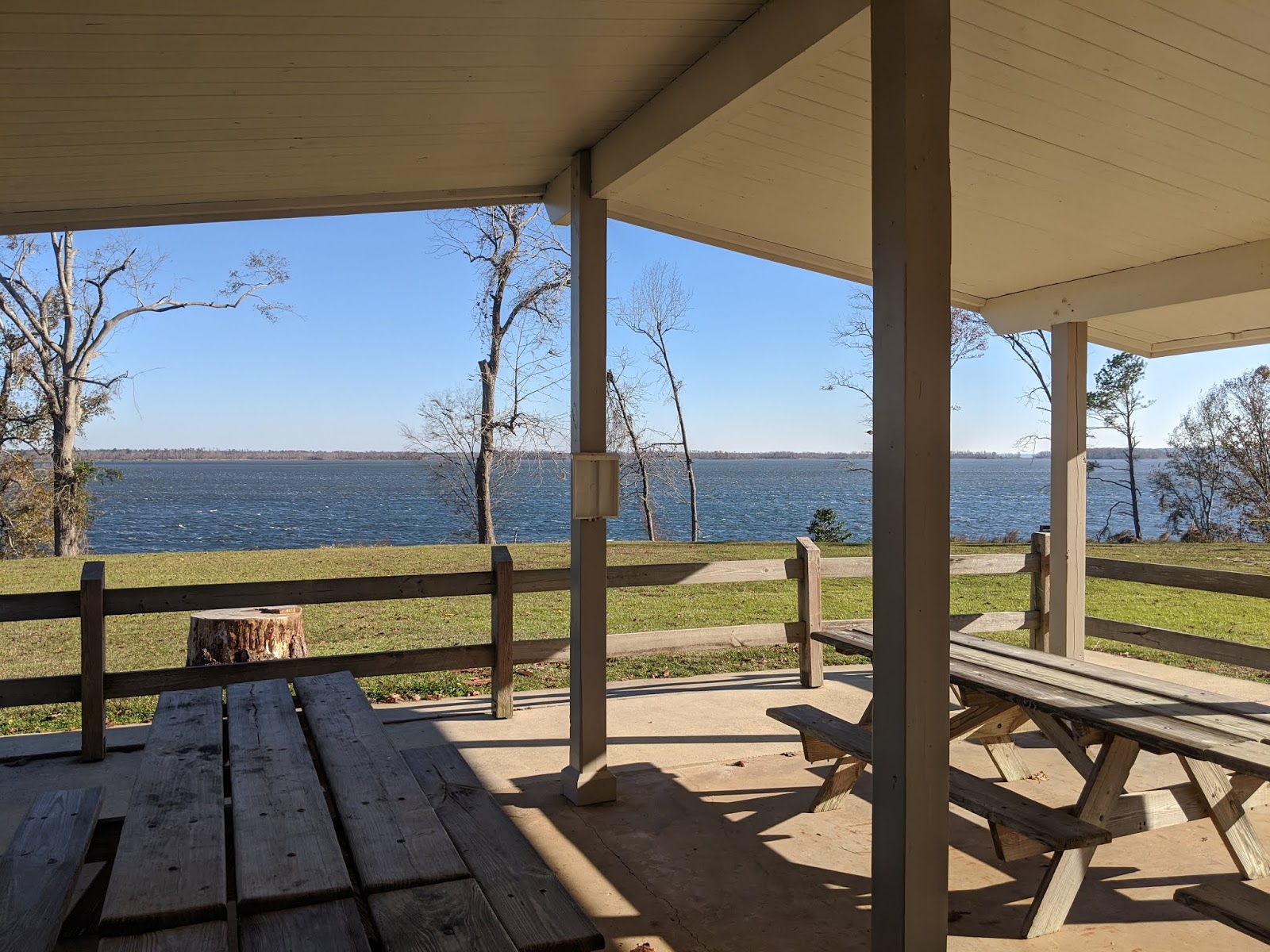
Three Rivers State Park is on the shores of beautiful
Lake Seminole in Sneads, Florida.
To carry out his war, Bowles commissioned a flotilla of "privateer" ships that sailed from the Apalachicola River out into the Gulf of Mexico to prey on Spanish merchant ships. These pirate vessels raided dozens of ships, and their crews included Native Americans from the Perryman towns. The raids continued for about five years until he was captured again and sent away to prison in Cuba, where he died.

The story of Bowles and his pirate ships is a big part of the culture and history of Jackson County. Two different buried treasure legends originate from his activities!

Pirate & Heritage Days will feature a boat parade on Lake Seminole, food trucks, vendors, living history encampments, live music, storytelling, and much more! Everything will take place lakefront at beautiful Three Rivers State Park, with the boat parade launching at Sneads Park and passing the festival grounds.

More details are coming soon, but mark your calendars for the afternoon/evening of May 1 and morning/midday of May 2! If you have a boat or even a kayak or canoe, make plans now to join the boat parade on Friday, May 1!


Thursday, December 19, 2019

The Christmas Capture of the Steamboat Bloomer

The 1862 Union Raid in Walton, Geneva, Holmes & Washington Counties

by Dale Cox

The Union raid came ashore at Four Mile Landing at today's
Freeport, Florida, on Christmas Day of 1862. 
The paddlewheel steamboat Bloomer was the object of a raid launched by the U.S. Army and Navy during Christmas week 1862.

The 130-ton sternwheel boat was built at New Albany, Indiana, in 1856, but operated on the Choctawhatchee River. She carried cargo and passengers to and from points as far up the river as Geneva, Alabama, providing transportation through Choctawhatchee Bay and Santa Rosa Sound to Pensacola.

Her owner decided not to risk his boat when the War Between the States or Civil War erupted in 1861, opting instead to rope her to the bank one-mile below Geneva.

The Bloomer's presence there soon attracted the attention of Acting Master E.D. Bruner of the U.S. Navy. He commanded the schooner USS Charlotte, which in late 1862 was stationed at East Pass near today's resort city of Destin, Florida.

East Pass near Destin, Florida, as seen on a rainy winter day.
The USS Charlotte was stationed here to prevent Southern
vessels from slipping through the Union blockade.
Bruner was debating how to capture the Bloomer when he was visited by Lt. James H. Stewart of the 91st New York Infantry. The army officer was scouting Choctawhatchee Bay with a small detachment of soldiers:

...He said he was “on a scout,” and remained with me five days, during which time we made a partial arrangement to ascend the Choctawhatchee River in company, he to furnish a detachment of soldiers and I to take the men under my command. On or about the 17th of December Lieutenant Stewart returned to East Pass with a detachment of 25 men and remained at my camp while I went to the Potomac for an extra boat, for transportation, and extra arms, etc. When I returned to the pass I received on board the schooner Charlotte Lieutenant Stewart and his command and proceeded up the bay to La Grange Bayou, 40 miles distant. I sent Master’s Mate Crissey with the Caroline in advance with orders to secure the pilot, which he had accomplished by the time we arrived. [1]

USS Charlotte sailed up to Four Mile Landing at Freeport
to put ashore the raiding party and its cannon.
The Charlotte sailed into LaGrange Bayou near present-day Freeport, Florida, on Christmas Eve of 1862. On the next morning, Christmas Day, the sailors and soldiers went ashore at Four Mile Landing. To support their movement, they also brought a boat howitzer ashore from the ship:

...I found when I arrived at the landing a number of horses and teams secured. I attached my gun to a team, loaded with provisions, and had everything ready by 3 o’clock, at which time we started. We traveled 16 miles before encamping. The next morning (Friday) at 6 o’clock we again started and traveled all day, encamping in the evening 17 miles from Geneva. At 3 o’clock p.m. I ordered a citizen volunteer to take a horse and proceed to ascertain if the route was clear before us, and also if the steamboat was afloat. Lieutenant Stewart and another person volunteered to accompany him. The scout returned in the evening and reported that everything was right and that Lieutenant Stewart had remained. [2]

The raiding party followed a road that led from Freeport up the west side of the Choctawhatchee River to Eucheeanna, then the county seat of Walton County. An unnamed correspondent from Marianna described the movement in a letter to the Montgomery Daily Mail:

Alexander L. McCaskill
State Archives of Florida.
...On Wednesday last they marched from “Four Mile Landing,” on the western boundary of Walton county, to the Court House, where they interfered with nothing; went a few miles further, arrested Hon. Mr. McCaskill, who was a member of our State Convention. [3]

The "Hon. Mr. McCaskill," seized by the raiders, was Alexander L. McCaskill. One of Walton County's delegates to the state secession convention, he was a Unionist farmer who voted against Florida's secession from the Union. His treatment at the hands of the raiders did not sit well with McCaskill,. After returning home, he enlisted in the 6th Alabama Cavalry, eventually rising to the rank of 1st lieutenant.

Lt. Stewart went aboard the idle steamboat, untied it from its moorings and floated it out to the middle of the Choctawhatchee. He and the soldier who accompanied him then added planking to the pilothouse to fortify it against small arms fire.

Acting Master Bruner reached the boat on Saturday morning, December 27, to find that it could be placed in running order within 24-hours. His men immediately went to work:

The raiding party steamed the Bloomer down the Choctawhatchee
River, passing such points as the Cowford (seen here).
...At 8 o’clock a.m. everything was reported ready, but upon getting up steam a hole was found in one of the boilers, and we were obliged to let the steam go down again in order to repair it, which took until 3 o’clock p.m., when everything being ready we started. After running two and a half days in one of the very worst rivers I have ever been in, and expecting to be fired upon at any moment, we returned safely alongside the Charlotte. [4]

The capture of the Bloomer was a remarkable exploit, but its value soon caused tension between the soldiers and sailors who took part in the adventure. The army and the navy both claimed the vessel as a prize, with Lt. Stewart going so far as to accuse Bruner of cowardice during the raid:

...During the march of 41 miles Mr. Bruner was very earnest to return, as citizens said there were several companies of rebel cavalry in the neighborhood, but my officer refused to retreat. At 23 miles from the vessel they were assured that she was sunk, and Mr. Bruner insisted upon a retreat. My officer said he would have a piece of the steamer if he had to dive for it. [5]

Bloomer, mounted cannon on her decks, and put her to use along the coast of Northwest Florida. She later took part in the burning of the village of St. Andrews (now Panama City) on St. Andrew Bay and participated in the destruction of hundreds of saltworks along the Gulf Coast.
The road used by the Union raiding party passed by the crystal
clear spring at today's Ponce de Leon Springs State Park.
A judge ultimately settled the dispute in favor of the U.S. Navy, which purchased the

The steamboat's owner never regained possession of his vessel. She sank at East Pass in June 1865, but was raised by the navy and sold to S.P. Griffin & Company of Woolsey, Florida.* The Griffin firm renamed the boat Emma and used her until 1868 when she was sold to foreign interests. Her eventual fate is unknown.

The Christmas raid of 1862 penetrated more than 50 miles of Confederate territory without the firing of a shot. Modern communities along its route include Freeport, Eucheeanna, Ponce de Leon, Barker Store, and Geneva.

The map below shows the Junction of the Choctawhatchee and Pea Rivers at Geneva, Alabama. The capture site was one mile downstream.


REFERENCES:

[1] Acting Master E.D. Bruner to Commander Alexander Gibson, U.S. Navy, commanding Frigate Potomac, January 3, 1863, ORN.
[2] Ibid.
[3] Montgomery Daily Mail, January 4, 1863.
[4] Brig. Gen. Neal Dow, U.S. Army, to Rear-Admiral David G. Farragut, U.S. Navy, January 2, 1863, ORN.


Sunday, December 15, 2019

The Battle of Ocheesee in Calhoun & Liberty Counties, Florida

The longest sustained fight of the Seminole Wars


by Dale Cox

Red Stick Creek warriors attack from the bank of the
Apalachicola River during the annual Scott 1817 Seminole
War Battle Reenactment. The attack at Ocheesee Bluff
looked similar to this.
The Native American army of the Prophet Josiah Francis launched a massive attack against three U.S. ships on the Apalachicola River on December 15, 1817 – 202 years ago today.

The morning of December 15 found 800-1,200 Red Stick Creek, Seminole, Lower Creek, Miccosukee, Yuchi, and Black Seminole warriors positioned on both sides of Florida’s Apalachicola River. Their location was a twisting section between Ocheesee Bluff in what is now Calhoun County and today’s Torreya State Park across the river in Liberty County. Provisioned with corn and other supplies captured at William Hambly’s plantation at present-day Blountstown, they were prepared for a battle that would prove to be the longest of the Seminole Wars.

The sloop Phoebe Ann and the schooners Little Sally and General Pike were ocean-going vessels with captains and crews accustomed to long voyages at sea. The latter of these was one of the supply vessels involved in the American attack on the Fort at Prospect Bluff or Negro Fort seventeen months before.

The Battle of Ocheesee was fought on the Apalachicola River
in Calhoun and Liberty Counties, Florida. The battlefield is
seen here from Ocheesee Bluff.
The ships were slowly making their way up the Apalachicola River with cargoes of ammunition, regimental clothing, and other supplies for the 4th and 7th Regiments of U.S. Infantry. The men of these units comprised the bulk of the garrison at Fort Scott on today's Lake Seminole. They had marched overland from Fort Montgomery and Camp Montpelier in Alabama, but the majority of their heavy supplies was sent by ship. The Prophet Francis was determined to stop the necessities from getting through.

The Prophet's strategy reflected lessons learned from the Creek War of 1813-1814. Maj. Gen. Andrew Jackson penetrated the heart of the Creek Nation and defeated the Red Stick forces at the Battle of Horseshoe Bend, thanks to a long and tenuous supply line. Francis recognized that U.S. troops were helpless without their supplies and moved to cut off the main fighting force at Fort Scott from resupply. He planned to starve out the garrison and force its retreat.

Warriors rained down fire on the U.S. vessels from the top of
Ocheesee Bluff. The large tree at the top was toppled by
Hurricane Michael in October 2018.
The site for the main attack on the Apalachicola River was carefully chosen. The river flows around two sharp bends between Ocheesee Bluff and today's Torreya State Park. The high bluffs in the park offered sweeping views of the entire scene, while the surface of Ocheesee Bluff on the west bank was just high enough for warriors to fire down into the ships as they attempted to pass. The alignment of the bends allowed warriors to fire from all four directions.

The vessels were moving upstream by warping. This means that they sailed in a zigzag course so their sails could catch just enough wind to keep moving. The alignment of the river bends, however, allowed rifles and muskets to be aimed at the decks and rigging from all four directions. If the sailors could not work the sails, the ships would be dead in the water.

In addition to their crews, the Little Sally and Phoebe Ann carried a 110 man escort under Maj. Peter Muhlenberg. A son of Gen. Peter He was a seasoned veteran of heavy fighting on the Canadian border during the War of 1812 and was the son of Gen. Peter Muhlenberg, the famed "fighting parson" of the American Revolution. His soldiers were primarily drawn from the 4th Regiment, although 40 men from the 7th had come down on a keelboat with Lt. Richard W. Scott in late November. 

The keelboat Aux Arc ("Ozark") fires her swivel gun during
this year's reenactment of the Scott Battle of 1817. A similar
boat took part in the Battle of Ocheesee.
Scott was dead now, along with 34 men, 6 women, and 4 children. (Please see The Scott Battle of 1817).

The 40 men of his original command were still with Muhlenberg. Another 40 men were ordered from Fort Scott to assist the unfortunate lieutenant but passed the scene of his defeat in the darkness without seeing anything. They informed the men on the ships of the outbreak of war and of their failure to find Scott's command. Maj. Muhlenberg kept them and their keelboat to strengthen his force, which now numbered around 190 men.

The three vessels reached William Hambly's store at Spanish Bluff (today's Neal Landing at Blountstown, Florida) late on December 13, 1817. They arrived just hours after a Red Stick Creek and Seminole force under the Fowltown war chief Chenubby attacked the settlement, capturing Hambly and his guest Edmund Doyle, and killing the U.S.-allied chief William Perryman. (Please see A Battle of Blountstown, Florida).

The signs were ominous, but Muhlenberg knew that the supplies onboard the ships - especially the ammunition - were desperately needed at Fort Scott. He continued slowly upriver, reaching the spot selected by the Prophet Francis for his attack on the morning of December 15, 1817:

Warriors firing from Ocheesee Bluff and other points around
a double bend of the Apalachicola River were able to pin
down the supply ships trying to sail upstream to Fort Scott.
On Monday morning the transports were attacked by Indians from both sides of the river with a heavy fire of small arms. We returned their fire, the firing has continued ever since. We have lost two men killed and thirteen wounded, most of them severely. Whether we have injured them any I am not able to say. We are now compelled to remain here, as it is impossible for us to carry out a warp, as a man cannot shew himself above the bulwarks without being fired on. [i]

One of the severely wounded men died within the next few days.

The three vessels could not move forward or backward. Warriors were firing from all directions, and the sailors could not work the rigging and sails. The anchors were dropped, and the soldiers fired back as best they could.

The Phoebe Ann and Little Sally often sailed in pirate-infested waters and were undoubtedly armed with at least swivel cannon for their protection. A few small cannonballs have been found in the battlefield area, so the guns were undoubtedly used when possible. 

This massive old live oak atop Ocheesee Bluff likely survived
the Battle of Ocheesee. It later stood in the yard of the historic
Gregory House which can be visited today on the opposite
side of the river in Torreya State Park.
It was a chaotic scene. War cries and shouts from the warriors filled the air as the rattle of musket and rifle fire was punctuated by the occasional boom of a cannon. The sound of lead balls striking the bulwarks and masts of the ships was constant, as were the groans and cries of the wounded soldiers: 

…I can assure you that our present situation is not the most Pleasant not knowing how soon or whether we are to receive succor from above, the wounded are but in a bad situation owing to the vessels being much crowded, and it is impossible to make them any ways comfortable on board. Not having other means to communicate to you, I am compelled to dispatch the keel boat with instructions to make the best of his way to Fort Scott. I hope to hear from you soon with instructions how I am to proceed in my present situation. [ii] 

The keelboat was fitted with a protective cover before it left Fort Scott. This allowed Capt. J.J. Clinch and his men to break through the ring of fire and escape upriver by using their oars. The two larger ships had no such protection and were destined to remain engaged in the most prolonged continuous battle of the Seminole Wars.

The Battle of Ocheesee continued for two weeks to come.

The best places to see the battlefield are from Ocheesee Landing in Calhoun County and Torreya State Park across the river in Liberty County. The landing is at the east end of Ocheesee Landing Road off FL-69 between Blountstown and Grand Ridge, Florida. The state park is at 2767 NW Torreya Park Road in Bristol, Florida.

There are no interpretive signs to tell the story, but the fighting took place between the clearly visible bends of the river (see the map below). Ocheesee Bluff is also the site of a noted "ghost town" and was the county seat for one of Florida's lost counties! Click play to learn more:


  Editor's Note: Please consider these books by historian Dale Cox to learn more about the Battle of Ocheesee and the Seminole War in 1817-1818:


References:

[i] Maj. P. Muhlenburg to Lt. Col. Matthew Arbuckle, December 17, 1817, Adjutant General, Letters Received, National Archives.

[ii] Ibid.

Friday, December 13, 2019

A Battle at Blountstown, Florida

The Seminole War attack at Blunt's Town and Spanish Bluff

by Dale Cox

The Apalachicola River as seen from "Spanish Bluff," the site
of today's Neal Landing at Blountstown, Florida.
A battle on the banks of the Apalachicola River 202 years ago today marked the end of a remarkable Lower Creek chief.

The Prophet Josiah Francis and other Red Stick Creek, Seminole, Miccosukee, and Maroon (Black Seminole) leaders made clear their disavowal of an attempt by Atasi Mico, William Perryman, George Perryman, Johnson, and the white trader Edmund Doyle to open peace negotiations with U.S. Army officers at Fort Scott on the Georgia frontier. (Please see Earthquake shakes peace effort on the Apalachicola River).

They did so by attacking the Spanish Bluff home of William Hambly, where Doyle and others had taken shelter:

…On the 13th instant, Hambly and Doyle were made prisoners by this party, and, I presume, killed, and their property of every description taken possession of. The chief, William Perryman, who had gone down with a party to protect Hambly and Doyle, was killed, and his men forced to join the opposite party. All of the Indians on the Chattahoochee, below Fort Gaines, who are not disposed to go to war, I fear will be compelled to remove above for security.[i]

William Hambly's home and trading store overlooked the
Apalachicola River at Spanish Bluff. The site is now a
popular recreation spot in Calhoun County.
Spanish Bluff touched the river where Neal Landing Park is located today at Blountstown, Florida. The town of the Tuckabatchee chief John Blunt stood nearby, and it is from this community that Blountstown takes its name. The modern city was founded at Spanish Bluff but later relocated to the higher ground where it stands today.

The killing of William Perryman by the Prophet’s party marked the end of that chief’s remarkable career of leadership among the Lower Creeks and Seminoles. The leader of Tellmochesses, a Eufaula town on the west side of the Chattahoochee River near Parramore Landing in present-day Jackson County, Florida, he was the son of the well-known Lower Creek/Seminole leader Thomas Perryman and the grandson of the British trader Theophilus Perryman.

William Perryman came of age as a chief and warrior during the American Revolution when he led warriors from the Perryman towns to St. Augustine to fight alongside the British against the American Patriots in Georgia. He and his men were engaged in numerous skirmishes and battles across Northeast Florida and Southeast Georgia during the Revolution, and he was recognized with the rank of captain by the British Army.

William Perryman was the brother-in-law of the
adventurer and pirate William Augustus Bowles.
William Augustus Bowles married William Perryman’s sister during his first sojourn among the Lower Creeks. The two brothers-in-law got along well enough at first, and warriors from Tellmochesses were among the fighters who supported the adventurer. Some even crewed his “privateer” (i.e., pirate) ships.

This changed, however, when Bowles threatened the life of Thomas Perryman during a minor dispute. William responded to this action with uncharacteristic anger and signed an agreement with the Spanish at San Marcos de Apalache (Fort St. Marks) to help capture the adventurer. He remained on good terms with the Spanish after that, supplying them with beef from his extensive herds and providing them with intelligence about events in the Creek Nation.

William Perryman was called “Indian Will” by Col. Andrew Ellicott, the U.S. Commissioner of Limits, who arrived in the area in 1799 to survey the permanent boundary between Spanish Florida and the claimed territory of the United States. He warned Ellicott of a planned attack by Creek and Seminole warriors. Led by the chief of Tallassee, they were angry that the Americans and Spanish were dividing their lands.

William Perryman was one of the Lower Creek and Seminole chiefs who went to Pensacola in 1813 to plead for military support from Great Britain. A British warship was in port, and they sent a message by him to the governor in the Bahamas. The Creek War of 1813-1814 was underway, and the chiefs feared that the growing war would spread to them.

The battle took place in the area of today's Neal Landing Park
on the Apalachicola River at Blountstown, Florida.
This was the request that brought British forces to the Apalachicola River in 1814. They built forts at Prospect Bluff (the "Negro Fort") and just below the forks of the Chattahoochee and Flint Rivers. William and Thomas Perryman joined an alliance that supported Great Britain during the last days of the War of 1812.

William’s leadership role grew in 1815 with the death of his father. He and his followers stayed neutral when U.S. forces came down from Fort Gaines to build Fort Scott and attack and attack the Negro Fort during the summer of 1816. His brother – George Perryman – even served as caretaker at Fort Scott when the military withdrew that winter.

Perryman formed an alliance with the United States after the destruction of the Negro Fort. He provided intelligence to U.S. officers at Fort Gaines, and his name frequently appears in military reports from 1817.

The chief was involved in a plot to public flog Neamathla during a council at Fort Scott in August 1817. He believed that the Fowltown chief was endangering all of the towns of the area by confronting the army. Neamathla did not appear, and the plan was dashed.

Blountstown was founded at Spanish Bluff but later moved up
the hill to its present site. This historical marker notes the site
of the "old" courthouse which stood near Neal Landing.
In a last-ditch effort to restore peace after the U.S. raids on Fowltown and the Native American retaliation at the Scott Battle of 1817, William and George Perryman accompanied Edmund Doyle and the chief Johnston to Fort Scott on December 10, 1817. The negotiation failed.

The Prophet Francis and other principal leaders were not consulted about the Fort Scott council. This likely contributed to the attack that followed at Spanish Bluff on December 13, 1817.

Exactly what happened that day is not known. William Perryman and his warriors left their town near today's Parramore Landing in Jackson County, Florida, after the failed peace effort at Fort Scott and went down to Spanish Bluff. They planned to escort William Hambly and Edmund Doyle to safety, but the Prophet struck before they could complete their mission.

Hambly later described his experience: 

…[O]n the 13th of December last, when on my plantation on the Apalachicola, I was made a prisoner of by a party of Seminole Indians, and taken up to the Ocheesee Bluffs in company with Mr. Doyle, who was made a prisoner with me; they kept us here three days, during which time they were busily engaged with some transports which were then ascending the river to Fort Scott; from thence they took us to Mekosukee, where the Indians informed me that they had been told by the commandant of St. Marks, that war was declared between Spain and the United States. From this place we were carried to the Suwanee, when Kenhagee [i.e., Cappachimico], principal chief of the Seminoles, told me that we had been taken and robbed by order of Arbuthnott, and taken there to be tried by him. [ii]

The U.S. Army later executed the Bahamian trader Alexander Arbuthnot on charges that he conspired to kill Hambly and Doyle. The Maroon (Black Seminole) chief Nero intervened to save their lives, taking them to the Spanish fort of San Marcos de Apalache instead. 

The Fowltown war chief Chenubby led the attack on Hambly's home. He also took part in the Scott Battle on November 30, 1817. [iii]

The raid on Spanish Bluff provided the Prophet’s forces with a large quantity of food, which they used to sustain themselves during their coming attack on the U.S. supply ships on the Apalachicola. That siege – remembered today as the Battle of Ocheesee Bluff – began on December 15, 1817.

Editor's Note: Learn more about the battles on the Apalachicola River in 1817 from Dale Cox's books The Scott Battle of 1817 and Fort Scott, Fort Hughes & Camp Recovery. Just click the links for ordering information. 

Visit the site of the battle and see a great view of the Apalachicola River at Neal Landing in Blountstown, Florida:


References:

[i] Lt. Col. Matthew Arbuckle to Major General Edmund P. Gaines (dated Fort Scott), December 20, 1817, American State Papers – Military Affairs, Vol. 1, pp. 689-690.

[ii] Certificate of William Hambly, July 24, 1818, National Archives.

[iii] William Hambly and Edmund Doyle to Maj. Gen. Andrew Jackson, May 2, 1818, National Archives.

Thursday, December 12, 2019

Earthquake shakes peace effort on the Apalachicola River

The ground trembles beneath the feet of peace emissaries.

by Dale Cox

USGS map showing that Intensity IV and V
earthquakes were felt well into Florida during
the New Madrid events of 1811-1817.
The New Madrid Earthquakes traditionally played a role in the coming of the Creek War of 1813-1814. It is a little known fact that an earthquake also shook the borderlands of Southwest Georgia, Southeast Alabama, and North Florida during the early stages of the Seminole Wars. It happened on the night of December 10, 1817:

Earthquake! – The shock of an Earthquake was distinctly felt in Milledgeville (Geo.) on Wednesday night, the 10th inst. about 11 o’clock. A gentleman recently from Columbia, in this State, informs that a slight shock was also experienced there, at exactly the same time. – Charleston City Gazette, December 25, 1817.

Experts believe that the quake was a strong aftershock of the massive New Madrid Earthquakes of 1811-1812. It was felt from its center point in the Mississippi River valley somewhere between Memphis, Tennessee, and the forks of the Mississippi and Ohio Rivers all the way to the Gulf of Mexico and the Atlantic Ocean.  A strange noise also accompanied the tremor:

Massive Reelfoot Lake in Tennessee was created by the
New Madrid Earthquakes of 1811-1812.
The 1817 quake was an aftershock.
Between 11 and 12 o’clock on the night of Wednesday, an earthquake was felt in this town [i.e., Knoxville, TN] – the shock continued about half a minute, and violently shook the houses and furniture, arousing many that were asleep. It was accompanied by a rumbling noise, which many think was of longer duration than the noise accompanying the quakes at this season five years ago, though the shock was not so violent. The undulation was from west to east. – American Beacon, January 2, 1818 (republishing a letter from Knoxville dated December 1817).

The shock was felt at Fort Scott on the Flint River in Southwest Georgia and along the Apalachicola River in Florida. The Prophet Josiah Francis, who was assembling an army of more than 1,000 warriors for an attack on two United States supply ships, may have seen it as an omen. It definitely served notice that the Seminole War was about to spread.

The earthquake also signaled the entry of a new state to the Union. Mississippi became one of the United States on December 10, 1817.

The earthquake tossed boats on the Apalachicola River
when it struck on December 10, 1817.
There was an important conference at Fort Scott on the same day. Several of the Lower Creek chiefs in alliance with the U.S. Army appeared at the fort with an offer of peace from one of the most influential Red Stick chiefs. The U.S. raids on Fowltown and the Native American retaliation at the Scott Battle of 1817 threatened to engulf the borderlands with blood and fire. The Atasi Mico (Autossee Mico) made one last attempt to stop the war from spreading:

A proposition has been made by the Hostile Chiefs through the friendly chiefs Perriman and Johnston for peace. As evidence of their desire for peace, they say they will not permit their warriors to fire on our vessels ascending the river, that they will send on board the vessels the woman they took from Lieut. Scott’s command. - Lt. Col. Matthew Arbuckle to Commanding Officer of the Supply Boats on the Apalachicola River, December 10, 1817)

The Apalachicola River as seen from Spanish Bluff, where
William Hambly lived in 1817.
The circumstances of the proposition received from the chiefs are difficult to fully ascertain. It followed a discussion held between the Atasi Mico and Edmund Doyle, an employee of John Forbes & Company. Atasi Mico was a Red Stick Creek who had evacuated into Florida with his surviving followers after the Battle of Horseshoe Bend in 1814. Doyle was the storekeeper in charge of the trading post at Prospect Bluff on the lower Apalachicola River.

The meeting between the two likely took place at or near Spanish Bluff in what is now Calhoun County, Florida. Doyle had sought shelter there at the home of his friend and sometimes coworker William Hambly after hearing of the Battle of Fowltown. Atasi Mico was among the chiefs and warriors gathering at nearby Ocheesee Bluff under the leadership of the Prophet Josiah Francis for a planned attack on two U.S. ships making their way up the Apalachicola River with supplies for Fort Scott.

The Jim Woodruff Dam stands where the Chattahoochee
and Flint Rivers joined to form the Apalachicola in 1817.
The details of the discussions are not known. Still, Atasi Mico did authorize Doyle to go with the neutral chiefs William Perryman, George Perryman, and Johnston to see Lt. Col. Matthew Arbuckle. He had assumed command at Fort Scott on the departure of Maj. Gen. Edmund P. Gaines after the latter was ordered to the St. Marys River.

The meeting took place at Fort Scott on December 10, 1817, and the lieutenant colonel was quick to tell Johnston and the Perryman brothers that he had not authorized Doyle to make an overture to the Native American force:

I have understood that Mr. Doyle has had a talk with Ottossee Micko about making peace. I did not ask Mr. Doyle to make this, or any other Talks with the hostile Indians, but I shall be glad if the talk has enduced them to wish for peace, as their Great Father the President of the United States, has always wished for peace with them. - Lt. Col. Matthew Arbuckle, Talk delivered on the 10th of Decr. 1817 to three Indian Chiefs, December 10, 1817.

Arbuckle outlined the U.S. Army’s position on what had happened at Fowltown. He touched on the real truth of the war by telling the chiefs that “the army did not come here to make war on the Indians, but expected their assistance in getting the negroes belonging to the white people who are in their country.” He also asked that “some offenders should be given up.”

The peace initiative failed.

For the Prophet Josiah Francis, who commanded the American Indian army that was gathering on the Apalachicola for an attack on the army's supply boats, the earthquake likely was an omen. The war expanded dramatically over the days that followed.

Editor's Note: You can learn more about the First Seminole War in these books by Dale Cox:


Saturday, November 30, 2019

The Scott Battle of 1817 at Chattahoochee, Florida

First U.S. Defeat of the Seminole Wars

by Dale Cox

The attack on Lt. Scott's boat as painted by Eric Sapronetti.
Editor's Note: The following is excerpted from historian Dale Cox's book The Scott Battle of 1817: First U.S. Defeat of the Seminole Wars.

- Excerpt - 

THE BLOODIEST DAY OF THE FIRST SEMINOLE WAR dawned not much different than other recent days on Florida’s Apalachicola River. Mount Tambora still exerted its influence on the weather of the world, and temperatures along the border of Spanish Florida were falling to levels lower than normal.

Aboard the open vessel commanded by Lieutenant Richard W. Scott of the 7th U.S. Infantry, men, women, and children shivered in the early morning mist. Some of the soldiers shivered from the cold, but nearly half of them shook with the fever that had overcome them on their long journey from the Alabama River to the Apalachicola. Onshore and hidden in the trees where they could not benefit even from the meager sunlight of the morning, Creek, Seminole, Yuchi (Euchee), and African warriors shivered as well. It takes time for the sun to rise high enough over the bluffs that tower above the east bank of the river for the woods and swamps below to benefit from its warming rays.

The Apalachicola River at Chattahoochee, Florida, as seen
from the air on a beautiful fall day.
Roughly one mile below the original confluence of the Chattahoochee and Flint Rivers, the course of the Apalachicola makes a full bend. The site of the junction is now beneath the waters of Lake Seminole just above the Jim Woodruff Dam. One mile below the dam, however, the river still swings around the same bend as it begins its southward flow to the Gulf of Mexico. A panoramic view of the curve of the river can be seen from the dock at Chattahoochee Landing, and in 1817, as a boat rounded the bend from the South, it would have been possible for its passengers to see straight up the channel to the point of land formed by the confluence...

...As the boat entered the widest part of the arc of the bend, it was pushed hard by the full force of the water pouring from the river’s two main tributaries. The Apalachicola was beginning its winter rise, a fact that made its current even stronger. The vessel was pushed from the center of the river towards the east bank as the men pulled hard on their oars to maneuver it against the current and around the bend. Their forward progress stalled as the current ran hard against the side of the boat and drove it ever closer to the bank. All that could be seen there were the trees and bushes of the swamp, and the focus of the lieutenant and his men was devoted almost entirely to the navigation of the large bend so that they did not run aground in the shallows.

The boat used by Lt. Scott's command was similar to the
Aux Arc ("Ozark"), a 38-foot keelboat that is coming from
Arkansas to take part in the reenactment on Dec. 6-8.
The chill of the morning replaced by the heat of the adrenalin running through their veins, hundreds of warriors waited in the thick trees and brush that lined the east bank at the point where the boat would be forced closest to shore. Stripped for battle and painted in their traditional colors and designs, they took careful aim with their rifles and muskets and waited for the signal to open fire.

Lieutenant Scott and his men were focused almost entirely on getting their boat around the bend and into the straight channel that would take them up to the confluence when the east bank of the Apalachicola River suddenly erupted with a solid wall of flame:

[The survivors] report that the strength of the current, at the point of the attack, had obliged the lieutenant to keep his boat near the shore; that the Indians had formed along the bank of the river, and were not discovered until their fire commenced; in the first volley of which Lieutenant Scott and his most valuable men fell. 


The site of the Scott Battle of 1817 at Chattahoochee, Florida.
The explosion of gunfire from the trees and bushes along the bank all but annihilated the able-bodied portion of Scott’s command. The lieutenant and most of his armed men went down without ever firing a shot. The boat now floated on the current and in minutes was pushed aground in the shallows. The various war cries of the Red Stick Creek, Seminole, Yuchi, and African warriors rose above the scene, drowning out the terrified screams of the women and children of Lieutenant Scott’s party.

Among the soldiers on the boat that day was a man identified only by his last name, Gray. Severely wounded in the first volley, he was still at Fort Scott when Major General Andrew Jackson arrived there in March 1818 at the head of a brigade of Georgia militiamen. In the campfires of the army camps, Gray described the speed and ferocity with which the attack took place:

…As those on board were hooking and jamming (as the boatmen called it) near the bank, and opposite a thick canebrake, the Indians fired on them, killing and wounding most of those on board at the first fire. Those not disabled from the first fire of the Indians made the best fight they could, but all on board were killed except Mrs. Stuart and two soldiers Gray, and another man whose name I have forgot, if I ever knew it; they were both shot, but made their escape by swimming to the opposite shore. 

- End of Excerpt -

By the time the battle ended, Lt. Scott, 34 men, 6 women, and 4 children were dead. There were Native American casualties as well, but the total number is known. Six soldiers, five of them badly wounded, escaped by leaping from the boat and swimming to today's Jackson County shore. 

Editor's Note: The only other survivor of Scott's command was Mrs. Elizabeth Stewart, the wife of a soldier. She was rescued by a warrior named Yellow Hair. Her complete story is a fascinating part of Cox's book, the newest edition of which was released this week! It is available in both book and Kindle formats.

You can order now by clicking the ad below.