A Two Egg TV Page. See more at https://twoeggtv.com.
Showing posts with label fort scott. Show all posts

Friday, December 16, 2022

The Battle of Fort Hughes in Bainbridge, Georgia

A Seminole War fight for survival!

by Dale Cox

The site of Fort Hughes is marked by a federal monument
placed at today's J.D. Chason Memorial Park in the 1880s.
A cloud of smoke enveloped the blufftop at Bainbridge, Georgia, 205 years ago today. Hundreds of Red Stick Creek, Seminole, and Maroon (Black Seminole) warriors exchanged fire with a detachment of soldiers in Fort Hughes, a small log stockade at today's J.D. Chason Memorial Park.

The battle started on the previous day, simultaneous with an attack by a much larger Native American army on the supply ships Little Sally and Phoebe Ann at Ocheesee Bluff, Florida, (please see The Battle of Ocheesee).

The fight at Ocheesee was part of an effort to stop supplies and communications from reaching Fort Scott, the U.S. Army headquarters on the lower Flint River. The attack on Fort Hughes, however, was an aggressive attempt to take the stockade and wipe out the soldiers defending it.

This story continues below. To enjoy a video version, click to play:


The little fort measured only 90-feet per side and was built by Lt. Col. Matthew Arbuckle to defend the Flint River crossing at Burges's Bluff (today's Bainbridge). His 300-man force was falling back from the Battle of Fowltown on November 23, 1817, with Lower Creek warriors in hot pursuit. To protect the column's rear during its slow crossing of the Flint, Arbuckle ordered his men to throw up a fort on the crest of the bluff.  He named it Fort Hughes after Aaron Hughes, a regimental musician, who was killed at Fowltown.

Fort Hughes is one of the stops on the Creek Heritage Trail.
A series of interpretive panels at J.D. Chason Memorial Park
tell the story of the fort and the Creek and Seminole Wars.
The outpost was square in design with blockhouses - two-story structures that housed soldiers and strengthened the defenses - on two diagonal corners. A section of the stockade line was discovered by archaeologist Brian Mabelitini in 2018. The excavation showed that the walls were built by digging a trench, standing posts upright in it, and then filling in around them. The posts or pickets of the stockade were surprisingly small, just thick enough to stop the lead balls fired from Native American rifles and muskets.

When Arbuckle finished the fort and completed his crossing of the Flint on November 25, he left behind Capt. John N. McIntosh of the 4th Regiment of U.S. Infantry with 40 men as a garrison. The assignment went quietly enough until December 15-18, when hundreds of warriors emerged from the nearby woods and tried to storm the post.

The soldiers repelled the initial attack, fighting desperately from behind their walls of thin posts as the warriors attacked from all sides. Lt. Col. Arbuckle later reported that McIntosh and his men were "surrounded by a large force, and his [McIntosh's] arrangements were such as to do him much credit." [1]

Neamathla (Eneah Emathla) was the powerful and charismatic
chief of Fowltown, a village near today's Bainbridge, Georgia.
He likely took part in the Battle of Fort Hughes.
Many of the warriors likely came from nearby Fowltown and were undoubtedly led by their prominent chief, Neamathla. Another group came from as far away as the Suwannee River and included fighters from as far away as the Suwannee River.

The latter group included not only Maroon (Black Seminole) fighters but also one of several white Bahamian residents who took part in the Seminole War of 1817-1818. Peter Cook came to Florida as a merchant and employee of the trader Alexander Arbuthnot. Displeased with his employer, he left him and joined Robert Ambrister on the Suwannee River. Ambrister was a former lieutenant in the British Marines and had served at Prospect Bluff (the "Negro Fort") on the Apalachicola during the War of 1812.

Ambrister sent him with a party of warriors to help take Fort Hughes, an experience that Cook described in a letter to his fiance in the Bahamas:

…The balls flew like hail-stones; there was a ball that had like to have done my job; it just cleared by breast. For six days and six nights we had to encamp in the wild woods, and it was constantly raining night and day; and as for the cold, I suffered very much by it; in the morning the water would be frozen about an inch thick. [2]

A luminary and memorial service held in 2017 to mark the
200ths anniversary of the fights at Fowltown and Fort Hughes.
The weather was severely cold in the late fall of 1817. Ash blasted into the atmosphere by the explosion of the Indonesian volcano Mount Tambora still impacted the climate of the Northern Hemisphere. Temperatures remained so unusually cold more than one year after the eruption that the years 1816-1818 became known as the "Year without a Summer." Others called it "Eighteen Hundred and Froze to Death."

The attacking force was unable to take Fort Hughes. The blockhouses of the outpost projected slightly from the walls, allowing Capt. McIntosh and his men to fire at any warriors who approached the stockade. The soldiers, meanwhile, were protected by the log walls of the blockhouses, and the attack force couldn't harm them.

Fort Hughes included two blockhouses similar to this
reconstructed one at Fort Mitchell Historic Site in Alabama.
Despite this advantage, the fight was a close thing for McIntosh's command. Fort Hughes did not have a well, and one officer who was present later described how the soldiers suffered greatly for water during the battle. A providential rain finally brought relief and saved the garrison from a need to break out through the Native American lines to find water.

The battle continued for three days before the chiefs and Cook finally decided that it was useless to continue and called off the fight. He and his force withdrew to the Suwannee, but their object was achieved. Lt. Col. Arbuckle at Fort Scott realized the vulnerability of Fort Hughes and sent troops to withdraw Capt. McIntosh's detachment.

Archaeological evidence suggests that the log walls of the fort later burned. Whether this fire took place during or after the war is not known.

The site of Fort Hughes can be visited today at J.D. Chason Memorial Park. Visitors can see a monument, interpretive panels, beautiful old trees, and a great view of the Flint River. The site is temporarily closed due to a major park enhancement project being carried out by the City of Bainbridge.

Click play here to learn more about the archaeological discovery of Fort Hughes:


Editor's Note: You can learn more about Fort Hughes, Fowltown, Fort Scott, and the Seminole War in 1817-1818 in these books from historian Dale Cox:


Thursday, December 12, 2019

Earthquake shakes peace effort on the Apalachicola River

The ground trembles beneath the feet of peace emissaries.

by Dale Cox

USGS map showing that Intensity IV and V
earthquakes were felt well into Florida during
the New Madrid events of 1811-1817.
The New Madrid Earthquakes traditionally played a role in the coming of the Creek War of 1813-1814. It is a little known fact that an earthquake also shook the borderlands of Southwest Georgia, Southeast Alabama, and North Florida during the early stages of the Seminole Wars. It happened on the night of December 10, 1817:

Earthquake! – The shock of an Earthquake was distinctly felt in Milledgeville (Geo.) on Wednesday night, the 10th inst. about 11 o’clock. A gentleman recently from Columbia, in this State, informs that a slight shock was also experienced there, at exactly the same time. – Charleston City Gazette, December 25, 1817.

Experts believe that the quake was a strong aftershock of the massive New Madrid Earthquakes of 1811-1812. It was felt from its center point in the Mississippi River valley somewhere between Memphis, Tennessee, and the forks of the Mississippi and Ohio Rivers all the way to the Gulf of Mexico and the Atlantic Ocean.  A strange noise also accompanied the tremor:

Massive Reelfoot Lake in Tennessee was created by the
New Madrid Earthquakes of 1811-1812.
The 1817 quake was an aftershock.
Between 11 and 12 o’clock on the night of Wednesday, an earthquake was felt in this town [i.e., Knoxville, TN] – the shock continued about half a minute, and violently shook the houses and furniture, arousing many that were asleep. It was accompanied by a rumbling noise, which many think was of longer duration than the noise accompanying the quakes at this season five years ago, though the shock was not so violent. The undulation was from west to east. – American Beacon, January 2, 1818 (republishing a letter from Knoxville dated December 1817).

The shock was felt at Fort Scott on the Flint River in Southwest Georgia and along the Apalachicola River in Florida. The Prophet Josiah Francis, who was assembling an army of more than 1,000 warriors for an attack on two United States supply ships, may have seen it as an omen. It definitely served notice that the Seminole War was about to spread.

The earthquake also signaled the entry of a new state to the Union. Mississippi became one of the United States on December 10, 1817.

The earthquake tossed boats on the Apalachicola River
when it struck on December 10, 1817.
There was an important conference at Fort Scott on the same day. Several of the Lower Creek chiefs in alliance with the U.S. Army appeared at the fort with an offer of peace from one of the most influential Red Stick chiefs. The U.S. raids on Fowltown and the Native American retaliation at the Scott Battle of 1817 threatened to engulf the borderlands with blood and fire. The Atasi Mico (Autossee Mico) made one last attempt to stop the war from spreading:

A proposition has been made by the Hostile Chiefs through the friendly chiefs Perriman and Johnston for peace. As evidence of their desire for peace, they say they will not permit their warriors to fire on our vessels ascending the river, that they will send on board the vessels the woman they took from Lieut. Scott’s command. - Lt. Col. Matthew Arbuckle to Commanding Officer of the Supply Boats on the Apalachicola River, December 10, 1817)

The Apalachicola River as seen from Spanish Bluff, where
William Hambly lived in 1817.
The circumstances of the proposition received from the chiefs are difficult to fully ascertain. It followed a discussion held between the Atasi Mico and Edmund Doyle, an employee of John Forbes & Company. Atasi Mico was a Red Stick Creek who had evacuated into Florida with his surviving followers after the Battle of Horseshoe Bend in 1814. Doyle was the storekeeper in charge of the trading post at Prospect Bluff on the lower Apalachicola River.

The meeting between the two likely took place at or near Spanish Bluff in what is now Calhoun County, Florida. Doyle had sought shelter there at the home of his friend and sometimes coworker William Hambly after hearing of the Battle of Fowltown. Atasi Mico was among the chiefs and warriors gathering at nearby Ocheesee Bluff under the leadership of the Prophet Josiah Francis for a planned attack on two U.S. ships making their way up the Apalachicola River with supplies for Fort Scott.

The Jim Woodruff Dam stands where the Chattahoochee
and Flint Rivers joined to form the Apalachicola in 1817.
The details of the discussions are not known. Still, Atasi Mico did authorize Doyle to go with the neutral chiefs William Perryman, George Perryman, and Johnston to see Lt. Col. Matthew Arbuckle. He had assumed command at Fort Scott on the departure of Maj. Gen. Edmund P. Gaines after the latter was ordered to the St. Marys River.

The meeting took place at Fort Scott on December 10, 1817, and the lieutenant colonel was quick to tell Johnston and the Perryman brothers that he had not authorized Doyle to make an overture to the Native American force:

I have understood that Mr. Doyle has had a talk with Ottossee Micko about making peace. I did not ask Mr. Doyle to make this, or any other Talks with the hostile Indians, but I shall be glad if the talk has enduced them to wish for peace, as their Great Father the President of the United States, has always wished for peace with them. - Lt. Col. Matthew Arbuckle, Talk delivered on the 10th of Decr. 1817 to three Indian Chiefs, December 10, 1817.

Arbuckle outlined the U.S. Army’s position on what had happened at Fowltown. He touched on the real truth of the war by telling the chiefs that “the army did not come here to make war on the Indians, but expected their assistance in getting the negroes belonging to the white people who are in their country.” He also asked that “some offenders should be given up.”

The peace initiative failed.

For the Prophet Josiah Francis, who commanded the American Indian army that was gathering on the Apalachicola for an attack on the army's supply boats, the earthquake likely was an omen. The war expanded dramatically over the days that followed.

Editor's Note: You can learn more about the First Seminole War in these books by Dale Cox:


Saturday, November 23, 2019

Neamathla surprises Arbuckle as fighting continues at Fowltown

Outnumbered warriors stand and fight in the Georgia woods.


by Dale Cox

Red Stick Creek warriors at the 2017 reenactment of the
Battle of Fowltown during the Scott 1817 Seminole War
Battle Reenactment at Chattahoochee, Florida.
The main fighting of the Battle of Fowltown took place 202 years ago today at the Lower Creek village just south of present-day Bainbridge, Georgia. 

The United States Army opened the battle with a night raid two days earlier (please see First Blood at Fowltown) but failed to kidnap the principal chief Neamathla as ordered to do. Maj. Gen. Edmund P. Gaines ordered a larger force back to the village. Numbering more than 300 men and augmented by a section of light artillery, the strike force was led by Lt. Col. Matthew Arbuckle of the 7th Infantry.

The troops marched from Fort Scott on November 22, 1817, crossing the Flint River at the fort itself to approach Fowltown from the opposite direction of the first attack.

The following is excerpted from my book Fowltown: Neamathla, Tutalosi Talofa & the First Battle of the Seminole Wars:

- Begin Excerpt -

The Village of Fowltown historical marker near the probable
site of the important Lower Creek town where the Seminole
Wars started on November 21-23, 1817.
Arbuckle’s command halted at some point during the night to rest for a few hours. This guaranteed that the men would be fresh for the battle while also delaying their arrival at Fowltown until well after sunrise. This was probably an intentional way of avoiding the confusion of fighting in the darkness should Neamathla once again resist the presence of the soldiers. It was late morning by the time the troops came within sight of the village:

…The town which is about eighteen miles distant from this place and four from the Bluff we entered on the 23 Instant about 10 O’clock in the morning without opposition. On our approach several signal guns were fired by the Indians who no doubt discovered one of our flanking parties but at the time that all the troops had reached the town no Indians were seen and a few yells only were heard from a swamp which skirts its north east side. I took a position near the town so as to secure the troops from any fire which might issue from the swamp, and after posting such sentinels as would prevent us from being surprised I ordered the men to refresh themselves while the waggons were loading with corn. 

Mountain laurel grows at the probable site of Fowltown south
of the Four Mile Creek swamps in Decatur County, Georgia.
Arbuckle was, by nature, a much more cautious officer than Maj. Twiggs. The fact that he approached Fowltown with flanking parties out is clear evidence that he was taking all proper steps to avoid being surprised. Such measures had likely been reinforced before his departure from Fort Scott by Gen. Gaines, who routinely cautioned officers under his command to be vigilant and careful.
The soldiers knew that Neamathla and his warriors were in the swamp and watching them, but the intensity of the attack still took them by surprise when it hit:

…[The loading of the wagons] was done and the troops were about to march when the Indians, fifty or sixty in number (as I judge) were perceived advancing by the sentinels posted in the swamp and fired on: The fire was instantly returned by the Indians who giving the War Hoop advanced rapidly towards our lines. Parties were immediately detached to take possession of the houses between our position and the swamp which movement checked the progress of the Indians and compelled them to fall back. A spirited fire was then kept up for twenty or twenty five minutes when the Indians retreated into the Swamp. During the affair the Indians frequently appeared in the open ground and from the number which were seen to fall, there can be no doubt but six or eight were killed and many severely wounded yet as the swamp was large and uncommonly thick I deemed it not prudent to pursue them into it or search for those who fell on its edges. 

Neamathla (Eneah Emathla)
The principal chief of Fowltown.
Arbuckle was surprised that Neamathla would attack a much larger force over open ground. The intensity of the attack also took him off guard. The officer did not realize, however, that the corn stocks in the village were vital to the survival of men, women, and children through the coming winter. The town had relocated three times in four years. Its once extensive herds of cattle were gone. The corncribs likely meant the difference between life and death for many in the community. The warriors were fighting to save their homes and families and did so against odds of roughly 6 to 1:

…A spirited fire was then kept up for twenty or twenty five minutes when the Indians retreated into the Swamp. During the affair the Indians frequently appeared in the open ground and from the number which were seen to fall, there can be no doubt but six or eight were killed and many severely wounded yet as the swamp was large and uncommonly thick I deemed it not prudent to pursue them into it or search for those who fell on its edges. The skill and valor displayed by the officers and men engaged in the little affair affords a pleasing prospect should their services be required on another important occasion. The Indians must have been deceived as to our numbers otherwise they should not have had the temerity to attack us. 

Pensacola's Jacksonian Guard demonstrates uniforms and
weapons of the Battle of Fowltown era.
Courtesy of the Jacksonian Guard
Whether all of the officers and soldiers fought as valiantly as Arbuckle indicated is subject to some debate. Rumors swirled after the battle that Lt. Milo Johnson of the 4th Artillery had not performed well in action. Johnson had graduated from the U.S. Military Academy at West Point in the Class of 1815. Notable officers to come from that class included Gen. Samuel Cooper, who became the highest-ranking Confederate officer, and Col. William Chase, who supervised the construction of Fort Pickens at Pensacola, Florida. Johnson requested a chance to defend himself against the allegations being made against him:

Having understood that a report is calculating through the camp, that I behaved unlike a soldier in being separated from my compy. and while separated in the affair at Fowl Town, on the 23d of Nov. 1817. I am compelled in justice to myself to demand a court of enquiry, to investigate the truth of sd. report. 

No further explanation of his actions during the battle has been found, and there is no evidence in the available military records that a court-martial was ever convened in his case. Subsequent events quickly overshadowed the Battle of Fowltown and Johnson’s conduct – whatever it might have been – was forgotten.

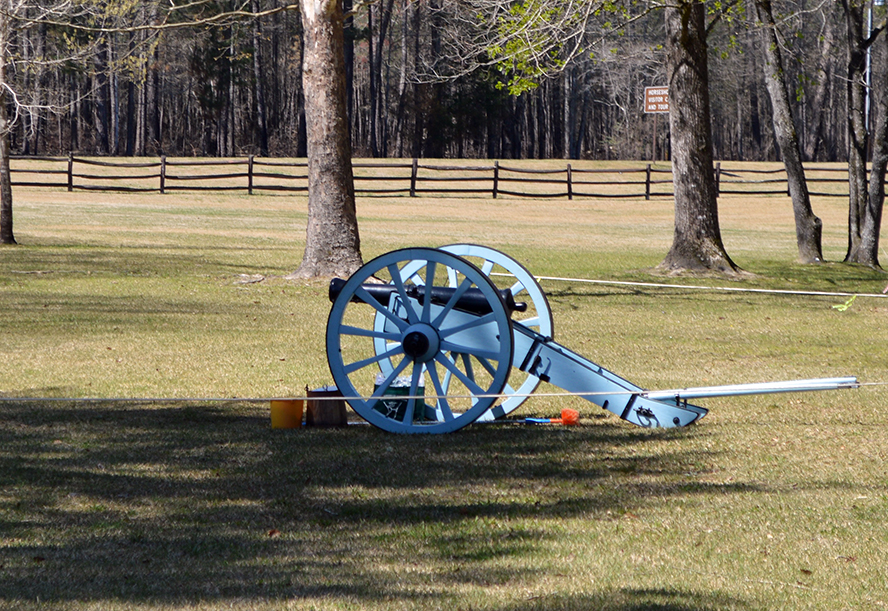
A cannon similar to the one carried to Fowltown by
Arbuckle's command is on display at Horseshoe Bend
National Military Park in Alabama.
Lt. Johnson’s mention of his company appears to indicate that Capt. Donoho’s artillery company was present at the Battle of Fowltown, even though it is not explicitly mentioned in the official reports. The unit did have several field guns, the largest of which was a 6-pounder. The deployment of at least one of these guns during the fighting would explain the discovery of a solid shot near Four Mile Creek. The cannonball is too small to date from the Civil War, and there was no other recorded action in the area from which it could date.

The Native American account of the battle was simple. Boleck and Cappachimico wrote – likely through Alexander Arbuthnot – in a letter to Gov. Charles Cameron in the Bahamas that Fowltown had been attacked by American soldiers. “Our Indians, rallying, drove the Americans from the town,” they reported, “but in their exertions had two more people killed.”

Fresh water trickles from a small steephead spring at the
probable site of Fowltown in Decatur County, Georgia.
The chiefs did not report the number of warriors who were wounded in the fighting, but U.S. soldiers reported seeing several fall along the edges of the swamp. Lt. Col. Arbuckle listed his own losses as 1 killed and 2 wounded. The soldier who lost his life at Fowltown was Pvt. Aaron Hughes, a regimental musician. He had joined the army at the age of 15 and served through the War of 1812 without injury. He was reportedly shot while trying to rally the troops by standing on an Indian cabin and playing his fife.

The firefight lasted 15-20 minutes and ended when Neamathla and his men withdrew deeper into the swamp. Arbuckle described what happened next as a “march,” but officers in his command said it was a “retreat.” The soldiers definitely moved quickly from the town and marched up the trail to Burges’s Bluff (Bainbridge):

The detachment consisted of 300 men, under the command of Colonel Arbucle. They were attacked about twelve miles from Fort Scott, by a party of Fowltown and Osouche Indians, supposed to be about one hundred, and had one man killed and two wounded, one dangerously. The Indian loss was supposed to be eight or ten. They captured some cattle during the flight, which were retaken in the towns, lying about eight miles from Fort Scot. – The detachment then retreated four miles and threw up breast works. 

Another officer described the battle in similar terms when he wrote to his father from Fort Scott on December 2, 1817:

"Fowl Town Swamp" as drawn by an early surveyor when
the area was still part of the original Early County, Georgia.
I marched from Fort Hawkins on the 15th Nov. and arrived here on the 19th, at night. On the 23d, Col. Arbuckle crossed Flint river with 300 men, for the purpose of destroying an Indian town, about 20 miles off. We arrived in the town about 12 o’clock, next day – at 3, the Indians attacked us, and after an action of about 15 minutes, they retreated into a large swamp which nearly surrounded their town. – The loss cannot be ascertained – Ours, 1 killed, 1 severely and 3 slightly wounded. 

The brief account provided by Cappachimico and Boleck (“Bowlegs”) appears to indicate that Neamathla attacked the retreating soldiers somewhere between Fowltown and Burges’s Bluff and recovered some of the stolen cattle. None of the U.S. accounts are known to mention such an encounter, but the beef was vital to the survival of the Tutalosis, and a raid or quick strike to recover some of it makes sense.

- End of Excerpt -

The soldiers either "marched" or "retreated" to Burges's Bluff (present-day Bainbridge), where they started building a new stockade that they named Fort Hughes after the slain musician.

If angered by the unprovoked raid on his town two days earlier, Neamathla was infuriated by the larger strike. Runners went out from Fowltown to call for help, and hundreds of warriors soon began a general movement for the Flint and Apalachicola Rivers from as far away as the Suwannee.

Retaliation was coming.

Editor's Note: Learn more about the Battle of Fowltown in Dale Cox's acclaimed book Fowltown: Neamathla, Tutalosi Talofa & the First Battle of the Seminole Wars.

Experience living history camps, military drills, musket and cannon demonstrations, the 19th-century keelboat Aux Arc ("Ozark"), battle reenactments, and more at the annual Scott 1817 Seminole War Battle Reenactment in Chattahoochee, Florida, on December 7-8, 2019. Learn more at Scott1817.com.

Friday, November 22, 2019

A keelboat sails down the Apalachicola River

Lt. Richard W. Scott's last command leaves Fort Scott.


by Dale Cox

The 38-foot keelboat Aux Arc ("Ozark") underway on the
Flint River arm of Lake Seminole in 2017.
As U.S. troops attacked Fowltown on November 21, 1817 (please see First Blood at Fowltown),  igniting a war that would continue more than 40-years, a major disaster was building on Florida's Apalachicola River.

The march of the 4th and 7th Regiments from Camp or Fort Montgomery north of Mobile to Fort Scott had necessitated the transport of supplies, ordnance, ammunition, uniforms, and other necessities by ship on the Gulf of Mexico. Maj. Gen. Edmund P. Gaines contracted sailing vessels for this purpose, sending them out from Mobile in two flotillas.

The first of these, escorted by 1st Lt. Richard W. Scott and a detachment of the 7th Infantry, reached Fort Scott without significant incident. The second was guarded by a larger force under Brevet Maj. Peter Muhlenberg of the 4th U.S. Infantry. It reached the mouth of the Apalachicola River as the main bodies of the two regiments were marching across present-day Alabama.

The Aux Arc recreates the keelboats that carried tons of
cargoes on America's rivers in the 18th and 19th centuries.
Anticipating the arrival of Muhlenberg's three ships, Gen. Gaines ordered Lt. Scott to take a detachment of 40 men and go back down the Apalachicola to meet them. The lieutenant had already navigated the river, and his experience, Gaines assumed, would prove helpful to the major. 

Scott, a Virginia-born officer with experience in the War of 1812, did not know that the general planned to attack Fowltown and provoke a war. In truth, Gaines himself probably did not expect his raid to ignite the fiery response that it did. Either way, he gave the lieutenant no indication of his plans, simply ending advise that Muhlenberg use the junior officer's detachment to help bring up the supply ships.

Many keelboats, as the Aux Arc demonstrates, were propelled
by either oars or sail. The vessel will be on the Apalachicola
River at Chattahoochee, Florida, for the Scott 1817 Seminole
War Battle Reenactment on December 6-8, 2019.
Lt. Scott's command left Fort Scott aboard a keelboat. These shallow-draft vessels were the workhorses of America's rivers long before inventor Robert Fulton took the steamboat New Orleans down the Mississippi River in the winter of 1811-1812. They continued to operate on rivers throughout the country for decades to come.

A good example of a keelboat is the Aux Arc (pronounced "Ozark"), the Arkansas-based vessel that will take part in this year's Scott 1817 Seminole War Battle Reenactment on December 6-8. Fitted with a mast and sail and a small cabin, the Aux Arc is 38-feet long but draws only about 12-inches of water. Even when loaded with a full crew and a cargo weighing several tons, she still draws only 13-inches or so.
At least one account indicates that Lt. Scott's keelboat carried
a swivel cannon like this one on the Aux Arc. You can see it
fire at the Scott 1817 Seminole War Battle Reenactment.
Like the Aux Arc, Scott's keelboat was also equipped with oars and could be rowed up or downriver by her crew when the wind failed. They could cover remarkable distances in short periods when going downstream. One keelboat leaving Fort Gaines, for example, traveled some 60-miles down the Chattahoochee River in a single night. Going upriver, of course, was much slower.

Scott's boat was somewhere on the Apalachicola when the Maj. Gen. Gaines sat down on November 22, 1817, to order a second attack on Fowltown. Maj. David E. Twiggs and his men had returned to Fort Scott the night before with news of their failure to capture Neamathla. The general decided to try again, this time from a different direction with a more significant force.

The task this time was assigned to Lt. Col. Matthew Arbuckle, who was given more than 300 men and a detachment of artillery. He was also ordered to carry wagons and bring away as much corn as possible from the log cribs in the Native American town. Food supplies were running short at Fort Scott, and Gaines hoped to supplement his own stocks by raiding those of the Creeks.

Fighting at Fowltown resumed the next morning.

div> Editor's Note: This article is part of a series that helps explain the background of the annual Scott 1817 Seminole War Battle Reenactment. This year's event is coming up in two weeks on December 6-8, 2019. Please visit Scott1817.com for more information.

For a quick 30-second look at what to expect at the annual reenactment, please click play:


Wednesday, November 20, 2019

Soldiers cross the Flint River at Bainbridge, Georgia

Twiggs marches start the Seminole Wars

by Dale Cox

Archaeologist Brian Mabelitini (left) and historian Dale Cox
look out at the Flint River from Burges's Bluff from
J.D. Chason Memorial Park in Bainbridge, Georgia.
Note: This article continues a series leading up to the annual Scott 1817 Seminole War Battle Reenactment at Chattahoochee, Florida. The event is set for December 6-8 and commemorates the first U.S. defeat of the Seminole Wars.

United States troops from the 4th and 7th Infantry Regiments used dugout canoes to cross the chilly Flint River to Burges's Bluff 202 years ago today. The site is recognized today as Bainbridge, Georgia.

The 250-men were on their way to start the first battle of the Seminole Wars. This series of conflicts lasted more than forty years until the very eve of the American War Between the States or Civil War. Thousands of men, women, and children lost their lives, and tens of thousands more were forced west on the Trail of Tears.

A section of the original Fort Scott Road or "Jackson Trail,"
no longer in use, is still visible on an island in Lake Seminole.
The objective of the soldiers, who left a large but still-incomplete frontier stockade called Fort Scott, was Fowltown, a Creek Indian village on the margin of the swamps that surrounded Four Mile Creek south of present-day Bainbridge. Maj. Gen. Edmund P. Gaines was ordered by the Monroe Administration to take and hold the town's chief, Neamathla (Eneah Emathla), as a hostage until his followers agreed to give up their lands to the United States. Please see yesterday's article.

He drafted written orders to Maj. David E. Twiggs for a raid on Fowltown 202 years ago this morning:

The hostile character & Conduct of the Indians of the Fowl Town, settled within our limits, rendering it absolutely necessary that they should be removed, you will proceed to the town with the detachment assigned you, and remove them. You will arrest and bring the chiefs and warriors to this place, but should they oppose you, or attempt to escape, you will in that event treat them as enemies. Your men are to be strictly prohibited, in any event, from firing upon, or otherwise injuring, women and children. [1]

The 7th United States Infantry Living History Association
recreates a march along a section of the old 10 Mile Still Road
during the Scott 1817 event two years ago.
The route of the battalion followed today's 10 Mile Still Road, which follows the original "Jackson Trail" or "Fort Scott Road" from the point it plunges into Lake Seminole until it disappears under the modern development of the city of Bainbridge.
The original path ended on the west bank of the Flint river opposite Burges's Buff, a high plateau where the historic district of downtown Bainbridge exists today.

The bluff takes its name from the late 18th and early 20th-century deerskin trader James Burges. He operated a trading house there in the Lower Creek town of Pucknauhitla, which spread from about Oak City Cemetery on the north to the vicinity of J.D. Chason Memorial Park in the south. The crossing point was just below Chason Park.

Burgess died some 10-15 years before the Fowltown raid, and Pucknauhitla was no longer occupied, but his old crossing was still there, and the old fields and ruins of the houses were still evident.

The Flint River crossing site at Bainbridge, Georgia.
Subsequent reports from Fort Hughes, a small stockade built on the bluff four days later, indicate that the only boat at the crossing was a dugout canoe. The soldiers undoubtedly used this vessel to get across the river, a process that would have been slow and laborious. 

Curiously, just such a dugout was found in the river not far away by modern searchers and is on display at the Decatur County Historical Society Museum in Bainbridge. It was made with metal tools, but it is impossible to say whether it is the same canoe.

The day was blustery as temperatures dropped throughout the Southeast. Ice formed in the streets of Charleston, South Carolina, that night as the first cold front of the season swept down through the region. Temperatures had been unseasonably warm all month, but things changed as Twiggs, and his men slowly crossed the Flint River and climbed up Burges's Bluff.

The cold wind was perhaps an omen to what they were about to unleash.

Editor's Note: This series will continue tomorrow with the story of the first U.S. attack on Fowltown and the beginning of the Seminole Wars. To learn more about the upcoming Scott 1817 Seminole War Battle Reenactment, please visit Scott1817.com.

References:

[1] Maj. Gen. Edmund P. Gaines to Maj. David E. Twiggs, Nov. 20, 1817.


Tuesday, November 19, 2019

They'd cry out I was a savage: Neamathla stands against the U.S. Army

Neamathla, General Gaines, and Washington Irving!

by Dale Cox

Neamathla (Eneah Emathla)
Primary Chief of Fowltown
Note: As we approach the Scott 1817 Seminole War Battle Reenactment, which will take place on Dec. 6-8 in Chattahoochee, Florida, I will post articles that give you information about the significance of that encounter. DC

The effective strengths of the Fourth and Seventh Infantry Regiments of the U.S. Army began arriving at Fort Scott on today's Lake Seminole in Southwest Georgia 202 years ago today. The soldiers did not know it, but they were coming to start a war.

Maj. Gen. Edmund P. Gaines, a hero of the War of 1812, commanded the march, which started at Camp or Fort Montgomery in the Tensaw settlement of what is now Alabama. He was under orders from the administration of President James Monroe to kidnap the Red Stick Creek chief Neamathla (Eneah Emathla) and some of his leading men. 

Neamathla was the principal chief of Fowltown, a Lower Creek village that had recently resettled on the swamps of Four Mile Creek about 3-4 miles south of present-day Bainbridge, Georgia. He and his followers sided with the Prophet Josiah Francis during the Creek War of 1813-1814 but were defeated at the Battle of Uchee Creek and forced to evacuate to the Florida borderlands. 

Rearmed by the British during the closing months of the War of 1812, they refused to evacuate their lands as required by the Treaty of Fort Jackson, which seized more than 22 million acres from the Creeks. Neamathla had not signed that document. "The land is mine," he told Maj. David E. Twiggs of the U.S. Army that summer, "I am directed by the Powers Above to defend it."

Maj. Gen. Edmund P. Gaines, USA
Photographed later in life.
National Archives.
Angered by the chief's "defiance," the powers in Washington, DC, instructed Gen. Gaines to hold the chief as a hostage until his followers left the Fort Jackson Treaty lands. The general started his troops for Fort Scott.

Hindsight shows that everyone involved in the U.S. side of the dispute - from subordinate officers at the fort on the Flint to the highest officials in the Monroe Administration - underestimated Neamathla. The fighting that would take place at Fowltown and on the Apalachicola River over the next eleven days would show by how much.

Perhaps the best account of the chief was written by the famed author Washington Irving. Remembered today for The Legend of Sleepy Hollow and other works, Irving interviewed Florida Gov. William P. Duval about his later interactions with the chief. Duval met Neamathla as lands were being selected for Florida’s capital city of Tallahassee:

…He was a remarkable man; upward of sixty years of age, about six feet high, with a fine eye, and a strongly-marked countenance, over which he possessed great command. His hatred of white men appeared to be mixed with contempt: on the common people, he looked down with infinite scorn. He seemed unwilling to acknowledge any superiority of rank or dignity in Governor Duval, claiming to associate with him on terms of equality as two great chieftains.[i]

Washington Irving, the noted American
writer who penned a fascinating account
of Neamathla.
Library of Congress.
Irving’s statement that the chief was unwilling to acknowledge the superiority of the white governor is powerful. It shows that Neamathla regarded himself as the equal of any white leader. He also left no doubt about his feelings concerning the U.S. occupation of his lands:

…This country belongs to the red man; and if I had the number of warriors at my command that this nation once had, I would not leave a white man on my lands. I would exterminate the whole. I can say this to you, for you can understand me: you are a man; but I would not say it to your people. They’d cry out I was a savage, and would take my life. They cannot appreciate the feelings of a man that loves his country.[ii]

Duval was attempting to arrange the movement of Neamathla and his followers from a village site at Tallahassee to a new reservation established for them near the Ochlockonee River in Gadsden County, Florida. The chief’s voice grew louder and louder until it could be heard over the entire village as he made clear that he was willing to fight to the death to defend the lands of his people:

…He held in his hand a long knife, with which he had been rasping tobacco; this he kept flourishing backward and forward, as he talked, by way of giving effect to his words, brandishing it at times within an inch of the governor’s throat. He concluded his tirade by repeating, that the country belonged to the red men, and that sooner than give it up, his bones and the bones of his people should bleach upon its soil.[iii]

Pensacola's Jacksonian Guard demonstrates the uniforms,
weapons and musical instruments of the 4th and 7th
Regiments. The unit will participate in the Scott 1817
Reenactment at Chattahoochee, FL on Dec. 6-8, 2019.
Neamathla eventually did put his words into action. He never occupied the tiny reservation established for him in Florida but instead moved up the Chattahoochee River to the surviving part of the Creek Nation. There he became the principal chief of Hitchiti and emerged as one of the principal leaders in the Creek War of 1836.

Captured by U.S. and Alabama militia troops, he was placed in chains and marched west on the Trail of Tears. An officer who saw him wrote that the chief was over 80 years old but never uttered a complaint despite the weight of his chains. He reached what is now Oklahoma during the brutal winter of 1836-1837. One of the final mentions of him to appear in U.S. Army records is a plea for his people to receive the blankets that they had been promised. They were suffering in the snow and ice and had nothing with which to cover themselves.  

Editor's Note: The events of November 1817 are commemorated by the annual Scott 1817 Seminole War Battle Reenactment at Chattahoochee, Florida. This year's event is scheduled for December 6-8 and will feature an Education Day for school and home school students on Friday, December 6, followed by public days on Saturday and Sunday, December 7 and 8. Activities take place at River Landing Park and feature living history encampments, demonstrations, exhibits, a mobile museum, the authentic 19th-century replica keelboat Aux Arc ("Ozark"), and battle reenactments on both Saturday and Sunday. All activities are free to the public.

For more information, please visit https://scott1817.com. This video will give you a quick 30-second preview:


[i] Washington Irving, “Conspiracy of Neamathla” in The Works of Washington Irving, Author’s Revised Edition, Volume XVI, Wolfert's Roost, New York, G.P. Putnam, 1863, page 297.
[ii] Ibid., pp. 297-298.
[iii] Ibid., pp. 301-302.

Saturday, November 22, 2008

The Remarkable Story of Elizabeth Stewart Dill

By Dale Cox

Apalachicola River – In a recent article we explored the history of Scott’s Massacre, a battle fought on the Apalachicola River between Sneads and Chattahoochee on November 30, 1817. If you missed the article, you can read it online by scrolling down this page.

The battle took place when Creek and Seminole warriors attacked a U.S. Army supply boat commanded by Lieutenant Richard W. Scott of the 7th Infantry Regiment. Casualties were severe. Of the 40 men, 7 women and 4 children on board, 34 men, 6 women and all 4 children were killed.

The only female survivor of the massacre was Mrs. Elizabeth Stewart. Twenty-nine years old and a native of Maryland, she was the wife of a soldier stationed at Fort Scott. The old fort was located on the Flint River arm of what is now Lake Seminole and was the headquarters of General Edmund P. Gaines and the First Brigade.

Although six other women and four children died in the attack, Mrs. Stewart was saved through the intervention of one of the chiefs. Taken to the Seminole town of Miccosukie near present-day Tallahassee, she was assigned to the women belonging to a band of Creek refugees led by Chief Peter McQueen. A key leader in the Creek War of 1813-1814, McQueen had fled to Florida following the Battle of Horseshoe Bend, Alabama.

Although records mentioning her captivity are rare, Mrs. Stewart appears to have performed tasks such as cooking and watching over the children of McQueen’s band. One of these was a nine year old boy then called “Billy” or “Powell.” In later years he became the great Seminole leader Osceola and it is his life that is memorialized today at Florida State University football games by “Chief Osceola,” the mascot of the Seminoles. In 1817 he was among the refugees that had fled to Florida from Alabama with Peter McQueen.

Enough mention of Mrs. Stewart appears in correspondence and military records of the time to verify that U.S. Army officers knew she was alive. The chances of locating and rescuing her, however, must have seemed remote.

In April of 1818, however, Andrew Jackson’s troops attacked McQueen’s warriors at Econfina Natural Bridge between Tallahassee and the Suwannee River. As the fight developed, Mrs. Stewart was seen hiding in the brush by Timpoochee Barnard, a Creek warrior fighting on the side of the United States. Barnard fought his way through the action to Mrs. Stewart and carried her safely to General Jackson.

Although early frontiersman Thomas Woodward told a vivid story later in life of the death of “Sergeant Stewart” at Scott’s Massacre, records of the time indicate that Woodward was repeating a fictional story. There was no soldier named Stewart killed during the battle and General William McIntosh, the famed Creek leader of Coweta, wrote a few days after Mrs. Stewart’s rescue that she had been returned to “her father and husband” who he said were with General Jackson.

The Stewarts settled about sixty miles north of Jackson County in Fort Gaines, Georgia. He died there in the early 1820s and she remarried a local merchant named Thomas Dill. The couple was one of the wealthiest on the frontier and a Fort Gaines legend holds that their riches originated during Elizabeth’s captivity. As the story goes, Native American warriors considered paper money worthless to them and would throw it away as they returned from raids. Elizabeth collected the money from the ground and stashed it away. By the time of her rescue, she is said to have collected a fortune.

Elizabeth Stewart Dill is buried in the Old Pioneer Cemetery in Fort Gaines and her beautiful home – seen above and supposedly built with the paper money collected in Florida – still stands as a beautiful landmark in the picturesque old town. Her story is truly one of the most remarkable in area history.

Editor’s Note: The story of Scott’s Massacre is presented in detail in Dale Cox’s new book, The History of Jackson County, Florida: Volume One. The book is available in Marianna at Chipola River Book and Tea downtown and can be ordered online by clicking here.


Friday, May 30, 2008

Lake Seminole History, Part Ten

Continuing our look at historic sites around Lake Seminole, this is Camp Recovery.
Located in Decatur County, Georgia, less than a 30 minute drive from Jackson County, Camp Recovery was a hospital camp established for soldiers at nearby Fort Scott during the great fever outbreak in 1820.

Surgeons at the fort were anxious to find some way of relieving the suffering of the soldiers stationed there. Of the 780 men at Fort Scott, 769 were ill with what modern experts believe was malaria.

Finally, after considering the options, they decided to move as many of the men as they could to a camp located on a high pine ridge a few miles south of the fort. It was hoped that moving the men from the "swamp air" at Fort Scott would help them recover. The cause of malaria had not yet been identified in 1820 and most experts believe it was caused by "bad air."

More than 100 soldiers were moved to the site known today as Camp Recovery, where a camp was established in the open pine woods. At first they did show signs of recovery, but a heavy rain set in and the soldiers soon relapsed. A number died and were buried in a cemetery at the site. The camp was abandoned soon after.

During the 1880s, the U.S. Government placed a monument at the site to mark the burial ground.

We will have more on Camp Recovery in our next post.


Sunday, May 25, 2008

Lake Seminole History, Part Nine

After rebuilding Fort Scott during the summer of 1817, U.S. troops held the post until the fall of 1821.

During this time the fort served as the headquarters for the U.S. Army's Southern Command. General Andrew Jackson launched his invasion of Florida from here during the First Seminole War of 1817-1818. The post served as an important frontier bastion until Spain ceded Florida to the United States.

The site of Fort Scott proved extremely unhealthy. Malaria ravaged the troops assigned to guard the Georgia frontier. By 1820, 769 of the 780 men assigned to the fort were sick. Dozens of them died. The story was repeated in 1821.

By the time Fort Scott was abandoned in September of 1821, more than 100 U.S. soldiers had died at the isolated post. They were buried on the grounds and their resting place today is forgotten and overgrown.

Our series on historic sites around Lake Seminole will continue.

Friday, May 23, 2008

Lake Seminole History, Part Eight


This is a view of the site of Fort Scott as it appears today. Other than a few traces of earthworks, nothing remains of the old fort and the site is overgrown with trees and brush.
Following his return from the expedition to the lower Apalachicola River, Col. Clinch ordered his men to begin the construction of a new, much larger fort on this site. The work was progressing well when the post was inspected by Major J.M. Davis in October of 1816.
Davis described the new fort at that time as consisting of a line of barracks, constructed end to end, in a row about 100 yards back from the edge of the bluff. The buildings were constructed of squared logs and designed so that by closing the doors and windows, they could be easily defended against a force attacking with small arms. A similar structure for the officers was constructed between this line of buildings and the edge of the bluff.
The fort was still not finished when Clinch was ordered to evacuate the site in December of 1817, so it was left in the care of George Perryman, a local Native American leader. Shortly after the troops left, however, Creek and Seminole warriors arrived at the fort, drove Perryman and his family away and set fire to the buildings.
The bloodless attack prompted the U.S. government to order to reoccupation of the fort and by June of 1817, troops were again at the site and busy reconstructing the fort.
We will continue our look at Fort Scott when our series continues.

Thursday, May 22, 2008

Lake Seminole History, Part Seven


Continuing our look at historic sites around Lake Seminole, we shift today to the Georgia side of the Lake.
This is the State of Georgia marker for Fort Scott. The marker is located at Hutchinson's Ferry Landing (better known as Wingate's Lodge) in Decatur County, Georgia.
Fort Scott was an extremely important military post constructed by the U.S. Army in June of 1816. Under orders to establish a new outpost at the confluence of the Flint and Chattahoochee Rivers, just above the border of Spanish Florida, Lt. Col. Duncan L. Clinch and a battalion from the 4th U.S. Infantry arrived in the area during the first week of June of 1816. After surveying the area, they selected a commanding bluff just up the Flint River from the confluence. The site is only about 10 miles from Jackson County (as the crow flies).
Here they constructed a rough log stockade that was originally named Camp Crawford after Secretary of War William Crawford, a Georgian. The name was changed to Fort Scott later in the year.
It was from this post that Clinch launched the expedition in July of 1816 that would result in the bloody destruction of the so-called "Negro Fort" on the lower Apalachicola River. To read more about this expedition, please see a series currently underway on our sister site, Civil War Florida.
When Clinch returned from that expedition in August, he renamed the new outpost Fort Scott in honor of General Winfield T. Scott, a hero of the recent War of 1812. He also began construction of a new, much more extensive fort at the site.
We will have more on Fort Scott when our series continues.