A Two Egg TV Page. See more at https://twoeggtv.com.
Showing posts with label fowltown. Show all posts

Friday, December 16, 2022

The Battle of Fort Hughes in Bainbridge, Georgia

A Seminole War fight for survival!

by Dale Cox

The site of Fort Hughes is marked by a federal monument
placed at today's J.D. Chason Memorial Park in the 1880s.
A cloud of smoke enveloped the blufftop at Bainbridge, Georgia, 205 years ago today. Hundreds of Red Stick Creek, Seminole, and Maroon (Black Seminole) warriors exchanged fire with a detachment of soldiers in Fort Hughes, a small log stockade at today's J.D. Chason Memorial Park.

The battle started on the previous day, simultaneous with an attack by a much larger Native American army on the supply ships Little Sally and Phoebe Ann at Ocheesee Bluff, Florida, (please see The Battle of Ocheesee).

The fight at Ocheesee was part of an effort to stop supplies and communications from reaching Fort Scott, the U.S. Army headquarters on the lower Flint River. The attack on Fort Hughes, however, was an aggressive attempt to take the stockade and wipe out the soldiers defending it.

This story continues below. To enjoy a video version, click to play:


The little fort measured only 90-feet per side and was built by Lt. Col. Matthew Arbuckle to defend the Flint River crossing at Burges's Bluff (today's Bainbridge). His 300-man force was falling back from the Battle of Fowltown on November 23, 1817, with Lower Creek warriors in hot pursuit. To protect the column's rear during its slow crossing of the Flint, Arbuckle ordered his men to throw up a fort on the crest of the bluff.  He named it Fort Hughes after Aaron Hughes, a regimental musician, who was killed at Fowltown.

Fort Hughes is one of the stops on the Creek Heritage Trail.
A series of interpretive panels at J.D. Chason Memorial Park
tell the story of the fort and the Creek and Seminole Wars.
The outpost was square in design with blockhouses - two-story structures that housed soldiers and strengthened the defenses - on two diagonal corners. A section of the stockade line was discovered by archaeologist Brian Mabelitini in 2018. The excavation showed that the walls were built by digging a trench, standing posts upright in it, and then filling in around them. The posts or pickets of the stockade were surprisingly small, just thick enough to stop the lead balls fired from Native American rifles and muskets.

When Arbuckle finished the fort and completed his crossing of the Flint on November 25, he left behind Capt. John N. McIntosh of the 4th Regiment of U.S. Infantry with 40 men as a garrison. The assignment went quietly enough until December 15-18, when hundreds of warriors emerged from the nearby woods and tried to storm the post.

The soldiers repelled the initial attack, fighting desperately from behind their walls of thin posts as the warriors attacked from all sides. Lt. Col. Arbuckle later reported that McIntosh and his men were "surrounded by a large force, and his [McIntosh's] arrangements were such as to do him much credit." [1]

Neamathla (Eneah Emathla) was the powerful and charismatic
chief of Fowltown, a village near today's Bainbridge, Georgia.
He likely took part in the Battle of Fort Hughes.
Many of the warriors likely came from nearby Fowltown and were undoubtedly led by their prominent chief, Neamathla. Another group came from as far away as the Suwannee River and included fighters from as far away as the Suwannee River.

The latter group included not only Maroon (Black Seminole) fighters but also one of several white Bahamian residents who took part in the Seminole War of 1817-1818. Peter Cook came to Florida as a merchant and employee of the trader Alexander Arbuthnot. Displeased with his employer, he left him and joined Robert Ambrister on the Suwannee River. Ambrister was a former lieutenant in the British Marines and had served at Prospect Bluff (the "Negro Fort") on the Apalachicola during the War of 1812.

Ambrister sent him with a party of warriors to help take Fort Hughes, an experience that Cook described in a letter to his fiance in the Bahamas:

…The balls flew like hail-stones; there was a ball that had like to have done my job; it just cleared by breast. For six days and six nights we had to encamp in the wild woods, and it was constantly raining night and day; and as for the cold, I suffered very much by it; in the morning the water would be frozen about an inch thick. [2]

A luminary and memorial service held in 2017 to mark the
200ths anniversary of the fights at Fowltown and Fort Hughes.
The weather was severely cold in the late fall of 1817. Ash blasted into the atmosphere by the explosion of the Indonesian volcano Mount Tambora still impacted the climate of the Northern Hemisphere. Temperatures remained so unusually cold more than one year after the eruption that the years 1816-1818 became known as the "Year without a Summer." Others called it "Eighteen Hundred and Froze to Death."

The attacking force was unable to take Fort Hughes. The blockhouses of the outpost projected slightly from the walls, allowing Capt. McIntosh and his men to fire at any warriors who approached the stockade. The soldiers, meanwhile, were protected by the log walls of the blockhouses, and the attack force couldn't harm them.

Fort Hughes included two blockhouses similar to this
reconstructed one at Fort Mitchell Historic Site in Alabama.
Despite this advantage, the fight was a close thing for McIntosh's command. Fort Hughes did not have a well, and one officer who was present later described how the soldiers suffered greatly for water during the battle. A providential rain finally brought relief and saved the garrison from a need to break out through the Native American lines to find water.

The battle continued for three days before the chiefs and Cook finally decided that it was useless to continue and called off the fight. He and his force withdrew to the Suwannee, but their object was achieved. Lt. Col. Arbuckle at Fort Scott realized the vulnerability of Fort Hughes and sent troops to withdraw Capt. McIntosh's detachment.

Archaeological evidence suggests that the log walls of the fort later burned. Whether this fire took place during or after the war is not known.

The site of Fort Hughes can be visited today at J.D. Chason Memorial Park. Visitors can see a monument, interpretive panels, beautiful old trees, and a great view of the Flint River. The site is temporarily closed due to a major park enhancement project being carried out by the City of Bainbridge.

Click play here to learn more about the archaeological discovery of Fort Hughes:


Editor's Note: You can learn more about Fort Hughes, Fowltown, Fort Scott, and the Seminole War in 1817-1818 in these books from historian Dale Cox:


Friday, December 13, 2019

A Battle at Blountstown, Florida

The Seminole War attack at Blunt's Town and Spanish Bluff

by Dale Cox

The Apalachicola River as seen from "Spanish Bluff," the site
of today's Neal Landing at Blountstown, Florida.
A battle on the banks of the Apalachicola River 202 years ago today marked the end of a remarkable Lower Creek chief.

The Prophet Josiah Francis and other Red Stick Creek, Seminole, Miccosukee, and Maroon (Black Seminole) leaders made clear their disavowal of an attempt by Atasi Mico, William Perryman, George Perryman, Johnson, and the white trader Edmund Doyle to open peace negotiations with U.S. Army officers at Fort Scott on the Georgia frontier. (Please see Earthquake shakes peace effort on the Apalachicola River).

They did so by attacking the Spanish Bluff home of William Hambly, where Doyle and others had taken shelter:

…On the 13th instant, Hambly and Doyle were made prisoners by this party, and, I presume, killed, and their property of every description taken possession of. The chief, William Perryman, who had gone down with a party to protect Hambly and Doyle, was killed, and his men forced to join the opposite party. All of the Indians on the Chattahoochee, below Fort Gaines, who are not disposed to go to war, I fear will be compelled to remove above for security.[i]

William Hambly's home and trading store overlooked the
Apalachicola River at Spanish Bluff. The site is now a
popular recreation spot in Calhoun County.
Spanish Bluff touched the river where Neal Landing Park is located today at Blountstown, Florida. The town of the Tuckabatchee chief John Blunt stood nearby, and it is from this community that Blountstown takes its name. The modern city was founded at Spanish Bluff but later relocated to the higher ground where it stands today.

The killing of William Perryman by the Prophet’s party marked the end of that chief’s remarkable career of leadership among the Lower Creeks and Seminoles. The leader of Tellmochesses, a Eufaula town on the west side of the Chattahoochee River near Parramore Landing in present-day Jackson County, Florida, he was the son of the well-known Lower Creek/Seminole leader Thomas Perryman and the grandson of the British trader Theophilus Perryman.

William Perryman came of age as a chief and warrior during the American Revolution when he led warriors from the Perryman towns to St. Augustine to fight alongside the British against the American Patriots in Georgia. He and his men were engaged in numerous skirmishes and battles across Northeast Florida and Southeast Georgia during the Revolution, and he was recognized with the rank of captain by the British Army.

William Perryman was the brother-in-law of the
adventurer and pirate William Augustus Bowles.
William Augustus Bowles married William Perryman’s sister during his first sojourn among the Lower Creeks. The two brothers-in-law got along well enough at first, and warriors from Tellmochesses were among the fighters who supported the adventurer. Some even crewed his “privateer” (i.e., pirate) ships.

This changed, however, when Bowles threatened the life of Thomas Perryman during a minor dispute. William responded to this action with uncharacteristic anger and signed an agreement with the Spanish at San Marcos de Apalache (Fort St. Marks) to help capture the adventurer. He remained on good terms with the Spanish after that, supplying them with beef from his extensive herds and providing them with intelligence about events in the Creek Nation.

William Perryman was called “Indian Will” by Col. Andrew Ellicott, the U.S. Commissioner of Limits, who arrived in the area in 1799 to survey the permanent boundary between Spanish Florida and the claimed territory of the United States. He warned Ellicott of a planned attack by Creek and Seminole warriors. Led by the chief of Tallassee, they were angry that the Americans and Spanish were dividing their lands.

William Perryman was one of the Lower Creek and Seminole chiefs who went to Pensacola in 1813 to plead for military support from Great Britain. A British warship was in port, and they sent a message by him to the governor in the Bahamas. The Creek War of 1813-1814 was underway, and the chiefs feared that the growing war would spread to them.

The battle took place in the area of today's Neal Landing Park
on the Apalachicola River at Blountstown, Florida.
This was the request that brought British forces to the Apalachicola River in 1814. They built forts at Prospect Bluff (the "Negro Fort") and just below the forks of the Chattahoochee and Flint Rivers. William and Thomas Perryman joined an alliance that supported Great Britain during the last days of the War of 1812.

William’s leadership role grew in 1815 with the death of his father. He and his followers stayed neutral when U.S. forces came down from Fort Gaines to build Fort Scott and attack and attack the Negro Fort during the summer of 1816. His brother – George Perryman – even served as caretaker at Fort Scott when the military withdrew that winter.

Perryman formed an alliance with the United States after the destruction of the Negro Fort. He provided intelligence to U.S. officers at Fort Gaines, and his name frequently appears in military reports from 1817.

The chief was involved in a plot to public flog Neamathla during a council at Fort Scott in August 1817. He believed that the Fowltown chief was endangering all of the towns of the area by confronting the army. Neamathla did not appear, and the plan was dashed.

Blountstown was founded at Spanish Bluff but later moved up
the hill to its present site. This historical marker notes the site
of the "old" courthouse which stood near Neal Landing.
In a last-ditch effort to restore peace after the U.S. raids on Fowltown and the Native American retaliation at the Scott Battle of 1817, William and George Perryman accompanied Edmund Doyle and the chief Johnston to Fort Scott on December 10, 1817. The negotiation failed.

The Prophet Francis and other principal leaders were not consulted about the Fort Scott council. This likely contributed to the attack that followed at Spanish Bluff on December 13, 1817.

Exactly what happened that day is not known. William Perryman and his warriors left their town near today's Parramore Landing in Jackson County, Florida, after the failed peace effort at Fort Scott and went down to Spanish Bluff. They planned to escort William Hambly and Edmund Doyle to safety, but the Prophet struck before they could complete their mission.

Hambly later described his experience: 

…[O]n the 13th of December last, when on my plantation on the Apalachicola, I was made a prisoner of by a party of Seminole Indians, and taken up to the Ocheesee Bluffs in company with Mr. Doyle, who was made a prisoner with me; they kept us here three days, during which time they were busily engaged with some transports which were then ascending the river to Fort Scott; from thence they took us to Mekosukee, where the Indians informed me that they had been told by the commandant of St. Marks, that war was declared between Spain and the United States. From this place we were carried to the Suwanee, when Kenhagee [i.e., Cappachimico], principal chief of the Seminoles, told me that we had been taken and robbed by order of Arbuthnott, and taken there to be tried by him. [ii]

The U.S. Army later executed the Bahamian trader Alexander Arbuthnot on charges that he conspired to kill Hambly and Doyle. The Maroon (Black Seminole) chief Nero intervened to save their lives, taking them to the Spanish fort of San Marcos de Apalache instead. 

The Fowltown war chief Chenubby led the attack on Hambly's home. He also took part in the Scott Battle on November 30, 1817. [iii]

The raid on Spanish Bluff provided the Prophet’s forces with a large quantity of food, which they used to sustain themselves during their coming attack on the U.S. supply ships on the Apalachicola. That siege – remembered today as the Battle of Ocheesee Bluff – began on December 15, 1817.

Editor's Note: Learn more about the battles on the Apalachicola River in 1817 from Dale Cox's books The Scott Battle of 1817 and Fort Scott, Fort Hughes & Camp Recovery. Just click the links for ordering information. 

Visit the site of the battle and see a great view of the Apalachicola River at Neal Landing in Blountstown, Florida:


References:

[i] Lt. Col. Matthew Arbuckle to Major General Edmund P. Gaines (dated Fort Scott), December 20, 1817, American State Papers – Military Affairs, Vol. 1, pp. 689-690.

[ii] Certificate of William Hambly, July 24, 1818, National Archives.

[iii] William Hambly and Edmund Doyle to Maj. Gen. Andrew Jackson, May 2, 1818, National Archives.

Monday, November 25, 2019

Black Seminoles march for the Apalachicola

Fighters from the Suwannee prepare to battle the U.S. Army.

by Dale Cox

Abraham was a prominent Black Seminole or Maroon
freedom fighter and "sense bearer" or advisor.
He is portrayed here by Antonio Wright.
The United States Army's attacks on the Creek Indian village of Fowltown ignited outrage across the Florida borderlands. (Please see First Blood at Fowltown and Neamathla battles Arbuckle for details on the two days of fighting at Fowltown).

News that U.S. troops attacked the town in the dark, killing women as well as men, brought warriors across the region to their feet. Any hope that Cappachimico, the principal chief of Miccosukee, and others had of avoiding war with the United States, was now gone. Even leaders friendly to the whites were upset over the unprovoked raids and warned that they might not be able to control their young men.

One group of men who responded to Neamathla's calls for help knew well what it meant to oppose the United States military. They were Maroons or escaped slaves - commonly called Black Seminoles - from Nero's town on the Suwannee River. They were black men for whom every battle was a fight for freedom, and every night brought fears of raids by slave catchers from Georgia or the Carolinas.

The real Abraham as he appeared two decades later.
This engraving by N. Orr appeared in the 1848 book
The Origin, Progress, and Conclusion of the Florida
War
, by John T. Sprague.
Among these fighters were survivors of the deadly 1816 U.S. attack on the Fort at Prospect Bluff or "Negro Fort." Abraham, Polydore, and others were in the log and earth fort on the lower Apalachicola River when a heated cannonball from an American gunboat ricocheted off a pine tree and struck one of their three gunpowder magazines. The result was a horrible explosion that killed 270 men, women, and children in an instant. 

Now, just one year later, they grabbed their British-made Brown Bess muskets and started for the Apalachicola, where the Prophet Josiah Francis, an influential Red Stick Creek leader, was raising an army to fight the Americans. The Maroons or Black Seminoles marched with confidence because they still possessed a magazine of arms and ammunition that was removed from the Negro Fort before its destruction.

The number of men under Nero's command is difficult to determine, as estimates by white writers of the time vary wildly. The consensus seems to be that he commanded around 300 well-armed men, many of whom were trained during their time with the British Colonial Marines in 1814-1815. In fact, quite a few probably still wore their British uniforms in 1817, although they were definitely starting to assimilate to the culture of the Alachua Seminoles alongside whom they lived.

The Maroons or Black Seminoles were among hundreds of
warriors who gathered here on the Apalachicola River to
attack any U.S. boats trying to bring supplies upstream.
A large contingent of the black fighters was sent by the Prophet to join a force assembling just below the forks of the Chattahoochee and Flint Rivers. The Red Stick chief "Homathlemico" (probably Hoboeithle Mico) commanded the group of 300-400 warriors. In addition to the men from Nero's town, they included angry warriors from Fowltown, a group of Yuchi from the lower Chattahoochee River, and many Red Stick Creeks. Others joined as well.

The plan developed by Francis and the other vital leaders was to blockade all approaches to Fort Scott and prevent supplies from reaching the soldiers there. The Prophet learned well from the Creek War of 1813-1814 that the only way to defeat the U.S. Army was to cut off its provisions. Any boats coming upriver would be attacked and stopped.

Lt. Scott's command was aboard a keelboat similar to the
Aux Arc (pronounced "Ozark"), seen here. The beautiful
vessel will participate in this year's Scott 1817 Seminole War
Battle Reenactments on December 6-8.
The strike force just below the confluence camped around the abandoned War of 1812 British fort that is commonly called Nicolls' Outpost today. Several U.S. reports refer to it as "Fort Apalachicola." It stood atop a large prehistoric Native American mound at today's River Landing Park.

They waited there for an American vessel to appear and offer them a chance to strike back not just for Fowltown but for the destruction of the Negro Fort one year before. The next boat to come into view on this section of the big river would be the keelboat commanded by Lt. Richard W. Scott of the 7th Regiment, U.S. Infantry.

Editor's Note: The Maroons or Black Seminoles played a critical role in the Seminole victory at the Scott Battle of 1817. Antonio Wright will portray the famed leader Abraham this year. More than 1,000 area school students will have a remarkable educational opportunity to learn the real Abraham's story during Education Day activities on Friday, December 6. Wright will be joined this year by Matthew Shack, a descendent of Maroons and noted educator from Gulf Coast State College, who will tell the students more about Black Seminoles and their struggle for freedom.

The annual Scott 1817 Seminole War Battle Reenactment takes place at River Landing Park in Chattahoochee on December 6-8, 2019. Entry is free to all. Click to visit Scott1817.com for more information.

Click play below to enjoy a brief 30-second preview of this year's reenactment:


Sunday, November 24, 2019

Battle reenactments two weeks away in Chattahoochee, FL

Scott 1817 event to feature amphibious battle on the Apalachicola.

by Dale Cox
Red Stick Creek warriors like these will join two days of
battle reenactments at Chattahoochee, Florida, on
December 7-8, 2019.
Soldiers and warriors are set to battle it out as the 19th-century comes to life at River Landing Park in Chattahoochee, Florida on December 6-8, 2019.

The beautiful park on the Apalachicola River will host this year's Scott 1817 Seminole War Battle Reenactment, three days of living history events, demonstrations, battle reenactments, and more. Friday, December 6, is Education Day with more than 1,000 students coming from schools and home school groups throughout the region to learn about early 19th-century life. 

The authentic 38-foot keelboat Aux Arc ("Ozark") will be
part of the fighting as warriors attack her from the banks of
the Apalachicola River on December 7 & 8, 2019.
Saturday, December 7, and Sunday, December 8, will be the main public days. The grounds will be open from 9 a.m. to 3 p.m. Eastern/8 a.m. to 2 p.m. Central each day. Visitors can explore the living history camps to meet Creek, Seminole, Miccosukee, Yuchi, and Maroon (Black Seminole) warriors and their families. Then they will meet early frontier settlers, the soldiers of Jacksonian Guard, early boatmen aboard the authentic 38-foot keelboat Aux Arc (pronounced "Ozark"), and more!

At 12:30 p.m. Eastern/11:30 a.m. Central on Saturday and 2 p.m. Eastern/1 p.m. Central on Sunday, the public is invited to witness full-scale amphibious battle reenactments along the banks of the Apalachicola River! 

Ed Williams, the captain of the Aux Arc, demonstrates the
firing of the boat's swivel gun. Original accounts indicate that
such a cannon was fired in the Scott Battle of 1817.
Photograph by Tim Richardson
The Scott 1817 event commemorates the first battles of the Seminole Wars, which took place along the Florida-Georgia border in November 1817. These began on November 21, 1817, with the first U.S. attack on the Creek village of Fowltown (please see First Blood at Fowltown), followed by more fighting in the town near Bainbridge on November 23 (please see Fighting continues at Fowltown).

The first two battles were launched by the United States. The third and most deadly fight, however, came when Native American and Maroon (Black Seminole) forces retaliated at today's River Landing Park on November 30, 1817. Several hundred warriors overwhelmed Lt. Richard W. Scott's command, which was making its way upriver to Fort Scott on present-day Lake Seminole. Lt. Scott, 34 soldiers, 6 women, and 4 children were killed in action, 5 other soldiers were wounded. Seminole/Red Stick Creek casualties are unknown.

Soldiers of Pensacola's Jacksonian Guard will take part in
the battle reenactments as musket, rifle, and cannon fire
flash across the Apalachicola River at Chattahoochee, Florida,
on December 7-8, 2019.
The dead of both sides will be remembered in a unique luminary service on Saturday night, December 7, at 6:30 p.m. Eastern/5:30 p.m. Central. Participants will light 400 luminaries along the Apalachicola River to honor the men, women, and children, who died in the fighting not only at the Scott Battle of 1817 but in other actions across the area in 1816-1819. Included will be 270 luminaries for the victims of the 1816 explosion that destroyed the Fort at Prospect Bluff or "Negro Fort" on the Apalachicola River.

In addition to the battle reenactments, visitors can visit a mobile museum, see exhibits, explore vendors, buy lunch, and much more. The soldiers of the Jacksonian Guard will provide military drill demonstrations and perhaps even teach a little old-fashioned dancing as well!

The Scott 1817 Seminole War Battle Reenactment is FREE to visit and open to visitors of all ages on Saturday and Sunday from 9 a.m. to 3 p.m. Eastern/8 a.m. to 2 p.m. Central, and during the luminary service on Saturday night. Please visit Scott1817.com or www.facebook.com/scott1817 for more information.

River Landing Park is at 500 River Landing Road, Chattahoochee, Florida. See the map at the bottom of this page for directions. Also, be sure to enjoy this quick 30-second video preview! Just click play:


Saturday, November 23, 2019

Neamathla surprises Arbuckle as fighting continues at Fowltown

Outnumbered warriors stand and fight in the Georgia woods.


by Dale Cox

Red Stick Creek warriors at the 2017 reenactment of the
Battle of Fowltown during the Scott 1817 Seminole War
Battle Reenactment at Chattahoochee, Florida.
The main fighting of the Battle of Fowltown took place 202 years ago today at the Lower Creek village just south of present-day Bainbridge, Georgia. 

The United States Army opened the battle with a night raid two days earlier (please see First Blood at Fowltown) but failed to kidnap the principal chief Neamathla as ordered to do. Maj. Gen. Edmund P. Gaines ordered a larger force back to the village. Numbering more than 300 men and augmented by a section of light artillery, the strike force was led by Lt. Col. Matthew Arbuckle of the 7th Infantry.

The troops marched from Fort Scott on November 22, 1817, crossing the Flint River at the fort itself to approach Fowltown from the opposite direction of the first attack.

The following is excerpted from my book Fowltown: Neamathla, Tutalosi Talofa & the First Battle of the Seminole Wars:

- Begin Excerpt -

The Village of Fowltown historical marker near the probable
site of the important Lower Creek town where the Seminole
Wars started on November 21-23, 1817.
Arbuckle’s command halted at some point during the night to rest for a few hours. This guaranteed that the men would be fresh for the battle while also delaying their arrival at Fowltown until well after sunrise. This was probably an intentional way of avoiding the confusion of fighting in the darkness should Neamathla once again resist the presence of the soldiers. It was late morning by the time the troops came within sight of the village:

…The town which is about eighteen miles distant from this place and four from the Bluff we entered on the 23 Instant about 10 O’clock in the morning without opposition. On our approach several signal guns were fired by the Indians who no doubt discovered one of our flanking parties but at the time that all the troops had reached the town no Indians were seen and a few yells only were heard from a swamp which skirts its north east side. I took a position near the town so as to secure the troops from any fire which might issue from the swamp, and after posting such sentinels as would prevent us from being surprised I ordered the men to refresh themselves while the waggons were loading with corn. 

Mountain laurel grows at the probable site of Fowltown south
of the Four Mile Creek swamps in Decatur County, Georgia.
Arbuckle was, by nature, a much more cautious officer than Maj. Twiggs. The fact that he approached Fowltown with flanking parties out is clear evidence that he was taking all proper steps to avoid being surprised. Such measures had likely been reinforced before his departure from Fort Scott by Gen. Gaines, who routinely cautioned officers under his command to be vigilant and careful.
The soldiers knew that Neamathla and his warriors were in the swamp and watching them, but the intensity of the attack still took them by surprise when it hit:

…[The loading of the wagons] was done and the troops were about to march when the Indians, fifty or sixty in number (as I judge) were perceived advancing by the sentinels posted in the swamp and fired on: The fire was instantly returned by the Indians who giving the War Hoop advanced rapidly towards our lines. Parties were immediately detached to take possession of the houses between our position and the swamp which movement checked the progress of the Indians and compelled them to fall back. A spirited fire was then kept up for twenty or twenty five minutes when the Indians retreated into the Swamp. During the affair the Indians frequently appeared in the open ground and from the number which were seen to fall, there can be no doubt but six or eight were killed and many severely wounded yet as the swamp was large and uncommonly thick I deemed it not prudent to pursue them into it or search for those who fell on its edges. 

Neamathla (Eneah Emathla)
The principal chief of Fowltown.
Arbuckle was surprised that Neamathla would attack a much larger force over open ground. The intensity of the attack also took him off guard. The officer did not realize, however, that the corn stocks in the village were vital to the survival of men, women, and children through the coming winter. The town had relocated three times in four years. Its once extensive herds of cattle were gone. The corncribs likely meant the difference between life and death for many in the community. The warriors were fighting to save their homes and families and did so against odds of roughly 6 to 1:

…A spirited fire was then kept up for twenty or twenty five minutes when the Indians retreated into the Swamp. During the affair the Indians frequently appeared in the open ground and from the number which were seen to fall, there can be no doubt but six or eight were killed and many severely wounded yet as the swamp was large and uncommonly thick I deemed it not prudent to pursue them into it or search for those who fell on its edges. The skill and valor displayed by the officers and men engaged in the little affair affords a pleasing prospect should their services be required on another important occasion. The Indians must have been deceived as to our numbers otherwise they should not have had the temerity to attack us. 

Pensacola's Jacksonian Guard demonstrates uniforms and
weapons of the Battle of Fowltown era.
Courtesy of the Jacksonian Guard
Whether all of the officers and soldiers fought as valiantly as Arbuckle indicated is subject to some debate. Rumors swirled after the battle that Lt. Milo Johnson of the 4th Artillery had not performed well in action. Johnson had graduated from the U.S. Military Academy at West Point in the Class of 1815. Notable officers to come from that class included Gen. Samuel Cooper, who became the highest-ranking Confederate officer, and Col. William Chase, who supervised the construction of Fort Pickens at Pensacola, Florida. Johnson requested a chance to defend himself against the allegations being made against him:

Having understood that a report is calculating through the camp, that I behaved unlike a soldier in being separated from my compy. and while separated in the affair at Fowl Town, on the 23d of Nov. 1817. I am compelled in justice to myself to demand a court of enquiry, to investigate the truth of sd. report. 

No further explanation of his actions during the battle has been found, and there is no evidence in the available military records that a court-martial was ever convened in his case. Subsequent events quickly overshadowed the Battle of Fowltown and Johnson’s conduct – whatever it might have been – was forgotten.

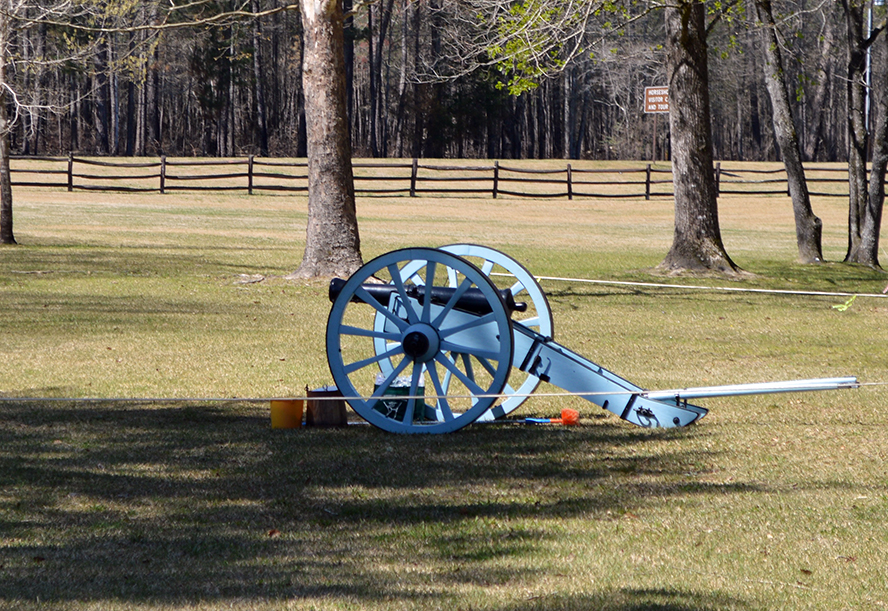
A cannon similar to the one carried to Fowltown by
Arbuckle's command is on display at Horseshoe Bend
National Military Park in Alabama.
Lt. Johnson’s mention of his company appears to indicate that Capt. Donoho’s artillery company was present at the Battle of Fowltown, even though it is not explicitly mentioned in the official reports. The unit did have several field guns, the largest of which was a 6-pounder. The deployment of at least one of these guns during the fighting would explain the discovery of a solid shot near Four Mile Creek. The cannonball is too small to date from the Civil War, and there was no other recorded action in the area from which it could date.

The Native American account of the battle was simple. Boleck and Cappachimico wrote – likely through Alexander Arbuthnot – in a letter to Gov. Charles Cameron in the Bahamas that Fowltown had been attacked by American soldiers. “Our Indians, rallying, drove the Americans from the town,” they reported, “but in their exertions had two more people killed.”

Fresh water trickles from a small steephead spring at the
probable site of Fowltown in Decatur County, Georgia.
The chiefs did not report the number of warriors who were wounded in the fighting, but U.S. soldiers reported seeing several fall along the edges of the swamp. Lt. Col. Arbuckle listed his own losses as 1 killed and 2 wounded. The soldier who lost his life at Fowltown was Pvt. Aaron Hughes, a regimental musician. He had joined the army at the age of 15 and served through the War of 1812 without injury. He was reportedly shot while trying to rally the troops by standing on an Indian cabin and playing his fife.

The firefight lasted 15-20 minutes and ended when Neamathla and his men withdrew deeper into the swamp. Arbuckle described what happened next as a “march,” but officers in his command said it was a “retreat.” The soldiers definitely moved quickly from the town and marched up the trail to Burges’s Bluff (Bainbridge):

The detachment consisted of 300 men, under the command of Colonel Arbucle. They were attacked about twelve miles from Fort Scott, by a party of Fowltown and Osouche Indians, supposed to be about one hundred, and had one man killed and two wounded, one dangerously. The Indian loss was supposed to be eight or ten. They captured some cattle during the flight, which were retaken in the towns, lying about eight miles from Fort Scot. – The detachment then retreated four miles and threw up breast works. 

Another officer described the battle in similar terms when he wrote to his father from Fort Scott on December 2, 1817:

"Fowl Town Swamp" as drawn by an early surveyor when
the area was still part of the original Early County, Georgia.
I marched from Fort Hawkins on the 15th Nov. and arrived here on the 19th, at night. On the 23d, Col. Arbuckle crossed Flint river with 300 men, for the purpose of destroying an Indian town, about 20 miles off. We arrived in the town about 12 o’clock, next day – at 3, the Indians attacked us, and after an action of about 15 minutes, they retreated into a large swamp which nearly surrounded their town. – The loss cannot be ascertained – Ours, 1 killed, 1 severely and 3 slightly wounded. 

The brief account provided by Cappachimico and Boleck (“Bowlegs”) appears to indicate that Neamathla attacked the retreating soldiers somewhere between Fowltown and Burges’s Bluff and recovered some of the stolen cattle. None of the U.S. accounts are known to mention such an encounter, but the beef was vital to the survival of the Tutalosis, and a raid or quick strike to recover some of it makes sense.

- End of Excerpt -

The soldiers either "marched" or "retreated" to Burges's Bluff (present-day Bainbridge), where they started building a new stockade that they named Fort Hughes after the slain musician.

If angered by the unprovoked raid on his town two days earlier, Neamathla was infuriated by the larger strike. Runners went out from Fowltown to call for help, and hundreds of warriors soon began a general movement for the Flint and Apalachicola Rivers from as far away as the Suwannee.

Retaliation was coming.

Editor's Note: Learn more about the Battle of Fowltown in Dale Cox's acclaimed book Fowltown: Neamathla, Tutalosi Talofa & the First Battle of the Seminole Wars.

Experience living history camps, military drills, musket and cannon demonstrations, the 19th-century keelboat Aux Arc ("Ozark"), battle reenactments, and more at the annual Scott 1817 Seminole War Battle Reenactment in Chattahoochee, Florida, on December 7-8, 2019. Learn more at Scott1817.com.

Friday, November 22, 2019

A keelboat sails down the Apalachicola River

Lt. Richard W. Scott's last command leaves Fort Scott.


by Dale Cox

The 38-foot keelboat Aux Arc ("Ozark") underway on the
Flint River arm of Lake Seminole in 2017.
As U.S. troops attacked Fowltown on November 21, 1817 (please see First Blood at Fowltown),  igniting a war that would continue more than 40-years, a major disaster was building on Florida's Apalachicola River.

The march of the 4th and 7th Regiments from Camp or Fort Montgomery north of Mobile to Fort Scott had necessitated the transport of supplies, ordnance, ammunition, uniforms, and other necessities by ship on the Gulf of Mexico. Maj. Gen. Edmund P. Gaines contracted sailing vessels for this purpose, sending them out from Mobile in two flotillas.

The first of these, escorted by 1st Lt. Richard W. Scott and a detachment of the 7th Infantry, reached Fort Scott without significant incident. The second was guarded by a larger force under Brevet Maj. Peter Muhlenberg of the 4th U.S. Infantry. It reached the mouth of the Apalachicola River as the main bodies of the two regiments were marching across present-day Alabama.

The Aux Arc recreates the keelboats that carried tons of
cargoes on America's rivers in the 18th and 19th centuries.
Anticipating the arrival of Muhlenberg's three ships, Gen. Gaines ordered Lt. Scott to take a detachment of 40 men and go back down the Apalachicola to meet them. The lieutenant had already navigated the river, and his experience, Gaines assumed, would prove helpful to the major. 

Scott, a Virginia-born officer with experience in the War of 1812, did not know that the general planned to attack Fowltown and provoke a war. In truth, Gaines himself probably did not expect his raid to ignite the fiery response that it did. Either way, he gave the lieutenant no indication of his plans, simply ending advise that Muhlenberg use the junior officer's detachment to help bring up the supply ships.

Many keelboats, as the Aux Arc demonstrates, were propelled
by either oars or sail. The vessel will be on the Apalachicola
River at Chattahoochee, Florida, for the Scott 1817 Seminole
War Battle Reenactment on December 6-8, 2019.
Lt. Scott's command left Fort Scott aboard a keelboat. These shallow-draft vessels were the workhorses of America's rivers long before inventor Robert Fulton took the steamboat New Orleans down the Mississippi River in the winter of 1811-1812. They continued to operate on rivers throughout the country for decades to come.

A good example of a keelboat is the Aux Arc (pronounced "Ozark"), the Arkansas-based vessel that will take part in this year's Scott 1817 Seminole War Battle Reenactment on December 6-8. Fitted with a mast and sail and a small cabin, the Aux Arc is 38-feet long but draws only about 12-inches of water. Even when loaded with a full crew and a cargo weighing several tons, she still draws only 13-inches or so.
At least one account indicates that Lt. Scott's keelboat carried
a swivel cannon like this one on the Aux Arc. You can see it
fire at the Scott 1817 Seminole War Battle Reenactment.
Like the Aux Arc, Scott's keelboat was also equipped with oars and could be rowed up or downriver by her crew when the wind failed. They could cover remarkable distances in short periods when going downstream. One keelboat leaving Fort Gaines, for example, traveled some 60-miles down the Chattahoochee River in a single night. Going upriver, of course, was much slower.

Scott's boat was somewhere on the Apalachicola when the Maj. Gen. Gaines sat down on November 22, 1817, to order a second attack on Fowltown. Maj. David E. Twiggs and his men had returned to Fort Scott the night before with news of their failure to capture Neamathla. The general decided to try again, this time from a different direction with a more significant force.

The task this time was assigned to Lt. Col. Matthew Arbuckle, who was given more than 300 men and a detachment of artillery. He was also ordered to carry wagons and bring away as much corn as possible from the log cribs in the Native American town. Food supplies were running short at Fort Scott, and Gaines hoped to supplement his own stocks by raiding those of the Creeks.

Fighting at Fowltown resumed the next morning.

div> Editor's Note: This article is part of a series that helps explain the background of the annual Scott 1817 Seminole War Battle Reenactment. This year's event is coming up in two weeks on December 6-8, 2019. Please visit Scott1817.com for more information.

For a quick 30-second look at what to expect at the annual reenactment, please click play:


Thursday, November 21, 2019

First Blood: The Dawn Attack at Fowltown

Day One of the Battle of Fowltown

by Dale Cox

The probable site of Fowltown in Decatur County, Georgia.
Note: The following is excerpted from my 2017 book Fowltown: Neamathla, Tutalosi Talofa & the first battle of the Seminole Wars. Today is the 202nd anniversary of the first day of the three-day-long Battle of Fowltown, the first engagement of the Seminole Wars. To read yesterday's preliminary article, please see Soldiers cross the Flint River.

- Begin Excerpt -

The morning of November 21, 1817, was seasonably cold, especially as the soldiers moved down into the broad basin of Fowltown Swamp and Four Mile Creek. The creek flows out of the swamp just over one mile east of the Flint River and then runs in a slightly northwest directly to its confluence with the Flint. The route of the march from Burges’s down to the swamp likely followed a trail shown on the 1819 District Plats of Survey on file at the Georgia Archives. This pathway or “road” ran parallel to the Flint River about halfway between the east bank and today’s Faceville Road (GA 97).  [1]

Neamathla (Eneah Emathla)
The primary chief of Fowltown.
Neamathla was not expecting an attack by U.S. troops and no warriors had been placed to guard his town against surprise. This allowed Twiggs to approach the town undetected and begin to form his companies for an enveloping movement:

…Having marched all the night of the 20th I reached the town before day light on the morning of the 21st & posted the troops in order of Battle intending silently to surround it & without blood shed bring to you the chief & warriors, but they fled from the companies of Majr. Montgomery & Cpt. Birch on my right & fired upon my left under Capts. Allison & Bee when they were fired on in return. Discovering my superiority of force they fled to a neighboring swamp. [2]

The exchange of fire between Neamathla’s warriors and the soldiers of Bee’s and Allison’s companies on Twiggs’s right flank was the first of the Seminole Wars. Fighting would continue with an occasional interruption for the next 41 years.

Maj. David E. Twiggs, USA
(As seen 43-years later)
Matthew Brady photograph,
Library of Congress.
Fowltown had been taken by complete surprise, and the firing on both sides was wild. No soldiers were wounded, and Twiggs reported that the Creeks had lost “but few as they received but one round & fled.” He did not provide estimates of Native American losses in his brief written report of the affair but apparently told Gen. Gaines that the fire of Neamathla’s men “was briskly returned by the detachment, and the Indians put to flight with the loss of four warriors slain – and, as there is reason to believe, many more wounded.” [3]

Gaines wrote to Maj. Gen. Andrew Jackson on the day of the attack, informing him of the skirmish and reporting that the village’s casualties included at least one woman:

It is with deep regret I have to add that a woman was accidentally shot with some warriors in the act of forcing their way through our line formed for the purpose of arresting their flight. The unfortunate woman had a blanket fastened round her (as many of the warriors had) which amidst the smoke in which they were enveloped, rendered it impossible, as I am assured by the officers present, to distinguish her from the warriors. [4]

The Native American account of the attack was included in a letter from Cappachimico and Boleck (Bowlegs) to Gov. Charles Cameron in the Bahamas. The document appears to have been written for them by Alexander Arbuthnot and is somewhat garbled. The part that appears to refer to the pre-dawn attack of November 21 begins with a mention of the letter sent to Cappachimico by Gen. Gaines:

Creek Heritage Trail interpretive panel for the Battle of
Fowltown at Chason Memorial Park in Bainbridge, Georgia.
…This letter only appears to have been a prelude to plans determined on by the said General and General Jackson, to bring on troops and settlers, to drive us from our lands; and take possession of them; for, in the end of [November], a party of Americans surrounded Fowl Town during the night, and in the morning began setting fire to it; making the unfortunate inhabitants fly to the swamps, and who in their flight had three persons killed by the fire of the Americans. [5]

The troops remained in Fowltown only until daybreak. Maj. Twiggs reported that they did not destroy the town but left it intact. He did report to Gen. Gaines that a significant quantity of corn was seen in the corncribs of the village and that he and his officers had inspected Neamathla’s home. There, according to the general, they found “a British uniform coat (Scarlet) with a pair of gold Epaulettes, and a certificate signed by a british Captain of Marines.” The certificate noted that Neamathla had always been a “true and faithful friend to the British” and was signed by Capt. Robert White of the Royal Marines. [6]

Twiggs returned to Fort Scott with his battalion on the same day as the skirmish, taking with him little besides a few horses and a few head of cattle. He reported to Gen. Gaines that his men and officers all performed well in what was for many their baptism of fire. [7]

- End of Excerpt -

The first attack did not really rise to the level of a full-fledged battle, but the fighting at Fowltown was far from over and the fiercest encounter was still to come.

Editor's Note: This special series commemorates the opening days of the First Seminole War and provides historical background for the coming Scott 1817 Seminole War Battle Reenactment in Chattahoochee, Florida. The event is set for December 6-8, 2019, and features living history encampments and demonstrations, exhibits, a mobile museum, battle reenactments, vendors, and more. For more information, please visit Scott1817.com.

References:

[1] District Plat of Survey, Early County, District 20, October 5, 1825 (copied from 1819 plat), Survey Records, Surveyor General, RG 3-3-24, Georgia Archives.
[2] Bvt. Maj. David E. Twiggs to Maj. Gen. Edmund P. Gaines, November 21, 1817, Records of the Adjutant General’s Office, Letters Received, National Archives.
[3] Ibid.; Maj. Gen. Edmund P. Gaines to Gov. Peter Early, November 21, 1817, published in the New York Commercial Advertiser, December 15, 1817.
[4] Maj. Gen. Edmund P. Gaines to Maj. Gen. Andrew Jackson, November 21, 1817, Jackson Papers, Library of Congress.
[5] Cappiahimico and Bowlegs to Gov. Cameron, n.d., included in The Trials of A. Arbuthnot and R.C. Ambrister, London, 1819: 19-21.
[6] Gaines to Jackson, November 21, 1817.
[7] Gaines to Jackson, November 21, 1817.


Wednesday, November 20, 2019

Soldiers cross the Flint River at Bainbridge, Georgia

Twiggs marches start the Seminole Wars

by Dale Cox

Archaeologist Brian Mabelitini (left) and historian Dale Cox
look out at the Flint River from Burges's Bluff from
J.D. Chason Memorial Park in Bainbridge, Georgia.
Note: This article continues a series leading up to the annual Scott 1817 Seminole War Battle Reenactment at Chattahoochee, Florida. The event is set for December 6-8 and commemorates the first U.S. defeat of the Seminole Wars.

United States troops from the 4th and 7th Infantry Regiments used dugout canoes to cross the chilly Flint River to Burges's Bluff 202 years ago today. The site is recognized today as Bainbridge, Georgia.

The 250-men were on their way to start the first battle of the Seminole Wars. This series of conflicts lasted more than forty years until the very eve of the American War Between the States or Civil War. Thousands of men, women, and children lost their lives, and tens of thousands more were forced west on the Trail of Tears.

A section of the original Fort Scott Road or "Jackson Trail,"
no longer in use, is still visible on an island in Lake Seminole.
The objective of the soldiers, who left a large but still-incomplete frontier stockade called Fort Scott, was Fowltown, a Creek Indian village on the margin of the swamps that surrounded Four Mile Creek south of present-day Bainbridge. Maj. Gen. Edmund P. Gaines was ordered by the Monroe Administration to take and hold the town's chief, Neamathla (Eneah Emathla), as a hostage until his followers agreed to give up their lands to the United States. Please see yesterday's article.

He drafted written orders to Maj. David E. Twiggs for a raid on Fowltown 202 years ago this morning:

The hostile character & Conduct of the Indians of the Fowl Town, settled within our limits, rendering it absolutely necessary that they should be removed, you will proceed to the town with the detachment assigned you, and remove them. You will arrest and bring the chiefs and warriors to this place, but should they oppose you, or attempt to escape, you will in that event treat them as enemies. Your men are to be strictly prohibited, in any event, from firing upon, or otherwise injuring, women and children. [1]

The 7th United States Infantry Living History Association
recreates a march along a section of the old 10 Mile Still Road
during the Scott 1817 event two years ago.
The route of the battalion followed today's 10 Mile Still Road, which follows the original "Jackson Trail" or "Fort Scott Road" from the point it plunges into Lake Seminole until it disappears under the modern development of the city of Bainbridge.
The original path ended on the west bank of the Flint river opposite Burges's Buff, a high plateau where the historic district of downtown Bainbridge exists today.

The bluff takes its name from the late 18th and early 20th-century deerskin trader James Burges. He operated a trading house there in the Lower Creek town of Pucknauhitla, which spread from about Oak City Cemetery on the north to the vicinity of J.D. Chason Memorial Park in the south. The crossing point was just below Chason Park.

Burgess died some 10-15 years before the Fowltown raid, and Pucknauhitla was no longer occupied, but his old crossing was still there, and the old fields and ruins of the houses were still evident.

The Flint River crossing site at Bainbridge, Georgia.
Subsequent reports from Fort Hughes, a small stockade built on the bluff four days later, indicate that the only boat at the crossing was a dugout canoe. The soldiers undoubtedly used this vessel to get across the river, a process that would have been slow and laborious. 

Curiously, just such a dugout was found in the river not far away by modern searchers and is on display at the Decatur County Historical Society Museum in Bainbridge. It was made with metal tools, but it is impossible to say whether it is the same canoe.

The day was blustery as temperatures dropped throughout the Southeast. Ice formed in the streets of Charleston, South Carolina, that night as the first cold front of the season swept down through the region. Temperatures had been unseasonably warm all month, but things changed as Twiggs, and his men slowly crossed the Flint River and climbed up Burges's Bluff.

The cold wind was perhaps an omen to what they were about to unleash.

Editor's Note: This series will continue tomorrow with the story of the first U.S. attack on Fowltown and the beginning of the Seminole Wars. To learn more about the upcoming Scott 1817 Seminole War Battle Reenactment, please visit Scott1817.com.

References:

[1] Maj. Gen. Edmund P. Gaines to Maj. David E. Twiggs, Nov. 20, 1817.