Today marks the 203rd anniversary of the Scott Battle of 1817. The first Native American victory of the Seminole Wars, this engagement took place on the bank of the Apalachicola River at what is now River Landing Park in Chattahoochee, Florida. Click play above to learn more about the battle and a new archaeology project that is aimed at finding key evidence from the battlefield itself!
Showing posts with label seminole war. Show all posts
Showing posts with label seminole war. Show all posts
Monday, November 30, 2020

Friday, December 13, 2019
A Battle at Blountstown, Florida
The Seminole War attack at Blunt's Town and Spanish Bluff
by Dale Cox
 |
| The Apalachicola River as seen from "Spanish Bluff," the site of today's Neal Landing at Blountstown, Florida. |
The Prophet Josiah Francis and other Red Stick Creek, Seminole, Miccosukee, and Maroon (Black Seminole) leaders made clear their disavowal of an attempt by Atasi Mico, William Perryman, George Perryman, Johnson, and the white trader Edmund Doyle to open peace negotiations with U.S. Army officers at Fort Scott on the Georgia frontier. (Please see Earthquake shakes peace effort on the Apalachicola River).
They did so by attacking the Spanish Bluff home of William Hambly, where Doyle and others had taken shelter:
They did so by attacking the Spanish Bluff home of William Hambly, where Doyle and others had taken shelter:
…On the 13th instant, Hambly and Doyle were made prisoners by this party, and, I presume, killed, and their property of every description taken possession of. The chief, William Perryman, who had gone down with a party to protect Hambly and Doyle, was killed, and his men forced to join the opposite party. All of the Indians on the Chattahoochee, below Fort Gaines, who are not disposed to go to war, I fear will be compelled to remove above for security.[i]
 |
| William Hambly's home and trading store overlooked the Apalachicola River at Spanish Bluff. The site is now a popular recreation spot in Calhoun County. |
The killing of William Perryman by the Prophet’s party marked the end of that chief’s remarkable career of leadership among the Lower Creeks and Seminoles. The leader of Tellmochesses, a Eufaula town on the west side of the Chattahoochee River near Parramore Landing in present-day Jackson County, Florida, he was the son of the well-known Lower Creek/Seminole leader Thomas Perryman and the grandson of the British trader Theophilus Perryman.
William Perryman came of age as a chief and warrior during the American Revolution when he led warriors from the Perryman towns to St. Augustine to fight alongside the British against the American Patriots in Georgia. He and his men were engaged in numerous skirmishes and battles across Northeast Florida and Southeast Georgia during the Revolution, and he was recognized with the rank of captain by the British Army.
 |
| William Perryman was the brother-in-law of the adventurer and pirate William Augustus Bowles. |
This changed, however, when Bowles threatened the life of Thomas Perryman during a minor dispute. William responded to this action with uncharacteristic anger and signed an agreement with the Spanish at San Marcos de Apalache (Fort St. Marks) to help capture the adventurer. He remained on good terms with the Spanish after that, supplying them with beef from his extensive herds and providing them with intelligence about events in the Creek Nation.
William Perryman was called “Indian Will” by Col. Andrew Ellicott, the U.S. Commissioner of Limits, who arrived in the area in 1799 to survey the permanent boundary between Spanish Florida and the claimed territory of the United States. He warned Ellicott of a planned attack by Creek and Seminole warriors. Led by the chief of Tallassee, they were angry that the Americans and Spanish were dividing their lands.
William Perryman was one of the Lower Creek and Seminole chiefs who went to Pensacola in 1813 to plead for military support from Great Britain. A British warship was in port, and they sent a message by him to the governor in the Bahamas. The Creek War of 1813-1814 was underway, and the chiefs feared that the growing war would spread to them.
 |
| The battle took place in the area of today's Neal Landing Park on the Apalachicola River at Blountstown, Florida. |
William’s leadership role grew in 1815 with the death of his father. He and his followers stayed neutral when U.S. forces came down from Fort Gaines to build Fort Scott and attack and attack the Negro Fort during the summer of 1816. His brother – George Perryman – even served as caretaker at Fort Scott when the military withdrew that winter.
Perryman formed an alliance with the United States after the destruction of the Negro Fort. He provided intelligence to U.S. officers at Fort Gaines, and his name frequently appears in military reports from 1817.
The chief was involved in a plot to public flog Neamathla during a council at Fort Scott in August 1817. He believed that the Fowltown chief was endangering all of the towns of the area by confronting the army. Neamathla did not appear, and the plan was dashed.
 |
| Blountstown was founded at Spanish Bluff but later moved up the hill to its present site. This historical marker notes the site of the "old" courthouse which stood near Neal Landing. |
The Prophet Francis and other principal leaders were not consulted about the Fort Scott council. This likely contributed to the attack that followed at Spanish Bluff on December 13, 1817.
Exactly what happened that day is not known. William Perryman and his warriors left their town near today's Parramore Landing in Jackson County, Florida, after the failed peace effort at Fort Scott and went down to Spanish Bluff. They planned to escort William Hambly and Edmund Doyle to safety, but the Prophet struck before they could complete their mission.
Hambly later described his experience:
…[O]n the 13th of December last, when on my plantation on the Apalachicola, I was made a prisoner of by a party of Seminole Indians, and taken up to the Ocheesee Bluffs in company with Mr. Doyle, who was made a prisoner with me; they kept us here three days, during which time they were busily engaged with some transports which were then ascending the river to Fort Scott; from thence they took us to Mekosukee, where the Indians informed me that they had been told by the commandant of St. Marks, that war was declared between Spain and the United States. From this place we were carried to the Suwanee, when Kenhagee [i.e., Cappachimico], principal chief of the Seminoles, told me that we had been taken and robbed by order of Arbuthnott, and taken there to be tried by him. [ii]
The U.S. Army later executed the Bahamian trader Alexander Arbuthnot on charges that he conspired to kill Hambly and Doyle. The Maroon (Black Seminole) chief Nero intervened to save their lives, taking them to the Spanish fort of San Marcos de Apalache instead.
The Fowltown war chief Chenubby led the attack on Hambly's home. He also took part in the Scott Battle on November 30, 1817. [iii]
The raid on Spanish Bluff provided the Prophet’s forces with a large quantity of food, which they used to sustain themselves during their coming attack on the U.S. supply ships on the Apalachicola. That siege – remembered today as the Battle of Ocheesee Bluff – began on December 15, 1817.
Editor's Note: Learn more about the battles on the Apalachicola River in 1817 from Dale Cox's books The Scott Battle of 1817 and Fort Scott, Fort Hughes & Camp Recovery. Just click the links for ordering information.
Visit the site of the battle and see a great view of the Apalachicola River at Neal Landing in Blountstown, Florida:
References:
[i] Lt. Col. Matthew Arbuckle to Major General Edmund P. Gaines (dated Fort Scott), December 20, 1817, American State Papers – Military Affairs, Vol. 1, pp. 689-690.
[ii] Certificate of William Hambly, July 24, 1818, National Archives.
[iii] William Hambly and Edmund Doyle to Maj. Gen. Andrew Jackson, May 2, 1818, National Archives.
Thursday, December 12, 2019
Earthquake shakes peace effort on the Apalachicola River
The ground trembles beneath the feet of peace emissaries.
by Dale Cox
 |
| USGS map showing that Intensity IV and V earthquakes were felt well into Florida during the New Madrid events of 1811-1817. |
Earthquake! – The shock of an Earthquake was distinctly felt in Milledgeville (Geo.) on Wednesday night, the 10th inst. about 11 o’clock. A gentleman recently from Columbia, in this State, informs that a slight shock was also experienced there, at exactly the same time. – Charleston City Gazette, December 25, 1817.
Experts believe that the quake was a strong aftershock of the massive New Madrid Earthquakes of 1811-1812. It was felt from its center point in the Mississippi River valley somewhere between Memphis, Tennessee, and the forks of the Mississippi and Ohio Rivers all the way to the Gulf of Mexico and the Atlantic Ocean. A strange noise also accompanied the tremor:
 |
| Massive Reelfoot Lake in Tennessee was created by the New Madrid Earthquakes of 1811-1812. The 1817 quake was an aftershock. |
The shock was felt at Fort Scott on the Flint River in Southwest Georgia and along the Apalachicola River in Florida. The Prophet Josiah Francis, who was assembling an army of more than 1,000 warriors for an attack on two United States supply ships, may have seen it as an omen. It definitely served notice that the Seminole War was about to spread.
The earthquake also signaled the entry of a new state to the Union. Mississippi became one of the United States on December 10, 1817.
 |
| The earthquake tossed boats on the Apalachicola River when it struck on December 10, 1817. |
A proposition has been made by the Hostile Chiefs through the friendly chiefs Perriman and Johnston for peace. As evidence of their desire for peace, they say they will not permit their warriors to fire on our vessels ascending the river, that they will send on board the vessels the woman they took from Lieut. Scott’s command. - Lt. Col. Matthew Arbuckle to Commanding Officer of the Supply Boats on the Apalachicola River, December 10, 1817)
 |
| The Apalachicola River as seen from Spanish Bluff, where William Hambly lived in 1817. |
The meeting between the two likely took place at or near Spanish Bluff in what is now Calhoun County, Florida. Doyle had sought shelter there at the home of his friend and sometimes coworker William Hambly after hearing of the Battle of Fowltown. Atasi Mico was among the chiefs and warriors gathering at nearby Ocheesee Bluff under the leadership of the Prophet Josiah Francis for a planned attack on two U.S. ships making their way up the Apalachicola River with supplies for Fort Scott.
 |
| The Jim Woodruff Dam stands where the Chattahoochee and Flint Rivers joined to form the Apalachicola in 1817. |
The meeting took place at Fort Scott on December 10, 1817, and the lieutenant colonel was quick to tell Johnston and the Perryman brothers that he had not authorized Doyle to make an overture to the Native American force:
I have understood that Mr. Doyle has had a talk with Ottossee Micko about making peace. I did not ask Mr. Doyle to make this, or any other Talks with the hostile Indians, but I shall be glad if the talk has enduced them to wish for peace, as their Great Father the President of the United States, has always wished for peace with them. - Lt. Col. Matthew Arbuckle, Talk delivered on the 10th of Decr. 1817 to three Indian Chiefs, December 10, 1817.
Arbuckle outlined the U.S. Army’s position on what had happened at Fowltown. He touched on the real truth of the war by telling the chiefs that “the army did not come here to make war on the Indians, but expected their assistance in getting the negroes belonging to the white people who are in their country.” He also asked that “some offenders should be given up.”
The peace initiative failed.
For the Prophet Josiah Francis, who commanded the American Indian army that was gathering on the Apalachicola for an attack on the army's supply boats, the earthquake likely was an omen. The war expanded dramatically over the days that followed.
Editor's Note: You can learn more about the First Seminole War in these books by Dale Cox:
Saturday, November 30, 2019
The Scott Battle of 1817 at Chattahoochee, Florida
First U.S. Defeat of the Seminole Wars
by Dale Cox
 |
| The attack on Lt. Scott's boat as painted by Eric Sapronetti. |
 .
- Excerpt -
THE BLOODIEST DAY OF THE FIRST SEMINOLE WAR dawned not much different than other recent days on Florida’s Apalachicola River. Mount Tambora still exerted its influence on the weather of the world, and temperatures along the border of Spanish Florida were falling to levels lower than normal.
Aboard the open vessel commanded by Lieutenant Richard W. Scott of the 7th U.S. Infantry, men, women, and children shivered in the early morning mist. Some of the soldiers shivered from the cold, but nearly half of them shook with the fever that had overcome them on their long journey from the Alabama River to the Apalachicola. Onshore and hidden in the trees where they could not benefit even from the meager sunlight of the morning, Creek, Seminole, Yuchi (Euchee), and African warriors shivered as well. It takes time for the sun to rise high enough over the bluffs that tower above the east bank of the river for the woods and swamps below to benefit from its warming rays.
Roughly one mile below the original confluence of the Chattahoochee and Flint Rivers, the course of the Apalachicola makes a full bend. The site of the junction is now beneath the waters of Lake Seminole just above the Jim Woodruff Dam. One mile below the dam, however, the river still swings around the same bend as it begins its southward flow to the Gulf of Mexico. A panoramic view of the curve of the river can be seen from the dock at Chattahoochee Landing, and in 1817, as a boat rounded the bend from the South, it would have been possible for its passengers to see straight up the channel to the point of land formed by the confluence...
...As the boat entered the widest part of the arc of the bend, it was pushed hard by the full force of the water pouring from the river’s two main tributaries. The Apalachicola was beginning its winter rise, a fact that made its current even stronger. The vessel was pushed from the center of the river towards the east bank as the men pulled hard on their oars to maneuver it against the current and around the bend. Their forward progress stalled as the current ran hard against the side of the boat and drove it ever closer to the bank. All that could be seen there were the trees and bushes of the swamp, and the focus of the lieutenant and his men was devoted almost entirely to the navigation of the large bend so that they did not run aground in the shallows.
The chill of the morning replaced by the heat of the adrenalin running through their veins, hundreds of warriors waited in the thick trees and brush that lined the east bank at the point where the boat would be forced closest to shore. Stripped for battle and painted in their traditional colors and designs, they took careful aim with their rifles and muskets and waited for the signal to open fire.
THE BLOODIEST DAY OF THE FIRST SEMINOLE WAR dawned not much different than other recent days on Florida’s Apalachicola River. Mount Tambora still exerted its influence on the weather of the world, and temperatures along the border of Spanish Florida were falling to levels lower than normal.
Aboard the open vessel commanded by Lieutenant Richard W. Scott of the 7th U.S. Infantry, men, women, and children shivered in the early morning mist. Some of the soldiers shivered from the cold, but nearly half of them shook with the fever that had overcome them on their long journey from the Alabama River to the Apalachicola. Onshore and hidden in the trees where they could not benefit even from the meager sunlight of the morning, Creek, Seminole, Yuchi (Euchee), and African warriors shivered as well. It takes time for the sun to rise high enough over the bluffs that tower above the east bank of the river for the woods and swamps below to benefit from its warming rays.
 |
| The Apalachicola River at Chattahoochee, Florida, as seen from the air on a beautiful fall day. |
...As the boat entered the widest part of the arc of the bend, it was pushed hard by the full force of the water pouring from the river’s two main tributaries. The Apalachicola was beginning its winter rise, a fact that made its current even stronger. The vessel was pushed from the center of the river towards the east bank as the men pulled hard on their oars to maneuver it against the current and around the bend. Their forward progress stalled as the current ran hard against the side of the boat and drove it ever closer to the bank. All that could be seen there were the trees and bushes of the swamp, and the focus of the lieutenant and his men was devoted almost entirely to the navigation of the large bend so that they did not run aground in the shallows.
 |
| The boat used by Lt. Scott's command was similar to the Aux Arc ("Ozark"), a 38-foot keelboat that is coming from Arkansas to take part in the reenactment on Dec. 6-8. |
Lieutenant Scott and his men were focused almost entirely on getting their boat around the bend and into the straight channel that would take them up to the confluence when the east bank of the Apalachicola River suddenly erupted with a solid wall of flame:
[The survivors] report that the strength of the current, at the point of the attack, had obliged the lieutenant to keep his boat near the shore; that the Indians had formed along the bank of the river, and were not discovered until their fire commenced; in the first volley of which Lieutenant Scott and his most valuable men fell.
The explosion of gunfire from the trees and bushes along the bank all but annihilated the able-bodied portion of Scott’s command. The lieutenant and most of his armed men went down without ever firing a shot. The boat now floated on the current and in minutes was pushed aground in the shallows. The various war cries of the Red Stick Creek, Seminole, Yuchi, and African warriors rose above the scene, drowning out the terrified screams of the women and children of Lieutenant Scott’s party.
 |
| The site of the Scott Battle of 1817 at Chattahoochee, Florida. |
Among the soldiers on the boat that day was a man identified only by his last name, Gray. Severely wounded in the first volley, he was still at Fort Scott when Major General Andrew Jackson arrived there in March 1818 at the head of a brigade of Georgia militiamen. In the campfires of the army camps, Gray described the speed and ferocity with which the attack took place:
…As those on board were hooking and jamming (as the boatmen called it) near the bank, and opposite a thick canebrake, the Indians fired on them, killing and wounding most of those on board at the first fire. Those not disabled from the first fire of the Indians made the best fight they could, but all on board were killed except Mrs. Stuart and two soldiers Gray, and another man whose name I have forgot, if I ever knew it; they were both shot, but made their escape by swimming to the opposite shore.
- End of Excerpt -
By the time the battle ended, Lt. Scott, 34 men, 6 women, and 4 children were dead. There were Native American casualties as well, but the total number is known. Six soldiers, five of them badly wounded, escaped by leaping from the boat and swimming to today's Jackson County shore.
Editor's Note: The only other survivor of Scott's command was Mrs. Elizabeth Stewart, the wife of a soldier. She was rescued by a warrior named Yellow Hair. Her complete story is a fascinating part of Cox's book, the newest edition of which was released this week! It is available in both book and Kindle formats.
You can order now by clicking the ad below.
You can order now by clicking the ad below.
Friday, November 29, 2019
Eve of Battle: Lt. Scott's Last Night
"I am not able to make a stand against them."
by Dale Cox
 |
| The keelboat Aux Arc (pronounced "Ozark") is similar to the one used by Scott's command. It will take part in the annual reenactment set for Dec. 7-8 in Chattahoochee, Florida. |
Lt. Richard W. Scott navigated his shallow-draft keelboat up the Apalachicola River 202 years ago today. He knew that hundreds of warriors waited somewhere near the forks of the Chattahoochee and Flint Rivers, which form the Apalachicola on the border between Florida and Georgia. He kept going anyway, despite the warning of a longtime trader:
Mr. Hambly informs me that the Indians are assembling at the junction of the river, where they intend to make a stand against those vessels coming up the river; should this be the case, I am not able to make a stand against them. My command does not exceed forty men and one-half sick, and without arms. I leave this immediately. [1]
 |
| The Apalachicola River as seen from Spanish Bluff, today's Neal Landing in Blountstown, Florida. This was the site of William Hambly's trading post. |
Hambly undoubtedly knew of the U.S. Army's attacks on Fowltown, and this news likely formed the basis of his warnings to Scott. The lieutenant had gone down the river from Fort Scott to assist Maj. Peter Muhlenberg in bringing the supply ships Phoebe Ann and Little Sally upstream. The sailing vessels were slowing coming up the river, but Maj. Gen. Edmund Gaines worried about the speed of their progress.
Instead of keeping Scott and his 40-men as the general suggested, however, Muhlenberg replaced 20 of the lieutenant's able-bodied men with 20 sick soldiers from his own detachment and ordered him to take them, 7 women, and 4 children to Fort Scott. A supply of regimental clothing for soldiers of the 4th Infantry was also placed on the keelboat.
 |
| The Jim Woodruff Dam stands at the original point where the Chattahoochee and Flint Rivers merged to create the Apalachicola. The blue water beyond it is Lake Seminole. |
Lt. Scott's vessel is often described as a "flatboat" or "barge" by modern writers but really was a keelboat. Flatboats and barges were generally rectangular vessels designed for downstream travel. Quite often, they were broken up after reaching their destinations and the lumber used in other construction projects. A keelboat, however, was a shallow-draft vessel that could move both up and downstream,
 |
| Scott's keelboat was similar to the 38-foot Aux Arc (pronounced "Ozark"), which is coming from its homeport in Arkansas to take part in this year's Scott 1817 Seminole War Battle Reenactment on December 6-8 at Chattahoochee, FL. |
Steamboats were not yet in use on the Apalachicola, so the army depended on keelboats to move men and supplies. All were propelled by oars, and some even had masts and sails. They also usually had a cabin or shelter, and accounts from the time of Scott's voyage indicate that this was the case with his vessel.
By nightfall on November 30, 1817, 202 years ago today, Lt. Scott's boat was nearing the confluence of the Chattahoochee and Flint River. He and his command had made it as far as the vicinity of today's Interstate 10 near Aspalaga Bluff but thus far had not seen so much as a single warrior. That would change the next day.
Editor's Note: To learn more about these real events, please consider Dale Cox's newly updated book, The Scott Battle of 1817: First U.S. Defeat of the Seminole Wars . It is available now in both paperback and Kindle editions.
REFERENCES:
[1] Lt. Richard W. Scott to Maj. Gen. Edmund P. Gaines, November 28, 1817.
 . It is available now in both paperback and Kindle editions.
REFERENCES:
[1] Lt. Richard W. Scott to Maj. Gen. Edmund P. Gaines, November 28, 1817.
Tuesday, November 26, 2019
Scott 1817 Reenactment announces Schedule of Events
Battle Reenactments, Native American Camps, Military Demonstrations & More!
 |
| A cannon firing demonstration aboard the authentic keelboat Aux Arc (pronounced "Ozark"). |
The official Schedule of Events for this year's annual Scott 1817 Seminole War Battle Reenactment is out! This year's event takes place on December 6-8 at River Landing Park in Chattahoochee, Florida.
This year's activities include TWO full-scale battle reenactments, military demonstrations, traditional music, a massive luminary event, rifle and musket firing demonstrations, cannon firings, Creek/Seminole Indian camps, the authentic 38-foot keelboat Aux Arc ("Ozark), a frontier preaching service, and more.
Admission is FREE! Food vendors will be available all three days, plus there will be other vendors, exhibitors, and more.
SCOTT 1817 REENACTMENT
SCHEDULE OF EVENTS
Friday, December 6
EDUCATION DAY
9:00 AM Eastern/8:00 AM Central
Grounds open for area school and home school students and groups.
9:15 AM Eastern - 1:30 PM Eastern
Living History Demonstrations
3 PM Eastern/2 PM Central
Grounds close for the day.
Saturday, December 7
PUBLIC DAY
9 AM Eastern/8 AM Central
Grounds open for the General Public.
9:15 AM Eastern
Jacksonian Guard Flag Ceremony
9:30 AM Eastern
Keelboat Aux Arc Cannon Firing
Living History Demonstrations in Camps
10 AM Eastern
Jacksonian Guard Musket Firing Demonstration
10:30 AM Eastern
Keelboat Aux Arc Cannon Firing
11 AM Eastern
Jacksonian Guard Demonstration
Native American Musket Firing Demonstration
11:30 AM Eastern
Jacksonian Guard, Militia, Boatmen parade to the Keelboat Aux Arc
(Camp Activities Pause/Shift to Battlefield)
12 Noon Eastern
Keelboat Aux Arc Departs for the Battle Reenactment
12:30 PM Eastern/11:30 AM Central
BATTLE REENACTMENT
(All other activities pause)
2 PM Eastern
Jacksonian Guard Demonstration
Living History Demonstrations Resume in Camps
3 PM Eastern/2 PM Central
Grounds Close to the Pubic
6:30 PM Eastern/5:30 PM Central
Luminaries on the Apalachicola
Sunday, December 8
PUBLIC DAY
9 AM Eastern/8 AM Central
Grounds Open to the Public
9:15 AM Eastern
Jacksonian Guard Flag Ceremony
9:30 AM Eastern
Keelboat Aux Arc Cannon Firing
Living History Demonstrations in Camps
10 AM Eastern
Jacksonian Guard Musket Firing Demonstration
10:30 AM Eastern
Frontier Preaching at the Keelboat Aux Arc
(All other activities pause)
11 AM Eastern
Ballet Dancers on the Keelboat Aux Arc
Jacksonian Guard Demonstration
Native American Musket Firing Demonstration
Living History Demonstrations in Camps
11:30 AM Eastern
Keelboat Aux Arc Cannon Firing
12 Noon Eastern
Jacksonian Guard Dance Party!
Frontiersmen demonstrate Long Rifle Firing.
1 PM Eastern
Jacksonian Guard, Militia, Boatmen Parade to the Keelboat Aux Arc
(Camp Activities End/Shift to Battlefield)
1:30 PM Eastern
Keelboat Aux Arc leaves the dock for the Battle
2 PM Eastern/1 PM Central
BATTLE REENACTMENT
(All other activities end)
3 PM Eastern
Grounds close for 2019!
For more information, please visit Scott1817.com or www.facebook.com/scott1817.
The Scott 1817 Seminole War Battle Reenactment is sponsored by Two Egg TV, the Focus Foundation, the City of Chattahoochee, and Chattahoochee Main Street.
For directions to the reenactment site, please use the map below:
For directions to the reenactment site, please use the map below:
Monday, November 25, 2019
Black Seminoles march for the Apalachicola
Fighters from the Suwannee prepare to battle the U.S. Army.
by Dale Cox
 |
| Abraham was a prominent Black Seminole or Maroon freedom fighter and "sense bearer" or advisor. He is portrayed here by Antonio Wright. |
News that U.S. troops attacked the town in the dark, killing women as well as men, brought warriors across the region to their feet. Any hope that Cappachimico, the principal chief of Miccosukee, and others had of avoiding war with the United States, was now gone. Even leaders friendly to the whites were upset over the unprovoked raids and warned that they might not be able to control their young men.
One group of men who responded to Neamathla's calls for help knew well what it meant to oppose the United States military. They were Maroons or escaped slaves - commonly called Black Seminoles - from Nero's town on the Suwannee River. They were black men for whom every battle was a fight for freedom, and every night brought fears of raids by slave catchers from Georgia or the Carolinas.
 |
| The real Abraham as he appeared two decades later. This engraving by N. Orr appeared in the 1848 book The Origin, Progress, and Conclusion of the Florida War, by John T. Sprague. |
Now, just one year later, they grabbed their British-made Brown Bess muskets and started for the Apalachicola, where the Prophet Josiah Francis, an influential Red Stick Creek leader, was raising an army to fight the Americans. The Maroons or Black Seminoles marched with confidence because they still possessed a magazine of arms and ammunition that was removed from the Negro Fort before its destruction.
The number of men under Nero's command is difficult to determine, as estimates by white writers of the time vary wildly. The consensus seems to be that he commanded around 300 well-armed men, many of whom were trained during their time with the British Colonial Marines in 1814-1815. In fact, quite a few probably still wore their British uniforms in 1817, although they were definitely starting to assimilate to the culture of the Alachua Seminoles alongside whom they lived.
 |
| The Maroons or Black Seminoles were among hundreds of warriors who gathered here on the Apalachicola River to attack any U.S. boats trying to bring supplies upstream. |
The plan developed by Francis and the other vital leaders was to blockade all approaches to Fort Scott and prevent supplies from reaching the soldiers there. The Prophet learned well from the Creek War of 1813-1814 that the only way to defeat the U.S. Army was to cut off its provisions. Any boats coming upriver would be attacked and stopped.
 |
| Lt. Scott's command was aboard a keelboat similar to the Aux Arc (pronounced "Ozark"), seen here. The beautiful vessel will participate in this year's Scott 1817 Seminole War Battle Reenactments on December 6-8. |
They waited there for an American vessel to appear and offer them a chance to strike back not just for Fowltown but for the destruction of the Negro Fort one year before. The next boat to come into view on this section of the big river would be the keelboat commanded by Lt. Richard W. Scott of the 7th Regiment, U.S. Infantry.
Editor's Note: The Maroons or Black Seminoles played a critical role in the Seminole victory at the Scott Battle of 1817. Antonio Wright will portray the famed leader Abraham this year. More than 1,000 area school students will have a remarkable educational opportunity to learn the real Abraham's story during Education Day activities on Friday, December 6. Wright will be joined this year by Matthew Shack, a descendent of Maroons and noted educator from Gulf Coast State College, who will tell the students more about Black Seminoles and their struggle for freedom.
Editor's Note: The Maroons or Black Seminoles played a critical role in the Seminole victory at the Scott Battle of 1817. Antonio Wright will portray the famed leader Abraham this year. More than 1,000 area school students will have a remarkable educational opportunity to learn the real Abraham's story during Education Day activities on Friday, December 6. Wright will be joined this year by Matthew Shack, a descendent of Maroons and noted educator from Gulf Coast State College, who will tell the students more about Black Seminoles and their struggle for freedom.
The annual Scott 1817 Seminole War Battle Reenactment takes place at River Landing Park in Chattahoochee on December 6-8, 2019. Entry is free to all. Click to visit Scott1817.com for more information.
Click play below to enjoy a brief 30-second preview of this year's reenactment:
Sunday, November 24, 2019
Battle reenactments two weeks away in Chattahoochee, FL
Scott 1817 event to feature amphibious battle on the Apalachicola.
by Dale Cox
 |
| Red Stick Creek warriors like these will join two days of battle reenactments at Chattahoochee, Florida, on December 7-8, 2019. |
The beautiful park on the Apalachicola River will host this year's Scott 1817 Seminole War Battle Reenactment, three days of living history events, demonstrations, battle reenactments, and more. Friday, December 6, is Education Day with more than 1,000 students coming from schools and home school groups throughout the region to learn about early 19th-century life.
 |
| The authentic 38-foot keelboat Aux Arc ("Ozark") will be part of the fighting as warriors attack her from the banks of the Apalachicola River on December 7 & 8, 2019. |
At 12:30 p.m. Eastern/11:30 a.m. Central on Saturday and 2 p.m. Eastern/1 p.m. Central on Sunday, the public is invited to witness full-scale amphibious battle reenactments along the banks of the Apalachicola River!
 |
| Ed Williams, the captain of the Aux Arc, demonstrates the firing of the boat's swivel gun. Original accounts indicate that such a cannon was fired in the Scott Battle of 1817. Photograph by Tim Richardson |
The first two battles were launched by the United States. The third and most deadly fight, however, came when Native American and Maroon (Black Seminole) forces retaliated at today's River Landing Park on November 30, 1817. Several hundred warriors overwhelmed Lt. Richard W. Scott's command, which was making its way upriver to Fort Scott on present-day Lake Seminole. Lt. Scott, 34 soldiers, 6 women, and 4 children were killed in action, 5 other soldiers were wounded. Seminole/Red Stick Creek casualties are unknown.
 |
| Soldiers of Pensacola's Jacksonian Guard will take part in the battle reenactments as musket, rifle, and cannon fire flash across the Apalachicola River at Chattahoochee, Florida, on December 7-8, 2019. |
In addition to the battle reenactments, visitors can visit a mobile museum, see exhibits, explore vendors, buy lunch, and much more. The soldiers of the Jacksonian Guard will provide military drill demonstrations and perhaps even teach a little old-fashioned dancing as well!
The Scott 1817 Seminole War Battle Reenactment is FREE to visit and open to visitors of all ages on Saturday and Sunday from 9 a.m. to 3 p.m. Eastern/8 a.m. to 2 p.m. Central, and during the luminary service on Saturday night. Please visit Scott1817.com or www.facebook.com/scott1817 for more information.
River Landing Park is at 500 River Landing Road, Chattahoochee, Florida. See the map at the bottom of this page for directions. Also, be sure to enjoy this quick 30-second video preview! Just click play:

Saturday, November 23, 2019
Neamathla surprises Arbuckle as fighting continues at Fowltown
Outnumbered warriors stand and fight in the Georgia woods.
by Dale Cox
 |
| Red Stick Creek warriors at the 2017 reenactment of the Battle of Fowltown during the Scott 1817 Seminole War Battle Reenactment at Chattahoochee, Florida. |
The United States Army opened the battle with a night raid two days earlier (please see First Blood at Fowltown) but failed to kidnap the principal chief Neamathla as ordered to do. Maj. Gen. Edmund P. Gaines ordered a larger force back to the village. Numbering more than 300 men and augmented by a section of light artillery, the strike force was led by Lt. Col. Matthew Arbuckle of the 7th Infantry.
The troops marched from Fort Scott on November 22, 1817, crossing the Flint River at the fort itself to approach Fowltown from the opposite direction of the first attack.
The troops marched from Fort Scott on November 22, 1817, crossing the Flint River at the fort itself to approach Fowltown from the opposite direction of the first attack.
The following is excerpted from my book Fowltown: Neamathla, Tutalosi Talofa & the First Battle of the Seminole Wars :
- Begin Excerpt -
Arbuckle’s command halted at some point during the night to rest for a few hours. This guaranteed that the men would be fresh for the battle while also delaying their arrival at Fowltown until well after sunrise. This was probably an intentional way of avoiding the confusion of fighting in the darkness should Neamathla once again resist the presence of the soldiers. It was late morning by the time the troops came within sight of the village:
…The town which is about eighteen miles distant from this place and four from the Bluff we entered on the 23 Instant about 10 O’clock in the morning without opposition. On our approach several signal guns were fired by the Indians who no doubt discovered one of our flanking parties but at the time that all the troops had reached the town no Indians were seen and a few yells only were heard from a swamp which skirts its north east side. I took a position near the town so as to secure the troops from any fire which might issue from the swamp, and after posting such sentinels as would prevent us from being surprised I ordered the men to refresh themselves while the waggons were loading with corn.
Arbuckle was, by nature, a much more cautious officer than Maj. Twiggs. The fact that he approached Fowltown with flanking parties out is clear evidence that he was taking all proper steps to avoid being surprised. Such measures had likely been reinforced before his departure from Fort Scott by Gen. Gaines, who routinely cautioned officers under his command to be vigilant and careful.
The soldiers knew that Neamathla and his warriors were in the swamp and watching them, but the intensity of the attack still took them by surprise when it hit:
…[The loading of the wagons] was done and the troops were about to march when the Indians, fifty or sixty in number (as I judge) were perceived advancing by the sentinels posted in the swamp and fired on: The fire was instantly returned by the Indians who giving the War Hoop advanced rapidly towards our lines. Parties were immediately detached to take possession of the houses between our position and the swamp which movement checked the progress of the Indians and compelled them to fall back. A spirited fire was then kept up for twenty or twenty five minutes when the Indians retreated into the Swamp. During the affair the Indians frequently appeared in the open ground and from the number which were seen to fall, there can be no doubt but six or eight were killed and many severely wounded yet as the swamp was large and uncommonly thick I deemed it not prudent to pursue them into it or search for those who fell on its edges.
Arbuckle was surprised that Neamathla would attack a much larger force over open ground. The intensity of the attack also took him off guard. The officer did not realize, however, that the corn stocks in the village were vital to the survival of men, women, and children through the coming winter. The town had relocated three times in four years. Its once extensive herds of cattle were gone. The corncribs likely meant the difference between life and death for many in the community. The warriors were fighting to save their homes and families and did so against odds of roughly 6 to 1:
…A spirited fire was then kept up for twenty or twenty five minutes when the Indians retreated into the Swamp. During the affair the Indians frequently appeared in the open ground and from the number which were seen to fall, there can be no doubt but six or eight were killed and many severely wounded yet as the swamp was large and uncommonly thick I deemed it not prudent to pursue them into it or search for those who fell on its edges. The skill and valor displayed by the officers and men engaged in the little affair affords a pleasing prospect should their services be required on another important occasion. The Indians must have been deceived as to our numbers otherwise they should not have had the temerity to attack us.
Whether all of the officers and soldiers fought as valiantly as Arbuckle indicated is subject to some debate. Rumors swirled after the battle that Lt. Milo Johnson of the 4th Artillery had not performed well in action. Johnson had graduated from the U.S. Military Academy at West Point in the Class of 1815. Notable officers to come from that class included Gen. Samuel Cooper, who became the highest-ranking Confederate officer, and Col. William Chase, who supervised the construction of Fort Pickens at Pensacola, Florida. Johnson requested a chance to defend himself against the allegations being made against him:
Having understood that a report is calculating through the camp, that I behaved unlike a soldier in being separated from my compy. and while separated in the affair at Fowl Town, on the 23d of Nov. 1817. I am compelled in justice to myself to demand a court of enquiry, to investigate the truth of sd. report.
No further explanation of his actions during the battle has been found, and there is no evidence in the available military records that a court-martial was ever convened in his case. Subsequent events quickly overshadowed the Battle of Fowltown and Johnson’s conduct – whatever it might have been – was forgotten.
Lt. Johnson’s mention of his company appears to indicate that Capt. Donoho’s artillery company was present at the Battle of Fowltown, even though it is not explicitly mentioned in the official reports. The unit did have several field guns, the largest of which was a 6-pounder. The deployment of at least one of these guns during the fighting would explain the discovery of a solid shot near Four Mile Creek. The cannonball is too small to date from the Civil War, and there was no other recorded action in the area from which it could date.
The Native American account of the battle was simple. Boleck and Cappachimico wrote – likely through Alexander Arbuthnot – in a letter to Gov. Charles Cameron in the Bahamas that Fowltown had been attacked by American soldiers. “Our Indians, rallying, drove the Americans from the town,” they reported, “but in their exertions had two more people killed.”
The chiefs did not report the number of warriors who were wounded in the fighting, but U.S. soldiers reported seeing several fall along the edges of the swamp. Lt. Col. Arbuckle listed his own losses as 1 killed and 2 wounded. The soldier who lost his life at Fowltown was Pvt. Aaron Hughes, a regimental musician. He had joined the army at the age of 15 and served through the War of 1812 without injury. He was reportedly shot while trying to rally the troops by standing on an Indian cabin and playing his fife.
The firefight lasted 15-20 minutes and ended when Neamathla and his men withdrew deeper into the swamp. Arbuckle described what happened next as a “march,” but officers in his command said it was a “retreat.” The soldiers definitely moved quickly from the town and marched up the trail to Burges’s Bluff (Bainbridge):
The detachment consisted of 300 men, under the command of Colonel Arbucle. They were attacked about twelve miles from Fort Scott, by a party of Fowltown and Osouche Indians, supposed to be about one hundred, and had one man killed and two wounded, one dangerously. The Indian loss was supposed to be eight or ten. They captured some cattle during the flight, which were retaken in the towns, lying about eight miles from Fort Scot. – The detachment then retreated four miles and threw up breast works.
Another officer described the battle in similar terms when he wrote to his father from Fort Scott on December 2, 1817:
I marched from Fort Hawkins on the 15th Nov. and arrived here on the 19th, at night. On the 23d, Col. Arbuckle crossed Flint river with 300 men, for the purpose of destroying an Indian town, about 20 miles off. We arrived in the town about 12 o’clock, next day – at 3, the Indians attacked us, and after an action of about 15 minutes, they retreated into a large swamp which nearly surrounded their town. – The loss cannot be ascertained – Ours, 1 killed, 1 severely and 3 slightly wounded.
The brief account provided by Cappachimico and Boleck (“Bowlegs”) appears to indicate that Neamathla attacked the retreating soldiers somewhere between Fowltown and Burges’s Bluff and recovered some of the stolen cattle. None of the U.S. accounts are known to mention such an encounter, but the beef was vital to the survival of the Tutalosis, and a raid or quick strike to recover some of it makes sense.
- End of Excerpt -
The soldiers either "marched" or "retreated" to Burges's Bluff (present-day Bainbridge), where they started building a new stockade that they named Fort Hughes after the slain musician.
If angered by the unprovoked raid on his town two days earlier, Neamathla was infuriated by the larger strike. Runners went out from Fowltown to call for help, and hundreds of warriors soon began a general movement for the Flint and Apalachicola Rivers from as far away as the Suwannee.
Retaliation was coming.
Editor's Note: Learn more about the Battle of Fowltown in Dale Cox's acclaimed book Fowltown: Neamathla, Tutalosi Talofa & the First Battle of the Seminole Wars.
 :
- Begin Excerpt -
 |
| The Village of Fowltown historical marker near the probable site of the important Lower Creek town where the Seminole Wars started on November 21-23, 1817. |
…The town which is about eighteen miles distant from this place and four from the Bluff we entered on the 23 Instant about 10 O’clock in the morning without opposition. On our approach several signal guns were fired by the Indians who no doubt discovered one of our flanking parties but at the time that all the troops had reached the town no Indians were seen and a few yells only were heard from a swamp which skirts its north east side. I took a position near the town so as to secure the troops from any fire which might issue from the swamp, and after posting such sentinels as would prevent us from being surprised I ordered the men to refresh themselves while the waggons were loading with corn.
 |
| Mountain laurel grows at the probable site of Fowltown south of the Four Mile Creek swamps in Decatur County, Georgia. |
The soldiers knew that Neamathla and his warriors were in the swamp and watching them, but the intensity of the attack still took them by surprise when it hit:
…[The loading of the wagons] was done and the troops were about to march when the Indians, fifty or sixty in number (as I judge) were perceived advancing by the sentinels posted in the swamp and fired on: The fire was instantly returned by the Indians who giving the War Hoop advanced rapidly towards our lines. Parties were immediately detached to take possession of the houses between our position and the swamp which movement checked the progress of the Indians and compelled them to fall back. A spirited fire was then kept up for twenty or twenty five minutes when the Indians retreated into the Swamp. During the affair the Indians frequently appeared in the open ground and from the number which were seen to fall, there can be no doubt but six or eight were killed and many severely wounded yet as the swamp was large and uncommonly thick I deemed it not prudent to pursue them into it or search for those who fell on its edges.
 |
| Neamathla (Eneah Emathla) The principal chief of Fowltown. |
…A spirited fire was then kept up for twenty or twenty five minutes when the Indians retreated into the Swamp. During the affair the Indians frequently appeared in the open ground and from the number which were seen to fall, there can be no doubt but six or eight were killed and many severely wounded yet as the swamp was large and uncommonly thick I deemed it not prudent to pursue them into it or search for those who fell on its edges. The skill and valor displayed by the officers and men engaged in the little affair affords a pleasing prospect should their services be required on another important occasion. The Indians must have been deceived as to our numbers otherwise they should not have had the temerity to attack us.
 |
| Pensacola's Jacksonian Guard demonstrates uniforms and weapons of the Battle of Fowltown era. Courtesy of the Jacksonian Guard |
Having understood that a report is calculating through the camp, that I behaved unlike a soldier in being separated from my compy. and while separated in the affair at Fowl Town, on the 23d of Nov. 1817. I am compelled in justice to myself to demand a court of enquiry, to investigate the truth of sd. report.
No further explanation of his actions during the battle has been found, and there is no evidence in the available military records that a court-martial was ever convened in his case. Subsequent events quickly overshadowed the Battle of Fowltown and Johnson’s conduct – whatever it might have been – was forgotten.
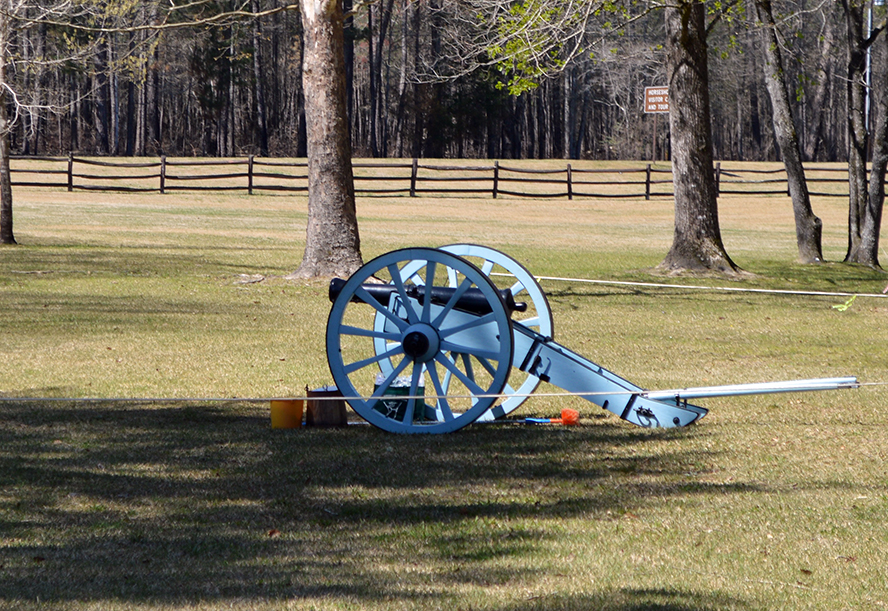 |
| A cannon similar to the one carried to Fowltown by Arbuckle's command is on display at Horseshoe Bend National Military Park in Alabama. |
The Native American account of the battle was simple. Boleck and Cappachimico wrote – likely through Alexander Arbuthnot – in a letter to Gov. Charles Cameron in the Bahamas that Fowltown had been attacked by American soldiers. “Our Indians, rallying, drove the Americans from the town,” they reported, “but in their exertions had two more people killed.”
 |
| Fresh water trickles from a small steephead spring at the probable site of Fowltown in Decatur County, Georgia. |
The firefight lasted 15-20 minutes and ended when Neamathla and his men withdrew deeper into the swamp. Arbuckle described what happened next as a “march,” but officers in his command said it was a “retreat.” The soldiers definitely moved quickly from the town and marched up the trail to Burges’s Bluff (Bainbridge):
The detachment consisted of 300 men, under the command of Colonel Arbucle. They were attacked about twelve miles from Fort Scott, by a party of Fowltown and Osouche Indians, supposed to be about one hundred, and had one man killed and two wounded, one dangerously. The Indian loss was supposed to be eight or ten. They captured some cattle during the flight, which were retaken in the towns, lying about eight miles from Fort Scot. – The detachment then retreated four miles and threw up breast works.
 |
| "Fowl Town Swamp" as drawn by an early surveyor when the area was still part of the original Early County, Georgia. |
The brief account provided by Cappachimico and Boleck (“Bowlegs”) appears to indicate that Neamathla attacked the retreating soldiers somewhere between Fowltown and Burges’s Bluff and recovered some of the stolen cattle. None of the U.S. accounts are known to mention such an encounter, but the beef was vital to the survival of the Tutalosis, and a raid or quick strike to recover some of it makes sense.
- End of Excerpt -
The soldiers either "marched" or "retreated" to Burges's Bluff (present-day Bainbridge), where they started building a new stockade that they named Fort Hughes after the slain musician.
If angered by the unprovoked raid on his town two days earlier, Neamathla was infuriated by the larger strike. Runners went out from Fowltown to call for help, and hundreds of warriors soon began a general movement for the Flint and Apalachicola Rivers from as far away as the Suwannee.
Retaliation was coming.
Editor's Note: Learn more about the Battle of Fowltown in Dale Cox's acclaimed book Fowltown: Neamathla, Tutalosi Talofa & the First Battle of the Seminole Wars
.
Experience living history camps, military drills, musket and cannon demonstrations, the 19th-century keelboat Aux Arc ("Ozark"), battle reenactments, and more at the annual Scott 1817 Seminole War Battle Reenactment in Chattahoochee, Florida, on December 7-8, 2019. Learn more at Scott1817.com.
Subscribe to:
Posts (Atom)