A Two Egg TV Page. See more at https://twoeggtv.com.
Showing posts with label thomas perryman. Show all posts

Thursday, January 23, 2020

The Boy in the Barrel: A Future Pirate's First Ship

"A branch of a tree his mast, a blanket his sail."

by Dale Cox

Editor's note: To provide readers with more information about William Augustus Bowles, the real person behind the pirate treasure stories still heard in eastern Jackson County, Florida, historian and author Dale Cox is writing a series of new articles. The life and adventures of Bowles and his crews will be commemorated on May 1-2 during Pirate & Heritage Days at Three Rivers State Park.

The signing of a declaration of war against Spain at Estiffanulga Bluff in 1800 (please see GOD SAVE MUSKOGEE: Pirate War on the Apalachicola) brought the enigmatic adventurer William Augustus Bowles into direct conflict with that country. But who was Bowles? And how did his story begin?

The future adventurer and pirate was born in Maryland in ca. 1763 and was thirteen when war erupted between Great Britain and its American colonies. "An artless school-boy, perfectly unacquainted with any mode of life beyond what he had learnt at his father's farm," according to the interviewer who wrote his autobiography, Bowles joined a Loyalist regiment and entered the service of King George III. 

The Battle of Monmouth, where Bowles claimed to fight in a
"flank company." From a painting by Emanuel Leutze.
Berkley Library
He claimed to serve in a "flank company" at the Battle of Monmouth, New Jersey, before sailing with his regiment from New York to Jamaica. This is possible as his regiment was part of the British army at that time. From Jamaica, he sailed with his fellow soldiers to Pensacola where he arrived late in 1778. Bowles was selected as a cadet at Pensacola, a position that allowed him to train to become an officer, but he blew his chances after he failed to return to camp from a brief leave in town. He either deserted or was dismissed from the service.

Destitute and only around 15 years old, the young man was, to paraphrase his biographer, too proud to beg and unwilling to work:

A party of the Creek nation were on their return home from Pensacola, whither they had come to receive their annual presents; and young Bowles, delighted with the novelty of situation now opened to him, joined the party, having thrown his regimental coat, in contempt of his oppressors, into the sea. [1]

Pensacola Bay at Floridatown.
The Native Americans were Seminoles from the Perryman towns on the lower Chattahoochee River. The most important of these communities was Tocktoethla, the village of Thomas Perryman which stood in today's Seminole County, Georgia. The other was Tellmochesses, the town of his son, William Perryman. It stood near Parramore Landing in modern Jackson County, Florida.

Bowles was accepted by the Perryman chiefs and their followers. Both Thomas and William spoke English, as did many of their followers, so it was easy for the young man to talk with them. Thomas Perryman, in particular, liked Bowles. The teenager was restless, though, and remained with his new friends only a few months before he decided to return to Pensacola:

William Augustus Bowles.
When he arrived on the opposite shore of the bay, he found a hogshead [i.e. barrel], which some British ships had left behind them; and Bowles, impatient of delay, without waiting for any other conveyance, like an Eskimaux [i.e. Eskimo], with the difference of a hogshead for a boat, the branch of a tree his mast, a blanket his sail, and a few stones his ballast, navigated the extensive shores of the harbour, in the day procuring the food of life, and beguiling the tediousness of time by fowling and fishing, and at night regaling on his prey; the sky his canopy, and the earth his bed. [2]

The sight of the future pirate bobbing around Pensacola Bay in a barrel with a blanket for a sail must have been entirely novel. His return to Pensacola likely was via the Pensacola-St. Augustine Road, a horse path that connected the capitals of the colonies of East and West Florida. Branch trails from it led to the Perryman towns, while its western terminus was at today's Floridatown in Santa Rosa County.

Bowles continued his adventures around the bay into the winter of 1779-1780, a time during which his biographer admitted that the young man first developed his dreams of glory.

Note: Learn more about the life of William Augustus Bowles in future articles and mark your calendar now to attend Pirate and Heritage Days at Three Rivers State Park in Sneads, Florida, on May 1-2, 2020. Please click here for more information.


Thursday, January 9, 2020

Pirate & Heritage Days coming to Three Rivers State Park!

May event will commemorate the legacy of William Augustus Bowles!

by Dale Cox

The pirate and adventurer William Augustus Bowles
will be remembered at Pirate & Heritage Days at
Three Rivers State Park in Sneads, Florida.
The Chattahoochee River and Lake Seminole in eastern Jackson County are abundant in the history of the adventurer and pirate William Augustus Bowles. He once lived along the river, and his ships made it as far upstream as the forks of the Chattahoochee and Flint Rivers, where Lake Seminole is located today.

To commemorate this unprecedented era of history, Three Rivers State Park is working with the Jackson County Tourist Development Council, the City of Sneads, Jackson County Parks,  and Two Egg TV to host a brand new festival. Pirate & Heritage Days will take place at the lakefront state park on May 1 & 2, 2020.

Bowles arrived in the area during the American Revolution after he was tossed from the British military at Pensacola for a disciplinary infraction. He wandered lost in the woods of Northwest Florida until a trading party of Native Americans found him and carried him to the Perryman towns. These large Lower Creek Indian villages were near today's Parramore Landing.

Bowles enjoyed his new life there so thoroughly that he married Mary Perryman, the daughter of Chief Thomas Perryman, and was adopted by the tribe. He fought at the Battle of Pensacola, one of the most significant actions of the Revolutionary War, in 1781. America's ally Spain won the battle, however, and regained control of the city and Florida.

Bowles's pirate ships flew the "State of
 Muskogee" flag in 1799-1804.
State Archives of Florida/Memory Collection
The adventurer went briefly to his family home in Maryland and then on to the Bahamas, from where he came back to the area to open a new route for smuggled goods from the islands. Spain captured him, however, and sent him away to Cuba, Spain, and eventually the Philipines. Bowles escaped, and by 1799 was back in North Florida!

He was furious over his treatment and declared war on Spain! By this time, he called himself the Director-General of the "State of Muskogee," a mostly imaginary empire that he founded in the Florida borderlands. His followers included white adventurers from American territory and the Bahamas, Maroons (escaped slaves), and a few hundred Lower Creek, Seminole, and Miccosukee warriors.

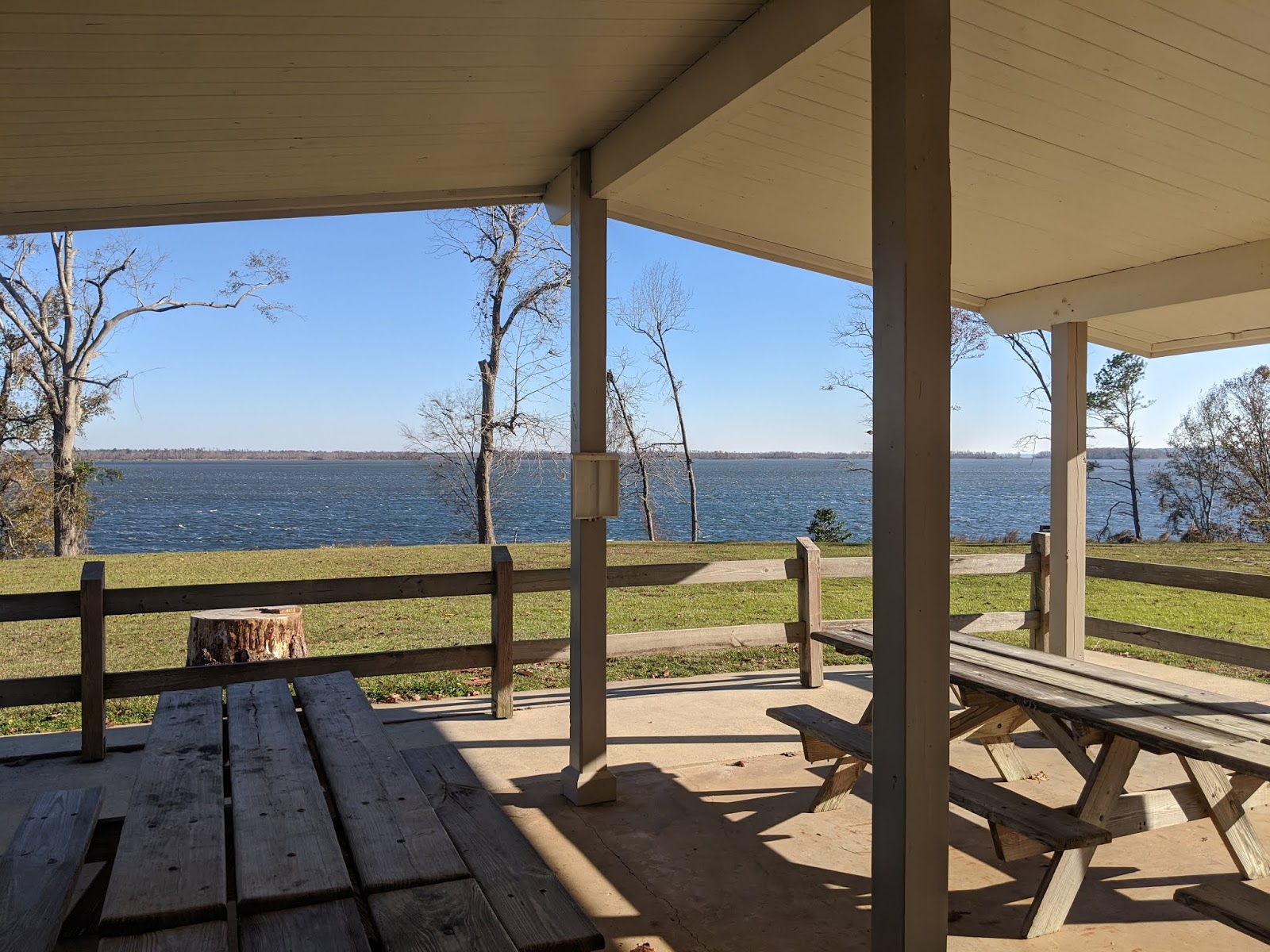
Three Rivers State Park is on the shores of beautiful
Lake Seminole in Sneads, Florida.
To carry out his war, Bowles commissioned a flotilla of "privateer" ships that sailed from the Apalachicola River out into the Gulf of Mexico to prey on Spanish merchant ships. These pirate vessels raided dozens of ships, and their crews included Native Americans from the Perryman towns. The raids continued for about five years until he was captured again and sent away to prison in Cuba, where he died.

The story of Bowles and his pirate ships is a big part of the culture and history of Jackson County. Two different buried treasure legends originate from his activities!

Pirate & Heritage Days will feature a boat parade on Lake Seminole, food trucks, vendors, living history encampments, live music, storytelling, and much more! Everything will take place lakefront at beautiful Three Rivers State Park, with the boat parade launching at Sneads Park and passing the festival grounds.

More details are coming soon, but mark your calendars for the afternoon/evening of May 1 and morning/midday of May 2! If you have a boat or even a kayak or canoe, make plans now to join the boat parade on Friday, May 1!


Thursday, September 26, 2019

William Augustus Bowles and the Wreck of HMS Fox

Part 1: Disaster on St. George Island

By Dale Cox

William Augustus Bowles marker at Dr. Julian G. Bruce
St. George Island State Park in Florida.
Editor's Note: This is Part 1 of a new series by historian Dale Cox the activities of William Augustus Bowles in 1799-1800. 

Fox Point is the name applied to the eastern end of Florida’s St. George Island. Time and the elements have moved the location of this landmark over the years. Its name is a lasting memorial to a disaster that may have shaped the future of the Southeastern United States.

HMS Fox was one of fourteen British warships honored with that name. She entered the service of the Royal Navy in 1799, a time when Great Britain was at war with France and Spain in the Anglo-Spanish and Napoleonic Wars. The 150-ton schooner was armed with 14-16 heavy cannon and on a secret mission when she sailed into the path of a hurricane and was wrecked off today’s Carrabelle, Florida.

The Fox was the spearhead of a British plan to seize control of Spanish Florida. Onboard was one of the most notorious and enigmatic adventurers and pirates ever to set foot on the white sand beaches of St. George Island.

Self-Portrait of William Augustus Bowles.
William Augustus Bowles was a controversial figure on the Southern frontier. A former Loyalist officer who fought on the side of Great Britain during the American Revolution, he settled among the Lower Creeks or Seminoles where he married the daughter of Chief Thomas Perryman. A bigamist, he also had a wife in the Chickamauga towns of the Cherokee. Spanish authorities captured the Maryland-born adventurer and exiled him to the Philippines, but he escaped their custody and made his way to England.

Bowles represented himself as the “emperor” of the combined Muscogee (Creek) and Cherokee nations in meetings with British authorities, convincing them that he headed an army of Native American warriors. This force, he promised, would follow him in a scheme to seize Florida from Spain and hand it over to Great Britain. Then at war with Spain, the British went along.

HMS Fox was to be the instrument of Bowles’s delivery. Captained by Lt. James Woolridge, she sailed from Great Britain to the Bahamas in the summer of 1799, and from there the ship northwest across the Florida Straits and into the Gulf of Mexico. The ship’s mission was to set Bowles ashore near the mouths of the Apalachicola and Ochlockonee Rivers. Also, onboard was a force of nearly 100 mercenaries, arms, ammunition, rum, and an array of other goods intended for distribution to the warriors he expected to call into the service of Great Britain.

This section of a map by Andrew Ellicott shows the site of
the shipwreck at the east end of St. George Island.
Library of Congress
Disaster struck as the vessel entered Apalachee Bay and was hit by a severe September hurricane. High winds tore away the masts of the Fox, and the tidal surge threw her helpless hulk ashore on the east end of St. George Island.

The wreck took place on September 17, 1799. Woolridge, Bowles, and the crew and mercenaries fled to the highest nearby dunes where they stayed, exposed to the elements until spotting a small boat four days later. Woolridge took advantage of the opportunity to send a note to U.S. Commissioner of Limits Andrew Ellicott, who arrived at Apalachicola Bay that day:

On his Britainic Majesty’s Service.
Fox Point, September 22d, 1799.
Sir,
I beg leave to make known to you, that I am at present on a small island on this coast, which is well known to the bearers, with the crew of his Britainic Majesty’s schooner Fox, late under my command, but which was unfortunately wrecked five days since, on this coast. As there is no possibility of saving the schooner, I trust sir, your humanity will induce you to stop here, and devise with me, some means of removing those unfortunate men, who have nothing more than some provisions saved from the wreck to exist on; the island producing nothing; on the contrary, for two days, during the late gale, the sea made a break over it, so that for those two days, we were with nearly two feet of water on the ground. – Lt. James Woolridge, Royal Navy, to Col. Benjamin Hawkins, September 22, 1799.

Ellicott soon met with Wooldridge and Bowles. Caught between his duty to the United States, which was then an ally of Spain, and his humanitarian need to help the castaways, the American authority provided them with food. He declined, however, to help them escape the island.

Editor’s Note: The story of the wreck of HMS Fox and the future of the British effort to gain control of Florida continued to develop over coming days. Watch for the next article in this series on Saturday, September 28. We will post a link here as soon as it is available.

Saturday, April 5, 2014

#84 The Pirate Billy Bowlegs in Jackson County (100 Great Things about Jackson County, Florida)


William Augustus Bowles
The pirate Billy Bowlegs is #84 on my list of 100 Great Things about Jackson County, Florida.

Please click here to see the entire list as it is unveiled.

Jackson County, of course, is inland from the Gulf of Mexico, yet it has the strongest connection of any place in Florida to the infamous pirate and adventurer William Augustus Bowles. He is the man celebrated in Fort Walton Beach today as the pirate Billy Bowlegs and is often confused with the Seminole chiefs of the same name.

How Bowles came to be called "Billy Bowlegs" is a mystery to me as there is no evidence he ever used the name during his lifetime. That point aside, however, he most definitely was a pirate.

Born in Maryland, he first came to what is now Jackson County during the American Revolution after he was thrown out of the British military. East and West Florida, divided by the Apalachicola and Chattahoochee Rivers, were then colonies of Great Britain. Spain's more than 250 year rule had ended in 1763 when it lost control of Florida in the treaty that ended the Seven Years' War (known in America as the French & Indian War).

Parramore Landing Park
Making his way east from Pensacola, Bowles likely was trying to walk home to Maryland when he became hopelessly lost in the vast wilderness of the Florida Panhandle. Rescued by Creek Indian warriors from the Perryman towns, he was brought to the Chattahoochee River.

The Perryman towns stood on opposite sides of the river near present-day Parramore Landing Park. Thomas Perryman, the half-Creek son of trader Theophilus Perryman, lived on the Georgia side of the river at what later became Fairchild State Park. His son, William, lived in what later became Jackson County at Tellmochesses, a Creek Indian town that stood on high ground back from the river just north of Parramore Landing.

Creek Indian village in Jackson County, Florida
Bowles became closely associated with both Thomas and William Perryman, both of whom had taken up arms along with their people on the side of the British in the American Revolution. By the time the future pirate reached their villages, they had fought against American Patriots in Georgia.

Bowles married into the Perryman family, becoming a son-in-law of Thomas Perryman and brother-in-law of William Perryman. He frequented their towns and was a regular fixture in the Creek Indian villages along the Chattahoochee and Apalachicola Rivers.

Flag flown by Bowles' pirate ships
In the years that followed, Bowles declared himself the "Director General" of the "State of Muskogee." In this capacity, he declared war on Spain and commissioned the "Muskogee Navy," really a flotilla of well-armed pirate ships that attacked merchant shipping in the Gulf of Mexico.

The Spanish Coast Guard sent armed ships to destroy Bowles and his nest of pirates, but the "Muskogee Navy" was too strong for them and proved victorious in a pitched battle at Apalachicola Bay. The Spanish retreated and the pirates continued their depredations.

Uniquely, the crews of the pirate vessels commissioned by William Augustus Bowles included not only white and African American sailors, but Creek and Seminole Indian sailors as well. While his "State of Muskogee" existed only on paper and in his mind, his ships sailed with diverse crews.

Bowles eventually was taken prisoner and died at El Morro Castle in Cuba. What became of his ships - except for one seized by the English in the Bahamas - is not known. His legend lives on at the Billy Bowlegs Festival in Fort Walton Beach and may soon be celebrated in a Pirate Festival being considered for Parramore Landing Park!

The little known fact that the Pirate "Billy Bowlegs" once lived in Jackson County is #84 on our list of 100 Great Things about Jackson County, Florida.

If you missed the earlier post about Bowles' lost pirate treasure, please visit Lost Treasure of the Money Pond.


Friday, January 8, 2010

The Pirate of Two Egg, Florida


In continuing the expansion of my http://www.twoeggfla.com/ website, I've added a new page on the man I like to call the "Pirate of Two Egg."

William Augustus Bowles was probably one of the most fascinating individuals ever to walk the soil of Jackson County. Born in Maryland to a Loyalist family in the years before the American Revolution, he served in the British military when he was still just a young teenager. He was sent to Pensacola, where he quickly ran afoul of his superior officers and found himself cast out the service with no means of support, a long way from home.

Wandering into the wilderness, he became lost and was on the verge of starvation when he was rescued by a party of Indian warriors from the village of Tellmochesses which stood about 7 miles east of Two Egg. This was one of the Perryman Towns, so named because they were headed by various members of the Perryman family. William Perryman, the chief of Tellmochesses, was a grandson of the English trader Theophilus Perryman. Like other members of the family, he could speak English and was a prosperous and educated man. He took Bowles across the Chattahoochee River to meet his father, Thomas Perryman, the head of the clan and a prominent leader among the Lower Creek and Seminole Indians.

The Perryman family adopted William Bowles and he married William Perryman's oldest sister. He would go on to become one of the most notorious pirates of the Gulf Coast, a man celebrated each year at Fort Walton Beach's "Billy Bowlegs Festival."

To learn more, please visit the new page at www.twoeggfla.com/billybowlegs.