A Two Egg TV Page. See more at https://twoeggtv.com.
Showing posts with label history. Show all posts

Wednesday, July 10, 2024

Stunning Archaeological Discovery made in Chattahoochee, Florida

 
Nicolls' Outpost interpretive panel
at River Landing Park in
Chattahoochee, Florida.

Archaeologists find complete War of 1812 fort in a Chattahoochee Park!


Advanced technology deployed for the first time in North America has produced stunning results in Chattahoochee, Florida. A team of scientists led by Dr. Mary Glowacki, PhD, of Pre-Columbian Archaeological Research Group, Inc., a 501(c)3 nonprofit contracted by the City of Chattahoochee, have revealed the entire outline of Nicolls' Outpost or "Fort Apalachicola". 

As explained in Dale Cox's book Nicolls' Outpost: A War of 1812 Fort at Chattahoochee, Florida, the fort was built by the British in 1814-1815. It was to serve as a "jumping off" point for one wing of a planned invasion of the State of Georgia. Lt. Col. Edward Nicolls of His Majesty's Royal Marines would lead a column from the head of the Apalachicola River up the Flint River against the Georgia frontier and the state capital in Milledgeville, while a second British force advanced up the coast from Cumberland Island to Savannah. 


The War of 1812 ended as Nicolls was assembling a column that included thousands of British Royal and Colonial Marines; the 5th West Indian Regiment from Jamaica; and Seminole, Miccosukee, Yuchi, and Red Stick Creek warriors in late February 1815. The Colonial Marines were composed largely of free Black men who had self-liberated from slavery, while the Native Americans had spent months training in light infantry tactics at Nicolls' Outpost and its sister post, the Fort at Prospect Bluff (later called "Negro Fort" by American officials).

Outline of the fort at
River Landing Park in
Chattahoochee as determined
by the new project.
The end of the war cancelled a looming a battle with an outgunned U.S. force under Col. Benjamin Hawkins that was camped a few miles above the forks of the Chattahoochee and Flint Rivers (today's Lake Seminole) in what is now Seminole County, Georgia. Each side saluted the other and Hawkins withdrew his fighters with relief. 

The role of Nicolls' Outpost, however, was not yet over. Col. Nicolls assembled a large gathering of American Indian leaders there for an important council on March 10, 1815. Important chiefs and warriors representing most of the towns of today's Seminole Tribe of Florida and Miccosukee Tribe of Indians of Florida marked a treaty that day requesting continued independent relations with Great Britain. More significantly, the document represented the first time that so many representatives of towns that eventually became part of today's federally recognized Seminole and Miccosukee Tribes committed to remain free and independent in Florida, and to mutually defend each other if attacked. 

The exact date on which the fort was evacuated by the British is not known, but Lt. Col. Nicolls reported to a Spanish officer that a handful of soldiers were still there as late as April 1815. The British withdrew from the Apalachicola River in late May, so the evacuation date was probably around the end of April or beginning of May 1815.

The fort was later mentioned in U.S. Army reports as the site where Seminole, Miccosukee, and Maroon (self-liberated Black fighters) forces achieved the first Native American victory of the Seminole Wars during the Scott Battle on November 30, 1817.

To learn more about the archaeological discovery and the remarkable technology that made it possible, enjoy this video from Two Egg TV:


Also of interest is this acclaimed Two Egg TV documentary on the Fort at Prospect Bluff, sister post to Nicolls' Outpost:


Sunday, April 30, 2023

The Great FOOTBALL Clash between MALONE & MARIANNA!

 1925 Pigskin Classic Electrified Jackson County!

by Dale Cox

Legends still persist in northern Jackson County about the days one century ago when Malone High School teams dominated not just the hardwood, but the gridiron, too!

Some of them are fairly exotic: "Malone once beat Auburn University in an exhibition game!" "The Tigers were so good at football that the politicians from Marianna had their team shut down!" There are a host of others - some of them far less glorious.

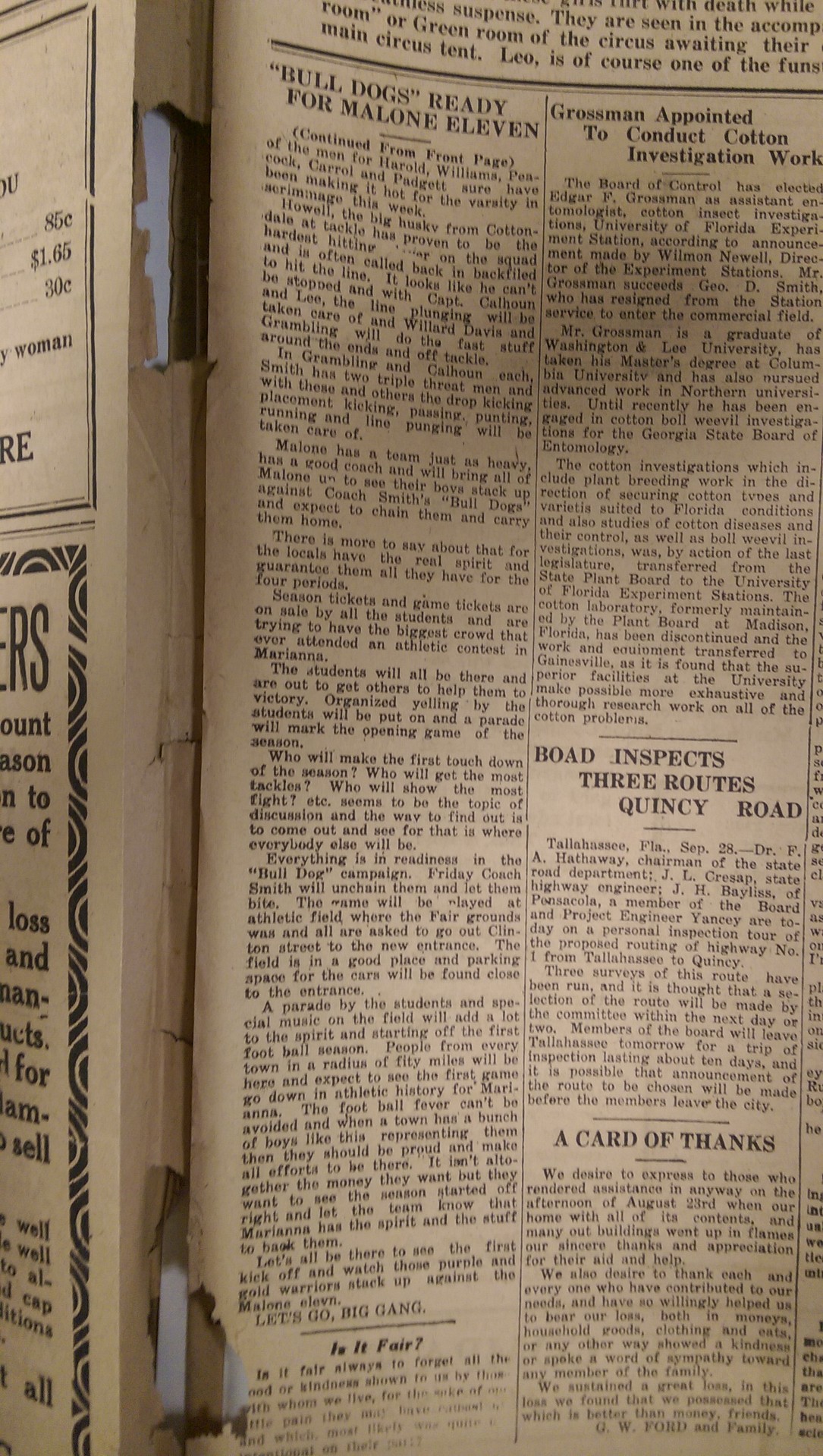
The truth of the matter is that the basketball powerhouse from the peanut fields fielded such a good football team in 1925 that news of the arrival of the Tigers in Marianna to play the hometown Bulldogs drew frontpage headlines. 

The following appeared in the Marianna Times-Courier on October 1, 1925:


As promised, the game was played before the largest crowd ever to attend a sporting event in Jackson County to that date. 

It was a "3-yards and a cloud of dust" slug fest that Marianna won, 7-6.


Tuesday, March 3, 2020

New Video: Civil War in Apalachicola, Florida

Two Egg TV releases new Apalachicola video!


Two Egg TV has a new video on the Civil War in Apalachicola, Florida. It tells the story of events in the beautiful old city from 1861-1865 and takes you on a journey to some of Apalachicola's unique historic sites.

Apalachicola was the third busiest seaport on the Gulf Coast when the war began in 1861. The next four years destroyed its commerce and drove away much of its population, leaving Apalachicola as a "city between the lines."

Now streaming at the Two Egg TV channel on your Roku smart tv or other devices, at https;//youtube.com/twoeggtv or you can watch right here:


If you are interested in learning more about the Civil War from historian and author Dale Cox, please consider these books:


Thursday, January 23, 2020

The Boy in the Barrel: A Future Pirate's First Ship

"A branch of a tree his mast, a blanket his sail."

by Dale Cox

Editor's note: To provide readers with more information about William Augustus Bowles, the real person behind the pirate treasure stories still heard in eastern Jackson County, Florida, historian and author Dale Cox is writing a series of new articles. The life and adventures of Bowles and his crews will be commemorated on May 1-2 during Pirate & Heritage Days at Three Rivers State Park.

The signing of a declaration of war against Spain at Estiffanulga Bluff in 1800 (please see GOD SAVE MUSKOGEE: Pirate War on the Apalachicola) brought the enigmatic adventurer William Augustus Bowles into direct conflict with that country. But who was Bowles? And how did his story begin?

The future adventurer and pirate was born in Maryland in ca. 1763 and was thirteen when war erupted between Great Britain and its American colonies. "An artless school-boy, perfectly unacquainted with any mode of life beyond what he had learnt at his father's farm," according to the interviewer who wrote his autobiography, Bowles joined a Loyalist regiment and entered the service of King George III. 

The Battle of Monmouth, where Bowles claimed to fight in a
"flank company." From a painting by Emanuel Leutze.
Berkley Library
He claimed to serve in a "flank company" at the Battle of Monmouth, New Jersey, before sailing with his regiment from New York to Jamaica. This is possible as his regiment was part of the British army at that time. From Jamaica, he sailed with his fellow soldiers to Pensacola where he arrived late in 1778. Bowles was selected as a cadet at Pensacola, a position that allowed him to train to become an officer, but he blew his chances after he failed to return to camp from a brief leave in town. He either deserted or was dismissed from the service.

Destitute and only around 15 years old, the young man was, to paraphrase his biographer, too proud to beg and unwilling to work:

A party of the Creek nation were on their return home from Pensacola, whither they had come to receive their annual presents; and young Bowles, delighted with the novelty of situation now opened to him, joined the party, having thrown his regimental coat, in contempt of his oppressors, into the sea. [1]

Pensacola Bay at Floridatown.
The Native Americans were Seminoles from the Perryman towns on the lower Chattahoochee River. The most important of these communities was Tocktoethla, the village of Thomas Perryman which stood in today's Seminole County, Georgia. The other was Tellmochesses, the town of his son, William Perryman. It stood near Parramore Landing in modern Jackson County, Florida.

Bowles was accepted by the Perryman chiefs and their followers. Both Thomas and William spoke English, as did many of their followers, so it was easy for the young man to talk with them. Thomas Perryman, in particular, liked Bowles. The teenager was restless, though, and remained with his new friends only a few months before he decided to return to Pensacola:

William Augustus Bowles.
When he arrived on the opposite shore of the bay, he found a hogshead [i.e. barrel], which some British ships had left behind them; and Bowles, impatient of delay, without waiting for any other conveyance, like an Eskimaux [i.e. Eskimo], with the difference of a hogshead for a boat, the branch of a tree his mast, a blanket his sail, and a few stones his ballast, navigated the extensive shores of the harbour, in the day procuring the food of life, and beguiling the tediousness of time by fowling and fishing, and at night regaling on his prey; the sky his canopy, and the earth his bed. [2]

The sight of the future pirate bobbing around Pensacola Bay in a barrel with a blanket for a sail must have been entirely novel. His return to Pensacola likely was via the Pensacola-St. Augustine Road, a horse path that connected the capitals of the colonies of East and West Florida. Branch trails from it led to the Perryman towns, while its western terminus was at today's Floridatown in Santa Rosa County.

Bowles continued his adventures around the bay into the winter of 1779-1780, a time during which his biographer admitted that the young man first developed his dreams of glory.

Note: Learn more about the life of William Augustus Bowles in future articles and mark your calendar now to attend Pirate and Heritage Days at Three Rivers State Park in Sneads, Florida, on May 1-2, 2020. Please click here for more information.


Tuesday, October 8, 2019

Legend of Georgia's "Loch Ness Monster"

The Sea Serpent of the Georgia Coast!

by Dale Cox


The marshes near the mouth of the Altamaha River are the
home of a monster dubbed the Altamaha-ha by locals!
Darien - A mysterious river or sea monster has been a fixture of Georgia's Atlantic coast for more than 200 years!

It is called the "Altamaha-ha" ("Altie" for short) after the Altamaha River and is usually seen around Darien and Butler Island. It also appears to roam as far north as Sapelo Sound and as far south as St. Simons and Jekyll Islands. It is undoubtedly one of the most-sighted monsters in North America.

The community Darien, built on the site of earlier Native American, Spanish, and English settlements, was founded by Scot Highlanders. They were recruited in 1735 at Inverness, Scotland, and came as part of Gov. James Oglethorpe's effort to establish the colony of Georgia. Their American settlement was first called New Inverness, a tribute to their birthplace across the ocean.

The original Inverness borders Loch Ness, a massive lake that is famed for its legendary monster. Perhaps it is appropriate that the New World home of the Scot immigrants soon developed a similar reputation!

Darien is a charming coastal community that was founded by
Scot Highlanders in the 1730s. It is rich in history and legend.
The estuary or delta of the Altamaha River is beautiful and mysterious. Vast marshes, multiple river channels, and abandoned 18th and 19th-century rice fields and canals create a stunning coastal landscape. This is the domain of the Altamaha-ha, a 30-foot long monster with flippers like a seal.

The creature made its splash on the national scene in 1981 when former newspaper publisher Larry Gwin saw it while fishing with a friend named Steven Wilson. They said it had two big humps about five feet apart and made a wake like a speedboat.

Newspapers across the United States ran articles about the sighting, and other witnesses started coming forward. Harvey Blackman of Brunswick reported seeing the monster in the 1970s. He said it had a snake-like head and was 15-20 feet long. Frank Culpepper saw a massive wake in the area of Blackman's sighting. A friend ran for a rifle, but whatever caused the disturbance was gone before he could get off a shot.

Fort King George State Historic Site features a beautifully
restored English fort. Several sightings of the Altamaha-ha
have been made nearby.
The 1981 reports followed a rash of publicity about the Loch Ness Monster, and the skeptical were inclined to believe that locals around Darien were trying to cash in on a few tourist dollars. The late 20th century, however, was not the first time that a sea monster was seen in the vicinity.

The Savannah Georgian newspaper first reported a sighting of the Altamaha-ha by Capt. Delano of the schooner Eagle in an article datelined Darien on April 18, 1830. The captain was sailing off St. Simons Island when he saw the monster:

...He repeated the...particulars precisely, describing the animal he saw as being about 70 feet long, and its circumference about that of a sugar hogshead, moving with its head (shaped like an Alligator's) about 8 feet out of the water. - Savannah Georgian, April 22, 1830.

A hogshead is a large barrel or cask.

The cannon of Fort King George aim out over the marshes
of the Altamaha River estuary.
Five other men on the schooner also saw the creature, and their account was verified by several planters from St. Simons Island who reported seeing something similar. In fact, they said that the beast was viewed from shore using telescopes on many occasions.

Disbelievers were quick to point out that North Atlantic Right Whales are often seen in the waters off St. Simons Island, but Capt. Delano was an experienced sailor who told the newspaper that he knew a whale when he saw one:

...Capt. D. also states, that he is acquainted with all kinds of whale, and that he never saw but once before, (about 4 years since, off Doboy bar,) a monster similar to the one above described.  - Charleston Mercury, March 29, 1830.

Doboy Sound, where Delano saw the monster four years before in 1826, separates Sapelo Island from the Georgia mainland and connects to the Altamaha River.

The channels and marshes around Butler Island are the
home of Georgia's "Loch Ness Monster," the Altamaha-ha.
Curiously, a sloop that sailed from the Darien wharves that same year was named the Sea Serpent! Was it coincidence, or did she reflect a legend that was already well-established by that time? Either way, the 1826 and 1830 sightings confirm that people have seen something strange in the waters around the mouth of the Altamaha for a long, long time.

As is usually the case with such stories, legend claims that Native Americans were the first to tell of the creature. The Tama Indians were living on the Darien River, a tributary of the Altamaha when Spanish missionaries built a mission at the site of today's Fort King George. No documentation survives to corroborate such claims, but the Muscogee (Creek) Indians definitely told stories of giant snakes in Georgia's rivers.

Many people have offered theories about the Altamaha-ha, but no one has conclusively solved the mystery. In fact, eyewitnesses continue to come forward. A troop of Boy Scouts, timber workers, fishermen, hunters, and others all say that they have seen something strange in the water. An amateur photographer even captured video of something odd swimming in the channel off Fort King George Historic Site in 2010:


Interested in learning more or visiting beautiful Darien, Georgia? These links will help you out:

Points of Interest in Darien, Georgia

Butler Island Plantation

Fort King George State Historic Site

Fort Darien Marker

Union Raid on Darien, Georgia

City of Darien Official Website

www.visitdarien.com

GHOSTS, MONSTERS, & MYSTERIES OF THE SOUTH!


Saturday, June 22, 2019

A Congressman and a state senator take hostages in Jackson County

Rep. Charles M. Hamilton
(R) Florida
by Dale Cox

You often hear about members of Congress from one party or the other holding senior citizens hostage. It is usually a rhetorical device employed in debates over Social Security or Medicare, but it actually happened in Jackson County, Florida.

A Member of Congress took an elderly man hostage at Marianna in 1870 and used him as a human shield. In fact, he was even assisted by the U.S. Assessor - or tax man - for Florida!

The incident took place during the heated campaign leading up to the election of 1870. Rep. Charles M. Hamilton, a Republican, represented Florida in Congress and claimed to live in Jackson County although he had not so much as visited the county in over one year.

The same was true of state Sen. William J. Purman, who double-dipped as U.S. Assessor for Florida. He represented Jackson County's district at the State Capitol, although he lived in Tallahassee.

Both men were Carpetbaggers - a term used by white and sometimes black Southerners to refer to Northerners who came South after the Civil War or War Between the States to seek office or establish businesses.

Hamilton and Purman arrived at Marianna in 1866 as the agent and assistant agent of the Bureau of Refugees, Freedmen and Abandoned Lands - usually called the Freedmen's Bureau or just The Bureau.

Bureau agents did respectable work in many areas, smoothing the way for African Americans as they made the transition from slavery to freedom. They helped the former slaves - who were called Freedmen - negotiate labor contracts, opened schools for black and white children alike, and even distributed rations to starving people of all races in war-ravaged areas.

Sen. William J. Purman
Hamilton and Purman, however, engaged in a series of bitter confrontations with Jackson County residents, exceeded their legal authority by ordering armed gangs to kidnap citizens who defied them and were accused of numerous improprieties by a U.S. Army officer sent to investigate their activities.

Hamilton, in fact, went so far as to urge - in writing - the killing of white citizens by black citizens and the start of a race war of sorts in Jackson County. He was under indictment for kidnapping in the Circuit Court - which was then under the control of the Reconstruction government - when he was named as Florida's sole U.S. Congressman and left the county.

Purman, who took over as Bureau agent in Marianna after Hamilton's departure, was wounded in an assassination attempt and left Jackson County for Tallahassee, where he represented the county in the state legislature even though he no longer lived there. To his credit, he intervened and stopped the race war that Hamilton attempted to ignite.

As the election of 1870 heated up, more Democrats - many of whom were former Confederates - registered to vote and formerly untouchable politicians like Hamilton and Purman faced at least a minimal political threat. So, the two men came back to Jackson County on a campaign swing. As they did, one of Florida's leading African American officials accused them both of being little more than thieves, a sign that their popularity was falling with both races.

Marianna in the late 1800s
The Congressman and state senator conferred with Sheriff Thomas West,  an appointee of Florida's Reconstruction Governor, who called for an armed posse of 500 men to escort them out of the county. There were clear signs that the population did not intend to let Hamilton and Purman leave Jackson County alive and West - who was generally liked by both sides in the growing Reconstruction era bitterness - feared for their lives.

Many citizens, however, feared that the appearance of such an armed irregular posse would lead to the violence it was intended to prevent. A delegation of Marianna's older and more-established citizens went to West, Hamilton, and Purman to try to convince them of the error of the plan:

When the older citizens found such was to be the program, they immediately came to us, and begged, for God’s sake, that we should not call out such a posse, saying that their young men would not stand it; that war would take place right away at once. They said: “Ask any means for your safety, and you shall have it.” Thereupon, we selected ten of the oldest and best citizens as hostages. - Testimony by William J. Purman, November 11, 1871.

Purman later testified about the events before a Select Subcommittee of the U.S. Congress investigating the outbreak of violence in Jackson County. The members were stunned to some degree that a sitting member of the U.S. House of Representatives (Hamilton) and a Federal official (Purman) would resort to such drastic measures:

Question. You spoke of some ten or twelve old men going with you as hostages. Do you mean by that they went out to answer with their lives for any assault on you?

Answer. No, sir; I will explain what I mean, Mr. Senator. There were fifteen of us, and ten of them, and had we been attacked, and had it become necessary to go on, spiritually speaking, into the land of Canaan, every one of those men would have gone with us.

Question. You would have murdered those old men?

Answer. We would not have gone alone ; we would have done what it is said Indians have done under certain circumstances. We have heard of Indians, who, when pursued, would interpose the women and children they may have kidnapped between the guns of their enemies and themselves. Had we been pursued in that way, we would have made a bulwark of those hostages.

No censure or other action was taken against Hamilton or Purman for their role in the episode, but fortunately, no violence occurred as the party made its way from Marianna to Tallahassee by way of Bainbridge, Georgia.

At least one modern writer has justified the taking of elderly peacemakers as hostages and using them as human shields by a U.S. Congressman and the equivalent of an IRS agent. In truth, it is difficult to justify such actions in any circumstance.

The violence in Jackson County continued in spells from 1865 to 1876 and occasionally after that. As is often the case, events that were domestic or personal in nature have been included in tabulations of political assassinations created by modern historians, but there can be no disputing that it was a bitter and stressful time.


The use of American citizens as human shields by two Federal authorities in Jackson County worked in that both escaped with their lives. They never faced legal consequences for their roles in the episode.

Tuesday, February 28, 2017

147 years ago: The murder of Jackson County Clerk of Court John L. Finlayson

Dr. John L. Finlayson, Clerk of Court for Jackson
County, was murdered on February 26, 1869.
State Archives of Florida/Memory Collection
This week marks the 147th anniversary of the murder of John L. Finlayson, Jackson County's Clerk of Court. State Senator W.J. Purman was wounded in the attack.

The Reconstruction era was at its height in 1869 and Florida was still patrolled by troops of the U.S. Army. Citizens were deprived of their rights under the First and Second Amendments of the Constitution and could even be jailed for such things as carrying a firearm or peacefully assembling.

The people of Jackson County had faced a shocking litany of wrongs in the four years since the war. Rape was legally excused as an "act of war." Kidnapping and false imprisonment were countenanced by Federal officials who then openly defied the local courts after being indicted for their crimes. Teenage girls were dragged before military tribunals.

It has long been assumed that the shootings of John L. Finlayson and W.J. Purman were carried out by assassins attempting to break the power of the Reconstruction government. This is certainly possible but remains unproved. No one was ever arrested for the crime. Purman said at the time that he believed the motive was personal.

The shooting took place on a Friday night:

W.J. Purman, Reconstruction era state senator
from Jackson County, said that the shooting
was not politically motivated.
State Archives of Florida/Memory Collection
SHOCKING MURDER AND ASSASSINATION – Intelligence reached us last night of a shocking assassination and murder which took place at Marianna, Jackson County, on Friday night last, about 8 o’clock. – The victim was Dr. John L. Finlayson, Clerk of the Circuit Court. It seems that Dr. F. and Maj. W.J. Purman were on their way to some place in the village. Maj. P. walking a little behind, and while crossing a vacant lot were fired on by some person behind a tree at a distance of forty yards, one shot striking Dr. Finlayson in the head and penetrating to the brain and another striking Maj. Purman in the neck. Dr. F. survived about two hours, and Maj. Purman was regarded in a critical condition. The perpetrator of this cowardly and shocking murder is unknown, but if there is justice in Florida it is to be hoped that he will not long escape discovery and punishment. (Tallahassee Floridian, March 2, 1869)

Local tradition holds that the fatal shots were fired from behind an ancient tree that still stands in the yard of the historic Davis-West House in Marianna. The home was then rented to Finlayson and Purman.

The two men were an odd pairing. Purman had served in the Union army and had arrived in Jackson County following the war to assist Charles Hamilton in the operation of the local office of the Bureau of Refugees, Freedmen and Abandoned Lands. Commonly called the Freedman's Bureau, the agency ostensibly worked to help former slaves as they adapted to life as free citizens. 

In Jackson County, however, the bureau was accused of corruption by both local residents and Federal officials. Purman was at the center of many of the allegations.


Confederate Service Record
Card from the file of John
L. Finlayson.
Finlayson, on the other hand, had been born and raised on his parents' farm just west of Marianna. He served in Capt. Richard Smith's Marianna Dragoons (later Company B, 15th Confederate Cavalry) and had returned home from the war to find that Union raiders had looted the farm. His mother, despite her Unionist sympathies, later said that the destruction was done "by the Yankees, at the instigation of the Devil."

His recent history was not enough to deter the young physician from associating himself with Carpetbaggers like Hamilton and Purman. He was described by a newspaper of the time as "one of the leading radicals" of Jackson County. 

...Dr. Finlayson was born in Jackson county, but a liberal education, a generous nature, and a patriotic spirit, made him a Republican. He was, therefore, a “Scalawag.” Senator Purman was born in the North, but had the audacity to settle in Florida. He was therefore, a “Carpet-Bagger.” And who can doubt that if what politicians and writers allow themselves to say of these classes is believed, some will be found bad enough or fanatical enough to endeavor to exterminate them? And who can avoid the fear that others equally fanatical, equally bad, less accustomed to political affairs, should take up the creed of retaliation, and create other innocent victims? (Pensacola Observer, March 19, 1869).

The author of the above commentary was the editor of the pro-Northern Pensacola Observer. He was correct in fearing that "others equally fanatical, equally bad" might try to retaliate. 

Charles Hamilton, onetime Bureau official in Jackson County and now Florida's sole representative in the U.S. House of Representatives, wrote a private letter to friends still in the county to advocate attacks on local whites by former slaves. Purman, to his credit, intervened and stopped such violence before it could be started.

Local citizens gathered in Marianna in the days following the murder to express their general concern. A committee was appointed and the following resolution was unanimously adopted:


The historic Davis-West House from the murder scene. The
fatal shots were traditionally fired from the oak tree on the
left side of the photograph.
WHEREAS, on the night of the 26th of February, 1869, Dr. JOHN L. FINLAYSON was assassinated, and the same act nearly resulted in the assassination of Major W.J. PURMAN, who was badly wounded, and thinking as we do, and as all men of correct views think, that assassination is a most despicable act, which should be discountenanced and frowned down by all honest men, and deeming that it is very meet and proper that our community should express its abhorrence of the act, we do.

Resolve. That the said act of assassination meets our entire detestation and disapproval. We condemn it as we condemn any action of assassination, and we do not think that any portion of our citizens approve said detestable act.

Resolved, That we concur in opinion with Major Purman that the act was not induced by political feeling, but was caused by personal animosity.

Resolved, that it is the duty of civil authorities to be untiring in their efforts to find out and arrest the perpetrators of this atrocious deed.

Resolved, That these resolutions be published in all the newspapers of Florida.

J.L.G. BAKER, President.

C.W. Davis, Secretary. (Tallahassee Floridian, March 9, 1869).


Gov. Harrison Reed of Florida.
State Archives of Florida/Memory Collection
The assassination of Finlayson and shooting of Purman also echoed loudly in the halls of the State Capitol Building in Tallahassee. Governor Harrison Reed announced on March 9 that the state would offer a $2,000 reward for the capture of the person or persons responsible. The amount was a substantial sum in the lean years that followed the War Between the States (or Civil War).

PROCLAMATION!
$2000 REWARD!
Harrison Reed, Governor of the State of Florida, to all to whom these Presents shall Come – Greeting:

WHEREAS, It has been made known to me that a foul and atrocious murder was committed upon the person of John L. Finlayson, in the town of Marianna, and county of Jackson, in this State, on the night of Friday, the twenty-sixth day of February, A.D. 1869; AND, WHEREAS, At the same time and place, the Hon. W.J. Purman was dangerously wounded by the same individual, to me unknown, and by the discharge of the same weapon which killed said Finlayson:

Now, therefore, I, HARRISON REED, Governor as aforesaid, by the power and authority vested in me, do hereby offer a reward of TWO THOUSAND DOLLARS to any person or persons who may apprehend or give such information as may lead to the apprehension and conviction of the party or parties who committed this foul and desperate murder.

And I hereby enjoy upon all good citizens the duty of aiding, by every means in their power, the exertions of the officers of the law to bring the guilty to punishment.

IN TESTIMONY WHEREOF, I have hereunto set my hand and caused the Great Seal of the State to be affixed, at Tallahassee, this fourth day of March, A.D. 1869.
HARRISON REED, Governor.
Attest: - JONATHAN C. GIBBS, Secretary of State.
March 9, ’69. (Tallahassee Floridian, March 9, 1869)

Such efforts failed. No one was ever brought to justice for the shootings. The mystery over the motive for the attack still exists today, especially because Purman said a short time later that he did not believe the purpose was politcal:

Mr. W.J. Purman has had, in this and the adjoining counties, many enemies, growing out of his conduct as Bureau agent, but it was generally believed that all active animosity on that account had by the time he was shot subsided. We are informed and believe that he had numerous enemies in this and adjoining counties on account of his connection with the collecting of U.S. dues to discharged United States soldiers, who believed that he had collected and defrauded them out of large amounts of the same. Whether their suspicions and charges are well based we are not to determine and do not ourselves charge, but may numerate as one of the numerous causes that has created to him enemies. This coupled with his declarations soon after his shooting, when in a critical situation, such as the law writers assign to establish the rule of evidence by dying declarations, and which declarations can be established by at least three very honorable, moderate and entire reliable gentlemen, that he did not believe the shooting was the result of “political animosity,” “but was done by personal enemies,” places the fact beyond a doubt that it did not partake of and was not prompted by political feeling. (Tallahassee Weekly Sentinel, April 27, 1869)

Unless some new information is discovered, the murder of Clerk of Court John L. Finlayson will remain one of the tragic mysteries of Jackson County's past.

Dale Cox
February 28, 2017


Tuesday, February 14, 2017

The railroad comes to Jackson County, Florida


A train rolls on the L&N through
the Panhandle of Florida.
State Archives of Florida: Memory Collection
The dream of linking Jackson County to larger markets by rail had been in a state of slumber for many years but as the economy surged following the end of Reconstruction, it did not take long for the vision to awaken. On March 4, 1881, under intense lobbying from residents of West Florida, the state legislature approved the incorporation of the Pensacola & Atlantic Railroad. The P&A, as the line was commonly known, was authorized to lay tracks from Pensacola to the Apalachicola River. Jackson County was finally getting its railroad.
The new line quickly found the capital it needed when the Louisville & Nashville Railroad (L&N) purchased $3,000,000 of its bonds and $3,000,000 of its capital stock in exchange for control of the company. This was a pre-arranged deal since both of the P&A’s principal officers were also executives with the L&N. The line, however, retained its P&A name for many years and functioned as a division of the larger company.

Many residents, for good reason, were still skeptical that the railroad would come. They had been let down many times before, but this time things were different. 
Col. W.D. Chipley, the vice president and general superintendent of the P&A, came to Marianna in early August. He offered $50,000 for right of way to build the railroad through the county and also announced plans to buy 2.5 acres for a depot at Marianna. Chipley told community leaders that he needed to hire as many workers as possible:

…The proposition was accepted by our citizens, and the survey of the road by Marianna will be “finished up” at once. The grading between here and Chattahoochee river will begin between the 10th and 15th of December next. All the laborers possible are desired.[i]

The crew poses with L&N #876.
State Archives of Florida/Memory Collection.
Things moved quickly. On September 6, 1881, the Columbus Daily Enquirer reported that contracts had been let for most of the distance between Marianna and Chattahoochee. Two hundred men were already at work clearing the right of way and grading the bed for the tracks. Major William H. Milton was the contractor for the five miles closest to Marianna. By the 20th of that month word reached Columbus that a site for the depot had been selected “between Mrs. White’s and Mrs. Myrick’s.” [ii]
October brought news that 411 men were now at work on the section of the line between the Apalachicola River and Marianna, with “every mile but two having a force on it.” November came with news that a severe drought was affecting Jackson County but that large numbers of hands were passing through Marianna on their way to join the work crews laying the tracks. Twelve miles of track bed had been graded between the county seat and Chattahoochee. 
There was also a report of a violent outbreak in one of the work camps:

…A white man from Gadsden county became involved in a difficulty with a negro some weeks ago. The white man had but one friend with him and that was a colored man from his own county; the rest of the negroes took part for the negro, and the white man was taken out and severely whipped; after which he left the camp and returned to his home. Last Thursday night, as the negroes of this camp were sitting around their fires, they were fired upon by several parties. One negro was killed and several more wounded. The parties who did the shooting are unknown, though suspicion points to the whipped white man and his friends. The negro killed was, unfortunately, the one who befriended the white man. The ringleader in causing the difficulty escaped unhurt. Since this we hear every man has left this camp. The railroad contractor at the time of the first difficulty was absent.[iii]

Marianna's historic 1880s depot as it appeared when still
located near the tracks. It was badly damaged by fire but
moved to its current location on Caledonia Street and restored.
Dale Cox Collection
Despite such incidents, the project moved quickly. The drought dried up creeks and swamps along the route making it easier for workers to prepare the grades and trestles. Even the steamboat lines on the Chattahoochee River, which would soon face competition from the new railroad, pitched in to help. The crew of the steamboat Moore found the machinery for building the bridge over the Apalachicola River hung up on a sand bar below Neal’s Landing. They used a tow line to pull the barge free and sent it down to the construction site at Chattahoochee.[iv]
It took a little over one year to build the railroad line through Jackson County. Crews working from both the east and the west neared Marianna in January of 1883:

The completion of the P.&A. draweth to a close.
We expect to have through trains on next week.
Work on the bridge at Chattahoochee is retarded on account of high water.
The steamer Newton or some other boat will soon be sent to Chattahoochee to be used for transferring purposes.
The track layers from the west expect to take dinner here next Tuesday. Our citizens ought to “set ‘em up.”
Capt. W.D. Chipley, Col. DeFuniak, Chief Engineer Davies and others of the P.&.A.R.R. were in town last week.[v]

Marianna's historic depot building as it appears today. It has
been rotated on its axis. The side facing the right of the
photo actually faced the railroad tracks in its original location.
On February 10, 1883, as was reported in The New York Times, “Pensacola was connected with the Apalachicola River to-day by the completion of the Pensacola and Atlantic Railroad.”[vi]

It would take two more months to complete the bridge over the river at Chattahoochee, but for all practical purposes Jacksonville was now linked to Pensacola by rail. Marianna gained considerable importance as the location of one of only two original depots on the line (the other was Milton). Other communities along the route had to settle for a boxcar parked on a siding instead of a full station of their own, at least for the time being. Stations came to other communities in time.
The building of the P&A had been a dramatic accomplishment. A total of 161 miles of track had been laid across swamps, rivers, creeks and bays from the Apalachicola to Pensacola. Not only that, but the railroad paid black laborers on an equal scale with white laborers with both earning $1.50 per day for their work on the line.
Col. W.D. Chipley
Washington County Historical Society

As was normally the case with privately built railroads, the P&A received massive land grants from the State of Florida. More than 2,830,000 acres of land were transferred to the railroad from the state with the expectation that the company would then sell off or develop the land to recover its expenses in building the line. As the land was sold, new settlements and towns developed bringing widespread economic development to all of West Florida.

The plan worked as expected. Col. Chipley was named land commissioner for the line and by 1897 his efforts had led to the sale of more than 995,000 acres of land for a net of $860,343.65. New towns rapidly grew along the route of the line. In Jackson County, for example, the town of Sneads grew out of what had been the old Pope’s settlement. The railroad also gave birth to the modern towns of Grand Ridge, Cypress and Cottondale. Such places as Chipley, Bonifay, Caryville, Westville, DeFuniak Springs and Crestview also came into existence thanks to the P&A Railroad.


[i] Marianna Courier, quoted by the Columbus Daily Enquirer, August 10, 1881, p. 2.
[ii] Columbus Daily Enquirer, September 6, 1881, p. 4, and September 20, 1881, p. 4.
[iii] Columbus Daily Enquirer, November 1, 1881, p. 4.
[iv] Columbus Daily Enquirer, November 26, 1881, p. 4.
[v] Marianna Courier quoted by the Columbus Daily Enquirer, January 24, 1883, p. 4.
[vi] The New York Times, February 11, 1883.
[vii] Columbus Daily Enquirer, March 13, 1883, p. 4.
[viii] Greg Turner, A Short History of Florida Railroads, Arcadia Publishing, 2003, p. 86.


Sunday, December 28, 2014

100 Great Things about Jackson County, Florida: The List

This page lists each part in my series "100 Great Things about Jackson County, Florida." As each new post is added, it will be included here so you can access the entire series in one place. Just click each link to read that post:

Tuesday, August 12, 2014

#66 Marianna's historic L&N Train Station (100 Great Things about Jackson County, Florida)

The Vintage Depot now occupies the historic train station.
Marianna's beautiful old train station is #66 on our list of 100 Great Things about Jackson County, Florida.

Please click here to see the full list as it is unveiled.

A symbol of the elegance and style that once symbolized travel by train in America, the historic L&N train station in Marianna has been beautifully restored and today is home to the unique Vintage Depot. It is located on South Caledonia street across from Chipola Apartments and just up the hill from its original location by the tracks.

Unique items for sale fill the interior today.
Despite its antebellum prosperity, Marianna had to wait until after the War Between the States (or Civil War) for the railroad to arrive and connect it to points east and west. There had been many promises and speculations over the years. In 1881, however, Col. W.D. Chipley and Frederick R. De Funiak joined with others to found the P&A Railroad, so named because it would connect Pensacola on the west with the Apalachicola River on the east. The line was incorporated by the Florida Legislature on March 4, 1881.

Unique counter in the depot.
Actual construction of the railroad began on June 1, 1881, by which time most of its stock was owned by the L&N. Twenty-two months later, trains were rolling all the way from Pensacola to the Apalachicola River where the line connected with another railroad built west from Jacksonville to Tallahassee, Quincy and Chattahoochee.

Passenger and freight service from Pensacola to Tallahassee began in May 1883. Along the way, the railroad built platforms and passenger stations for the convenience of its customers. It could carry travelers from Marianna to Pensacola in about 5 hours, a trip that just two years earlier had taken days.

Marianna's historic L&N Depot was one of only two major stations built along the line between Pensacola and the Apalachicola River. The other was in Milton, where the West Florida Railroad Museum is located today.

Inside the depot today.
Built in 1881-1882, the historic station was ready for service by the time the railroad reached Marianna. It was originally located just west of where Caledonia Street intersected with the tracks and was attached to a larger warehouse/storage facility. It served passengers for all of the decades that passenger trains stopped in Marianna.

Cars and planes eventually replaced the trains as a means of public transportation in Northwest Florida and the depot lost much of its original grandeur. In 1979 it was targeted by an arsonist and severely damaged, but thankfully not destroyed.

Two years later the late Floye Brewton purchased the gutted shell of the main depot structure and moved it up the hill to a lot adjacent to today's Wells Fargo Bank. He carefully restored the structure and it has since provided office space for a number of businesses and individuals, including U.S. Rep. Pete Peterson (D, Marianna).

Unique displays in the depot.
The historic L&N train station is now home to the Vintage Depot, a boutique operated by Rhonda Dykes.  Open to the public Tuesday-Saturday, it is preserved in its beautifully restored state.  The shop features vintage and vintage inspired (new) home decor and gift items as well as lines of chalk & clay paint and milkpaint for transforming furniture and other items into artistic decor.

Rhonda also teaches painting workshops to help those with an interest in restoring and transforming furniture and other items using the products from the store. She welcomes visitors who would like to see the beautiful old building and learn more about its history.

The Vintage Depot also carries the complete list of my books.

Visit them online at https://www.facebook.com/thevintagedepot.