A Two Egg TV Page. See more at https://twoeggtv.com.

Tuesday, September 10, 2019

The "Hot Springs" of Cottonwood, Alabama

The Story of Sealy's Hot Mineral Wells

by Dale Cox

Sealy's Hot Sale Mineral Well resort is seen here on a
popular postcard from the late 1940s and early 1950s.
Dreams of oil wealth vanished for Cottonwood as quickly as they had come (please see Cottonwood, Alabama: "Floating on a pool of oil"). 

The Sealy brothers, who invested tens of thousands of dollars of their own money during the craze, were nothing if not determined. They soon realized that their failed oil wells just might pay off after all.

Sealy Well No. 1 penetrated to depths of nearly 5,000 feet before the drilling was called to a halt. One of the last drill bits, however, struck something that proved almost as valuable as oil - hot water:

Nine years ago on the Sealy farm about three-fourths of a mile from Cottonwood, a well was started in search for oil. After almost four years of drilling and expenditure of about $123,000, at a depth of 4,280 feet, just as it had almost reached the top, the drill dropped and the terrific impact of its fall for almost three-fourths of a mile, broke the strata and immediately a powerful stream of hot salt mineral water gushed out and from then until now the hot salt mineral water has been pouring out at a rate of over 10,000 gallons per hour at a temperature of about 110 degrees. - (Mayor J.T. White of Cottonwood, "Oil Drill In Valley Fails But A Mineral Spring Is Result," Columbus Daily-Enquirer, February 13, 1937.)

A small stream of hot water flows from the former resort
grounds and under Sealy Wells Road in Cottonwood.
The artesian well or "hot spring" created a stream of water that flowed off into low spot that soon became a lake. Members of Cottonwood's African American community were the first to test the curative powers of the water. Like most Americans of the early 20th-century, they believed that hot mineral water could cure a variety of illnesses.

One man found relief from rheumatism after bathing in the water. Not long after it was noticed that a dog with the mange cured itself by swimming in the lake. This led another to dig a hole deep enough for his ailing mule to enter and soak itself. The mule was cured of sores and lameness.

These early experiments generated considerable excitement in Cottonwood and prompted a local man named Pete Lambert to see if the water could cure his broken leg. Lambert was driving a mule-team when his leg was broken in an accident. Doctors were preparing to amputate the unhealed limb, but he tried bathing in the lake for 27 straight days. The broken bones healed.

As Mayor J.T. White of Cottonwood reported in 1937, the hot spring suddenly became a sensation:

The hot water pool at Sealy Springs was a popular part of
from the days of its creation in the 1930s.
Alabama Department of Archives and History
The news of the cures began to spread. The Sealy's had the water analyzed and found it contained six valuable mineral elements, some not found in any other hot water wells or springs in America. Then it was discovered that taken internally the water was beneficial for ulcerated stomach, kidney diseases and liver complaints; and still later that catarrh [i.e., mucus buildup in the nose or throat] would be cured by snuffing the water into the nostrils and taking the baths. - Ibid.

The brothers J.R. Sealy and C.S. Sealy realized the potential of their accidental discovery. In the spring of 1936, they started building a resort around their "hot mineral well" that included 55 hotel rooms, cottages, apartments, a large assembly area, and dining rooms. Visitors could "take the waters" in 32 rooms with baths built for that purpose as well as in a 50x100 foot swimming pool. 

So many people came - more than 10,000 in 1936-1937 - that almost the entire town of Cottonwood "was turned into a big rooming house to care for the overflow of people who came for bathing and treatment in the healing waters of the well."

The resort was a stunning success. By 1938 its fame had spread across the nation, and even hotels in Panama City were advertising the fact that they were only 90-minutes from Cottonwood, Alabama:

The gates to the Sealy Hot Salt Mineral Wells resort
still retain a touch of their original splendor.
Cottonwood, Alabama, "the Hot Springs of the Southeast," has become famous the nation over within a comparatively short period of time for its hot salt mineral springs, the healing properties of whose waters are declared to have been beneficial to a great number of people. - (Columbus Daily Enquirer, March 27, 1938.)

Sealy's Hot Mineral Wells or Sealy Springs rivaled similar destinations by the eve of World War II. Many who had previously gone to Hot Springs, Arkansas, or Warm Springs, Georgia, came to Cottonwood instead. Even President Franklin Roosevelt expressed interest in the resort.

Campgrounds with trailer hookups were added, and the resort advertised activities and amenities for visitors to enjoy when not taking the baths. Guided quail and fox hunting expeditions became a significant part of life at Sealy Springs, with the Sealy brothers acquiring access to 43,000 acres of hunting lands.

Visitors came by the thousands. Some arrived by car from Dothan, Panama City, and other points. Others came in the comfort of passenger cars on the AF&G Railroad, which connected the town of Cowarts near Dothan with Malone and Greenwood in Northwest Florida. The doctors and nurses on staff helped those paralyzed from polio as well as sufferers of arthritis, injuries, muscular diseases, and even the measles. Most left convinced that the hot mineral waters had helped them.

Nature has reclaimed the surviving structures of the resort.
The final years before World War II marked the peak of the resort's success. And then Japan attacked Pearl Harbor on December 7, 1941.

The country mobilized for war and trips to resorts like Sealy's Hot Mineral Wells became luxuries in which few indulged. The post-war years did not bring back Cottonwood's glory days. The central administration building of the resort was destroyed by fire in 1947, but there were no injuries as "few guests were registered."

Sealy Springs finally closed as a resort, and the facility later went through uncertain times when a much-investigated medical clinic opened there. Comedian Dick Gregory was also reportedly in negotiations to develop the site as a diet clinic in the late 1980s. A 2001 fire ended the resort's 65-year history, however, by destroying the main facilities.

The site of the hot springs is overgrown and all but forgotten today. An iron gate, dilapidated fence, and a few surviving structures are all that remain as reminders of its fascinating history.

The hot water still flows, filling the warm water lake on the grounds and then flowing away down a creek to eventually make its way to the Gulf of Mexico.

Editor's Note: The grounds of the hot springs can be viewed from Sealy Wells Road at its intersection with Joe Cook Street in Cottonwood, Alabama. The site is private property and is closed to the public so please view from the right-of-way and do not trespass.


Monday, September 9, 2019

Cottonwood, Alabama: "Floating on a pool of oil"

The Cottonwood Oil Boom of 1927

by Dale Cox


The 1927 oil boom is briefly mentioned on the historical marker
that tells the story of Cottonwood, Alabama.
One of the biggest oil booms ever seen in the South hit Cottonwood, Alabama, in October 1927. It started when someone realized that water from local wells would actually fuel gasoline engines:

     There are four wells on an acre of ground near the center of town at Cottonwood that have been showing evidences of oil for several years. All have been abandoned so far as drinking purposes, but recently evidences of oil became more pronounced.
     The oil is refined to a degree, having seeped from the underground strata of oil, which geologists say comes from the north, and which, they also say, cannot be far away.      
     Sam Barker, it is said, has been running a motor which operates a grist mill, the sole fuel used is that taken from his well. 
     Several automobile owners in Cottonwood have been propelling their cars with this fuel, it is said. - Dothan Eagle, May 4, 1927.

It didn't take long for the strange discovery to attract the attention of major investors. J.R. "Bob" Sealy and his brother were convinced of the validity of the strike when Bob filled a car with water from a local well and headed off for Dothan:

Bob Sealy, accompanied by Robert Malone, Calvin Welsh, John McCardle and John Bruner, drove a Ford touring car from Cottonwood to Dothan this morning on what they said was fuel drawn direct from one of the wells at Cottonwood which have been transformed by nature from drinking wells into refined gasoline. - Ibid.


The site of the O'Henry Oil Fields as it appears today in
Cottonwood, Alabama.
The Sealy brothers immediately purchased what quickly became known as the O'Henry Oil Fields, a large tract of land south of downtown Cottonwood. They eventually expanded their holdings to include thousands of acres and mineral rights were purchased for tens of thousands. The mineral rights acquisitions extended miles across the state line into Jackson County, Florida.

An oil geologist named R.G. Worthington was brought in from Oklahoma to inspect the site. He was reportedly a graduate of the Colorado School of Mines and visited Cottonwood in June 1927:

...He expressed his opinion that, beyond a doubt, the product coming into these wells is coming from crude oil. He made the statement that he had seen the same product coming out of the ground in other territories. Mr. Worthington has had eight years of field geology. Part of this time was spent with the Gypsy Oil Company of Tulsa, Oklahoma. His opinion is considered very valuable and correct. The opinion of many other geologists who have visited the O'Henry Oil Fields. - Dothan Eagle, June 17, 1927.

The opinion of Worthington was all it took. J.R. Sealy sent a petition to the Alabama Public Service Commission seeking permission to sell 750 acres of land. Each purchaser would gain one-acre of property and a "unit interest" in Sealy Well No. 1, the oil well that the Sealy brothers planned to drill.

This early Fire Protection Map shows many of the
buildings built during the Cottonwood oil boom.
Courtesy of Troy University.
At the same time, business interests in the community exploded. A committee of investors quickly committed to open a bank in Cottonwood:

The bank will be located next to the Cottonwood post office, on the site where the Rose Team room now stands. The tea room will be moved one lot south. This bank will be Spanish type, stucco building. The interior finish will be of Pecky Cypress, the same finish which has recently been used in the construction of the Cove Hotel at Panama City, Florida, and the dining room of the New Albany Hotel, Albany, Georgia. - Ibid.

Public excitement over Cottonwood oil reached its peak in late September and early October 1927. The Public Service Commission approved the planned land sale, and the town was deluged with people:

During the day Sunday, several thousand automobiles visited the Cottonwood section. In every instance, Bob said, these people were thoroughly sold on the merits of his proposition. They got out of their automobiles and looked into the wells, saw the oily film that covered them, smelled of the water drawn from them, and did every other thing that a curious throng is expected to do.
They were convinced, even as I was convinced last week, that something strange was happening in Cottonwood. In some instances they were ready to place bets that oil would be found. In others they admitted their ignorance even in the face of the things they saw but were filled with hope that oil would be found in commercial quantities. - Dothan Eagle, September 27, 1927.

A barbecue sponsored by the Sealy Brothers attracted 15,000 people to Cottonwood on October 6, 1927. They stood witness as the drill bit of Sealy Well No. 1 bit into the earth and started its way down. A second derrick - Sealy Well No. 2 - was already under construction by then. So high was the demand for information that Bob Sealy opened an office on North Foster Street in Dothan:

The oil boom led to a rush of commercial construction in
Cottonwood, as investors poured into the town.
As all this goes on, the people of Cottonwood continue with their program of building. Stories are being told of the opening of tea rooms, drug stores, warehouses, and various other forms of business...And while all this goes on, nine shallow wells in and around Cottonwood continue to flow a product so pure that it runs automobiles and gasoline engines. - Ibid.

By early October the Sealy brothers invested $40,000 of their own money in the belief that Cottonwood was about to become one of the wealthiest towns in America. In fact, Sealy Well No 1 did strike oil:

At 180 feet, Mr. Sealy said, salt water was struck. At 120 feet and also a depth slightly greater than 180 feet, fine oil showings were found. The oil showing shown at these two depths were similar to the oil in the nine surface wells in the Cottonwood community. - Dothan Eagle, December 13, 1927.

The well eventually reached a depth of nearly 5,000 feet, but the expected gusher never came. There was oil under Cottonwood, and it was from a natural deposit, not a leaky fuel tank as some like to claim today. The Sealy brothers just were never able to find it in a sufficient quantity to pump up for commercial purposes.

The oil boom faded as quickly as it had started and was over by the time the Great Depression hit two years later in 1929.

Despite its failure as an oil well, however, Sealy Well No. 1 did prove profitable. The water struck at 180 feet was not just salty, it was warm, and when the derrick was moved, it continued to flow up from the pipe in artesian style.

Dreams of oil wealth faded, but the story of Cottonwood's famed hot mineral well or "hot springs" was just beginning. More on the Sealy Hot Mineral Wells is coming in the next article!


Sunday, September 8, 2019

Massive diamond buried in Jackson County, Florida?

A dream of buried treasure!


by Dale Cox

Site of the treasure dig.
Jackson County is the only Florida county to touch two other states. Perhaps its location - where Florida borders both Alabama and Georgia - makes it a focal point for legends. Whatever the reason the county has more than its share of buried treasure stories.

The tale of the Money Pond is perhaps the most famous. Legend holds that Native American warriors dumped a fabulous treasure of gold and silver into a swamp in the northeastern part of the county to save it from Andrew Jackson's soldiers. Other alleged treasures include one near Little Zion Road north of Sneads and a rumored cache of Confederate gold.

One of the strangest stories, however, emerged from a dream:

Your correspondent has been favored with the facts of a most wonderful dream. The dreamer, Mr. Hardy Lewis of Decatur county, Ga., has for the past seven years dreamed of finding gold and a large diamond buried on the bank of the Chattahoochee river. - Letter dated "Neal's Landing, Fla., May 3," Columbus Enquirer, May 6, 1881.

Chattahoochee River at Neals Landing, Florida.
Mr. Lewis was described as a "highly respected citizen of Decatur county" and regularly told neighbors about his repetitive dream. They still must have been surprised, however, when he announced that his dreams had finally revealed the date on which he would find the treasure: May 5, 1881.

The man was absolutely convinced that his dreams were directing him to the fortune of a lifetime. He prepared supplies, tools, and helpers for a dig and headed for the banks of the Chattahoochee River on May 1, 1881:

...Being so much impressed by such an innocent dream he resolved to go to the spot and try the virtue of his visionary wondering. He came to the river opposite Neal's landing and recognized instantly the place where his treasure was buried, although this was his first visit. He has been digging two days, but states he will not find the object of his search until May 5th. - Ibid.

Lewis's dream was particular as to the value of the treasure. It consisted, he said, of a diamond "valued at $24,000" as well as a large quantity of gold. Taking inflation into account, a diamond worth $24,000 in 1881 would be worth $603,696.47 today.

Fine quality rough or uncut diamonds are difficult to price but currently sell for around $2,600 per carat. Assuming the diamond is of fine quality - and surely a dream diamond would be - then it would weigh 232 carats.

Another view of the Chattahoochee River at Neal's Landing.
The fallen tree was toppled by Hurricane Michael.
The dig took place in the riverbank between Neal's Landing and the mouth of Irwin's Mill Creek on the Jackson County side of the Chattahoochee River. The work was followed with great interest by residents of the area:

...At the time of this writing the digging is still going on, Mr. Lewis is an old and highly respected citizen of Decatur county, and the result of his excavation is awaited, by a large number, with much anxiety. - Ibid.

May 5 came and went, however, with no trace of the diamond or its accompanying gold. The search ended in failure, and all that survives as a reminder that it ever happened is a shallow depression in the riverbank.

In this era, when dreams no longer hold the significance that they did in the late 1800s, it is easy to smile and disregard the treasure hunt as foolishness. Doing so might be foolish as well.

The interpretive sign at Neals Landing survived Hurricane
Michael, while trees all around it were toppled.
The very spot selected by Lewis for his dig is within feet of the point where the paddlewheel steamboat Eagle caught fire and ran aground in 1854. The boat was carrying a season's worth of cotton money from Columbus, Georgia, down to Apalachicola, Florida, so it could be sent by ocean-going vessel to banks in New York. 

The value of the gold shipment in modern terms? $3,048,714.29.

Some of the money was recovered shortly after the wreck of the Eagle, but much of it remains buried beneath a 165-year accumulation of mud and silt. There is no mention of a lost diamond in the available accounts of the steamboat Eagle disaster but aboard the steamer were some of the wealthiest residents from along the Chattahoochee River. The wreck most certainly could contain a lost diamond and other pieces of jewelry.

Before you grab a shovel and head out, however, keep in mind that the site is now the property of the people of the United States. Digging is a federal offense that could send you to a U.S. penitentiary for years to come.


Saturday, September 7, 2019

Burning of the City of Eufaula at Neal's Landing, FL

Floating palace destroyed by fire.

by Dale Cox

The paddlewheel steamer City of Eufaula burned at
Neals Landing on February 11, 1921.
The Public Library of Cincinnati and Hamilton County.
Somewhere beneath the mud and water at Neals Landing rest the charred remains of one of the most elegant paddlewheel steamers ever to navigate the Chattahoochee River.

The City of Eufaula was a beautiful boat owned by the Planters and Merchants' Steamboat Company of Columbus, Georgia. The famed boatbuilder Sam J. Johnson built her hull at Apalachicola, signing the construction contract in August 1912. Launched and christened with champagne, the hull was towed to Columbus where construction of the decks, staterooms and other amenities was completed.

Powered by a sternwheel, the steamboat could carry more than 50 passengers and crew in addition to nearly 250 tons of cargo:

The City of Eufaula, built-in Columbus, had been in the river trade on the Chattahoochee between Columbus and lower river points for several years and the shrieking of its whistle had become a sound familiar to the ears of the people living along the course of the stream. - Columbus Ledger, February 13, 1921.


The City of Eufaula at a landing on the Chattahoochee River.
Dale Cox Collection
The boat operated successfully a little over eight years before disaster struck at Neals Landing on February 11, 1921. She was edged up to the steep riverbank taking on additional cargo when the crew noticed a smell of smoke:

No injuries were reported as a result of the disastrous blaze, but the fire had gained such headway and developed so rapidly until efforts to save the boat were fruitless, according to information brought to Columbus. A high river and a strong wind apparently encouraged the flames and soon after the discovery was made the vessel was almost enveloped, it was said. The City of Eufaula was bound for Columbus, but was laden with a comparatively light cargo, additional cargo was being taken at Neal’s Landing when the fire broke out. It was stated that the crew made a strong but vain effort to extinguish the fire, despite the headway of the flames and the disadvantage caused by the brisk wind. - Columbus Ledger, February 13, 1921.

The City of Eufaula is seen here taking on cargo. She was
doing the same at Neals Landing when the fire erupted.
The massive blaze was not the first for Neals Landing. The steamboat Eagle burned there in a fatal fire on January 29, 1854, and General Harrison suffered a boiler explosion near the landing that killed three men in 1842. Please click here to read more about the deadly sinking of the Eagle.

Perhaps the stretch of water was cursed by the Native Americans of Ekanachatte ("Red Ground")? The Muscogee (Creek) town stood on the site of Neal's Landing from circa 1763 to 1818. The extensive village was burned to the ground during the First Seminole War, and white settlers rushed in to claim the fertile fields and townsite.

The river landing is now part of Neals Landing Park, a recreation area off State Road 2 at the west end of the Chattahoochee River bridge. An interpretive panel near the boat ramp provides more information on the history of the site.

This map will help you find it:


Friday, September 6, 2019

A Second Seminole War attack on the Wakulla River

Creek warriors strike in the summer of 1839.

by Dale Cox

The Wakulla River was on the frontlines of war in 1839.
The summer of 1839 was the bloodiest of the Second Seminole War for families living in and on the borders of the Forbes Purchase in the Big Bend Region of Florida. Much of the Purchase area is recognizable today as the Apalachicola National Forest.

Native American warriors emerged from hiding places in the vast wilderness between the Apalachicola and Wakulla Rivers that year to strike against isolated homes and settlements. More than one dozen people, for example, were killed in a single attack at Estiffanulga Bluff in today's Liberty County. Others died in an attack on the Chaires' settlement within the fringes of the modern city of Tallahassee.

United States troops and Florida militia forces tried to strike back, carrying out raids deep into the swamps between the populated areas of Gadsden and Leon Counties and the coast. They generally failed, however, to bring the warriors to battle.

The American Indian warriors involved in these incidents were not Seminoles. They were members of Muscogee (Creek) bands that fled Alabama in 1837, hoping to escape atrocities being committed on their families at concentration or "emigration" camps. All of the remaining Muscogee people in Alabama were ordered into such camps in the fall of 1836 by U.S. officials intent on forcing them west on the Trail of Tears.

White outlaws raided some of the camps, however, killing elderly men and attacking girls and women. They even slit the noses and ears of Creek people to take their gold earrings and nose rings.

Leon County extended to the Gulf in 1839.
Determined to save their families from such outrages, several chiefs gathered their followers and broke from free from the concentration camps and broke for the swamps of the Pea River. Attacked by militia troops, they fought a slow retreat south across the border into the Walton, Okaloosa and Holmes County area of Florida where Florida troops joined the battle. Severe fighting took place in the Florida Panhandle during the spring and summer of 1837, as white soldiers and volunteers drove the desperate Creeks east to the Apalachicola River.

By the summer of 1839, several of the Muscogee (Creek) bands were in the Forbes Purchase, which for the most part was a vast, unsettled wilderness. They were desperate for food and other supplies, the necessity of which drove them to raid homes and settlements throughout the region.

One such raid took place 180-years ago this month in what is now Wakulla County, Florida:


On Friday the 27th ultimo a party of Indians attacked the house of Mr. Bunch on the Wakulla, murdered Mrs. Bunch and one child and burned the house; also fired on, and wounded badly, Mrs. Whitaker living neighbour to Mr. Bunch. A detachment of the ‘Minute men,’ started on Monday morning in pursuit of the Indians; the sad news not having reached town until Sunday night at 1 o’clock from the circumstance of Mr. Bunch living distant from any settlement. - Tallahassee Star, October 2, 1839.

The Wakulla River, where the attack reportedly took place, is
a place of spectacular natural beauty. The head spring is the
centerpiece of Edward Ball Wakulla Springs State Park.
Census records show that John J. Bunch lived near Shell Point on the Wakulla County coast by 1850. It is unclear if the attack was in that vicinity or actually on the Wakulla River as reported by local newspapers.

The "Minute men" sent to pursue the warriors failed to come up with them. Having obtained necessary supplies, the Creeks withdrew into the swamps and could not be found.

The editor of the Tallahassee Star lamented the ability of the warriors to strike almost at will along the frontier, and the inability of Gov. Richard Keith Call to stop them:

How these vagabond Indians are to be caught and captured is more than we can tell. The country seems to be their own; no sooner does the Governor start for the Suwannee with a force of 250 men, than the Indians break out on the Wakulla, in quite an opposite direction! It would appear that the Indians are apprised of every movement by the whites! We hope the Governor may come across them, and whip them severely, and we are sure if the ‘Minute Men’ overhaul them they will soon cry for quarters. Florida is sorely harassed and deserves the pity of the nation. - Tallahassee Star, October 2, 1839.

Col. William Davenport of the U.S. Army led regular troops into today's Apalachicola National Forest during the winter of 1839-1840 but utterly failed to locate and kill or capture the Creek people clinging to life there.

In fact, it was 1843 before they finally "came in" and agreed to go west on the Trail of Tears. The chief Pascola led them in a fight that continued well after the technical end of the Second Seminole War. Lt. Col. Ethan Allen Hitchcock finally used diplomacy instead of bayonets to convince Pascofa of the futility of continuing the fight. 

Pascofa's band boarded the steamboat William Gaston at Hitchcock Landing on the Ochlockonee River in January 1843. Soldiers reported that tears filled their eyes as they caught their last view of the lands east of the Mississippi that had belonged to their nation for more than 1,000 years.

The survivors of Pascofa's group reached what is now Oklahoma after a long journey by boat and on foot. They are remembered today as the ancestors of the Thomas Palmer Band of the Seminole Nation of Oklahoma.


Thursday, September 5, 2019

Eyewitness remembers capture of U.S. Arsenal at Chattahoochee, Florida

Participant recalls incident after 50 years

by Dale Cox

The Commanding Officer's Quarters of the U.S. Arsenal now
serve as the Administration Building of Florida State Hospital.
The seizure of the U.S. or Apalachicola Arsenal at Chattahoochee was Florida's first hostile act of the War Between the States or Civil War. The incident took place on the morning of January 6, 1861.

An inaccurate account of the act appeared in the Ocala Banner on January 27, 1905, prompting one of the actual participants to recount his own memories in a letter to the newspaper.

While many local residents refer to the gunpowder magazine preserved at the Apalachicola Arsenal Museum as the "arsenal" today, the historic brick structure was a small part of a much larger complex and was actually outside the walls of the central installation. The post as known to the soldiers of 1861 was a complex of brick buildings arranged around a 4-acre parade ground and connected by a sturdy brick wall. Two external magazines - of which today's museum is one - and a sutler's store stood away from the central complex.

The commanding officer's quarters and an adjoining guard room survive and form the Administration Building of today's Florida State Hospital. The open oak tree-shaded square behind the beautiful antebellum buildings was the original parade ground. Other structures lost to time include workshops, an armory, a shot tower, barracks, and storage buildings.

Interior of the gunpowder magazine, now the Apalachicola
Arsenal Museum on the grounds of Florida State Hospital.
Governor Madison S. Perry, recognizing the likelihood that Florida would secede from the Union, ordered the seizure of the arsenal, sending out instructions by telegraph on the evening of January 5, 1861. The task fell to Capt. William Gunn and the Young Guard, a militia company from Quincy, and they compelled the surrender of the facility from its small garrison on the morning of January 6, 1861.

A one-time Quincy resident gave a somewhat fanciful version of the story to the Ocala newspaper as part of a series that detailed his recollections of life in Florida during the 19th-century. Identifying himself only as an "Old Timer," he was too young to serve at the time of the seizure but witnessed the departure of Gunn and his men for Chattahoochee:

     Here, indeed, was the appearance of “red-handed war” and a scene, entirely different from the joyful demonstration of the week before, ensued. 
     Mothers, wives and sisters flocked to the churches and held public prayers and the night is remembered int hat little city as one of lamentations.
     A military company had already been organized, which was composed of the flower, manhood and chivalry of the little community, and this company was placed by orders from the “seat of government” under the command of the brigadier-general.
     All the vehicles of every description in the little city were pressed into service and in that way the first Florida troops marched forth to war!

     The company reached its point of destination just before day and at this supreme moment a “consultation of war” was held. [Ocala Banner, January 27, 1905]

A surviving section of the original arsenal wall can still
be seen near the site of the west gate.
The writer went on to describe the arsenal as a rectangular complex surrounded by a substantial brick wall but incorrectly remembered that four gates - one at the middle of each wall - provided access. The arsenal actually had two entrances, one adjacent to the Commanding Officer's Quarters and Guard Room in the west wall, and one near the barracks at the center of the east wall.

He told of how the company divided into four squads that used rockets to signal each other that they were in position near the gates. Also, he claimed that the complex was garrisoned only by one soldier. He identified the man as "Corporal Carpenter," who was supported only by his young son and a personal servant or slave:

He received the messenger with the flag of truce with soldierly dignity and asked for an "hour in which to take the matter under consideration." During this time, with his little army (son and servant) he placed a big brass cannon at each of the four closed gates and when he opened them in a show of hostile demonstration, things began to look like actual war had begin and some of the attacking force, it was told, had sudden and severe attacks of "ague!" [Ibid.]

The story caught the attention of William S. Wilson of Quincy, a one-time member of the Young Guard. He was among the citizen-soldiers who took the arsenal on the morning of January 6, 1861, and responded to the article with an account of his own:

 
The site of the west gate, where the confrontation took place
on January 6, 1861. The pretty area of trees and grass is the
original parade ground of the arsenal.
   Some one was kind enough to send me a copy of the Ocala Banner of January [27], and I read with much interest the account of the capture of the United States arsenal at Chattahoochee by the “Young Guard” of Quincy, Fla., in which company I was a member.
      According to my recollection, the account is true in the main, but not entirely devoid of error. I do not think the company was divided, but marched up to the gate in a body; and there was no display of sky rockets. No one was frightened, as no danger was anticipated. When we came in front of a large brass cannon with its ugly mouth pointing toward us, Henry Zeigler, one of the company, commonly known as “Dutch,” pretended to be badly scared, but subsequent events during the war proved that fear was not a part of his anatomy.
      According to my recollection the garrison consisted of Ordinance Sergeant Powell and three men, and maybe the sergeant’s son and servant. The man Carpenter may have been one of the men. [Ocala Banner, February 9, 1905]

The memory of a "brass cannon" was somewhat inaccurate in both accounts. An inventory of the arsenal prepared one-month earlier listed its single artillery piece as a 6-pound "iron gun." The "6-pound" description means that it fired iron cannonballs weighing six pounds.

The taking of the Apalachicola Arsenal - named for the Apalachicola River and not the city of Apalachicola - was accomplished without violence and no shots were fired. 

A second incident on the same day resulted in Florida's first gunfire of the war. Union soldiers fired a bloodless volley at a handful of state militiamen on the drawbridge of Fort Barrancas near Pensacola.

The arsenal complex served Florida and the Confederacy for the duration of the war. It later became the state's first penitentiary before taking on a new role as the ancestor of today's Florida State Hospital.


Tuesday, September 3, 2019

Should 1863 storm be called Hurricane "Chattahoochee"?

Remembering deadly Florida hurricane as Dorian churns offshore

by Dale Cox

Stern of the CSS Chattahoochee at the National
Civil War Naval Museum in Columbus, Georgia.
Hurricane “Amanda” was a tropical cyclone that slammed into Florida’s Apalachicola Bay on May 27-28, 1863. Researchers Michael Chenoweth and C.J. Mock concluded in a 2013 article that the storm was a rare May hurricane.

They took the name “Amanda” from the Union warship, USS Amanda. A six-gun sailing vessel, she ran aground during the storm and was burned by her own crew on May 27, 1863. For the sailors aboard a Confederate warship on the Apalachicola River, however, the storm could just as easily have been called Hurricane “Chattahoochee.” Their vessel, the CSS Chattahoochee, went down on the same day in Florida’s greatest naval tragedy of the War Between the States or Civil War.

The Chattahoochee, named for the river on which she was built, was a powerful warship that mounted six heavy guns, was more than 110 feet long and carried a crew of more than 100 men. She was built at shipyard developed by plantation-owner David S. Johnston at Saffold in Southwest Georgia. He had never built a ship before and many of his workers and slaves had never even seen one.

CSS Chattahoochee took longer to build than expected due to the scarcity of necessary supplies, a lack of skilled shipbuilders and river floods that swamped the construction site in the floodplain forest of the Chattahoochee River.

Model of the CSS Chattahoochee
The ship was launched at Saffold on January 1, 1863. Her original captain, Lt. Catesby ap R. Jones of the Confederate Navy, was a hero in the South. He had commanded the famed ironclad CSS Virginia (sometimes called the Merrimac) during her famed battle with the USS Monitor. The epic clash at Hampton Roads, Virginia, was the first battle between two ironclads.

The assignment of Jones to command the Chattahoochee is a clear indication of the hopes that the Confederate war effort held for her. He brought with him several of his officers and men from the CSS Virginia, which was scuttled by her crew in the James River during the Peninsula Campaign as Union troops made one of their many attempts to take Richmond.

Lt. Jones supervised the rest of the fitting of the ship and saw her become a full-fledged warship. The decision of the Confederate army to place obstructions in the Apalachicola River at “the Narrows” near present-day Wewahitchka, Florida, however, prevented the Chattahoochee from reaching Apalachicola Bay and the Gulf of Mexico. A disappointed Jones was transferred and command of the vessel was given to Lt. J.J. Guthrie. A number of the men from the CSS Virginia remained aboard.

The ship was tied to the Arsenal wharf at today’s River Landing Park in Chattahoochee, Florida, when news arrived that a Union boat party from the USS Port Royal had entered the lower Apalachicola River. The U.S. sailors had and captured the blockade runner Fashion in Brushy Creek north of today’s Prospect Bluff Historic Sites (Fort Gadsden) and were towing her downriver to the Gulf.

Lt. Guthrie ordered the crew of the Chattahoochee to raise steam. He intended to go down the river and recapture the blockade runner even if it meant he had to blast the army’s obstructions out of his way. The ship left her home port at Chattahoochee on May 26, 1863.

She was forced to stop later that day by shallow water flowing over a sandbar at Blountstown, Florida.

The Apalachicola River as seen from Neal Landing Park at
Blountstown, Florida, scene of the Chattahoochee disaster.
Neither the captain nor his crew knew that a major early-season hurricane was about to blow in from the Gulf of Mexico. A light rain was already falling and the barometric pressure began a sudden drop as the Chattahoochee rocked at anchor in the Apalachicola River. By the time Lt. Guthrie made it back to the ship on the next morning, the storm was whipping up whitecaps on the river. Realizing that it was impossible to catch the Union raiders and concerned over the severity of the storm, he ordered his men to turn the vessel around and take her back upriver and out of danger.

Hurricane conditions likely contributed to what happened next.

The crew was preparing to raise steam for the trip when an argument broke out below decks. A gauge was not working properly, and they could not tell how much water was in the boiler. The chief engineer was sick with a fever. He rose from his bunk to see what was wrong, but before he could intervene, the CSS Chattahoochee was suddenly rocked by a massive explosion!

Shipyard crews later found that the malfunctioning gauge had allowed the boiler to grow red hot before crew members opened the valves to fill it with water. The cool water hit the red hot iron of the boiler and instantly vaporized to high-pressure steam. The steam to burst through piping attached to the boiler and sprayed out in a deadly jet into the engine room of the ship.

Sixteen members of the crew were killed instantly, scalded to death where they stood. Another man was mortally injured, two others were severely scalded, and another four received minor burns.

Site of the CSS Chattahoochee disaster at Blountstown.
Panicked that the gunpowder in the ship’s magazines might explode, other crew members opened the plugs in the ship’s hull and let the proud Confederate warship sink to the bottom of the storm-tossed Apalachicola.

The horrible accident was described by C.S. Navy officers:

…No description, I am told, could possibly be given of the scene on the deck of the Chattahoochee, men running about frantic with pain, leaving the impression of their bleeding feet, and sometimes the entire flesh, the nails and all, remaining behind them. The dead and wounded were taken onshore, where they remained until the next afternoon, most of the time with a terrible storm raging.

The wounded men spent more than 24-hours in miserable and muddy conditions on the riverbank at Blountstown before a paddlewheel steamboat finally reached them. They carried to Ocheesee Bluff where a makeshift hospital was set up at the historic Gregory House, which can be seen today across the river at Torreya State Park. They were tended there by the ship’s surgeon along with the doctors and ladies of Ocheesee. As soon as they could be stabilized, the victims were carried by boat for extended treatment in Columbus, Georgia.

The dead were taken to Chattahoochee where they were buried south of the Apalachicola Arsenal complex. The burial site was forgotten over time, but a 20th-century construction project uncovered the graves. Archaeologists exhumed the bodies. A monument was placed not long after and can be seen today at the original gravesite on the west side of Main Street about 1/2 block south of U.S. 90.

The scene of the deadly explosion can be seen from Neal Landing Park in Blountstown, Florida.

Military and newspaper accounts from 1863 indicate that more than 150 people died in the hurricane, making it one of the 25 deadliest tropical cyclones ever to strike the United States.

To learn more about the CSS Chattahoochee, please enjoy this free documentary from Two Egg TV:


Wednesday, August 21, 2019

The Picnic Shooting at Blue Hole (September 28, 1869)

Blue Hole Spring at Florida Caverns State Park
A shooting near Blue Hole Spring in today's Florida Caverns State Park ignited one of the bloodiest confrontations of the Reconstruction-era. Often called the "picnic shooting," it occurred on September 28, 1869.

Like many such events about which little is known, the Picnic Shooting has grown considerably in the telling. Recent writers have called it a massacre. Others say it was an example of political assassination by a band of "regulators" intent on stamping out justice and fair treatment for black citizens recently freed from slavery.

There are several versions of what happened, but several basic facts are known. Calvin Rogers, an African American and the Reconstruction-era constable of Jackson County, was leading a party of picnic-goers along Carter's Mill Road. The group was on its way to celebrate the Union victory at the Battle of Marianna, a military encounter that allowed more than 600 enslaved men, women, and children to escape to freedom. It was the first and largest mass emancipation of slaves by force of arms in the county's history.

As the party approached the spring, Rogers walked ahead of the group and disappeared around a bend in the road. He suddenly called out that he had been shot at, although no eyewitnesses described hearing gunfire:

...He then called for Wyatt Scurlock, one of his friends, who on his approach to Rogers caught up a child, and he and the child were killed by one shot from some unknown person. Rogers, with the party, returned to Marianna, and with a party of whites and blacks, went in search of the murderer. They could find no clue to the perpetrator of the deed. (Macon Telegraph, 10/15/1869)


Hurricane Michael heavily damaged the area around the 
spring, which remains closed at this time.
The tragic incident could not have come at a worse time for the citizens of Jackson County. The county's federally-appointed sheriff, John W. King, had absconded with a large part of the county's treasury just four days earlier. Rogers was the constable, but he was involved in the shooting which precluded him from conducting an investigation. There was simply no law enforcement in the county to which the people could turn for help.

A coroner's inquest was held in the style of that era and a determination was reached that Scurlock and the child were killed by a shot fired by an unknown person. The posse searched but failed to find any trace of the murderer, with the possible exception of some hoof prints along the road. Both the coroner's jury and the posse included both white and black residents of the community.

The Picnic Shooting was not a massacre, as some modern journalists and writers have claimed, but it was tragic. No one was ever arrested in the case, largely because the governor - who controlled political appointments in the state - could not find a competent sheriff to serve in Jackson County.

Many questions about the incident remain unanswered. Why did Constable Rogers go ahead of the main group? Why did he call for Scurlock by name from an unseen location after claiming that a shot had been fired at him, a shot that no one else in the group heard?  The circumstances were suspicious but any hope of a thorough investigation ended when Marianna exploded with violence over the coming days.

The citizens, once again both black and white, convened a public meeting in the wake of the shooting. A number of Marianna's principal business leaders offered a reward for the apprehension of the person or persons responsible for the crimes. No one ever claimed the reward and Wyatt Scurlock and the child in his arms became statistics of Florida's Reconstruction-era.

The murders sparked demands for retaliation in some circles, based on the assumption that white leaders of the Democratic party had assassinated Scurlock for his role in Republican politics. The suspicions were never proved, but it did not take long for someone to strike back against one of Jackson County's key white leaders. 

Learn more: The Killing of Maggie McClellan: A Reconstruction-era tragedy in Jackson County, Florida

The site of the incident is within the boundaries of today's Florida Caverns State Park. The Blue Hole Spring still flows nearby, but the area around it was heavily damaged by Hurricane Michael on October 10, 2018. Cave tours have resumed at the park, but the Blue Hole remains closed until further repairs can be made.

This video will give you a quick look at Blue Hole Spring as it appears today (post-Hurricane Michael):


This video will take you on a fascinating flashlight tour of the main tour cave at Florida Caverns State Park:


Monday, August 19, 2019

The Killing of Maggie McClellan: A Reconstruction Tragedy in Jackson County

Col. James F. McClellan
The years after the Civil War were the most turbulent in the history of Jackson County, Florida.

Local control had been stripped from the people in Florida's counties. All local officials of any consequence were appointed by the governor.

It was a challenging time, with whites and blacks alike trying to adjust to the new order of life after the end of slavery. Crop failures and a bleak economy caused hunger and suffering, while U.S. soldiers often marched the streets to enforce the will of local officials against whom citizens had no recourse.

The number of assassinations or politically-targeted killings in the county never approached the estimates given by some modern writers. The closest the area came to a real "Jackson County War," in fact, was in the days following the murder of young Maggie McClellan on October 1, 1869.

The tragedy electrified Jackson County residents and ignited a violent outbreak that has assumed legendary status in Florida history. Miss McClellan was sitting on a boarding house veranda facing today's Jackson Street in Marianna when shots suddenly rang out in the dark. Col. James F. McClellan, the young woman's father, was wounded in the attack but held her in his arms as she quickly bled to death from a bullet wound to the heart. 

Jackson County Courthouse, the late 1800s
The boarding house attack was long shrouded by mystery and speculation. The discovery of a trove of Reconstruction-era documents during the demolition of the old Jackson County Jail, however, shed new light on the incident.

The documents, still bound in ribbons and sealed in the wax, included the case file and testimony from the trial of Alex Dickens. A freedman or former slave, he was convicted of being an accessory to McClellan's murder.

It is crucial when considering such cases to remember that the court system was then controlled by former Union officers and officials and not local residents. Dickens was judged by a jury that included both white and back members, while the judge was a Nothern appointee.

Perhaps the most poignant testimony heard during the trial was that given by Maggie's father, Col. James F. McClellan:

Lafayette Street in Marianna, the late 1800s
  James F. McClellan being duly sworn says that on Friday evening, Oct. 1st, 1869, between half past seven and eight o’clock (an hour in the night at least) at the Hotel (Mrs. Attaway’s) in town, my daughter Margaret Y. McClellan, James P. Coker, Miss Mary Ann Tillinghast, Miss Mollie Attaway and I were sitting in the front piazza, and were talking at the time. Am confident I was talking at the time. I was sitting near the right hand pillar as you pass in to the parlor. Col. Coker was at my left and the rest of the company also. I heard a slight noise near the fence which at the moment I supposed to be a calf or other animal. Immediately after I heard in a low but very distinct whisper the word “fire” which I recognized as the voice of Calvin Rogers. Instantaneously following the word fire was the report of two guns. They were just enough apart to distinguish that they were two guns fired very near to me. I felt the concussion. The charge of one of the guns hit me in the shoulder, passing out in the muscle of the arm. Either the same charge, or the other, hit my daughter immediately in the breast with four or five shot. I saw that she was hit from the fall of her head on her breast. The load that hit me produced some concussion to the nervous system but I soon recovered, and I said to the company to go into the house. I found my arm around my daughter and carried her into the passage where she slipped out of the chair and was carried into the room where she died a few moments after. She breathed I think but twice after being laid upon the bead. This occurred in Jackson County. The order to fire was in a suppressed tone but was very distinct. At first I thought I heard a hog or calf or something like a shuffle on the pavement. It was in a low tone, but very distinct. I know Calvin Rogers very well. I remember once to have heard him prompt a witness in a whisper before going before a Justice of the Peace. It was a distinct whisper. I have never had any doubt that it was the voice of Calvin Rogers. His enunciation was very distinct whether whispering or speaking. More so than other persons. I have never seen him since until the 27th of January. He was then dead. His residence was at that time in this place, and he was in Marianna almost daily. From the time of the killing, although diligent search was made, I have never been able to found out his exact whereabouts, was alleged he was in the county. The next morning I sued out a warrant for him. I think not later than nine o’clock. He was not arrested on that warrant, but was taken. I sued on another warrant. On the morning after the killing I made affidavit before Justice Dickinson of the murder of my daughter, Margaret Y. McClellan, against Rovers, on which, I believe, a warrant was issued. On the Tuesday or Wednesday afterwards I made affidavit before Adam McNealy, Justice of the Peace, charging Rogers with the same murder, and had seven or eight warrants issued and placed in the hands of the parties deputized. When Mr. West was appointed Sheriff, I had a warrant placed in his hands. After an indictment was made against him I consulted with Mr. West and with Mr. Davis as to the best means of capturing him believing that he was still in the county.

John Q. Dickinson
Clerk of Court during Dickens Trial
  An indictment was found against him at the next term of the Court. A public meeting was held nine or ten days after the murder at which a thousand dollars was offered for his capture. I subsequently published in the “Courier” a statement guaranteeing this reward. A large reward was offered by the Executive for the apprehension & conviction of the murderer of my daughter. Am uncertain whether Rogers’ name is in proclamation or no.

--

Col. McClellan's testimony, which offers a heartbreaking description of his daughter's death, was taken on May 21, 1870.

Maggie McClellan's murder sparked a regional manhunt for the suspected assassin, a freedman named Calvin Rogers. He was the constable of Jackson County when the assassination took place but died of gunshot wounds in a confrontation with a Jackson County Sheriff's posse near present-day Graceville.

Modern writers claim that Rogers was lynched or murdered, but he died while attempting to escape from sheriff's deputy who was trying to arrest him on an indictment for murder. The records and testimony surrounding the incident were also found in the trove of Reconstruction documents.

A rash of murders following Maggie McClellan's death leading Federal authorities to order soldiers back to the streets of Marianna. 

To read another eyewitness account of Maggie's murder, please click here: http://twoegg.blogspot.com/2012/02/another-account-of-killing-of-maggie.html.

Tuesday, July 23, 2019

USF confirms it! NO new bodies found at former Dozier School site!

Road leading to the site of the "non-graves"
excavated last week on the former Dozier School
for Boys property in Marianna, Florida.
University of South Florida (USF) professor Erin Kimmerle confirms that the "anomalies" at the former Dozier School site are NOT graves after all. We first reported this news last week, but the professor announced this morning that the initial dig is over.

NO bodies or human remains were found in excavations at a site pointed out by New South Associates. The ground-penetrating radar firm thought it had found "clandestine graves" on the campus of the former school for juvenile offenders.

The site was originally called the Florida Reform School and later the Florida Industrial School for Boys or the Arthur G. Dozier School for Boys. It is now called Endeavor.

The possible "clandestine graves" proved to be places where pine tree stumps had been removed.

USF will now move on to studying Lidar imagery to see if it can find any other signs of graves on the campus. The whole new study is costing taxpayers $850,000 thanks to an appropriation from the Florida Legislature.

Meanwhile, residents throughout the region continue their struggle to recover from the damage or destruction inflicted on their homes by Hurricane Michael.


Tuesday, July 16, 2019

UPDATE: NO HUMAN REMAINS found in new Dozier School dig

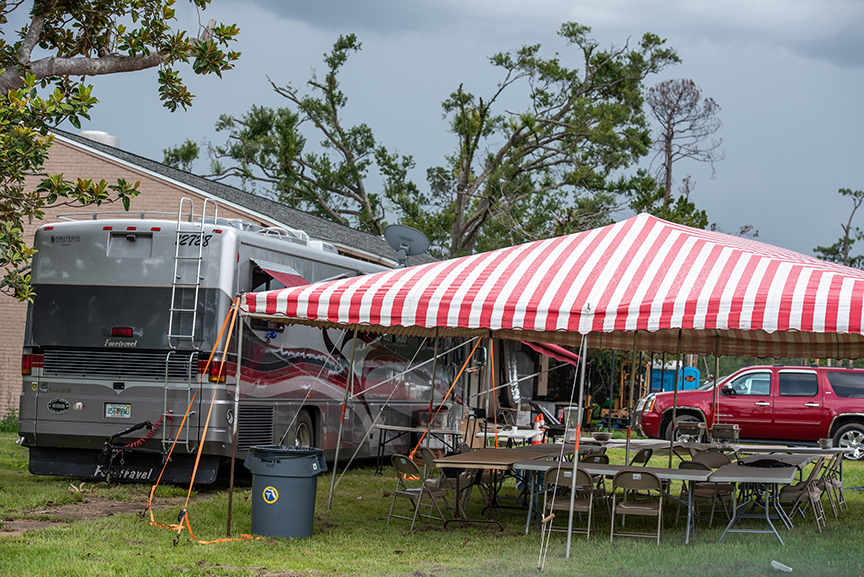
An RV, tent, tables, vehicles, and equipment set up on the
former Dozier School for Boys property in Marianna today.
UPDATE (7/19/2019) - No human remains were found this week by researchers investigating "anomalies" at the former Dozier School for Boys in Marianna, Florida.

Spots that New South Associates, a ground-penetrating radar firm believed might be "clandestine" graves, proved to be nothing of the sort. Professors and students from the University of South Florida (USF) found only roots and other similar debris.

USF will continue its work at the site in the future, using another $850,000 appropriated by the Florida Legislature following the New South claims.

Read our story posted on Tuesday (7/16/2019) here:

Marianna- The University of South Florida (USF) is digging again at the former Dozier School for Boys, funded by $850,000 from the Florida Legislature.

Researchers from New South Associates found "anomalies" that they suggest might or might not be "clandestine" graves in an area near an old fuel depot and livestock barns. The site is on the north side of the now-closed school, which has been renamed Endeavor by the local government.

The "anomalies" are in a small area that was heavily wooded until recently. The area was searched with ground-penetrating radar because of "oral tradition," according to researchers, "that there was either another burial ground or individuals had been are unmarked graves on the school's campus." [I]

Researchers from USF - including professor Erin Kimmerle - originally came to Marianna one decade ago with similar beliefs, but never found any graves outside the fence that once the school's known cemetery.

Despite false reporting by local, state, national, and international media outlets, the university's team looked at dozens of areas on campus during its previous investigation. None of those spots turned out to be hidden cemeteries or clandestine burial sites.

Kimmerle has cautioned the media this time that the "anomalies" might be trash pits, root balls, or even livestock burial sites.

New South Associates, the firm that conducted the ground-penetrating radar survey admitted as much in its report. "It is possible that some or all of these possible grave anomalies represent false positives," the researchers briefly stated, before proceeding with language referencing an"oral history of graves beyond the cemetery." [II]

The $850,000 given to USF will soon determine whether these "anomalies" are graves.

If "clandestine graves" of murder victims are found, may justice be done if anyone connected to them is still alive so long after the fact. If the "anomalies" turn out to be stump holes or garbage pits, then hopefully there will be enough money left over to refill them.

I do have one suggestion. Perhaps the professors, students, and state officials will take a small amount of their time while here to visit and help those who are living beneath the blue tarps of Hurricane Michael. They are suffering in tents, irreparable homes, FEMA trailers, or are being forced from the only houses they have ever known.

There is a shortage of money to help hundreds of hurricane victims, and maybe you can do a little for them while you are here. No matter what you do or do not believe about Dozier School, these elderly people and children of the storm were not the cause of it.


REFERENCES:

[I] Maeve Herrick and Sarah Lowery, Final Report, "Ground-Penetrating Radar Survey for Possible Unmarked Graves at the A.G. Dozier School for Boys North Campus," New South Associates Technical Report No. 2898, January 28, 2019: 1.

[II] Ibid.: 29.