A Two Egg TV Page. See more at https://twoeggtv.com.
Showing posts with label dig. Show all posts

Tuesday, July 16, 2019

UPDATE: NO HUMAN REMAINS found in new Dozier School dig

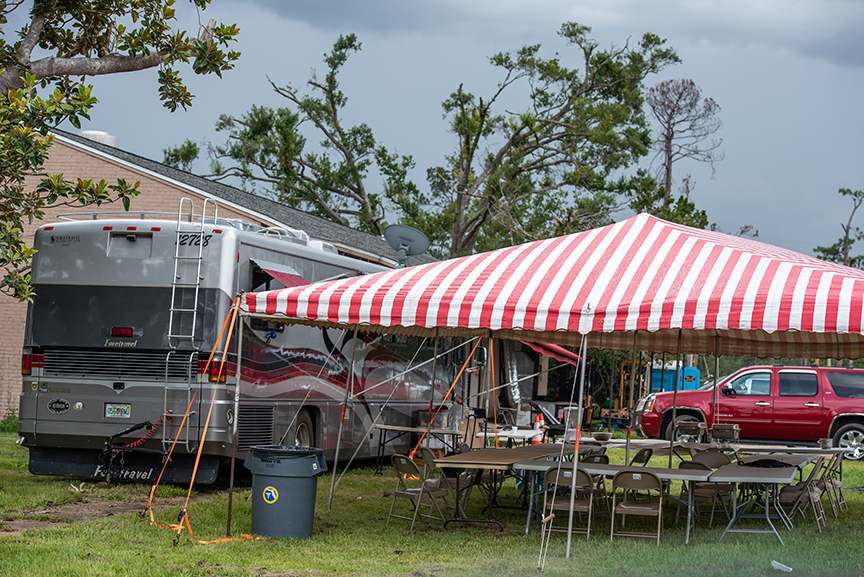
An RV, tent, tables, vehicles, and equipment set up on the
former Dozier School for Boys property in Marianna today.
UPDATE (7/19/2019) - No human remains were found this week by researchers investigating "anomalies" at the former Dozier School for Boys in Marianna, Florida.

Spots that New South Associates, a ground-penetrating radar firm believed might be "clandestine" graves, proved to be nothing of the sort. Professors and students from the University of South Florida (USF) found only roots and other similar debris.

USF will continue its work at the site in the future, using another $850,000 appropriated by the Florida Legislature following the New South claims.

Read our story posted on Tuesday (7/16/2019) here:

Marianna- The University of South Florida (USF) is digging again at the former Dozier School for Boys, funded by $850,000 from the Florida Legislature.

Researchers from New South Associates found "anomalies" that they suggest might or might not be "clandestine" graves in an area near an old fuel depot and livestock barns. The site is on the north side of the now-closed school, which has been renamed Endeavor by the local government.

The "anomalies" are in a small area that was heavily wooded until recently. The area was searched with ground-penetrating radar because of "oral tradition," according to researchers, "that there was either another burial ground or individuals had been are unmarked graves on the school's campus." [I]

Researchers from USF - including professor Erin Kimmerle - originally came to Marianna one decade ago with similar beliefs, but never found any graves outside the fence that once the school's known cemetery.

Despite false reporting by local, state, national, and international media outlets, the university's team looked at dozens of areas on campus during its previous investigation. None of those spots turned out to be hidden cemeteries or clandestine burial sites.

Kimmerle has cautioned the media this time that the "anomalies" might be trash pits, root balls, or even livestock burial sites.

New South Associates, the firm that conducted the ground-penetrating radar survey admitted as much in its report. "It is possible that some or all of these possible grave anomalies represent false positives," the researchers briefly stated, before proceeding with language referencing an"oral history of graves beyond the cemetery." [II]

The $850,000 given to USF will soon determine whether these "anomalies" are graves.

If "clandestine graves" of murder victims are found, may justice be done if anyone connected to them is still alive so long after the fact. If the "anomalies" turn out to be stump holes or garbage pits, then hopefully there will be enough money left over to refill them.

I do have one suggestion. Perhaps the professors, students, and state officials will take a small amount of their time while here to visit and help those who are living beneath the blue tarps of Hurricane Michael. They are suffering in tents, irreparable homes, FEMA trailers, or are being forced from the only houses they have ever known.

There is a shortage of money to help hundreds of hurricane victims, and maybe you can do a little for them while you are here. No matter what you do or do not believe about Dozier School, these elderly people and children of the storm were not the cause of it.


REFERENCES:

[I] Maeve Herrick and Sarah Lowery, Final Report, "Ground-Penetrating Radar Survey for Possible Unmarked Graves at the A.G. Dozier School for Boys North Campus," New South Associates Technical Report No. 2898, January 28, 2019: 1.

[II] Ibid.: 29.


Sunday, December 29, 2013

No Mass Grave at Dozier School Cemetery: Media Falls Silent

Dozier School Cemetery Site
Employees from the University of South Florida (USF) appear to have completed the exhumation of the graves from the Dozier School Cemetery. No mass grave was found.

The cemetery proved to be exactly what former school employees and local residents said it would be, an old cemetery where most of the graves were interred more than 75 years ago.

The media, which covered the beginning of the dig with carnival-like excitement, has vanished.

The university is expected to continue its research at Dozier for another eight months, trying to find a "second cemetery" that some claim must exist at the school. Former employees and local residents say there has not been a second cemetery within the memory of anyone alive in the community. State and Federal maps and plats dating back to the 1930s show only one cemetery, the one that has now been dug up by USF.

Wire from the original cemetery fence.
All of the graves found were inside the old fence line of that cemetery, which the media has sometimes confused with the small memorial erected at the site during the 1960s. In fact, an old wire fence surrounded a somewhat larger area and all of the graves were inside that area. The remains of that fence were visible in the spoil piles left behind when USF used heavy equipment to clear the historic site earlier in the year.

USF has not commented on the results of the dig and all media coverage stopped after the work revealed the bodies interred at the cemetery had been buried in coffins according to standard religious and mortuary practices of the time, not "dumped in holes" as some had claimed. USF employees - before falling silent - said during the first days of the dig that some of the coffins were "quite decorative."

Former employees of the school and local citizens with knowledge of its history had long said that the graves were not hidden or clandestine. They pointed out that people - both students and employees - had died at the school over its more than 100-year history and were known to be buried in the cemetery. They indicated that the bodies were buried in coffins and that funerals were held. A long-time maintenance employee of the school even pointed out that the graves originally had wooden markers, but that time and the elements had rotted them away. They disputed claims that the cemetery was a "dumping ground" for human bodies.  Despite the ridicule they faced in the media and on the internet, they maintained their stand.  In the end, they were right.

Although the university isn't talking for now, one thing is very clear: there were not 150 or more bodies in the cemetery as claimed by some former students of the now closed reform school. One former student told the media on the day that the dig began that there were "at least 100 more bodies up there" than the 50 or so thought by USF employees before the dig began.

The claims of hundreds of bodies in the cemetery received widespread coverage in state, national and international media. There has been no coverage since the claims proved false.

In answer to questions about why he had stopped covering the dig once it became clear that most of the allegations surrounding the cemetery were false, one journalist indicated he was "waiting for the final report because I don't want to report anything that isn't correct." Oddly, such journalistic standards were not at issue before the dig began. Wild stories then included allegations of everything from hundreds of graves in the cemetery to claims that it was a dumping ground for people murdered by the Ku Klux Klan (KKK).

Attorney General Pam Bondi and the NAACP pushed for the dig, claiming repeatedly that "atrocities" had occurred. A leader with the NAACP even compared Dozier School to the infamous Nazi death camp of Dachau. U.S. Senator Bill Nelson did as well, posturing for television cameras with statements such as, "where there's smoke, there's fire."

More than $600,000 in state and federal tax money funded the dig, but in the end no clandestine mass grave was found.  The USF employees and volunteers have gone back to Tampa to analyze the remains and try to identify bodies for the handful of next of kin they actually found. The media has gone silent.

The little memorial placed decades ago by school employees and students in memory of those buried in the cemetery was destroyed by the dig. The graves it commemorated are gone.


Tuesday, October 22, 2013

USF Researchers refuse to examine Dozier documents

One of the boxes of documents that USF researchers
refused to examine while "researching" Dozier School.
While claiming they are researching the "truth" about the small cemetery at the former Dozier School for Boys in Marianna, scientists and students from the University of South Florida (USF) today refused to even look at thousands of pages of documents about the school.

The awkward situation developed when a representative of a local historic preservation group contacted me to indicate they had been asked by USF researcher Antoinette Jackson to meet and discuss any documents relating to Dozier that might be in their collection.  Since the organization does not have any Dozier-related documents, its representative asked me if I would be willing to make my collection of thousands of pages of Dozier material available to the researchers.

I agreed to do so and boxed up a wealth of Dozier documentation from my collection and carried it to Marianna so the USF researchers could access it more easily.  After waiting nearly 2 hours, I was told that Jackson and her team members refused to even so much as look at it.

Obviously, they didn't want to so much as breathe the same air as me, even if that meant ignoring thousands of pages of material that sheds considerable light on the truth about the deaths and graves at the former Marianna reform school. 

Not only is this sad, it is silly. It is hard for me to imagine that any serious researcher would turn down the chance to view a collection containing thousands of pages of documentation on a topic of such interest to them.  But, sadly, that is the case with USF. 

The school apparently would rather remain in the dark than so much as talk politely with someone who disagrees with them and their tactics.  Perhaps the researchers would do well to learn that people can be polite, even though they disagree with you. 

Since $600,000 in taxpayer money is being spent on this fiasco, I would have assumed that they would want their research to be as accurate as possible.  I guess I assumed wrong.

The school (USF), as you probably know, is in the process of exhuming graves from the small, known cemetery at Dozier School, even though 80% of the families with loved ones buried there have not been contacted. So far they have found between 30 and 40 humans buried in coffins according to standard mortuary and religious practices of the early 20th century, along with a dog buried in an old cooler.

They have reported finding no graves outside of the traditional cemetery limits, despite often wild claims by a group of former students seeking large payments from the state.


Thursday, September 5, 2013

USF digs up a dog at Dozier School

Memorial Crosses at Dozier School Cemetery.
They were placed by staff and students in the 1960s.
UPDATED 9/6/2013 - Researchers from the University of South Florida used at least some of the more than $600,000 in taxpayer money they have been given to dig up the grave of a dog at the Dozier School Cemetery.

The cemetery is located on a hilltop on the campus of the former Dozier School for Boys in Marianna, Florida. The majority of the graves there date from prior to 1940 and contain the victims of a tragic fire that took place in 1914 and students as well as staff members who died during flue outbreaks in 1918 and during the 1930s.

Local residents and former employees of the school have long warned that some of the graves at the cemetery contain the remains of animals. Those warnings have now been verified.

A source close to the investigation indicates that hours were spent during the first phase of the taxpayer-funded project to dig up the remains of a dog that were buried in an old Coleman-type cooler.

Ben Montgomery, a reporter for a Tampa area publication, did not report that a potential grave revealed a dead dog, but confirms that he was aware of it:

"Dog was found months ago, during trenching. Not during Phase 1. It was modern. Included in report to the state."

Why a reporter covering this story would not consider the discovery newsworthy is not clear. Local residents have long said that animals would be found buried at the site. He incorrectly equates my statement about the "first phase" of the project with "Phase 1" as defined by USF. I was speaking of the phase of the project that involved the trenching he mentions in his post on Twitter.

Pets known to be buried at the cemetery include two dogs and a peacock named Sue. So far as is known, the University of South Florida team has not yet located the remains of the peacock.

All human remains exhumed so far have been found in the
area of this photo. The small memorial placed in the 1960s
can be seen at left. The two human graves were removed from
the area of disturbed earth at right.
The only two human graves exhumed so far turned out to contain the apparent remains of former Dozier students who had been buried - as local residents and former employees predicted - with proper care. The remains had been buried in coffins and one burial even included the pins from a burial shroud such as was used in the early 1900s.

No evidence of criminal activity has been found thus far and neither of the graves exhumed so far proved to be "clandestine" (as researchers and others have repeatedly claimed).

The entire media appears to have decided to ignore the exhumation of the dog, as no stories about the discovery have appeared. In addition, media reports that remains have been found "in the woods" our outside the "traditional boundary" of the cemetery are false. All graves located so far are within the boundary of the old cemetery fence.

To read more about the results of the dig so far, please see yesterday's post:  http://twoegg.blogspot.com/2013/09/facts-from-first-phase-of-dozier-school.html


Wednesday, September 4, 2013

Facts from the first phase of the Dozier School Cemetery digging

Memorial Area at Dozier School Cemetery
Researchers from the University of South Florida, along with law enforcement volunteers and even reporters, started digging last weekend at the Dozier School Cemetery in Marianna, Florida.

The first phase of their work is now over and they are not expected to return until October or November.

Contrary to what you may have read in newspapers or heard on television, here are the facts so far:
  • NO "clandestine" graves have been found. The graves located so far turned out to be historic graves that clearly demonstrated proper care was given to the bodies at the time they were buried.
  • Evidently unfamiliar with what happens to the terrain around Marianna during seasons of heavy rain, the researchers experienced problems due to the rain soaked condition of the ground at the cemetery. Instead of exhuming 4-5 graves as they expected, they only managed to dig up two.
  • NO graves have been found outside the traditional limits of the cemetery. ALL graves located so far are inside the old fence line of the Dozier School Cemetery and the limits of the cemetery as shown on state plats and federal topographic maps dating from the 1940s. (Some media outlets have incorrectly reported otherwise).
  • The two graves exhumed so far reveal that the bodies were interred in coffins, not just "dumped in holes" as some have claimed, and that proper mortuary procedures of the time were followed when the burials took place. Pins from burial shrouds were even found in the graves.
  • NO evidence of criminal activity has been found.
To make a long story short, investigators at the Dozier School Cemetery have found exactly what local people and former Dozier employees said they would find - historic graves prepared according to proper religious and mortuary practices of the time. 

To correct a few other media errors that have been prevalent this week:
  • The memorial crosses at the cemetery were placed there by Dozier employees, NOT the University of South Florida.
  • The memorial at the cemetery dates back to the 1960s, thirty years earlier than reported by the Tampa Bay Times. 
  • The cable around the memorial crosses is NOT the traditional boundary of the cemetery as some media outlets have reported. The actual traditional boundary surrounds 1-2 acres of land and originally consisted of a wire fence.
I'll post other updates as work continues this fall and winter, but so far researchers have found nothing more than local citizens predicted they would find.