A Two Egg TV Page. See more at https://twoeggtv.com.
Showing posts with label graves. Show all posts

Tuesday, July 23, 2019

USF confirms it! NO new bodies found at former Dozier School site!

Road leading to the site of the "non-graves"
excavated last week on the former Dozier School
for Boys property in Marianna, Florida.
University of South Florida (USF) professor Erin Kimmerle confirms that the "anomalies" at the former Dozier School site are NOT graves after all. We first reported this news last week, but the professor announced this morning that the initial dig is over.

NO bodies or human remains were found in excavations at a site pointed out by New South Associates. The ground-penetrating radar firm thought it had found "clandestine graves" on the campus of the former school for juvenile offenders.

The site was originally called the Florida Reform School and later the Florida Industrial School for Boys or the Arthur G. Dozier School for Boys. It is now called Endeavor.

The possible "clandestine graves" proved to be places where pine tree stumps had been removed.

USF will now move on to studying Lidar imagery to see if it can find any other signs of graves on the campus. The whole new study is costing taxpayers $850,000 thanks to an appropriation from the Florida Legislature.

Meanwhile, residents throughout the region continue their struggle to recover from the damage or destruction inflicted on their homes by Hurricane Michael.


Tuesday, July 16, 2019

UPDATE: NO HUMAN REMAINS found in new Dozier School dig

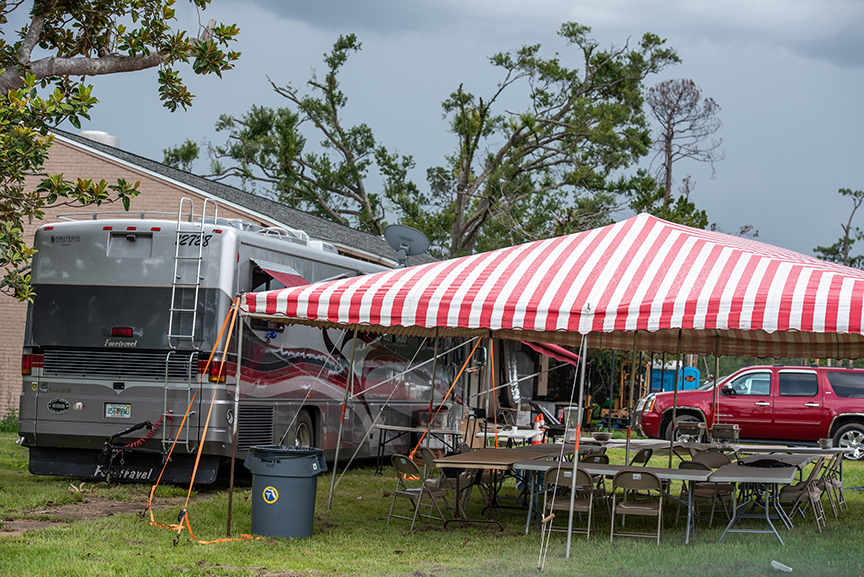
An RV, tent, tables, vehicles, and equipment set up on the
former Dozier School for Boys property in Marianna today.
UPDATE (7/19/2019) - No human remains were found this week by researchers investigating "anomalies" at the former Dozier School for Boys in Marianna, Florida.

Spots that New South Associates, a ground-penetrating radar firm believed might be "clandestine" graves, proved to be nothing of the sort. Professors and students from the University of South Florida (USF) found only roots and other similar debris.

USF will continue its work at the site in the future, using another $850,000 appropriated by the Florida Legislature following the New South claims.

Read our story posted on Tuesday (7/16/2019) here:

Marianna- The University of South Florida (USF) is digging again at the former Dozier School for Boys, funded by $850,000 from the Florida Legislature.

Researchers from New South Associates found "anomalies" that they suggest might or might not be "clandestine" graves in an area near an old fuel depot and livestock barns. The site is on the north side of the now-closed school, which has been renamed Endeavor by the local government.

The "anomalies" are in a small area that was heavily wooded until recently. The area was searched with ground-penetrating radar because of "oral tradition," according to researchers, "that there was either another burial ground or individuals had been are unmarked graves on the school's campus." [I]

Researchers from USF - including professor Erin Kimmerle - originally came to Marianna one decade ago with similar beliefs, but never found any graves outside the fence that once the school's known cemetery.

Despite false reporting by local, state, national, and international media outlets, the university's team looked at dozens of areas on campus during its previous investigation. None of those spots turned out to be hidden cemeteries or clandestine burial sites.

Kimmerle has cautioned the media this time that the "anomalies" might be trash pits, root balls, or even livestock burial sites.

New South Associates, the firm that conducted the ground-penetrating radar survey admitted as much in its report. "It is possible that some or all of these possible grave anomalies represent false positives," the researchers briefly stated, before proceeding with language referencing an"oral history of graves beyond the cemetery." [II]

The $850,000 given to USF will soon determine whether these "anomalies" are graves.

If "clandestine graves" of murder victims are found, may justice be done if anyone connected to them is still alive so long after the fact. If the "anomalies" turn out to be stump holes or garbage pits, then hopefully there will be enough money left over to refill them.

I do have one suggestion. Perhaps the professors, students, and state officials will take a small amount of their time while here to visit and help those who are living beneath the blue tarps of Hurricane Michael. They are suffering in tents, irreparable homes, FEMA trailers, or are being forced from the only houses they have ever known.

There is a shortage of money to help hundreds of hurricane victims, and maybe you can do a little for them while you are here. No matter what you do or do not believe about Dozier School, these elderly people and children of the storm were not the cause of it.


REFERENCES:

[I] Maeve Herrick and Sarah Lowery, Final Report, "Ground-Penetrating Radar Survey for Possible Unmarked Graves at the A.G. Dozier School for Boys North Campus," New South Associates Technical Report No. 2898, January 28, 2019: 1.

[II] Ibid.: 29.


Thursday, January 21, 2016

Cabinet hears Dozier Report, apologizes for "unspeakable horrors"

A group of Jackson County's Citizens of the Year warn the
media in 2014 that it was being one-sided in its coverage and
that no evidence of murders of students by staff would be
found at the Dozier School for Boys "Boot Hill" cemetery.
Photo courtesy of the Jackson County Times.
In a meeting that began late and was filled with jokes, the Florida Cabinet today heard the University of South Florida's project at Dozier School for Boys in Marianna.

Please click here to read a summary of that report or to read the entire document.

Cabinet members and Governor Rick Scott apologized to former Dozier students for the "unspeakable horrors" inflicted on them by the Jackson County residents who worked at Dozier School for Boys. The Cabinet members also praised Dr. Erin Kimmerle of the University of South Florida (USF) and the former students of the school.

Kimmerle presented her final report to the Cabinet. She called it a "historic project" and said the results achieved were "remarkable."

She said that the objective was to locate the burials and to identify the individuals buried in the graves so their remains could be returned to their families. She also said a main objective was to study the 1,400 acre campus to find other graves that might be located there.

Kimmerle told the Cabinet members that her team pursued all leads on the history of the Campus, a deliberately incorrect statement as she and her team refused to examine thousands of pages of documents offered to them by this writer.

She said that prior to the beginning of the exhumations, she and her team did ground truthing to determine which features were graves and which were fence posts, etc.  At the time, however, USF denied that it had dug into any of the graves and said it was only doing "stratigraphic" analysis.

Kimmerle also mentioned that her team found and removed thousands of artifacts. She did not mention that other artifacts were left behind in the tracks of her team's vehicles.

Among the coffins found, according to Dr. Kimmerle, were seven infant coffins that contained the remains of students and employees who died in the 1914 fire at one of the school's dormitory.

She mentioned that "a number of the boys" had burial shrouds, a standard mortuary practice of the early 20th century.

The professor, however, left out key information when she told Cabinet members that a lead pellet consistent with a lead shot was found in one of the graves. She mentioned the pellet, but did not tell the Cabinet that FDLE has examined the artifact and determined it was likely from a muzzle-loading black powder weapon. Guns of that type were antiques by the time the Florida Reform School (later Dozier School) was even built.

She said her team used "fire hoses" to push water through screens while digging at the site of the burned dormitory. Kimmerle indicated that small fragments of bone were found at the burned dormitory site, all believed to be associated with the individuals who died in that fire more than 110 years ago.

Kimmerle also said that USF has positively identified only 7 of the individuals that her team exhumed from the cemetery. Four have been reburied. The other 47 individuals exhumed remain in boxes at the University of South Florida.

Although the university earlier claimed to identify the remains of one of the employees who died in the 1914 fire, Kimmerle today said that they cannot positively identify his remains and that he will likely be buried with the "unknowns."

She made no references to murders in her discussion. Later in answer to a question from the Cabinet members, the professor said that, "We feel like our field work is done. "We feel like we have exhausted everything we can do in looking for additional burials."

Kimmerle was followed by Dr. Christian Wells, a professor of archaeology at USF. He indicated that the university investigated a number of other locations pointed out by former students as "burial" sites. "We surveyed 35 different regions," he said. None of those areas, he reported, revealed any evidence of human remains. In other words, claims that "hundreds" of graves and a "second cemetery" would be found on the campus were completely false.

Wells also indicated that contamination was found on areas of the campus. He encouraged the Governor and Cabinet to follow up on the issue.

Antoinette Jackson, another USF professor, then spoke about "the living." She said that "segregation" resonates today at the campus, which is now abandoned. She noted that some communities disagreed with the project and that the university needed to incorporate them into their narratives, something they have yet to do.

Jackson mentioned the need for additional "financial support." She focused on education, although many of the university's public forums and discussions about Dozier have focused on "restorative justice."

She mentioned that the team will be traveling to Japan - presumably at taxpayer expense - to tell the Dozier story.

Jackson concluded by encouraging those with "stories" to come forward. While the project was underway, however, USF absolutely refused to view thousands of pages of documentation in the possession of this writer.

None of the professors ever mentioned the word "murder" in relation to the graves. Kimmerle also finally admitted that all of the burials were found in a 50 by 150 foot area on Boot Hill. A few pieces of bone were also found in the ruins of the burned dormitory but did not contain enough material for DNA analysis.

NO other graves were found on campus. There was no second cemetery nor were any hidden graves found.

Jerry Cooper, a former student, addressed the Cabinet and urged that the bodies "not be returned to that area" saying the reasons why were "apparent." He said, "I don't know what happened at Marianna."

Charles Fudge, another former student, then spoke and said he was "Troy Tidwell's office boy" and swore there is a second cemetery with at least 30 graves on campus. He asked that the White House Boys be allowed to go look for it. The area he claimed contains the cemetery was among those investigated by USF and nothing was found.

Other former students said they wanted the dead interred "somewhere other than Jackson County." "Please don't leave those children there," the widow of a student begged, claiming that there are more graves still to be located at the campus.

Robert Straley, a former student, said that he has suffered an unfortunate accident recently that left him with his sixth concussion. He pointed out that many in Marianna are being forced to live with the blame for something they did not do. He called for a monument to be built and spoke of forgiveness and reconciliation.  He said the "whip has no place in our society." Corporal punishment at Dozier School ended more than 40 years ago.

Andrew Puel said he had heard "very credible testimony" that boys had been murdered at the school. USF, however, found no evidence of murders. Puel said he had "sworn statements" from former juveniles that they had seen killings, including a shooting, at the school.

Puel went on to say he wasn't telling the stories to be "sensational." He requested access for researchers to the ledgers that remain sealed due to juvenile privacy laws. FDLE, however, does have access to these ledgers as part of its current investigation.

Jerry Cooper then reappeared before the Cabinet and said that many former students had cancelled plans to attend "at the last minute." Others were present and he introduced them.

Dale Landry from the NAACP then appeared before the Cabinet. He called for a place that they can "sanctify" to hold the remains until they can be identified. He called for turning the old chapel on campus into a mausoleum until the remains can be identified, even if it takes decades. He also called for turning the "White House" into a permanent memorial to the "horrors" that took place at the school. Landry also asked for the state to fund reburial of identified remains.

Jim Dean, City Manager of Marianna, then spoke. He said he appeared with a group of civic and business leaders including County Commissioner Chuck Lockey and others. He offered the community's support to bring closure to the process.

Elmore Bryant, former Mayor of Marianna, spoke and asked for the land to be given back to Marianna. He said the leaders of Marianna were "men of character." He said that "We will make you proud of what we do with that land. We've been banged, but there are some good things that people don't talk about." He noted that the people of Marianna "respected me as the first black mayor of Marianna."

"When you come to Marianna, there are many good sides," Bryant continued. He invited the governor to come and talk.

Attorney General Pam Bondi then said to the White House Boys, "We know that you have suffered terrible, unspeakable atrocities." Bondi apparently didn't know the name of Jackson County, which she called "Marianna County, a beautiful county." She called Bondi a "Hero."

Earlier in the session, Bondi yelled out "Yayyyyyyyy!!" when told that USF students were in the room and praised Kimmerle for her "ground-breaking" work.

The university spent more than $600,000 in state and federal taxpayer funding on its Dozier project, even after FDLE had determined that there was no evidence of criminal activity by employees involving the cemetery. Meanwhile, USF President Dr. Judy Genshaft told Cabinet members that her institution has eliminated more than 50 other educational programs, including industrial training.

Please click here to read a summary of the key points in the USF report or to read the full report itself.

To learn the true history of the Dozier School cemetery, please consider my book Death at Dozier School: The Attempted Assassination of an American City (available in both paperback and Kindle formats).


Cabinet meeting continues: Atwater fondly remembers grandmother's switch.

Jeff Atwater, Florida's Chief Financial Officer,
fondly remembered his grandmother's switch
during today's Cabinet meeting.
Jeff Atwater, who serves as Florida's Chief Financial Officer, fondly remembered his grandmother's switch during today's meeting of the State Cabinet.

It was an odd moment in a meeting that will soon include a presentation from the University of South Florida (USF) on its project at Dozier School for Boys in Marianna. Among the allegations made against the school are charges by former students that they were "beaten" in a structure called the White House.

In a different discussion, Atwater mentioned that his grandmother kept a "Kentucky" switch on her front porch to assure good behavior and good grades.

The Cabinet meeting is still underway at this time (11:47 a.m. Central) and is several agenda items away from USF's presention.

-- Earlier posts on today's Cabinet meeting--

Attorney General Pamela Jo "Pam" Bondi yelled out "Yayyyy!" for students of the University of South Florida (USF) as the Florida Cabinet convened in Tallahassee this morning.

Representatives from the university are expected to present their final report on archaeological/anthropological work at the Dozier School for Boys cemetery later this morning.

Please click here to read a summary of that report or to read the full 168-page document.

Former County Judge Woodrow "Woody" Hatcher is in Tallahassee to respond to USF's presentation, but has already been told that he will only be allowed to speak for 2 minutes. That is less time than Bondi was given to show off a 40-pound dog available for adoption. It is also less time than the number of minutes late that the meeting was called to order.

USF President Judy Genshaft and Florida's other university presidents have been address the Cabinet about Governor Rick Scott's "Ready, Set, Work" challenge. When she mentioned that some USF students were present, the attorney general broke into a loud cheer of "Yayyyy!" and then mentioned Dr. Erin Kimmerle and what Bondi called her "ground-breaking" work. Kimmerle has directed the USF project at Dozier School for Boys.

Genshaft answered a direct question from Governor Scott about what study programs her university might have closed. Apparently, even as USF has spent more than $600,000 in state and federal taxpayer funds on the Dozier project, it has closed more than 50 of its study programs. Among these was a program that prepared students for jobs in industry.

The discussion with the various university presidents is still underway after more than 2 hours.

I'll post another update at 11:00 a.m. Central/12 Noon Eastern or shortly after unless something significant takes place before then.

Until then, please click here to read yesterday's story on USF's final report or to read the report itself.


Wednesday, January 20, 2016

No evidence of murders by staff members at Dozier School: USF final report is released

Dozier School Cemetery prior to its destruction
by the University of South Florida.
The University of South Florida (USF) has submitted its final report on the "Boot Hill" Cemetery at Dozier School for Boys in Marianna to the Florida Cabinet.
No physical evidence was found to support claims that employees of the former state facility killed any of the students buried in the little cemetery.
No evidence of a mysterious "second cemetery" - a theory widely promoted by the Tampa Bay Times, Miami Herald and other major news outlets - was found.
No evidence of "hidden burials" was found in any of the dozens of locations pointed out by former students of the school, many of whom call themselves the "White House Boys."
The only "projectile" found in association with any of the graves was a small bb-size piece of lead. The Hillsborough County Sheriff's Department previously said there was no evidence the individual in this grave was shot and suggested that the item could have been in his pocket. Analysis confirmed this assessment. The item could not be positively identified as a projectile at all, but was consistent in size with a buckshot from a black powder muzzle-loading firearm. These types of weapons were antiques by the time the Florida Reform School (later Dozier School for Boys) was even built.
The only verifiable murders that took place at the school were those of Robert Stephens, Earl Wilson and Eddie Black. All three were murdered by other students who were arrested, convicted and sentenced to prison for the murders.
USF said it was not able to view documentation about the 1966 drowning of Alphonse Glover in the school swimming pool. This statement is inaccurate as the coroner's report on Glover's death was among the documents in my possession that I offered to let researchers examine. They refused to look.
So far, USF has positively identified only seven of the bodies that it dug up from the school cemetery. The total cost of the project was nearly $700,000. The names of the others are mostly known and are consistent with the report completed by FDLE prior to the beginning of the USF project. DNA analysis is still pending and may determine the identifies of seven of the other bodies.
The report indicates that USF found three more graves than it can account for by name. The school, however, missed four deaths known to be associated with Dozier School. Three of these (2 students and one employee) took place prior to 1910. The fourth, of a male employee, took place during the influenza outbreak of 1918. Since one of these individuals is buried at Riverside Cemetery in Marianna, the other three could and probably do account for the three additional graves found by the university at the school cemetery. This information was offered to USF researchers but they refused to review it.
The school has no money to rebury the 51 bodies that it exhumed.
So in the end it comes down to this simple fact: The Dozier School Cemetery ("Boot Hill") is gone. No evidence of murders by staff was found. There was no mysterious second cemetery.
The USF report concludes with social justice language about "restorative justice," etc., and brags that the project generated news stories reaching an estimated 1.18 billion people around the world.
The Florida Department of Law Enforcement (FDLE) will have the final say on the cemetery, likely sometime in February. So far, there has been no indication that the state agency will draw any different conclusions about the nature of the graves.
If you would like to read the real story of the Dozier School Cemetery now that the vast majority of the media coverage has been discredited, please consider my book: Death at Dozier School: The Attempted Assassination of an American City (available in Paperback and Kindle formats).

Tuesday, December 23, 2014

Alarming facts about media coverage of Dozier School controversy

I am pleased to announce the release at Amazon.com of my new book, Death at Dozier School: The Attempted Assassination of an American City.

It can be purchased now at Amazon by clicking here:  Death at Dozier School. The book is also available in Marianna, FL at The Vintage Depot on South Caledonia Street, although they are now sold out until after Christmas.

This is a book about the Dozier School Cemetery, its destruction by the University of South Florida and the inaccurate media coverage that has surrounded the issue. Profits from the book are being donated to worthwhile causes, including the group funding effort for a friend who is battling cancer. 

Read more about why the book was written in this excerpt from the introduction:

THIS IS A BOOK ABOUT A CEMETERY.  I clarify this now because the former Dozier School for Boys in Florida is surrounded by a whirlwind of allegations, claims, opinions, and in some cases, outright falsehoods. Many of these have been exacerbated by media coverage generated and often coordinated by employees of the University of South Florida (USF), an institution of higher learning in Tampa. The university has used more than half a million dollars in taxpayer funding to search for and exhume graves on the campus of the former institution for juvenile offenders. To quote one of the graduate students involved in the project, it was done in the name of “social justice.”

Unfortunately, the Dozier School Cemetery is no better understood by the public at large today than it was before two years of research by USF and an accompanying frenzy of media coverage. The university has grown increasingly secretive about is work on the campus and on at least one occasion even went so far as to deny that it had released new information even as it provided a major report of findings to the State of Florida. Researchers once conducted media tours on the Dozier School campus and even allowed CNN unprecedented live access as the first graves were exhumed. Today they carefully hold their press conferences hundreds of miles away from the site and release only a trickle of information to a media that remains fixated on the fading narrative that the cemetery was a place where bodies were dumped following hundreds of “murders” and “abuse-related deaths” on the campus.

Why the dramatic change? This book will provide you with an opportunity to answer that question for yourself.

So then, this is a book about a cemetery. It is a history of the Dozier School or “Boot Hill” cemetery in Marianna, Florida. The goal is to make public the facts about the cemetery from its first interments more than 100 years ago to the present controversy that led to its destruction. This is not a book about the allegations of abuse that have been made against the school and its employees by groups of former students except where those allegations involve the cemetery or other rumored gravesites on campus. Much has been written about the “White House” – a structure on campus where corporal punishment was administered to students that has become a focal point of abuse allegations – but the building was not used for punishment purposes during most of the cemetery’s active history. Only one burial is known to have taken place in the Dozier School Cemetery after the former ice cream factory now called the “White House” was converted for use as a storage and punishment facility. For reasons that will be explained in the book, the individual buried in that grave was not connected to the “White House” allegations.

On the pages that follow you will find a documented history of the cemetery and its use to bury unfortunate students and employees of the school for roughly fifty years. The story it presents is tragic. In some cases it is heart-breaking. Yet there are also moments of inspiration and heroism associated with some of the graves. Those stories are related as well, in hopes that the reader will gain a better appreciation for the noble actions of some residents of the school, students and employees alike. 

To continue reading:  Death at Dozier School

Thursday, January 30, 2014

The Tampa Atrocities: Officially-sanctioned beatings, torture and death in Hillsborough County, Florida.

Skyline of Tampa, Florida
Photo by Lauren Pitone
by Dale Cox

This is a story that the Tampa Bay Times would not not tell.

There is a place in Florida where beatings of jail inmates was commonplace. It is a place where those in custody were stretched out face down in public view and lashed with a leather whip for minor offenses. It is a place where the officials called upon to investigate the practice voted instead to legally authorize it. And it happened during the 20th century.

Marianna and Dozier School?  Some other sleepy small town nestled in the pines and steeped in Old South tradition?  No, that place is Tampa and Hillsborough County, home to the University of South Florida and the Tampa Bay Times.

The use of the lash by authorities in Tampa and Hillsborough County was widespread and accepted deep into the 20th century. It continued for decades and no prisoner was immune to the threat of flogging on the whim of city and county officials. Judges even beat children in the courtrooms of the city.

The Tampa Tribune reported in 1909 that the practice of flogging prisoners had been initiated there ten years earlier by Judge Whitaker of the municipal court.  He "set a precedent," the historical account noted, "by personally applying the lash to two boy offenders convicted in his court."

The word "precedent" according to Merriam-Webster means "something done or said that can be used as an example or rule to be followed in the future."  When Judge Whitaker beat two children in Tampa's municipal court, he set an "example or rule to be followed in the future." Hillsborough County was not shy in following that example.


Road Gang Members in the 1920s
On April 10, 1921, for example, the Tampa Tribune reported that it had received a letter from a "well-known woman resident of Clearwater" who alleged that she had witnessed the "brutal flogging of a convict."

The unidentified eyewitness said that she and several others were traveling by car between Oldsmar and Tampa on the afternoon of Thursday, April 7, when she witnessed "the most brutal act I have ever seen." In a letter to the editor of the Tribune, she described seeing a county road camp prisoner face-down on the ground beside the road as a guard beat him "with all his might with a leather strap." The sound of the beating was so loud that the witnesses could hear each of the blows as they struck the man.

The woman was unable to say how long the beating went on, but she said that it continued for the entire time she and others in the car were within sight of the road crew. She also said that it caused her to wonder what else happened in the county prison camp "where there was no public to look on."

The eyewitness raised a good question. If a guard was so bold as to force an inmate to stretch out face down by a public road for a beating that continued for an untold length of time, what else could have been taking place in Hillsborough County away from the eyes of the public?  Could inmates of the county's prison camp have been maimed or even killed by the floggings they received?

The incident took place in the County Commission district of John T. Gunn, who told the Tribune that he had no reports of "extreme conduct on the part of the guards." He promised to make a "thorough investigation" of the allegations.

Hillsborough County Courthouse in 1921
Burgert Brothers photos, Courtesy Florida Memory Collection
True to his word, Gunn did investigate. In fact, he was so impressed with the details of the beating that he recommended the implementation of flogging as a standard punishment in Hillsborough County.  In fact, the Hillsborough County Commission called the county's sheriff on the carpet before a meeting of the board to demand he explain why 15 federal prisoners housed at the county jail were not turned over to the county to be used as forced laborers on its roads.  The sheriff had previously told Commissioner Gunn that he was willing to allow the county to use the prisoners, but that they could not be flogged. Before the commissioners on that day in 1921, however, he changed his mind and "withdrew his restrictions."

On April 14, 1921, the Tampa Tribune ran letters from readers both supporting and opposing the beating of county inmates with whips. On the same day the newspaper reported that Superintendent McIntosh, who managed the work camp, had given assurances that "no color discrimination" was being made in selecting inmates for flogging. McIntosh proudly described the whipping of three men in one day, two of them white and one black. The road camp "boss" told the newspaper that floggings also took place in the state convict camp in Hillsborough County as well.

The county's investigation of the beatings at its road camp ended with a commission vote giving full sanction to flogging as a suitable punishment for inmates.
St. Petersburg, Florida
Photo by Lauren Pitone
Flogging, in fact, became so popular in the Tampa Bay area that it soon spread to St. Petersburg. In 1931, ten years after Hillsborough County officially adopted flogging, a civilian group in neighboring Pinellas County started a "flogging for hire" organization.  For the right amount of money, they would arrange the flogging of anyone you wanted flogged.

The commercial floggers, however, went afoul of the law when they flogged... the law. On March 8, 1931, the group kidnapped and flogged Constable F.A. Howard of Ballast Point. Arrests followed.

Despite such evidence that flogging was reaching out of control proportions around Tampa Bay, the practice continued. On November 30, 1935, officers of the Tampa Police Department seized three Union labor organizers without a warrant and carried them to police headquarters. The men were illegally questioned about their political and organizing activities as a "mob" gathered outside. When the three Socialist Party members - Joseph Shoemaker, E.F. Pulnot and S.D. Rogers - were released, they were seized on the grounds of the Tampa Police Department by the "ruffian band" that lay in wait. Carried to a remote area, they were flogged and then scalding hot tar and feathers were poured on their bodies.

Pulnot and Rogers survived the barbarous treatment, but Shoemaker did not.  He died one week later from hideous injuries. Rev. G.F. Snyder of St. Paul's Lutheran Church in Tampa boldly spoke out against the atrocity, aiming his finger at "the very citadel of justice and law administration." A mass meeting was held, but public officials did not attend.

The focus of the nation fixed itself on Tampa. Florida Governor Dave Sholtz demanded a thorough investigation and labor leader Norman Thomas accused law enforcement of mishandling the investigation to "save the face of Tampa police and higher-ups." The president of the American Federation of Labor (AFL) threatened to cancel his group's planned national convention, set for Tampa in 1936.

Tampa Police officers in 1935
Courtesy Florida Memory Collection, Florida State Archives
Then came the bombshell. Six Tampa policemen were arrested on the night of December 18, 1935, on charges that they were members of the so-called "ruffian band." Shoemaker's death, it was alleged, did not result from an attack by a mob, but instead was an execution carried out with a lash and hot tar by Tampa police. A member of the city's fire department also was arrested.

A second bombshell came on January 23, 1936, when Tampa Police Chief R.G. Tittsworth was indicted by a special grand jury as an accessory to the crime. In the end, a total of 10 arrests were made in connection with the incident and Governor Sholtz appointed a special prosecutor to handle the case, saying in the process that he meant no disrespect to the Hillsborough County Solicitor, C.Jay Hardee.

The police officers were acquitted. The family of Joseph Shoemaker never received justice. There was no closure.

Nine hate groups are active around Tampa Bay
Photo by Lauren Pitone
A national civil rights publication called it a "Whitewash" and alleged that the police officers were members of the Ku Klux Klan (KKK). Whether they were or not is impossible to prove, but the Tampa Bay area is still infested with hate groups. According to the Southern Poverty Law Center (SPLC) in Montgomery, Alabama, there are 9 hate groups active in the Tampa Bay area. These include the New Black Panther Party, Neo-Nazis, Christian Identity and the racist Skinhead group Confederate Hammerskins. By comparison, Miami and North Miami are home to three hate groups, only one-third as many as Tampa Bay.  Marianna and Jackson County, home to the former Dozier School, have none.

The Tampa Bay Times has run story after story on the allegations of murders at Dozier School, even though 52 of the 55 people exhumed from the Dozier Cemetery are believed to have been buried there more than 75 years ago. How many stories has it published in the last two years about the officially-sanctioned beatings and death in Hillsborough County from the same era?  None.

I told Ben Montgomery, a reporter with the Tampa Bay Times, about the Tampa floggings in April 2013 and he told me he had never heard of them. I encouraged him to look into them. As of today, his paper continues to publicly ignore the horrors that took place in Tampa even while "seeking the truth" about Marianna. Montgomery has not responded to an email asking why he elected not to report on events that took place in his own community.

Think the official violence in Tampa and Hillsborough County ended long before the days of the "White House Boys" at Dozier School in Marianna?  Watch this video and think again: 2008 Abuse at Hillsborough County Jail.

The Tampa Bay Times at least covered that one.  And then there is this one, reported just today by the Tampa Tribune:  Woman dragged by Tampa police officer.

So far as is known no Tampa area media outlet has tried to find either the survivors of beatings or the families of individuals who were abused by authorities in Hillsborough County during the early 20th century. They continue, however, to run interviews and stories about alleged events that took place in Jackson County at exactly the same time in history.

The University of South Florida, meanwhile,  is spending more than $600,000 of taxpayer money in a "humanitarian effort" to identify 55 unknown graves at Dozier School.  How much money has USF spent to identify the 187 unknown graves at Woodlawn Cemetery within 15 minutes of the doors of its Anthropology Department?

Pam Bondi, Florida Attorney General
She has made no calls for justice in Hillsborough County atrocities.
How much money has the university spent to learn whether any beaten and abused inmates disappeared from the Hillsborough County Road Camp in the 1920s and 30s?

How much money has USF spent looking for a "lost" cemetery associated with the atrocities suffered by adults and children in Hillsborough County?

How many times has Attorney General Pam Bondi commented on the documented atrocities that took place in Tampa and Hillsborough County?  How often has she called for closure for the families of the victims?

Officers from the Hillsborough County Sheriff's Department spent time in Marianna assisting USF in its exhumation of the graves from the Dozier School Cemetery. How much time did they spend last year looking into the skeletons of their own past?

I think you already know the answers to these questions.

This is the first in a series of articles on this topic. Watch for part two in coming days.

Tuesday, January 28, 2014

USF confirms: No Mass Grave at Dozier School Cemetery

Memorial area at Dozier School Cemetery
BREAKING NEWS:  Tampa and Hillsborough County authorities beat, tortured and killed prisoners during same era as Dozier School allegations. Click here to read about the Tampa Atrocities


In a press conference this morning in Tampa, employees of the University of South Florida (USF) confirmed that the number of graves found at the Dozier School Cemetery matched exactly the number provided by me and others in the community.

The media all day has been claiming that researchers found "24 more graves than should be there."  That is categorically false. They found exactly the number of graves that documentation indicates should be there.

The university, which has spent more than $600,000 in taxpayer funds to dig up the historic cemetery at the former Dozier School for Boys in Marianna, FL, confirmed this morning that it had found 55 graves in the cemetery.

I tried to provide the university with evidence of 55 graves at the cemetery, but its employees refused to meet with me.

For more than 18 months, I have indicated that I believed there were "approximately 53 bodies there" (quote from the Tampa Bay Times, 4/13/2013). On September 22 of last year, I provided the university's legal office with documentation of 2 additional deaths at the school from the years prior to 1906, bringing the total to 55. University researchers never responded.

Artifact left behind in tracks of USF vehicle.
In October of last year, at the request of individuals from the local historic preservation trust, I loaded my documentation up and carried it to Marianna so the team from USF could go through it. It included clear evidence of 55 known graves in the cemetery. Even though USF had requested that the local group provide it access to any information available on the cemetery, its researchers refused to meet with me or examine the documentation I was making available to them.

It raised a question that remains unanswered today. What kind of scientist or professional researcher, being paid with taxpayer money to find the truth about the cemetery, would not examine a box containing thousands of pages of documentation?  You can answer that question for yourself.

Today's announcement by USF confirms an article I posted here on December 29, 2013: No Mass Grave at Dozier School Cemetery. There was no mass grave at the Dozier School Cemetery. In fact, claims by one former student that more than 150 graves would be found there, the university's announcement now confirms, have been proved to be completely false.

Memorial at Dozier before its destruction by project.
USF today did not comment on the causes of death for the individuals it dug up, more than 80% of them without the permission of their families and next of kin, but we already know that answer too: they died of sickness, in a tragic fire, in a couple of accidents - or were murdered by other students.

I said in early 2013 that if no bodies of students murdered by employees - as some have claimed - were found at the school, then employees of USF would owe the people of Marianna and Jackson County an apology. I predict, however, that no apology from them will ever come.

They say they will continue to search and dig in what is now becoming a clearly desperate effort to find more graves. Let them dig, but in my opinion no more public money should be provided to them once they have finished spending the more than $600,000 they have already been given.

I hope they can find the families of those known to be buried in the cemetery. It would be a shame if  80% of the bodies they dug up without first taking the time to do so are just thrown back in a hole with nothing but a number.  How is that an improvement?  Regardless, hopefully they can find the families that do not know they need closure so they can "give them closure" as they have promised.

1947 map showing original cemetery fence.
The media continues to try to spin the story, but to its credit USF timed the press conference well. By tomorrow, most likely, the news about Dozier will be lost in coverage of tonight's State of the Union speech and the big winter storm.

The media also continues to show its inability to understand that the little area at the school with metal crosses and a cable around them was a memorial, not the actual cemetery. The actual cemetery - once surrounded by a wire fence, portions of which were found in spoil piles left behind by USF - enclosed a somewhat larger area of around 50 by 100 feet. All of the graves found were inside the line of the original cemetery fence, not "outside the cemetery" as some media outlets have already claimed today.

Apparently they either can't understand that simple fact or they are lying to save their reputations.

 As far as Marianna and Jackson County are concerned, our community has been vindicated. The media will never say that and USF will never say that, but we know it and we can hold our heads a bit higher today.

I wish only peace and happiness to all involved in this fiasco.

Sunday, December 29, 2013

No Mass Grave at Dozier School Cemetery: Media Falls Silent

Dozier School Cemetery Site
Employees from the University of South Florida (USF) appear to have completed the exhumation of the graves from the Dozier School Cemetery. No mass grave was found.

The cemetery proved to be exactly what former school employees and local residents said it would be, an old cemetery where most of the graves were interred more than 75 years ago.

The media, which covered the beginning of the dig with carnival-like excitement, has vanished.

The university is expected to continue its research at Dozier for another eight months, trying to find a "second cemetery" that some claim must exist at the school. Former employees and local residents say there has not been a second cemetery within the memory of anyone alive in the community. State and Federal maps and plats dating back to the 1930s show only one cemetery, the one that has now been dug up by USF.

Wire from the original cemetery fence.
All of the graves found were inside the old fence line of that cemetery, which the media has sometimes confused with the small memorial erected at the site during the 1960s. In fact, an old wire fence surrounded a somewhat larger area and all of the graves were inside that area. The remains of that fence were visible in the spoil piles left behind when USF used heavy equipment to clear the historic site earlier in the year.

USF has not commented on the results of the dig and all media coverage stopped after the work revealed the bodies interred at the cemetery had been buried in coffins according to standard religious and mortuary practices of the time, not "dumped in holes" as some had claimed. USF employees - before falling silent - said during the first days of the dig that some of the coffins were "quite decorative."

Former employees of the school and local citizens with knowledge of its history had long said that the graves were not hidden or clandestine. They pointed out that people - both students and employees - had died at the school over its more than 100-year history and were known to be buried in the cemetery. They indicated that the bodies were buried in coffins and that funerals were held. A long-time maintenance employee of the school even pointed out that the graves originally had wooden markers, but that time and the elements had rotted them away. They disputed claims that the cemetery was a "dumping ground" for human bodies.  Despite the ridicule they faced in the media and on the internet, they maintained their stand.  In the end, they were right.

Although the university isn't talking for now, one thing is very clear: there were not 150 or more bodies in the cemetery as claimed by some former students of the now closed reform school. One former student told the media on the day that the dig began that there were "at least 100 more bodies up there" than the 50 or so thought by USF employees before the dig began.

The claims of hundreds of bodies in the cemetery received widespread coverage in state, national and international media. There has been no coverage since the claims proved false.

In answer to questions about why he had stopped covering the dig once it became clear that most of the allegations surrounding the cemetery were false, one journalist indicated he was "waiting for the final report because I don't want to report anything that isn't correct." Oddly, such journalistic standards were not at issue before the dig began. Wild stories then included allegations of everything from hundreds of graves in the cemetery to claims that it was a dumping ground for people murdered by the Ku Klux Klan (KKK).

Attorney General Pam Bondi and the NAACP pushed for the dig, claiming repeatedly that "atrocities" had occurred. A leader with the NAACP even compared Dozier School to the infamous Nazi death camp of Dachau. U.S. Senator Bill Nelson did as well, posturing for television cameras with statements such as, "where there's smoke, there's fire."

More than $600,000 in state and federal tax money funded the dig, but in the end no clandestine mass grave was found.  The USF employees and volunteers have gone back to Tampa to analyze the remains and try to identify bodies for the handful of next of kin they actually found. The media has gone silent.

The little memorial placed decades ago by school employees and students in memory of those buried in the cemetery was destroyed by the dig. The graves it commemorated are gone.


Tuesday, October 22, 2013

USF Researchers refuse to examine Dozier documents

One of the boxes of documents that USF researchers
refused to examine while "researching" Dozier School.
While claiming they are researching the "truth" about the small cemetery at the former Dozier School for Boys in Marianna, scientists and students from the University of South Florida (USF) today refused to even look at thousands of pages of documents about the school.

The awkward situation developed when a representative of a local historic preservation group contacted me to indicate they had been asked by USF researcher Antoinette Jackson to meet and discuss any documents relating to Dozier that might be in their collection.  Since the organization does not have any Dozier-related documents, its representative asked me if I would be willing to make my collection of thousands of pages of Dozier material available to the researchers.

I agreed to do so and boxed up a wealth of Dozier documentation from my collection and carried it to Marianna so the USF researchers could access it more easily.  After waiting nearly 2 hours, I was told that Jackson and her team members refused to even so much as look at it.

Obviously, they didn't want to so much as breathe the same air as me, even if that meant ignoring thousands of pages of material that sheds considerable light on the truth about the deaths and graves at the former Marianna reform school. 

Not only is this sad, it is silly. It is hard for me to imagine that any serious researcher would turn down the chance to view a collection containing thousands of pages of documentation on a topic of such interest to them.  But, sadly, that is the case with USF. 

The school apparently would rather remain in the dark than so much as talk politely with someone who disagrees with them and their tactics.  Perhaps the researchers would do well to learn that people can be polite, even though they disagree with you. 

Since $600,000 in taxpayer money is being spent on this fiasco, I would have assumed that they would want their research to be as accurate as possible.  I guess I assumed wrong.

The school (USF), as you probably know, is in the process of exhuming graves from the small, known cemetery at Dozier School, even though 80% of the families with loved ones buried there have not been contacted. So far they have found between 30 and 40 humans buried in coffins according to standard mortuary and religious practices of the early 20th century, along with a dog buried in an old cooler.

They have reported finding no graves outside of the traditional cemetery limits, despite often wild claims by a group of former students seeking large payments from the state.


Monday, September 9, 2013

Editor supports targeting of my deceased dad over Dozier story

On Saturday (9/7/2013) I posted a statement here that a reporter from the Tampa Bay Times was investigating my deceased father because of my personal stand on the Dozier School Cemetery issue.

Please follow this link to read my original statement: Tampa reporter targets my deceased father over Dozier story.

My father was never an employee of Dozier School, had no association of any kind with the Dozier School Cemetery and no involvement with the "White House" abuse allegations involving Dozier School.  The reporter, Ben Montgomery, indicates he is investigating my father because he is "trying to figure out why you're so vociferous."

In other words, Mr. Montgomery admits he is investigating my late father because I dared to exercise my rights under the First Amendment to the Constitution of the United States.

I have filed a protest of his conduct with both the President/CEO and Managing Editor of his newspaper. I have received the following response from Mike Nelson, Managing Editor of the Tampa Bay Times:

From: "mike@tampabay.com"
To: Dale Cox
Sent: Monday, September 9, 2013 11:28 AM
Subject: Re: Improper conduct by Times reporter

Dear Mr. Cox,

As I told you before, Ben Montgomery has the Tampa Bay Times' full support in his efforts to find the truth of what happened at Dozier.

Sincerely,

Mike Wilson
Managing Editor
mike@tampabay.com
(phone) 727-892-2924 | (fax) 727-893-8675
Tampa Bay Times (formerly St. Petersburg Times)
Florida’s largest newspaper now has a name that matches the region it serves.
twitter: @mwilsontimes | Facebook: tampabay.com 

--

Mr. Wilson's statement indicates to me that if you use your First Amendment rights to speak out against any issue on which his newspaper has taken a position, he will consider it acceptable for his newspaper's reporter to target and investigate your deceased parents.

In my view, this conduct on the part of the Tampa Bay Times is unethical, immoral and improper. If you would like to voice your opinion to Mr. Wilson, his email is mike@tampabaytimes.com.

Saturday, September 7, 2013

Tampa reporter targets my deceased father over Dozier story

At 11:06 p.m. on Friday night (September 6, 2013), Ben Montgomery of the Tampa Bay Times (formerly the St. Petersburg Times) informed me that he is investigating my late father.

Mr. Montgomery sent me an email informing me of this action on his part roughly 10 minutes after sending out a Tweet demanding that I change the content of a story I posted on this blog two days ago about a dog being exhumed by the University of South Florida at the Dozier School Cemetery. I have refused to make the change requested by Mr. Montgomery.

Subsequently, ten minutes after making his demand for the story change, he sent me the following email:

 ----- Forwarded Message -----
From: "BMontgomery@tampabay.com"
To: Dale Cox
Sent: Friday, September 6, 2013 11:06 PM
Subject: Re: Dozier


Dale --

Do you know what your father's role was at ACI? I've requested his employment records, but I was wondering if you might shed any light on his time there. I know trustees from ACI were often involved in helping track down Dozier escapees, but do you know whether your father would have been involved in any of those efforts? 

Ben

Sent from my iPhone

--

As you can see, Mr. Montgomery indicates he has requested my late father's employment records. 

I find this action on his part to be uncalled for and disgusting. My father was never an employee of Dozier School for Boys and died at about the time the whole "White House Boys" story first developed. He was never involved with the story.

Mr. Montgomery followed at 12:06 a.m. today with another email explaining that he was investigating my late father because he was "just trying to figure out why you're so vociferous." In other words, he is investigating my late father because I have exercised my Constitutional right of Free Speech.

The media considers itself the guardian of the First Amendment, yet in this case Mr. Montgomery is targeting my late father because I have spoken publicly about the Dozier School story. You can judge for yourself whether that is right or wrong.

My dad, as all who knew him will testify, was an honorable and decent man. To know that a reporter who disagrees with me on the Dozier issue has decided to investigate him is disgusting and sickening.

If you would like to voice your opinion on this matter, I encourage you to do so by writing to the managing editor of the Tampa Bay Times. He is Mr. Montgomery's boss.  His email address is mike@tampabay.com.


Dale Cox
September 7, 2013


Friday, September 6, 2013

White House Boy now claims "missing" boys must have been eaten by hogs or sent to dump!

Student with a Prize Hog
(State Archives of Florida, Florida Memory Collection)
Just when it seemed as if the wild stories told by some of the so-called "White House Boys" couldn't get any wilder, one now says that the reason murdered boys won't be found in the current dig at the Dozier School Cemetery is because they were "thrown in the dump" or "fed to the hogs."

Even though various members of the various White House Boys groups have been demanding for years that the cemetery be dug up by the University of South Florida, they now seem to be hedging their bets. This after more than $600,000 in taxpayer money has been provided for the project they demanded and after Governor Rick Scott and the members of the Florida Cabinet overruled the system set up by Florida law for such projects. A circuit judge, the state archaeologist and the Secretary of State all had denied permission for the project to go forward.

Memorial Area of Dozier School Cemetery
In an interview this week with the Graceville News - a Jackson County newspaper - one of the "White House Boys" said that the world would no longer be able to call him "a liar," but then launched into a long explanation of why the bodies of murdered students won't be found.

The man, who I am not identifying because he has received enough publicity from his changing stories, once claimed he had seen a boy burned to death in a dryer at the school's laundry. According to the Florida Department of Law Enforcement, however, he changed his story under oath to claim that he hadn't actually seen the alleged event that the Tampa Bay Times breathlessly reported he had witnessed.

Students tend to hogs at Dozier School
(State Archives of Florida, Florida Memory)
He now says that murdered boys won't be found on the campus of the Marianna school because they were burned in the incinerator, tossed in the dump, buried under the road or even chopped into pieces and fed to the hogs!

Apparently these would be the same hogs that were cared for by the students themselves and that they often entered in the Jackson County Fair, just as did students from other schools throughout the county.

The wild story is just the latest in a series of stories that have grown wilder and wilder since the groups surfaced a little over 5 years ago with claims that boys were beaten to death and murdered at the school more than 50 years ago. They have yet to provide a single name of a single boy they allege was murdered, but the claims by some of them grow wilder and wilder.

All graves exhumed so far were inside the traditional cemetery
and within the view of this photo, which shows the memorial
erected by staff members and students in the background.
The Graceville News also joined the growing list of U.S. newspapers to falsely report that the University of South Florida has located graves "outside the known burial grounds." The reporter seems not to understand that the small memorial of crosses erected by Dozier School employees and students in the 1960s is not the known burial ground, but instead is simply a memorial placed by them in memory of the students and employees known to be buried on the hill.

The actual burial ground is larger, was shown on federal and state maps as far back as the 1940s and originally was surrounded with a wire fence that no longer can be seen, although parts of it were found in the dirt that USF researchers had bulldozed from the cemetery along with ornamental cedar trees that once marked actual grave sites.

Partially surviving row of cedar trees at Dozier School Cemetery
The anthropologists, archaeologists and even a reporter they allowed to help them appear clueless to the fact that in the South, cedar trees often were planted at the head of graves. In earlier times, graves often were marked with wooden crosses or markers that deteriorated with time. To make sure graves could always found, people of earlier generations often planted cedar trees to help mark them far into the future.

The Dozier School Cemetery once included rows of cedar trees marking the actual grave sites. USF, however, had some of these trees pushed away using heavy equipment so researchers could search for graves - apparently not realizing the trees actually marked the graves.

Some of the trees survive and, as expected, one stands directly at the head of one of the two graves exhumed so far.

To read more about the real facts of the dig so far, please visit these links:

Facts from the first phase of the Dozier School Cemetery digging

USF digs up a dog at Dozier School

Thursday, September 5, 2013

USF digs up a dog at Dozier School

Memorial Crosses at Dozier School Cemetery.
They were placed by staff and students in the 1960s.
UPDATED 9/6/2013 - Researchers from the University of South Florida used at least some of the more than $600,000 in taxpayer money they have been given to dig up the grave of a dog at the Dozier School Cemetery.

The cemetery is located on a hilltop on the campus of the former Dozier School for Boys in Marianna, Florida. The majority of the graves there date from prior to 1940 and contain the victims of a tragic fire that took place in 1914 and students as well as staff members who died during flue outbreaks in 1918 and during the 1930s.

Local residents and former employees of the school have long warned that some of the graves at the cemetery contain the remains of animals. Those warnings have now been verified.

A source close to the investigation indicates that hours were spent during the first phase of the taxpayer-funded project to dig up the remains of a dog that were buried in an old Coleman-type cooler.

Ben Montgomery, a reporter for a Tampa area publication, did not report that a potential grave revealed a dead dog, but confirms that he was aware of it:

"Dog was found months ago, during trenching. Not during Phase 1. It was modern. Included in report to the state."

Why a reporter covering this story would not consider the discovery newsworthy is not clear. Local residents have long said that animals would be found buried at the site. He incorrectly equates my statement about the "first phase" of the project with "Phase 1" as defined by USF. I was speaking of the phase of the project that involved the trenching he mentions in his post on Twitter.

Pets known to be buried at the cemetery include two dogs and a peacock named Sue. So far as is known, the University of South Florida team has not yet located the remains of the peacock.

All human remains exhumed so far have been found in the
area of this photo. The small memorial placed in the 1960s
can be seen at left. The two human graves were removed from
the area of disturbed earth at right.
The only two human graves exhumed so far turned out to contain the apparent remains of former Dozier students who had been buried - as local residents and former employees predicted - with proper care. The remains had been buried in coffins and one burial even included the pins from a burial shroud such as was used in the early 1900s.

No evidence of criminal activity has been found thus far and neither of the graves exhumed so far proved to be "clandestine" (as researchers and others have repeatedly claimed).

The entire media appears to have decided to ignore the exhumation of the dog, as no stories about the discovery have appeared. In addition, media reports that remains have been found "in the woods" our outside the "traditional boundary" of the cemetery are false. All graves located so far are within the boundary of the old cemetery fence.

To read more about the results of the dig so far, please see yesterday's post:  http://twoegg.blogspot.com/2013/09/facts-from-first-phase-of-dozier-school.html