A Two Egg TV Page. See more at https://twoeggtv.com.
Showing posts with label 100 great things. Show all posts

Thursday, October 8, 2020

The Marianna UFO of 1955


UFO (unidentified flying object) stories are now part of American culture, albeit a hotly debated part. In 1955, however, they were breaking news and the military often kept them top secret. Such was the case with an incident that year in the skies over Jackson County that ranks as one of the nation's first government-verified UFO sightings.

Today's Marianna Municipal Airport was the home of Graham Air Base in 1955. Opened in 1953, Graham Air Base was a U.S. Air Force Contract Primary Flying Training Base where many of America's top Cold War and Vietnam era pilots were trained. Home to the 3300th Pilot Training Group, it provided pilot training on AT-6, PA-18, T-28, and T-34 propeller aircraft until 1957 when T-37 jet trainers were added to compliment.

On December 6, 1955, a civilian radar operator was working his normal shift at Graham Air Base when he detected something unusual on his scope. An unidentified object suddenly streaked into radar range, entering Jackson County from the south at a high rate of speed.

As the operator watched by radar, the UFO flew over Jackson County at a speed faster than any known U.S. Air Force plane. It first appeared to be following the Apalachicola River but angled to the northwest as it passed over Jackson County, a route that carried it close to both Marianna and the airbase.

USAF Record Card of Marianna UFO
When first observed, the object was flying at an altitude of about 15,000 feet, but as it streaked north over Alabama it climbed to an altitude of 30,000 feet.  It was lost from radar as it passed over Maxwell Air Force Base in Montgomery, Alabama.

Alarmed by the approach of the object, the Flight Service Center commander at Maxwell notified the Air Defense Command at Colorado Springs, Colorado, and the Air Force Chief of Staff in Washington, DC:

...One unidentified flying object sighted over Marianna FLA at 0100E Aircraft radar. Object at 15000 feet over Marianna FLA. Object proceeded to Montgomery ALA climbing to 30,000 FT elapsed time of object from Marianna FLA to Montgomery ALA five minutes. Object presently over Maxwell AFB. - Project Blue Book Record, U.S. Air Force, December 6, 1955.

Graham Air Base Historical Marker
Whatever it was, the UFO traveled the distance from Marianna to Montgomery (around 140 miles) in just five minutes. That equals around 28 miles per minute or 1,680 miles per hour.

Kept top secret at the time, the sighting was investigated by the U.S. Air Force as part of its "Project Blue Book." Between 1952 and 1970, Air Force investigators examined 12,618 alleged UFO incidents. Of that number, only 701 remain listed as "unidentified." The 1955 Marianna incident is one of those 701 cases.

Graham Air Base in the 1950s.
State Archives of Florida/Memory Collection
According to the Project Blue Book record card for the incident, investigators were unable to classify the UFO sighting due to "insufficient data for evaluation."

At least one person reported seeing an object in the sky over northern Jackson County at about the time of the incident. The eyewitness later recalled that he was on a trip from Alabama to Florida with his parents along US 231 when they suddenly saw an unidentified object fly over the highway near the Florida-Alabama line. He described it as a saucer-shaped object with red lights around its bottom. It made no sound. Whether it was the UFO picked up by radar operators is not known.

To this day, the Marianna UFO of 1955 has never been explained. 

Sunday, December 28, 2014

100 Great Things about Jackson County, Florida: The List

This page lists each part in my series "100 Great Things about Jackson County, Florida." As each new post is added, it will be included here so you can access the entire series in one place. Just click each link to read that post:

Tuesday, October 7, 2014

#57 Buena Vista Landing (100 Great Things about Jackson County, Florida)

Buena Vista Landing from the water.
Buena Vista Landing, a small but extraordinarily beautiful park on Lake Seminole, is #57 on my list of 100 Great Things about Jackson County, Florida.

Please click here to see the full list as it is unveiled.

If you are not familiar with Buena Vista, it is located off River Road (Highway 271) exactly 14 miles north of U.S. 90 at Sneads. The park was developed by the U.S. Army Corps of Engineers as part of its Lake Seminole project during the late 1950s. It is now managed by the Jackson County Parks Department.

Buena Vista is a paradise for birders.
The park occupies a low ridge that overlooks an arm of Lake Seminole. There has always been water here, but before the completion of the Jim Woodruff Dam in 1958 the stream was known as Sugar Mill Creek. It is now much wider and flows at a slower pace than it did prior to the completion of the dam and creation of the lake.

The elevated ground along the spring-fed stream has attracted human beings for thousands of years. It offered a good place to live above the normal flood levels of the Chattahoochee River with great access to food sources. The creek was rich in fish, shellfish, turtles, alligators and other foods while the surrounding woods and swamps offered bear, deer, possum, rabbits and other game animals. Nuts were plentiful, as were edible plants, roots, fruit and more.

Channel leading from Buena Vista to Chattahoochee River
By around the time of Christ a prehistoric American Indian village began to develop at what is now Buena Vista Landing. The people that lived here were subjects of the Kolomoki chiefdom, a far-flung prehistoric nation centered on a capital city at today's Kolomoki Mounds State Park near Blakely, Georgia.

The Kolomoki chiefdom was part of a culture known today as Weeden Island (also spelled Weedon). Thought by some archaeologists to have been the most powerful chiefdom or nation in the Americas from around AD 400 to AD 900, the Kolomoki people developed advanced knowledge of astronomy, engineering and art. They were exceptional makers of high-quality pottery and tools.

The village stood on the high ground at the top of the ramp.
The village at Buena Vista was a fair-sized Kolomoki town. Long-time residents of the area remember that bulldozers and graders uncovered vast piles of shells as they built the parking area. These shell mounds or middens were created by the people of the village as they enjoyed thousands of meals of shellfish from Sugar Mill Creek.

Archaeologists investigated the site in 1948 and again in 1979. They found broken sherds of prehistoric pottery that helped them to date the village to the Kolomoki era. They also found flint and quartz tools and arrowheads from that time period.

Chattahoochee River arm of Lake Seminole near Buena Vista
While most of the large and important prehistoric site is now covered with asphalt, the natural beauty of its setting can still be enjoyed. The park offers a boat ramp, dock and small picnic area and is a great place for fishing, picnicking, photography and birding. Many of the trees show beautiful colors in the fall and the parking lot area is known for its beautiful redbuds during the spring.

To reach Buena Vista Landing from U.S. 90 at Sneads, travel north for exactly 14 miles and turn right (east) on Buena Vista Road. The road dead-ends at the park.

One note:  Like all such places on Federal lands, the remnants of the archaeological site at Buena Vista are protected by U.S. law.


Monday, September 15, 2014

#60 The Campbellton Cavalry (100 Great Things about Jackson County, Florida)

William J. Daniel was a member of the Cambellton Cavalry
He is buried at Campbellton Baptist Church.
With the 150th anniversary of the Battle of Marianna approaching, the next few articles in our list of 100 Great Things about Jackson County, Florida, will focus on the men and boys that defended the county on September 26-27, 1864. The countdown continues with #60 the Campbellton Cavalry (sometimes called the Campbellton Home Guard).

Please click here to see the entire list as it is unveiled.

Soldiers and officers from both North and South enlisted and fought for a variety of reasons in 1861-1865, but the men and boys of the Campbellton Cavalry fought for one reason and one reason only - to defend their homes and families.

Spring Hill United Methodist Church
Established in 1897 at Spring Hill near Campbellton.
Most of the regular Confederate forces were withdrawn from Florida during the months following the Battle of Olustee in early 1864. The result was that homes and communities across vast regions of the state were left utterly defenseless.

At Spring Hill, just southwest of Campbellton, a group of around 30 local men and boys gathered in May 1864 to form a volunteer unit that they dubbed the Campbellton Cavalry. They came from as far south as present-day Cottondale and as far east as modern Malone, although most lived in the area from Campbellton to Holmes Creek.

F.B. Callaway served with the Campbellton Cavalry
He is buried at Campbellton Baptist Church
The citizen soldiers were comparable to the "Minutemen" of an earlier time. They continued their daily occupations, but were prepared to respond and fight in the event their homes were threated by Union troops or one of the deserter gangs that roamed the area. Like most such units of the time they elected their own captain.

That distinction went to a plantation owner named A.R. Godwin. A well-known resident of Jackson County, he was respected and trusted by his friends and neighbors, had served as a justice of the peace and was a member of the county grand jury on at least one occasion.

A reenactor armed with a shotgun prepares to fire.
From the documentary The Battle of Marianna, Florida to be released 9/27.
The company was in essence an irregular cavalry formed by civilians and disabled Confederate veterans. Its men had neither uniforms nor government arms.

Most of them carried the percussion lock shotguns that were so common in Jackson County homes of that age. While designed for hunting, these smoothbore guns were easy to load and could be fired accurately from horseback.

For the first few months of its existence, the Campbellton Cavalry did not do much actual duty. Some of the men wrote later in their pension applications that they guarded creek crossings and occasionally responded to reports of deserter activity. There is no indication that they came under fire prior to the Marianna Raid.

Interpretive kiosk at Campbellton Baptist Church
includes information on the Campbellton Cavalry.
The company was independent until August 1864 when troops in Northwest Florida were reorganized following the St. Andrew Bay Raid. Godwin's unit and Captain W.B. Jones' Vernon Scouts of Washington County were attached to Captain Wilson W. Poe's Company C, 1st Florida Infantry Reserves (Mounted). Together they formed a battalion for home defense with Poe as overall commander. Godwin and Jones retained company command of their individual units.

All three companies would fight against the Union troops that attacked Jackson and Washington Counties on September 26-28, 1864. The role of the Campbellton men in defending Jackson County during Marianna Raid will be discussed in future articles of this series.

No original roster of the Campbellton Cavalry has been found and only a partial list of its members can be reassembled from original accounts and later pension records:

Men of the Campbellton Cavalry

Alexander R. Godwin, Captain
William A. Abercrombie
George Ball
Samuel Bosworth
William Clayton
Cullen Curl
William Daniel
Mark Elmore
F.B. Haywood
Spencer Lamb (also given as Lamb Spencer)
William Mathews
A.J. McNeal
Charles Tipton
Ezekial Register
J.W. Rouse
Jasper Newton Williams
J.W. Williamson

If you had an ancestor that served in the Campbellton Cavalry and do not see them listed here, please let me know by leaving a comment.  I hope to identify as many of the men as possible before the 150th anniversary of the Battle of Marianna on September 27, 2014.

Saturday, September 6, 2014

#64 Medal of Honor recipient at Salem Cemetery (100 Great Things about Jackson County, Florida)

Grave of Private Ira Hough
Salem Methodist Church near Graceville
A final resting place of a Union hero of the War Between the States (or Civil War) is #64 on my list of 100 Great Things about Jackson County, Florida.

Please click here to see the full list as it is unveiled.

Visitors to historic Salem Cemetery in northwestern Jackson County are often surprised to find the grave of a Yankee soldier who received the Congressional Medal of Honor. The peaceful burial ground is the final resting place of Private Ira Hough of Indiana, a recipient of the Congressional Medal of Honor.

Ira Hough later in life
Hough was 19 years old when he enlisted in Company E, 8th Indiana Infantry. Nearly 6 feet tall, he had black hair, black eyes and a fair complexion. The young soldier was already a veteran by the time he found himself engaged in the Battle of Cedar Creek, Virginia, on October 19, 1864.

The first hours of the battle had not gone well for the Union army. Storming out of early morning mists and fog, the Confederate soldiers of Gen. Jubal Early had attacked the Federal force of Gen. Philip Sheridan. Early had fewer than 15,000 men compared to the 32,000 Union soldiers in Sheridan's army, but his attack was well-planned and fierce.

In early fighting, the outnumbered Confederates overran the Union VIII and XIX Corps before finally slowing in the face of a desperate stand by the men of the VI Corps. By 10:30 a.m., however, Early had defeated all three corps and the Union army was in retreat.

Sheridan at the Battle of Cedar Creek
Library of Congress
Sheridan had been in nearby Winchester, Virginia, when the battle erupted. In a desperate gallop still remembered as "Sheridan's Ride," he reached the battlefield to find his army shattered and on the verge of complete destruction. Rallying his troops, he led a counterattack that finally turned the tide of the battle and forced Early's hard-fighting Confederates to withdraw.


Grave of Isaac Hough
Among the troops that rallied to the general's flag for the counterattack was the 8th Indiana Infantry. Private Ira Hough, of Company E, was on the main battle line as Sheridan pushed forward and was one of 20 men credited with breaking into the Confederate lines and capturing the flags of their Southern foes.

The act was one of such distinction that all 20 men were named recipients of the Congressional Medal of Honor. President Abraham Lincoln personally presented Hough with his medal on October 26, 1864.

The young soldier from Indiana continued to serve with his regiment until the end of the war, when he returned home and resumed his pre-war occupation of farming. He married Elizabeth Moore in 1868 and continued to live in Indiana for more than 20 years.

Salem Methodist Church in Jackson County, Florida
In 1888 and well after the end of Reconstruction, however, he and Elizabeth relocated to a farm in northwestern Jackson County between Graceville and Chipley. They raised their family and lived there until her death in 1902.  Ira mourned his lifelong companion and relocated to Missouri for a few years after she passed away, but by 1907 was back in Florida.

He died at the home of L.J. Collins, Jr., on October 18, 1916. He and Elizabeth rest side by side at Salem Cemetery adjacent to Salem Methodist Church in Jackson County.

To reach Salem Church and Cemetery from Graceville, drive south on State Highway 77 for 5 miles and turn right on Tri County Road. Follow Tri County Road for 3.5 miles and you will see the church on your right at the intersection with Hickshill Road and Christy Lane.

Please click here to see other installments in the list of 100 Great Things about Jackson County, Florida.


Monday, May 26, 2014

#74 The Battle of the Flowers (100 Great Things about Jackson County, Florida)

Azaleas in bloom at Riverside Cemetery
The bloodless 1867 confrontation remembered today as the "Battle of the Flowers" is #74 on our list of 100 Great Things about Jackson County, Florida.

Please click here to see the entire list as it is unveiled.

We observe Memorial Day each year as a day of peace in which we honor and remember our nation's fallen soldiers. The custom was started in the South, where the wives, mothers, sisters and daughters of fallen Confederate soldiers gathered to maintain and "decorate" the graves of their loved ones with flowers. The families and comrades of Union soldiers soon adopted the practice as well and it eventually became a National Holiday.

In the Spring of 1867, however, this practice of memorializing the fallen ignited a bloodless uprising against oppression. The "Battle of the Flowers" was led by three young girls and became a landmark event in the history of Jackson County.

Col. John T. Sprague, U.S. Army
National Archives
The incident took place against the backdrop of the sudden and brutal suspension of Constitutional rights in the South. For two years after the end of the War Between the States (or Civil War), the people of the South for the most part tried to accept the outcome of the conflict. General Robert E. Lee had urged them to remain good citizens and they tried. Slavery was abolished, new state constitutions were drafted, elections were held and the long, difficult task of recovering from the destruction of war became the focus of Southern people of all races.

The U.S. Congress - forgetting President Lincoln's promise of "malice toward none, with charity for all" - decided in 1867 that the South had not been sufficiently "punished" for its role in the war. Military rule was implemented in the South and in April of that year Colonel John T. Sprague of the U.S. Army declared martial law in Florida.

To enforce its will, the government spread troops throughout the state and by May 1 a detachment of armed soldiers patrolled the streets of Marianna. The U.S. Constitution was suspended and the rights to speak freely, peacefully assemble and hold and bear arms were outlawed.

Grave of Lt. Isaac Adams at Riverside Cemetery
In Jackson County, opposition to this new policy manifested itself at Memorial Day when three young girls engaged in a now illegal protest.

On April 26, 1867, the ladies and girls of Marianna had observed Confederate Memorial Day by wearing their mourning dresses and placing flowers on the graves of Southern dead at Riverside and St. Luke's cemeteries. A few days later, in a move that probably was not intended to provoke controversy, a group of former slaves placed flowers on the grave of Lieutenant Isaac Adams at Riverside Cemetery.

Lt. Isaac Adams
Second Maine Cavalry
Adams, an officer in the 2nd Maine Cavalry, had been killed during the Battle of Marianna on September 27, 1864. The city had lost 20% of its male population that day, with the list of killed, wounded or captured including boys as young as 12 and men as old as 76.

Many Jackson County residents were still extremely bitter about the human losses suffered by the community in that battle, but they had said nothing when the family of Lieutenant Adams erected a stone monument at his grave. In May 1867, however, the community was alive with outrage over the suspension of the Constitutional Rights of former Confederate soldiers and their families. The adults of the community said little - at least in public - but three young girls carried out a brief protest to express their opinion of the U.S. Government and its soldiers.

The girls - one of whom had lost a brother in the Battle of Marianna and another of whom had seen a close friend shot down in front of her home - removed the fading flowers from Lieutenant Adams' grave and trampled them in the pathway. In normal times, such an action would not have been against Federal law and likely would have been upheld as an expression of free speech. 1867, however, was not a normal time.

Charles M. Hamilton
Library of Congress
Charles M. Hamilton, an agent of the U.S. Government's Bureau of Freedmen, Refugees & Abandoned Lands, ordered the three teenagers to appear before him to "answer the charge of having desecrated the graves of Union soldiers." Since agents of the "Bureau" were officers in the U.S. Army, Hamilton's order subjected civilians to a military trial, a clear violation of the United States Constitution.

The three teenagers did appear before Hamilton, but to his surprise they were accompanied by their attorney, their families and a huge crowd of supporters. The Marianna Courier described the results of the confrontation:

...An investigation was had, in which no reliable evidence was introduced to support the charge, and the young ladies were immediately released from arrest. We would advise our young ladies for the present, at least, to keep out of the way of these "Union soldiers" dead or alive. As there are no headboards, stones, or cenotaphs in the cemetery to guide your steps, it would be better not to go at all, for fear of treading unawares where you hadn't ought to, to spread flowers, or pick one up to decorate, for it might be called another name and you punished. - Marianna Courier, May 30, 1867.

The people of Marianna believed that Hamilton would have punished the girls had their family and friends not turned out in force. They also considered the agent's attempt to try the three teenagers before a military court to be an egregious abuse of power. The Courier heaped scorn on the agent and suggested that town authorities "immediately provide another avenue to the burial place of our dead that the 'Sacred Spot' be not viewed much less approached, at the peril to the innocent and unsuspecting."

The Battle of the Flowers was the final straw for many citizens of Jackson County, Florida. The nonviolent protest by the three girls led former Confederates across the county to end their peaceful cooperation with the U.S. authorities who controlled the county. Over the years that followed, these men would stage a successful rebellion against Hamilton and his cohorts. Much blood would be shed in what would be called the "Reconstruction War" or "Jackson County War," but by the time it ended U.S. troops no longer patrolled the streets of Marianna and control of the local government had been returned to the local people.

Tuesday, May 13, 2014

#75 The Headless Indian Chief of Sneads (100 Great Things about Jackson County, Florida)

Looking across to Jackson County on a foggy day.
The bizarre and tragic legend of the Headless Indian Chief of Sneads is #75 on our list of 100 Great Things about Jackson County, Florida.

Please click here to see the entire list as it is unveiled.

There is an old legend told by people who fish in the Apalachicola River between Sneads and the neighboring Gadsden County city of Chattahoochee. When conditions are just right and fog rises from the river to fill the vast swamp on the Jackson County side, the ghostly figure of a headless American Indian chief appears on the riverbank. He stands there in silence, as if in mourning over the disappearance of his people.

I first heard this ghost story when I was a child but never knew until about 10 years ago that there is a stunning true story behind it.

American Indian village of the 1830s.
The roots of the legend can be traced to the Creek War of 1836. In the spring of that year a portion of the Creek Nation rose up against white settlers in Alabama and Georgia in a final desperate attempt to halt plans to remove the entire nation to new lands west of the Mississippi. The odds against the warriors were overwhelming and they fought even knowing that they stood no real chance.

The war quickly went against them as U.S. troops and state militia forces from Alabama and Georgia moved in on the Creeks from all directions. As the fighting came to an end, soldiers forced the Creek men, women and children from their homes and into "emigration" camps to be forcefully removed from their homes and sent west on the Trail of Tears. Some warriors were arrested and tried for taking part in the war. Among them were three of my Yuchi Creek ancestors who were hanged at what is now Phenix City, Alabama.

Among the Creek chiefs at this time was a respected man named Coa-hadjo (not to be confused with the Seminole leader of the same name). As his people were disarmed and forced into an emigration camp, they were set upon by an outlaw group of militia soldiers who assaulted women, robbed people of jewelry and other valuables and generally terrorized the people of Coa-hadjo's band. Infuriated, he led his people out of the camp during the night and into the swamps of the upper Pea River.

They were driven from there south into what is now Walton County, Florida, where they engaged in a series of fights with white settlers and Florida militia troops. They eventually wound up making their way east through what is now Bay County. Desperate to prevent them from carrying out additional attacks, the interpreter Stephen Richards left Ocheesee Bluff and sought them out. Through his intervention they were convinced to surrender.

Seminole town in Jackson County, 1838
Richards brought them into Jackson County to Walker's Town, a village of Apalachicola Seminoles that stood just south of U.S. 90 on the high ground back from the Apalachicola River near today's Sneads. John Walker, the chief of the town, agreed to let them live among his people until the government provided transportation for them to all move west together.

Coa-hadjo, however, was stabbed to death by one of Walker's warriors. The people of the town prevented a war between the two bands by executing the murderer. When the people of Walker's town began their long journey west on the Trail of Tears, the graves of their ancestors and friends were left behind. One of these was that of Coa-hadjo.

One year later, Dr. Joseph Buchanan of Cincinnati, Ohio, wrote a letter from Pensacola in which he noted that he had obtained the skulls of Coa-hadjo and his murderer, a warrior named Lewis, as well as that of the long dead chief Mulatto King. Whether he dug them up himself or paid someone to steal them for him is not known. The bodies of the three men were left behind as Buchanan was interested only in their heads.

Jackson County shore as seen from Chattahoochee Landing
Buchanan was a phrenologist. This now extinct term referred to a scientist who believed he could determine the intelligence and personality of a person by examining the shape of their head. It was quack science and the exhumation of the graves of Coa-hadjo, Lewis and Mulatto King was a sacrilege.

The heads of the three American Indians were added to Buchanan's vast collection and what became of them is not known to this day. It was from this incident, however, that the legend of the Headless Indian Chief appears to have grown.

Does one of the three men appear on the banks of the Apalachicola in ghostly form to mourn the disappearance of his people on the Trail of Tears? I can't answer that question. I can say that each time I visit Chattahoochee Landing across the river on a foggy or rainy day, I always feel a bit of a chill run down my spine as I look across to the Jackson County shore and wonder if the headless chief will appear.

While the story is based on tragic events, the legend is an important part of the American Indian culture of our area and for that reason it is one of the 100 Great Things about Jackson County, Florida.

The story of the Headless Indian Chief of Sneads is one of the ten additional stories included in my book, The Ghost of Bellamy Bridge. It is available from Amazon in either book or Kindle format:

(Book) The Ghost of Bellamy Bridge: 10 Ghosts & Monsters from Jackson County, Florida

(Kindle) The Ghost of Bellamy Bridge


Sunday, May 11, 2014

#76 Chuck Hatcher (100 Great Things about Jackson County, Florida)

Chuck Hatcher
Photo courtesy of Patte Nettles Hatcher
This list consists primarily of places and stories, but the work Chuck Hatcher has done for our county is deserving of recognition. He is #76 on my list of 100 Great Things about Jackson County, Florida.

Click here to see the complete list as it is unveiled.

As Director of the Jackson County Parks & Recycling Department, Chuck Hatcher has supervised the most dramatic program of improvement of a local park system that I have ever seen. My career took me all around the country and I've seen great local parks and some that were not so great. Jackson County has always been blessed with beautiful scenery, but our park system has often fallen short of its potential. That has changed under Chuck's leadership and in a remarkable way.

Blue Springs
Blue Springs is the crown jewel of Jackson County's park system and under Chuck's leadership it has become a focal point for visitors from around the world. The agreement between the county and Cave Adventurers has turned Blue Springs into a major destination for divers and with his ability to write successful grant applications, Chuck has obtained the thousands of dollars in grant money needed to make Blue Springs a first class facility. Diving has become a major part of Jackson County's tourism effort and the visitors who come to take part are adding millions of dollars to the local economy each year.

If you haven't been lately, drop by after they reopen on Memorial Day weekend. The park is clean, nicely landscaped, the facilities have been dramatically improved, the summer employees are bright and energetic. You will find that under Hatcher's leadership, Blue Springs has become a world class park and attraction.

Chuck Hatcher at Bellamy Bridge
Chuck Hatcher has also been a leader in the effort to reopen historic Bellamy Bridge to the public. Through his own labors, those of his associates, inmates from the Jackson County Correctional Facility and volunteers, he supervised the building of the new Bellamy Bridge Heritage Trail, parking lot, fencing, informational kiosks and soon the much-needed footbridges. All of this was done without using a dime of property tax money.

Spring Creek Park, another facility that draws thousands of visitors from all over the region, features beautiful boardwalks, stunning views and a great launch facility for those who come to enjoy tubing, canoeing and kayaking on the cold clear waters of Spring Creek and the Chipola River.

Chuck Hatcher leading at lantern light tour at Bellamy Bridge
Other projects he has spearheaded include improving public access to Compass Lake, the dramatic improvement in maintenance for the parks along Lake Seminole, the development of Citizens Park into a major recreational and meeting facility for the people of Jackson County and more. Projects on the drawing board are equally exciting and will continue the progress that Jackson County has made in making clean, beautiful and safe recreation areas available for our citizens and visitors.

Sometimes our best citizens and public employees "fly below the radar" and do not receive the recognition they deserve. Chuck Hatcher and his employees have done more to improve life in Jackson County than anyone I know. In recognizing him I recognize them all as #76 on my list of the 100 Great Things about Jackson County, Florida.

Thursday, April 24, 2014

#79 Harry James (100 Great Things about Jackson County, Florida)

Trumpet virtuoso Harry James is #79 on our list of 100 Great Things about Jackson County, Florida.


Harry James performs "Concerto for Trumpet" in 1942.

Born in Albany, Georgia, on March 15, 1916, Harry Haag James has rightfully been called "swing's greatest trumpeter" and a jazz icon.

He was the son of Everette Robert James and Maybelle Stewart Clark James. Mr. James was the bandleader and trumpet player for the Mighty Haag Circus, in which his mother performed as an acrobat, aerialist and horseback rider.

If the name of the Mighty Haag Circus sounds familiar, that's probably because it wintered in Marianna for a significant part of its history. From here it traveled out by rail, truck and even horse-drawn wagon on tours that focused largely on the South. Despite its regional emphasis, however, the Mighty Haag was one of the most successful traveling circuses in American history. The James family, which lived in Marianna for a time, was one of the reasons for that success.

Born into a circus family, Harry first performed with the Mighty Haag Circus as a contortionist when he was only 4 years old. When he was 6, he was nearly trampled by his mother's horse during a performance with her, but was saved by performers. At about the same age, he began playing a snare drum with the circus orchestra and by the time he was 10 he started performing on the trumpet after receiving instructions from his father.

The James family relocated to Beaumont, Texas, in 1931 to perform with the Christy Brothers Circus. Harry attended school there during the winter months and won a Texas state music competition while attending Beaumont High School.

He never finished school, quitting to play trumpet professionally. He landed his first job with a national group in 1935 when he was hired by Ben Pollack's Orchestra. The next year he was hired by the famed Benny Goodman.

James quickly became a national sensation and in January 1939, with financial backing from Benny Goodman, he unveiled his own big band at a performance in Philadelphia, Pennsylvania. The featured vocalist was a then unknown male singer named Frank Sinatra.

Harry James and His Music Makers (known today as the Harry James Orchestra) broke into the Top 10 with "You Made Me Love You" during the week of December 7, 1941, the same week as the Japanese bombing of Pearl Harbor.

He performed in numerous movies and his music has appeared in even more, among them "My Dog Skip" and "Hannah and Her Sister."

James was married three times. His first wife was singer Louise Tobin, with whom he had two children. They divorced in 1943 and he married actress Betty Grable that same year. With her he had two more children, both daughters. James and Grable divorced after 22 years of marriage in 1965. He married a third time to Vegas showgirl Joan Boyd in 1968, but the marriage lasted only 2 years.

Despite a 1983 diagnosis of lymphatic cancer, Harry James continued to perform until nine days before his death. He passed away on July 5, 1983, exactly 40 years to the day after he married Betty Grable. The eulogy at his funeral was given by Frank Sinatra. In a strange bit of trivia, Betty Grable was buried 30 years to the day after the death of Harry James and 70 years to the day after their wedding.


Friday, April 18, 2014

#81 Legend of the Dogwood (100 Great Things about Jackson County, Florida)

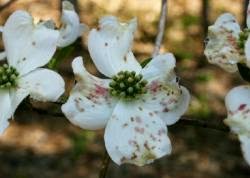
Dogwood blossoms on Good Friday
My favorite local Easter legend is #81 on the list of 100 Great Things about Jackson County, Florida.

Please click here to see the entire list as it is unveiled.

The beautiful dogwood tree is one of the best things about spring in the Deep South. The little trees shed their leaves in the winter after offering a beautiful burst of fall red color, but then in the spring they bloom with an incomparable glory of white blossoms.

Popular tradition in Jackson County associates them with the crucifixion and resurrection of Jesus Christ.

According to the story, the dogwood once grew much larger and served a terrible purpose. Its wood provided the cross on which Jesus was crucified.
A wild dogwood in bloom.

As Christians know, the story of the crucifixion is one of both great horror and great redemption. Good Friday, which is being observed across the world today, is remembered as the day on which Christ was nailed to a cross outside the walls of Jerusalem. It is remembered with horror because of the great suffering and cruelty he suffered. It is remembered as a day of great redemption, because it was the day on which he took the sins of the world upon his own shoulders and gave his life that we might live.

As Jesus said, "Greater love hath no man than this, that a man lay down his life for his friends." By laying down his life for us on Good Friday, he offered us all a better world and a brighter future.

The Legend of the Dogwood holds that because the tree served a terrible yet necessary purpose in providing the cross on which Jesus sacrificed his life for all people, it was altered and yet saved by God. Its size was reduced so that no dogwood would ever again grow large enough  to be used in a crucifixion. Then, to make up for its loss in stature, God blessed the tree with its beautiful blossoms.
Dogwood tree in bloom.

The blooms of the dogwood come to life each spring just before Easter to remind us of the resurrection of Jesus Christ. To help in this annual rite of remembrance, the blossoms were given special features. They are formed of four petals, with each blossom taking the shape of a cross.

The center of the flower symbolizes the crown of thorns that was placed on Jesus' head and the tip of each petal is indented with the prints of the nails that penetrated his hands and feet. And finally, by Good Friday of each year red spots appear on the beautiful white blossoms to symbolize the drops of blood that spilled from the body of the Savior.

The legend is an old and treasured part of Southern culture and history and is #81 on our list of 100 Great Things about Jackson County, Florida.

Happy Easter!


Monday, April 7, 2014

#83 The Gopher Tortoise (100 Great Things about Jackson County, Florida)

Gopher Tortoise
The fascinating and stately gopher tortoise is #83 on our list of 100 Great Things about Jackson County, Florida.

Please click here to see the full list as it is unveiled.

Gopher tortoises (Gopherus polyphemus) - or "gophers" as they are called locally - favor dry sandy lands and the piney woods of Jackson County are among their favorite habitats. My dad always said you could tell a Yankee from a Native Floridian by their definition of the word "gopher." A Yankee, he noted, thought that gophers had fur and were mammals. Native Floridians knew, of course, that gophers were tortoises!

A gopher tortoise out for a stroll.
Gophers are tortoises, not turtles. Both are reptiles, but turtles live in the water and tortoises live on dry land.

They live in burrows in the ground, some of which can be impressive in size. I've never been to the bottom of a gopher tortoise burrow, but the Florida Fish and Wildlife Conservation Commission indicates they average around 7 feet deep and 15 feet long, although burrows as long as 40 feet have been found.

A gopher tortoise heads for its burrow.
You can tell if a gopher tortoise is living in a burrow by looking at the shape of the opening. If the burrow entrance is half-moon in shape, the odds are that a gopher tortoise still lives there. If the burrow entrance is round, that usually means that the tortoise has moved on and an armadillo has taken up residence.

Be aware that abandoned gopher tortoise burrows are favorite homes for rattlesnakes.

During the War Between the States (or Civil War), soldiers from the Florida Panhandle were called "Gophers" because they liked to eat gopher tortoises so much. Private Wade H. Richardson of the 1st Florida U.S. Cavalry noted that the term was "derisive."

In fact, gopher tortoises were hunted almost to extinction during the late 1800s and early 1900s. Once considered a delicacy, they were shipped out commercially to restaurants all over the country aboard steamboats from ports including Old Parramore in Jackson County and Vernon in Washington County. Vernon, in fact, was once believed to be the largest gopher shipping point in the world. They remained important commercially until the dwindling population forced restaurants to switch to sea turtles for their soups and stews.

Headed underground in a cloud of dust!
The tortoises were favorites of sailors and sea captains during the 1700s and 1800s because they could be kept alive in the holds of ships and pulled out whenever the cook needed fresh meat! They remained popular for this use until refrigeration became commonplace on ocean-going vessels.

When the Great Depression swept across Florida in 1929, gopher tortoises became to residents of rural Jackson County what possums were to the residents of Wausau in Washington County. Nicknamed "Hoover Chickens" after President Herbert Hoover, they provided meat for hungry families.

A threatened species today, gopher tortoises still live in all 67 of Florida's counties. They usually graze within 150 feet of their burrows, which are common in pastures and pine woods. Controlled burns are vital to their survival, because they help assure that tender grasses and plants are available for them to eat. It is illegal to kill them or disturb their burrows.

Good places to see them include Three Rivers State Park, Florida Caverns State Park, the Upper Chipola WMA north of Marianna and Apalachee WMA north of Sneads.

If you would like to learn more about gopher tortoises, FWC has an excellent brochure available for download:  A Guide to Living with Gopher Tortoises.


Tuesday, April 1, 2014

Ghost Town of Old Parramore in Jackson County, Florida

Crumbling tobacco barn in Old Parramore
Old Parramore is an almost forgotten ghost town in eastern Jackson County, Florida.

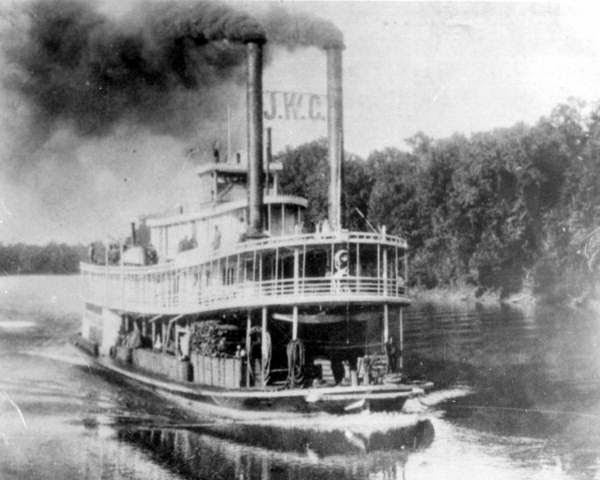
Established in the years after the War Between the States (or Civil War), it was a major riverboat port that came into existence as the local economy shifted from cotton production to naval stores and timber. Paddlewheel boats like the John W. Callahan and W.C. Bradley provided transport for these commodities.

https://twoegg.blogspot.com/2015/01/52-did-titanic-curse-sink-john-w.html
The John W. Callahan often stopped at Old Parramore
Five different riverboat landings served the growing community, providing places where paddlewheel steamboats could edge up to the bank of the Chattahoochee River to load or unload passengers and cargo. The most important of these was Peri Landing (pronounced "pea-rye"). It was located on a bend of the river just north of today's Parramore Landing Park.

A warehouse landing, Peri had storage facilities where farmers and businessmen could leave bales of cotton, timber and other cargo for the riverboats to transport either upriver to Columbus, Georgia, or downriver to Apalachicola, Florida. It holds a unique although forgotten place in local history as the eastern end of a major county road built in 1914 to connect western Jackson County with the Chattahoochee River. The steel Bellamy Bridge over the Chipola River that so many people love and remember was built as part of an upgrade associated with the building of the new road to Peri Landing.

Annual Oak Grove Homecoming at Old Parramore
Back on the high ground away from the river, the town of Parramore grew. It was centered around today's intersection of Oak Grove and Parramore Roads and at its height included at least five stores, blacksmith shop, cotton gin, sawmill, gristmill, post office and more. Large naval stores operations grew around the town, with turpentine stills operating in almost every direction. Local senior citizens recall how they could look to the horizons and see the stacks of the stills streaming black smoke into the air.

Site of Old Parramore business district today.
Railroads and modern highways eventually put the paddlewheel riverboats out of business and Old Parramore vanished with them. One by one the stores, turpentine stills and other businesses faded away. All that is left today are a couple of historic houses, a one-room school, cemeteries and the ruins of Central School.

Making hush puppies at the annual Central School Reunion
Two annual events bring the vanished town back to life each October. The annual Oak Grove Homecoming has been taking place for more than 50 years and features music, historical discussions, a brief sermon and dinner on the grounds. Each year, dozens of current and former Parramore residents and their families attend, along with those who come to learn more about the historic community.

The other event is the Central School Reunion. Former students and their families gather each year at the ruins of the historic school to remember the days of their youth.

If you would like to learn more about this significant Jackson County ghost town, please consider my book:

Old Parramore: The History of a Florida Ghost Town [Book]

Old Parramore: The History of a Florida Ghost Town [Kindle]


Monday, March 31, 2014

#86 The Graceville "Spook Lights" (100 Great Things about Jackson County, Florida)

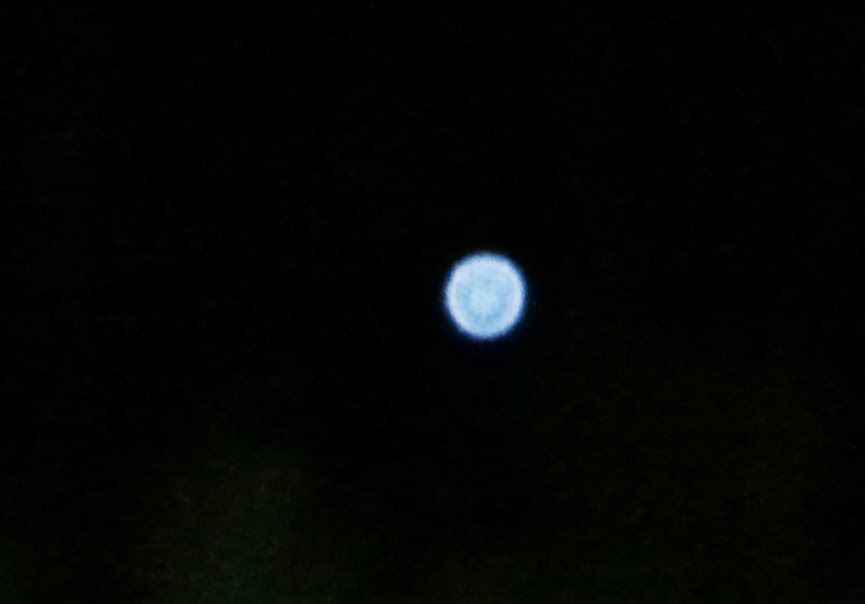
The Graceville Spook Lights
The mysterious Graceville Spook Lights are #86 on my list of 100 Great Things about Jackson County, Florida.

Please click here to see the entire list as it is unveiled.

On the west side of Graceville, there is a spot where you can look up the old railroad bed and see two strange lights that appear at unpredictable intervals almost every night. Legend says the lights are the unhappy ghosts of a man and woman who were hanged from the railroad trestle over 100 years ago.

Graceville Spook Lights
To see them, head west on State Highway 2 across Holmes Creek into Holmes County and turn left onto St. Johns Road. Pull off the side of the road and walk back east on Highway 2 a short distance to the old rail bed. From that point, if you look up the old railroad into Graceville and have a little luck, you will see the lights. You have to look for them from the Holmes County side of the line, but the lights themselves are in Jackson county.

(One note, please respect private property rights and don't walk up the old railroad bed to try to see them better. Not only is it disrespectful, illegal and dangerous, the lights will just vanish. They can only be seen from the spot by Highway 2. Also, please do not stand in the roadway!  You might become a ghost yourself.)

Now on with the story...

Spook lights or ghost lights are popular parts of Southern culture and folklore. North Carolina has its Maco Light. Georgia has the Surrency Spooklight. Arkansas is known for the Gurdon and Dover Lights and Missouri is famed for the Seneca Light. Like the Graceville Spook Lights, such phenomena appear almost nightly under the right conditions.

The ghost story behind the Graceville lights revolves around the all but forgotten 1910 hangings of Hattie Bowman and Edward Christian. The two had been arrested on charges related to the murder of Deputy Sheriff Allen Burns, who had gone to Bowman's home while investigating the theft of a gold watch from a Graceville merchant.

Residents of northwestern Jackson County were infuriated by the murder of Deputy Burns. A large group of people forced their way into the jail on the night of September 2, 1910, and dragged away the prisoners:

Graceville, Fla., Sept. 3 - Dangling from a trestle just outside the town, this morning, were found the bodies of Ed. Christian...charged with shooting Deputy Sheriff Allen Burns, and Hattie Bowman...who had been arrested on the charge of being implicated in the crime. (Toledo Blade, September 8, 1910)

The mob had taken Christian and Bowman to the trestle over Holmes Creek, tied nooses around their necks, tied the other ends of the ropes to the trestle ties, and kicked the two off the bridge. No one was ever arrested for their murders.

Graceville Spook Lights
Two strange flickering lights have been seen ever since from the point where the railroad crosses the road just west of Graceville. The lights are best seen in the winter, when the leaves have fallen from the trees, and first appear as a bare flicker, then grow in brightness briefly before fading away. Legend holds they are the ghosts of Hattie Bowman and Edward Christian, still seeking justice 104 years after they died.

While the story itself is tragic, the mysterious lights are on the list of 100 Great Things about Jackson County, Florida.

The story is included in my book, The Ghost of Bellamy Bridge: Ten Stories of Ghosts & Monsters from Jackson County, Florida. It is available at Chipola River Book & Tea in downtown Marianna or online from Amazon.com in both print and Kindle editions:

The Ghost of Bellamy Bridge [Paperback]

The Ghost of Bellamy Bridge [Kindle]