A Two Egg TV Page. See more at https://twoeggtv.com.
Showing posts with label marianna. Show all posts

Tuesday, August 13, 2024

Jackson Blue Springs sees surge in visitation!


Attendance Up by 50% at Jackson Blue Springs

Marianna, Florida - One of Jackson County's busiest tourist attractions is having another record year. Jackson Blue Springs - the county's second most visited spot behind Florida Caverns State Park - is drawing guests at a rate 50% higher than last year. And last year's visitation doubled that of the previous year.

The statistics are courtesy of Taylor Elliot from Coldwater Outfitters, the private company that now manages the springs for the Jackson County Board of County Commissioners. 

Two Egg TV's Kyla Clifton and Maison Dickson Fulton visited Jackson Blue Springs in August 2024 for a closer look at what is bringing the park such success!


Check out this video to learn about other great springs in West Florida:


Saturday, April 6, 2024

Florida Caverns employees given questionable treatment by Marianna newspaper

First Lady Casey Desantis, State
Parks Director Chuck Hatcher
& Park Manager Billy Bailey
at Florida Caverns State Park
during better days.
Newspaper neglects key facts in Florida Caverns story.

Commentary by Dale Cox

Note: This is a commentary that includes quite a few facts about the controversy surrounding the severe punishment of seven employees at Florida Caverns State Park. Please take the time to read it and I think that you will learn much about what has been taking place. You will also learn about some objections I have with last week's coverage of the issue in the Jackson County Times, a local newspaper based in Marianna. By way of disclosure, I have friends on all sides of this issue and am trying to be respectful to all involved. I also believe, however, that there is right and there is wrong.

Two Egg, Florida - The editor of a weekly newspaper in Marianna failed to mention a few things when she published a somewhat disjointed article about the controversy over severe punishments handed down for seven  employees at Florida Caverns State Park last week

No Illegal Acts

For example, Shelia Mader, the editor under whose byline the story appeared, did not mention that all of those employees - three of whom have worked at the beloved Marianna park for a combined sixty-four years - were cleared of any and all criminal violations of Florida law. (1) (Note: References appear at the bottom of this column).

She also did not mention that the Office of the Inspector General of the Florida Department of Environmental Protection recommended not the massive crackdown on employees at Florida Caverns State Park that has taken place in recent weeks, but simply stated:  "Based on the outcome of the investigation, as well as the analysis of archaeological materials confiscated from the park by McFadden and Frederick, we recommend that the Division ensures all Park staff are all properly trained on protecting natural and cultural resources in the Park." And yet that one sentence constitutes the entire "Recommendations" part of the 22-page report from the Inspector General's office. (2)

Perhaps most curious of all, the newspaper failed to explain why - with its own connection to one of the key people involved in the situation at the park - it was writing a supposedly unbiased story about it in the first place. After all, wouldn't a truly balanced and fair media outlet tell its readers that it was connected to people on one side of the story or the other?

A Family Matter?

The Jackson County Times failed to disclose to its readers that it has close personal ties to the Director of Florida State Parks. Chuck Hatcher is the man who made clear to employees at the park that he approved of the harsh punishments handed down against them. His father, Woody Hatcher, is the former county judge of Jackson County judge and the owner and publisher of the Jackson County Times. (3)

I asked Shelia about this:

Question: As editor of the paper and writer of the story in question, why did you not feel it necessary to disclose the relationship between the ownership of the Jackson County Times and one of the key figures (Chuck Hatcher, Director of Florida State Parks) in this matter? (4)

Answer: I received all information quoted in the paper from the State of Florida. None of the documents I received made mention of Chuck Hatcher in any capacity. Therefore, I felt there was no need to include him in the article. (5)

Park Manager Billy Bailey at a
Caverns Cultural Celebration
event enjoys speaking with
noted artist Lillie Clark.

I am not suggesting that a father who owns a newspaper would use his publication's pages to support his son in a controversial issue involving popular local park employees. I am questioning whether a writer not disclosing the connection in this particular story was a serious breach of journalistic ethics. 

This is what the Code of Ethics assembled by the Society of Professional Journalists says about the matter: "Avoid conflicts of interest, real or perceived. Disclose unavoidable conflicts." (6)

The same society recommends for further reading an article by journalism expert Tony Rogers, who included this on his list of recommendations for avoiding conflicts of interest:

Don't Cover Friends or Family Members. If you have a friend or relative who is in the public spotlight....you must recuse yourself from covering that person as a reporter. Readers simply won't believe that you'll be as tough on that person as you are on everyone else — and they'll probably be right. (7)

I asked Shelia if as the editor of a small town newspaper she was familiar with the SPJ's Code of Ethics and whether she believed they represented "best practices" for journalists. This is what she told me:

Answer: I am familiar with the SPJ Code of Ethics. I strive very hard to be fair to everyone involved in any story I write. That is why I waited until the Times had received all information from the state and quoted their findings and standings. (8)

She went on to state: 

 As an added note, the TIMES also published a Letter to the Editor in the same edition from a supporter of the park employees. We, in no way, voiced an opinion one way or the other in reference to the actions taken by the State. (9)

So, if the Jackson County Times was familiar with one of the best known code of ethics for journalists, and if the newspaper was familiar with all with the workings of state government, they surely must have known that this many employees at a premier Northwest Florida state park do not get severely punished without the Director of the state park service knowing about it.

Why not just fess up and admit that your newspaper has an above average family collection to the state park service director?

I do hope that all of the writers at the Jackson County Times will not just familiarize themselves with the SPJ and its Code of Ethics, but follow them. All communities need good sources of strong, independent, and fair local journalism. Newspapers should not be there to smooth things over for those with influence. They should treat everyone the same and tell all stories the same.

Innocent until proven guilty? Not in Jackson County!

Something struck me as I read the story in the Jackson County Times (or TIMES, as they prefer). I will let them battle out the capitalization and branding issue with that other TIMES in New York some day. 

Without getting too deep in the muck, it bothered me that no where in the article was there a comment, a "no comment," or even so much as a mention as a "The Times has not heard back" from any of the Florida Caverns employees named in the story.  (10)

I spent decades of my life in journalism, working my way up from the bottom (and believe me, it was the bottom) at local radio stations to managing newsrooms for some of the largest national media companies. There was always one true and fast rule above all others: No story ever ran without a serious effort to obtain all sides.

I tried to contact some of the Florida Caverns State Park employees named in the Jackson County Times story. I only heard back from Park Manager Billy Bailey in the time available before the publication of this story. He would not comment on the events of the investigation itself, but did say that he had not been contacted by the Times. (11)

I asked Shelia about this:

Answer: The allegations published were already a matter of public record. I did not contact any of the four employees involved in the issues at the Park. (12)

First, there are actually seven employees involved in the issues at the park, not four - if you do not count the employee who filed truth-challenged allegations in the first place. (13)

Second, just because an allegation is a matter of public record, a newspaper assumes that the accused no longer are entitled to defend themselves in anyway? This is America and these people were not found guilty in a court of law or even charged with a crime - in which case they would still be innocent until proven guilty. These are state employees who have been accused of crossing the lines of administrative rules at an environmental agency. 

There are many state employees in Jackson County. I hope that they all pay attention to the above answer from the Jackson County Times, because the newspaper has made clear exactly how it will treat you should you ever be accused of breaking an administrative rule of any type. It won't  bother to even contact you and give you a chance to defend yourself. A mere accusation in the public record is enough.

By the way, I also contacted Chuck Hatcher, director of Florida's state parks, to give him a chance to comment for this column. I have not heard back from him but should he answer my questions, I will happily add his comments.

Who writes what and when?

Something else also bothered me about the article. I had read and heard parts of it before, specifically on WMBB News 13 in Panama City. I asked Shelia about this:

Question: I noticed that the story published under your byline included, verbatim and unattributed, sentences and phrases from an earlier story by Cortney Evans of WMBB. I do realize that the Jackson County Times has a cooperative arrangement with WMBB, but is it your regular practice to publish under your own byline the work of another local reporter without giving that individual credit?

Answer:  The Times does share a partnership with WMBB.  The full interviews were forwarded to me and those that were published were the ones I opted to use. (14)

Fair enough, as far as it goes, but I was hoping that she would specifically address not the quotes from the recordings that WMBB made during interviews with local supporters of the park employees recently, but actual writing from her story itself. Shelia published under her own name lines lifted from the story written by Cortney Evans of WMBB. Here are a couple of examples:

Cortney Evans, WMBB: "The state completed an investigation at the park about the handling of wildlife and historical artifacts. 

Shelia Mader, Times: "The state completed an investigation at the park about the handling of wildlife and historical artifacts.

Cortney Evans, WMBB: "But, some of those heroes are now being reprimanded by the state. Cox said one of the allegations involves how they handled the rehabilitation of a baby owl.

Shelia Mader, Times: "Some of those employees are now being reprimanded by the state. One of the allegations involves the handling of the rehabilitation of a baby owl. (15)

Note that the Jackson County Times downplayed WMBB's description of the park employees as "heroes." Some of them stayed in the park through Hurricane Michael to protect it from looting. 

What really happened at Florida Caverns?

The situation at Florida Caverns State Park started when a relatively new employee decided that he did not like the way things were being done there. He started keeping notes on things ranging from how many minutes per day each of his fellow employees worked - apparently doing this while on his own work time - to the fact that some employees were rehabilitating injured or unhealthy wildlife or even picking up bottles, cans, and in two cases prehistoric artifacts they thought were endangered in a fire line in the park. He ultimately filed a complaint against several of his fellow employees and managers. (16)

This complaint was turned over to the Office of the Inspector General of the Florida Department of Environmental Protection. They started an investigation at the park last fall and concluded it in February of this year.

Because the investigation involved artifacts and archaeological sites, the Office of the Inspector General also involved Dr. Paulette McFadden from the Florida Division of Historical Resources. She is the Archaeologist for State Lands. I have attempted to reach her, but she does not respond to my efforts. I am told by park employees, though, that on her first visit to the Caverns she pointed to a framed collection of what most of us would call "arrowheads" and explained that they provided a good example of why the investigation and her work were so important. She told them the collection was a great example of artifacts from the area and she wanted to assure that information about them was preserved. Park employees subsequently explained to her that it was a collection for display only that had been donated to the park by former visitors and that the artifacts actually came from Indiana. None of them were local. 

Two reports were produced by these investigations, one by Dr. McFadden and the other by Inspector General Candie Fowler.

The reports revealed that the original complaint was less than accurate. Animals had not been removed from the park, as he had stated, nor were artifacts being as routinely collected as alleged. 

In fact, a baby owl and baby opossum had been rehabilitated by Park Manager Billy Bailey and returned to the wild in the park. Apparently, this is against the rules of the Florida Department of Environmental Protection. Two grass snakes had been used by park employees in interpretive programs with park visitors. This was also against state environmental rules. No laws were broken. No criminal acts were committed. 

A few park employees picked up old bottles and cans from trash piles around the closed Florida Caverns Golf Course (which the state plans to bulldoze and replace with a new RV park type campground). It appears that bulldozing the historic golf course is not an issue, but picking up old bottles and cans from trash piles near it is a violation of rules regarding historic artifacts. None of these artifacts ever left the park. Nothing was sold. No digging was done. No laws were broken. No criminal acts were committed.

Finally, new fire lines were plowed by the Division of Forestry when a prescribed burn got out of control in the park. While inspecting the fire lines after the fire, Park Manager Bailey and other employees noticed chert (flint) chips and a few other artifacts on the surface of the ground. Concerned that these might be damaged when the fire line was plowed again, they collected them and placed them in storage in the park. They were required to notify the Florida Division of Historical Resources of the newly discovered sites, which they failed to do. No artifacts were sold. No artifacts left the park. No digging was done. No laws were broken. No criminal acts were committed. (17)

While at the park, investigators seized multiple boxes of artifacts. The Jackson County Times showed a couple of these by reprinting photographs from the Inspector General's report. In fact, there have been boxes of artifacts in storage at Florida Caverns State Park for decades. A letter in my collection from Dr. A.R. Kelly of the National Park Service to Lewis G. Scoggins, Director of the Florida Park Service, written in 1946 shows that boxes of artifacts were sent to the park for storage that year:

Reference is made to your letter of inquiry to the Region One Office, National Park Service, concerning Florida Caverns archeological collections stored at Ocmulgee National Monument. Regional Director Allen, on March 19, has advised that this material has not been restored.

On March 14 to 17, consecutively, we sent the material by parcel post to Florida Caverns. There are four boxes containing the pottery which should be received by now. 

We regret that restoration of the pottery for purposes of exhibit was not completed due to the cessation of laboratory work during wartime [i.e., World War II]. (18)

These boxes of artifacts included material excavated at the park between 1930 and 1940 by archaeologists from the National Park Service. All of those artifacts have been carefully protected without issue by park employees for more than 75-years. They were never taken out of the park by anyone until the State of Florida seized them and took them to Tallahassee as part of this investigation.

These important cultural materials came from the caves and surrounding archaeological sites at Florida Caverns. Nothing wrong took place regarding them. They are now in Tallahassee and will likely never be returned to the community where they belong. Instead they will be placed in a basement in the capital city and forgotten. At Florida Caverns, they were perfectly safe and well-protected by a dedicated and conscientious team of employees that for three-quarters of a century made sure that nothing happened to them.

The Reports

I requested copies of the archaeological investigation from Dr. McFadden and the inspector general's investigation from Parks Director Hatcher under the provisions of Florida's Open Records laws. Neither of them responded to me. 

I subsequently contacted Inspector General Fuller directly and received an immediate response and within three hours a copy of the requested report. I repeated my request to Dr. McFadden for a copy of the archaeological report one week after my original, this time copying it to her boss as well, and immediately received a copy from the the Division of Historical Resources. (19)

 I still have heard nothing from Dr. McFadden or Chuck Hatcher themselves. I am also still waiting for the state to comply with public records requests for emails surrounding the investigation.

Park Manager Billy Bailey

So what happened to the seven employees at Florida Caverns State Park? I want to be a little careful here because these are good people who are trying to make the best of a bad situation. None of them have opted to go public about their situation. They are voiceless because speaking out could cost them their jobs, benefits, and more.

I will say this about park manager Billy Bailey, since the media and State of Florida press person Brian Miller chose to name him. He is a good person, a Christian, a good father to his daughters, and a gentleman. He has worked at Florida Caverns State Park for 18-years, starting off as a volunteer, and working his way up to park manager. I have known him for most of that time, am proud to call him my friend, and stand by him in this very difficult time. 

If you know me, then you know how much I care about our cultural resources. I am as familiar with the cultural resources of Florida Caverns State Park as anyone alive, more so than Dr. McFadden or anyone from Tallahassee. No one on that park staff, especially Billy Bailey, has intentionally done any significant damage to major archaeological sites at the park. In fact, removing them from the park will do more damage to the really important archaeological sites of the caves than any other single thing that could be done short of demolishing the park itself.

The claim by the state that Billy "chose" to resign is laughable. His choice was simple, resign or be fired. He "chose" to resign so that he could try to find employment with a different state agency in hopes of supporting his family. It is funny how far some people will take things when they don't want you around anymore. Billy deserves a good job even if those of us, his friends, fail in our effort to find mercy for him and the other employees from the leaders of the all powerful state.

Because park managers are "at will" employees, Billy cannot appeal his situation. He is literally without a way to defend himself even though he committed no criminal acts and the only recommendation suggested by the investigators was that he and other park employees receive additional training.

The Florida Caverns Seven and State Employees

In addition to Bailey, there are six other employees of the park caught up in this situation. I will not name them because they have chosen not to name themselves. The Jackson County Times printed parts of the Inspector General's report naming some of them while, at the same time, restricting information about the park itself and leaving out other parts of the report. I regret this because the employees themselves are trapped in a situation where they are forced to remain silent and voiceless in order to protect what remains of their careers. It strikes me as unfair to name them if they can't defend themselves.

The Society of Professional Journalists' Code of Ethics agrees in more than one of its rules:
  • Balance the public's need for information against potential harm or discomfort. Pursuit of the news is not a license for arrogance or undue intrusiveness.
  • Show compassion for those who may be affected by news coverage. Use heightened sensitivity when dealing with. . . subjects who are inexperience or unable to give consent.
  • Recognize that private people have a greater right to control information about themselves than public figures and others who seek power, influence, or attention. Weigh the consequences of publishing or broadcasting personal information. (20)
In this case we have a situation where a media outlet has printed allegations of broken administrative rules in an environmental agency against state employees who cannot speak up to defend themselves.
 

Conclusion - Five Questions


I know that I have written long, but this is important, especially for these seven park employees and all other state workers in Jackson County. My dad was a state employee. Here are the key questions that I hope you - and the staff and owners of the Jackson County Times - will consider:
  1. Have our friends and neighbors at Florida Caverns State Park been treated fairly by all of us, by the State of Florida, and by the local newspaper?
  2. Do all seven of the park employees deserve a second chance? I've been wrong more than I've been right in life and without second chances, I don't know where I would be today.
  3. Should 18 or 28 years on a job at one place count for something, especially if you work for the state or county? Should dedication still mean anything?
  4. Should a local newspaper be honest when it has connections to people of power on one side of a story? Should it do its best to be balanced and fair about the local news. Does everyone that it covers deserve a fair shake, regardless of how much money they have or political power they might wield?
  5. When an investigation says that someone is cleared of a crime, should a news story include that fact? When the recommendation of an inspector general is for more training, is that an indictment of the employees themselves, or of their supervisors in Tallahassee?
Thank you.


References:

(1) Jackson County Times, April 4, 2024.
(2) Final Report of Investigation, II-01-07-2023-221Department of Environmental Protection, Office of Inspector General, Internal Investigation, February 16, 2024.
(3) Jackson County Times, April 4, 2024.
(4) Dale Cox to Shelia Mader, April 6, 2024.
(5) Shelia Mader to Dale Cox, April 7, 2024.
(8) Shelia Mader to Dale Cox, April 7, 2024.
(9) Shelia Mader to Dale Cox, April 7, 2024.
(10) Jackson County Times, April 4, 2024.
(11) Billy Bailey, verbal confirmation to Dale Cox, April 5, 2024.
(12) Shelia Mader to Dale Cox, April 7, 2024.
(13) Confidential Source at Florida Department of Environmental Protection, Tallahassee, Florida.
(14) Shelia Mader to Dale Cox, April 7, 2024.
(16) Confidential Source at Florida Department of Environmental Protection, Tallahassee, Florida.
(17) Final Report of Investigation, II-01-07-2023-221Department of Environmental Protection, Office of Inspector General, Internal Investigation, February 16, 2024; McFadden, Dr. Paulette, and Cassandra Freeman, "Florida Caverns State Park: Analysis of Archaeological Materials Confiscated from the Park," Department of State, Division of Historical Resources, Bureau of Archaeological Resources, Public Lands Archaeology, January 10, 2024.
(18) Dr. A.R. Kelly to Lewis G. Scoggins, March 22, 1946, Park Archives, Florida Caverns State Park, Marianna, Florida (Copy in writer's personal archives).
(19) Final Report of Investigation, II-01-07-2023-221Department of Environmental Protection, Office of Inspector General, Internal Investigation, February 16, 2024; McFadden, Dr. Paulette, and Cassandra Freeman, "Florida Caverns State Park: Analysis of Archaeological Materials Confiscated from the Park," Department of State, Division of Historical Resources, Bureau of Archaeological Resources, Public Lands Archaeology, January 10, 2024.


Sunday, April 30, 2023

The Great FOOTBALL Clash between MALONE & MARIANNA!

 1925 Pigskin Classic Electrified Jackson County!

by Dale Cox

Legends still persist in northern Jackson County about the days one century ago when Malone High School teams dominated not just the hardwood, but the gridiron, too!

Some of them are fairly exotic: "Malone once beat Auburn University in an exhibition game!" "The Tigers were so good at football that the politicians from Marianna had their team shut down!" There are a host of others - some of them far less glorious.

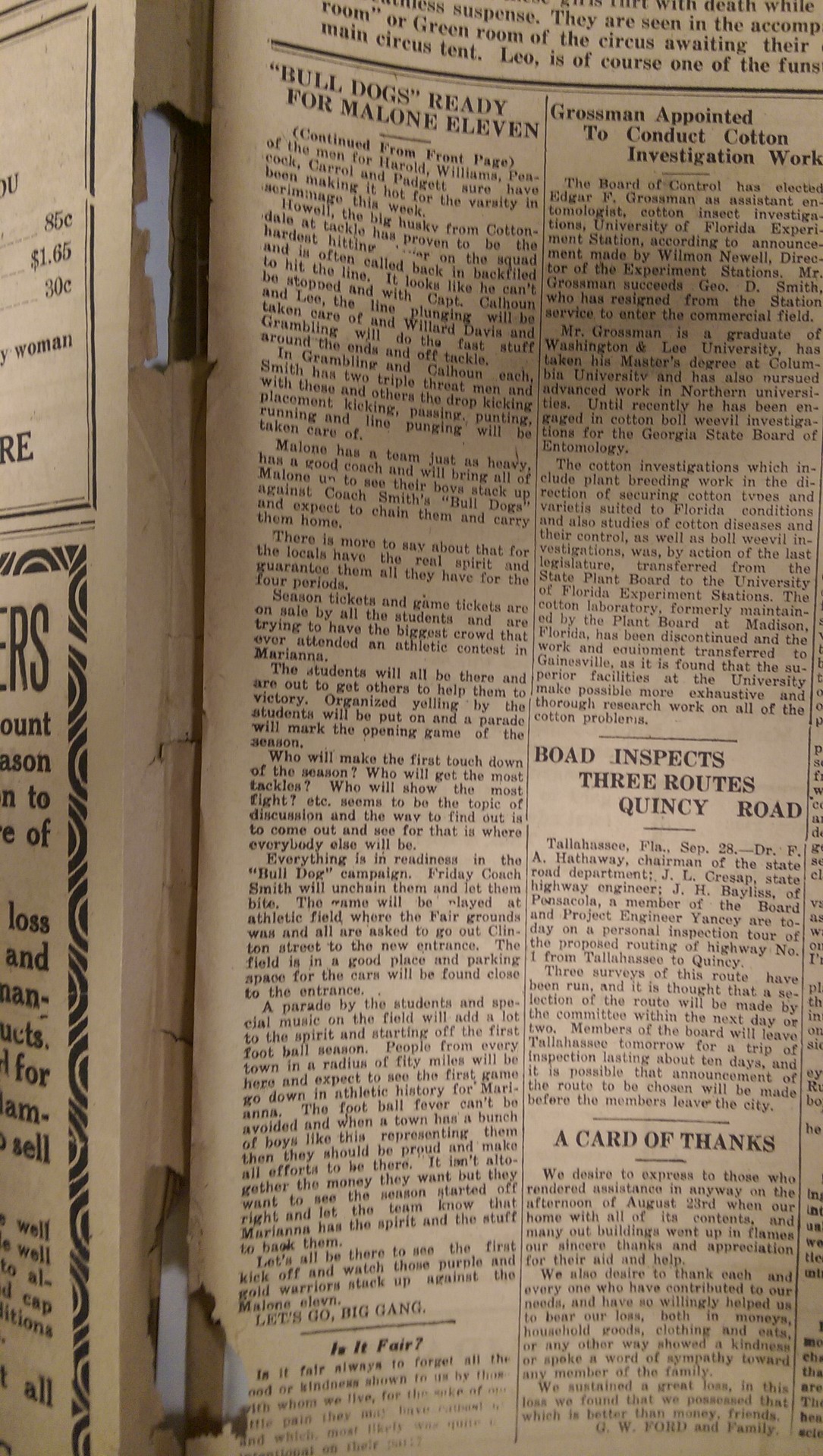
The truth of the matter is that the basketball powerhouse from the peanut fields fielded such a good football team in 1925 that news of the arrival of the Tigers in Marianna to play the hometown Bulldogs drew frontpage headlines. 

The following appeared in the Marianna Times-Courier on October 1, 1925:


As promised, the game was played before the largest crowd ever to attend a sporting event in Jackson County to that date. 

It was a "3-yards and a cloud of dust" slug fest that Marianna won, 7-6.


Thursday, October 8, 2020

The Marianna UFO of 1955


UFO (unidentified flying object) stories are now part of American culture, albeit a hotly debated part. In 1955, however, they were breaking news and the military often kept them top secret. Such was the case with an incident that year in the skies over Jackson County that ranks as one of the nation's first government-verified UFO sightings.

Today's Marianna Municipal Airport was the home of Graham Air Base in 1955. Opened in 1953, Graham Air Base was a U.S. Air Force Contract Primary Flying Training Base where many of America's top Cold War and Vietnam era pilots were trained. Home to the 3300th Pilot Training Group, it provided pilot training on AT-6, PA-18, T-28, and T-34 propeller aircraft until 1957 when T-37 jet trainers were added to compliment.

On December 6, 1955, a civilian radar operator was working his normal shift at Graham Air Base when he detected something unusual on his scope. An unidentified object suddenly streaked into radar range, entering Jackson County from the south at a high rate of speed.

As the operator watched by radar, the UFO flew over Jackson County at a speed faster than any known U.S. Air Force plane. It first appeared to be following the Apalachicola River but angled to the northwest as it passed over Jackson County, a route that carried it close to both Marianna and the airbase.

USAF Record Card of Marianna UFO
When first observed, the object was flying at an altitude of about 15,000 feet, but as it streaked north over Alabama it climbed to an altitude of 30,000 feet.  It was lost from radar as it passed over Maxwell Air Force Base in Montgomery, Alabama.

Alarmed by the approach of the object, the Flight Service Center commander at Maxwell notified the Air Defense Command at Colorado Springs, Colorado, and the Air Force Chief of Staff in Washington, DC:

...One unidentified flying object sighted over Marianna FLA at 0100E Aircraft radar. Object at 15000 feet over Marianna FLA. Object proceeded to Montgomery ALA climbing to 30,000 FT elapsed time of object from Marianna FLA to Montgomery ALA five minutes. Object presently over Maxwell AFB. - Project Blue Book Record, U.S. Air Force, December 6, 1955.

Graham Air Base Historical Marker
Whatever it was, the UFO traveled the distance from Marianna to Montgomery (around 140 miles) in just five minutes. That equals around 28 miles per minute or 1,680 miles per hour.

Kept top secret at the time, the sighting was investigated by the U.S. Air Force as part of its "Project Blue Book." Between 1952 and 1970, Air Force investigators examined 12,618 alleged UFO incidents. Of that number, only 701 remain listed as "unidentified." The 1955 Marianna incident is one of those 701 cases.

Graham Air Base in the 1950s.
State Archives of Florida/Memory Collection
According to the Project Blue Book record card for the incident, investigators were unable to classify the UFO sighting due to "insufficient data for evaluation."

At least one person reported seeing an object in the sky over northern Jackson County at about the time of the incident. The eyewitness later recalled that he was on a trip from Alabama to Florida with his parents along US 231 when they suddenly saw an unidentified object fly over the highway near the Florida-Alabama line. He described it as a saucer-shaped object with red lights around its bottom. It made no sound. Whether it was the UFO picked up by radar operators is not known.

To this day, the Marianna UFO of 1955 has never been explained. 

Tuesday, September 1, 2020

Marianna imposes mandatory Mask Order for businesses


The Marianna City Commission imposed the following by a 4-1 at its meeting on Tuesday, September 1, 2020. It takes effect immediately:


EMERGENCY ORDINANCE NO. 2020-___ E

AN EMERGENCY ORDINANCE OF THE CITY COMMISSION OF THE CITY OF MARIANNA,

FLORIDA, FINDING THAT A PUBLIC EMERGENCY EXISTS; REQUIRING EMPLOYEES IN BUSINESSES TO WEAR A FACE COVERING; PROVIDING FOR EXCEPTIONS; PLACING ADDITIONAL STANDARDS ON RETAIL ESTABLISHMENTS, FOOD SERVICE ESTABLISHMENTS AND BARS; PROVIDING PENALTIES FOR VIOLATION OF THIS ORDINANCE; PROVIDING FOR SEVERABILITY; AND PROVIDING AN EFFECTIVE DATE.

WHEREAS, The City of Marinna (“City”) is a municipality granted home rule authority pursuant to Article VIII, Section 2 of the Constitution of the State of Florida and may exercise its governmental, corporate and proprietary powers for municipal purposes, including to regulate for the protection of the public health, safety and welfare; and

WHEREAS, the City of Marianna is empowered, pursuant to Section 166.041(3)(b), Florida Statutes, to adopt emergency ordinances by a two-thirds majority vote; and WHEREAS, the World Health Organization, U.S. Health and Human Services Secretary, President of the United States, Governor of the State of Florida and the City of Marianna have all acknowledged and declared the outbreak of the novel coronavirus, COVID-19, to be an international, national, state and local emergency; and

WHEREAS, on March 9, 2020, the Governor of the State of Florida issued Executive Order 20-52 authorizing, among other things, local governments to execute their authority under the State Emergency Management Act; and

WHEREAS, since March 17, 2020, the City Commission has taken careful and measured action by Resolution and Emergency Ordinances to balance the public health and safety while also monitoring the need to allow for recreational and commercial activity to safely continue; and

WHEREAS, on June 3, 2020, the Governor of the State of Florida issued Executive Order 20-139 enacting the “Phase 2: Safe. Smart. Step-By-Step Plan for Florida’s Recovery” which expanded guidelines on safe congregations and recreational activities; and 

WHEREAS, the City is home to the Florida Caverns, Blue Springs, the Chipola River and other natural and eco-friendly areas to many visitors each year, while also serving as the permanent home for approximately 6,500 residents; and

WHEREAS, U. S. Highways 90, 71 and 73 as well as Interstate 10 are main travel routes for visitors coming into the State of Florida from other states and for Floridians traveling east toward Tallahassee, Jacksonville, Gainesville, Orlando and central and south Florida, and traveling west toward Pensacola, Mobile, New Orleans and other states; and

WHEREAS, since the reopening of the City’s recreational areas and local businesses under the enactment of Phase 2 Reopening, the City has seen an influx of visitors, and many of these visitors are exhibiting an attitude of carefreeness and indifference for CDC guidelines, regarding social distancing; and

WHEREAS, the City has observed that the reopening of the State has led to a corresponding rise in contact between individuals, the potential for increased community spread of COVID-19, and a rise in COVID-19 diagnoses in the City and in Jackson County; and

WHEREAS, since April 3, 2020, the Center for Disease Control (the “CDC”) has identified cloth face coverings by the public as an effective mitigation tool against the spread of COVID-19 transmission and provides guidance on how to wear, make and maintain cloth face coverings; and

WHEREAS, on June 22, 2020, State Surgeon General, Scott Rivkees, issued an additional public health advisory recommending people wear face coverings in any setting where social distancing is not possible, stating that in gatherings of fewer than 50 people, individuals should maintain at least six feet distance from each other or wear a face covering; and

WHEREAS, on July 12, 2020, the United States Surgeon General, Jerome Adams, issued recommendations that mandatory mask orders be put in place at “local and state levels”; and

WHEREAS, on July14, 2020, the CDC Director stated that “(c)loth face coverings are one of the most powerful weapons we have to slow and stop the spread of the virus – particularly when used universally within a community setting. All Americans have a responsibility to protect themselves, their families and their communities”; and

WHEREAS, the CDC, writing in the Journal of American Medical Association, stated that "c)ommunity-level protection afforded by use of cloth face coverings can reduce the number of new infections and facilitate cautious easing of more societally disruptive community interventions such as stay-at-home orders and business closings”and placed special emphasis on wearing face coverings while indoors or in poorly ventilated areas; and

WHEREAS, on July 14, 2020, President Donald Trump, speaking with CBS News, urged Americans to follow CDC guidelines and wear a mask; and

WHEREAS, the City Commission finds that, based upon the recommendations of the medical community and the rise in COVID-19 cases throughout the City and Jackson County, the continued risk of COVID-19 infection necessitates emergency measures to mitigate the spread;

NOW, THEREFORE, BE IT ORDAINED BY THE CITY COMMISSION OF THE CITY OF MARIANNA, FLORIDA, AS FOLLOWS:

SECTION 1. FINDING OF EMERGENCY: The foregoing recitals are true and correct and incorporated herein as if set out in full. For the reasons set out in the above recitals, the Commission finds and determines that the public health emergency facing the City requires enhanced restrictions adopted by this ordinance which are needed immediately to help address the dangers present in our nation, state and community.

SECTION 2. DEFINITIONS: For purposes of this Ordinance, the following terms shall have the meanings proscribed below:

A. “Business” means a location with a roof overhead under which any business is conducted, good are made, stored, processed, sold, or made available for sale, or where services are rendered. The term includes transportation network companies, such as Ubers and Lyft; vehicles operated for mass transit delivery services, taxis, limousines for hire, other enclosed passenger vehicles for hire.

B. “Face Covering” means a material that covers the nose and mouth in a manner that fits snugly against the sides of the face so there are no gaps. It can be secured to the head with ties or straps or simply wrapped around the lower face. It can be made of a variety of materials, such as cotton, silk or linen.

C. “Wear a Face Covering” means the securing of a face covering over the person’s nose and mouth and snuggly against the sides of the face.

D. “Lodging Establishment” means any unit, group of units, dwelling, building, or group of buildings within a single complex of buildings which is rented to guests more than three (3) times in a calendar year for periods of less than 30 days or one (1) calendar month, whichever is less, or which is advertised or held out to the public as a place regularly rented to guests.

E. “Food Service Establishment” means a business licensed to sell food covered by Executive Order 20-139

F. “Bar” means a business licensed to sell alcoholic beverages for on-premises consumption which is not also licensed to sell food.

SECTION 3. FACE COVERINGS IN THE CITY:

A. Business Employees. All persons who own or manage a Business shall assure that all persons who are employed or contracted by a Business wear a Face Covering while working indoors within the course of and scope of their employment or contract with that Business unless specifically exempted in Section 4 of this Ordinance.

B. Signage. Each Business shall conspicuously post signage at all points of public entry in substantially the form provided by the City, notifying individuals of the requirements of this Ordinance, and encouraging all patrons to abide by CDC guidelines regarding the use of face coverings and social distancing.

SECTON 4. EXCEPTIONS. Section 3B of this Ordinance shall not apply to the following:

A. An individual with a disability as defined by the Americans with Disabilities Act shall be allowed to request a reasonable modification of this requirement from a Business subject to this Ordinance. Such reasonable accommodation shall include requiring a scarf, looser Face Covering or face shield, allowing curbside pick-up, outdoor service, or removal of the face mask.

B. A person who is communicating with an individual who is hearing impaired who needs to see the mouth of the person speaking to facilitate communication.

C. Public safety, police, fire and other life safety and health care personnel whose use of personal protective equipment requirements are governed by their respective agencies and employers, while engaged in such employment.

D. Business owners, managers, employees and contractors who are in an area of a Business that is not open to customers, patrons, or the public while maintaining social distancing, excluding individuals involved in the preparation and service of food and beverages.

SECTION 5. ADDITIONAL REQUIREMENTS FOR RETAIL ESTABLISHMENTS, FOOD SERVICE ESTABLISHMENTS AND BARS.

Retail Establishments, Food Service Establishments and Bars shall be subject to the following additional standards contained herein: 

A. Patron Waiting Procedures. Each Indoor Amusement, Retail Establishment, Food Service Establishment and Bar shall implement procedures designed to mitigate the spread of COVID-19 transmission through the following means:

1. Placing clearly marked areas for individual groups to congregate spaced at least six feet from other waiting congregations. Businesses may utilize designated parking spaces as a patron waiting area to implement this procedure.

2. Placing clear markers for patrons to maintain at least six feet social distancing in checkout areas.

B. Employee Screening. Retail Establishments, Food Service Establishments and Bars must daily screen each employee to ensure that no employee who is exhibiting symptoms of COPVID-19 is permitted to work. Upon discovering that a current employee has been diagnosed with COVID-19, the establishment shall immediately close and disinfect the building interior. Businesses must notify the public of such closure and shall be permitted to reopen upon certification by the City’s Code Enforcement Department, by the contractor licensed by the State of Florida in biomedical waste treatment and disposal.

C. 50% Capacity. Indoor Amusements, Restaurants, Retail Establishments and Bars shall operate at 50% of their indoor capacity, excluding employees, as determined by the Fire Inspector. This capacity limitation shall be modified from time to time as the executive orders from the Governor are amended.

SECTION 6. ENFORCEMENT. Any violation of this Ordinance may be enforced by a member of the City’s Policy Department, Fire Department or Code Enforcement Officer as follows:

A. First Offense. An initial violation shall be memorialized by a written warning and staff shall be directed to educate the violator of the substance of this Ordinance. For any first violation of Section 3 of this Ordinance, a violator without a Face Covering shall be supplied one.

B. Second Offense. Punishable by a civil citation of $50.00.

C. Third or Subsequent Offenses are as follows:

1. Punishable by a civil violation of $150.00; or 

2. An order to cease operation, as a public nuisance, for twenty-four (24) hours. The Commission specifically finds repeat violations of the provision of this Ordinance to be a threat to the public health, safety and welfare of the City. 

SECTION 7. SEVERABILITY.

If any word, phrase, clause, section or portion of this Ordinance shall be held invalid or unenforceable by a court of competent jurisdiction, the remainder of this Ordinance shall continue in full force and effect.

SECTION 8. EFFECTIVE DATE.

Upon passage by two-thirds of the members of the City Commission, this Ordinance shall take effect at 5:00 P.M. on September __, 2020, without further reading or publication, to address the real and present public health emergency presented by the spread of the COVID-19 virus and shall remain in effect until 12:00 P. M. on , 2020, unless such date is otherwise extended by resolution of the City Commission.

THIS ORDINANCE shall be effective immediately upon passage.

PASSED by the City Commission of the City of Marianna, Florida, in session on

the ______ day of September, 2020.

CITY OF MARIANNA, FLORIDA

BY:

MAYOR

ATTEST: ______________________________

 Kimberly Applewhite, CLERK

Tuesday, June 2, 2020

T. Thomas Fortune: Civil Rights leader was born in Jackson County, Florida

T. Thomas Fortune
Marianna-born journalist and civil rights leader
He rose from slavery to editorial power.

by Dale Cox

Drivers zip past simple brown signs each day as they travel on U.S. 90 into Jackson County, Florida. The signs state simply that the county was the birthplace of T. Thomas Fortune.

He was a significant figure of the late 19th century, but many today do not know his story. Here are the basics:

Timothy Thomas Fortune was born into slavery at Marianna on October 3, 1856, but was destined to demonstrate just how far Americans could rise with education, hard work, inspiration, and determination. He has been called "Tuskegee's Point-Man" for his support of Booker T. Washington and the innovative programs at Tuskegee Institute (now Tuskegee University).

Based on Fortune's own memories, much about his childhood has been misrepresented by modern writers. His father, Emanuel Fortune, was enslaved by Joseph W. Russ, a prominent Jackson County resident. Russ not only encouraged Emanuel's education but entrusted him with the management of his large leather tannery. (Note: Russ was the father of the Joseph W. Russ, Jr. who later built Marianna's beautiful Russ House).


Emanuel Fortune
Father of T. Thomas Fortune
When Emanuel married Sarah Jane Hires, Joseph Russ arranged for the two to live together at the home of Eli P. Moore, a leading Marianna merchant, and partner in the firm of Alderman, Moore & Company. It was there that T. Thomas was born in 1856.

According to the later writings of T. Thomas Fortune, he and his parents were treated well by Russ and Moore, although they were kept in a condition of slavery. He grew up playing with Moore's four children and later remembered that he was never treated as anything other than a member of the family during the eight years that he lived in slavery.

When the War Between the States (or Civil War) came to an end, Emanuel Fortune enrolled his son in the new public school established in Marianna by the Freedman's Bureau. He excelled in his studies and quickly gained the attention of the publisher of the Marianna Courier newspaper, Frank Baltzell.

Marianna, as it appeared when T. Thomas Fortune lived there.
State Archives of Florida/Memory Collection
Just a few years older than T. Thomas, Frank likely had known the young man all of his life. Baltzell gave Fortune a job at the newspaper, starting him on a career that would lead him to heights never before attained by an African American in the United States.

T. Thomas Fortune went on to work at newspapers in Jacksonville, Washington, D.C., and New York over the years that followed. He enrolled at Howard University but was forced to withdraw after a few semesters due to financial restraints.


T. Thomas Fortune
He published his first book, Black and White, Labor, and Politics in the South, in 1883, establishing himself as an influential spokesman for the civil rights movement. It was T. Thomas Fortune who coined the term "Afro-American" (which eventually became today's African American), and he was a leading figure in the Afro-American League.

T. Thomas Fortune cultivated the friendship of Booker T. Washington during the 1890s and became a leading advocate of Washington's visionary Tuskegee Institute (now Tuskegee University) in Alabama. He helped with the preparation for publication of Washington's landmark book The Future of the American Negro.

Home of T. Thomas Fortune in New Jersey
Courtesy Library of Congress
By the early 1900s, Fortune was the chairman of the National Negro Business League. He also continued his career in journalism, becoming editor of the New York Age and The Negro World. The latter paper achieved a paid circulation of more than 200,000 under Fortune's leadership and was distributed in the United States, Canada, Europe, Africa, the Caribbean, and Central America.

T. Thomas Fortune died on June 2, 1928, in Philadelphia, Pennsylvania.

Signs designating Jackson County as his birthplace stand on U.S. 90 near Sneads and Cottondale, but the county, unfortunately, has no historical marker or monument to tell his story. His home in Red Bank, New Jersey, is listed on the National Register of Historic Places and remains a landmark to this day.

Read other stories on the history of Jackson County, Florida, by visiting https://twoegg.blogspot.com.

Saturday, March 14, 2020

The Pandemic of 1918 at Marianna's School for Boys

264 sick and thirteen dead in 48-hours.

by Dale Cox


The African American dormitory at Florida Industrial School
for Boys, where 196 of 198 students fell ill within 48-hours.
The Florida State Reform School became the Florida Industrial School for Boys (later Dozier School for Boys) in 1914. Four years later, it was devastated by the Spanish Influenza pandemic of 1918.
The flu hit with a vengeance, and the best efforts of doctors, nurses, and public health officials were quickly overwhelmed. Reports prepared by the latter indicate that 371 Floridians lost their lives to the flu during a twelve-day period that ended on October 17, 1918. And these deaths were just the beginning.
Jacksonville officials quarantined their entire city and urged citizens to wear masks. St. Augustine closed its schools, theaters and soda fountains while banning public gatherings and even church services. The month was remembered for years there as “churchless October.”
The Great Flu Pandemic of 1918 was the most severe and deadly pandemic in recorded history to strike the United States. Estimates vary, but between 500,000 and 650,000 Americans lost their lives, as did millions of people worldwide. The number of deaths from Spanish influenza was higher than the number of battle deaths suffered in World War I.
Children wearing masks during the
1918 Spanish Influenza pandemic.
Influenza spread like lightning, and in Jackson County, as much as 50% of the population fell sick within a matter of days. The Florida Industrial School for Boys, tragically, was not exempt.
Of the 267 students at the school, 264 fell ill within 48 hours. The assistant superintendent of the North or “colored” campus became sick, as did his entire family. All three of the school's engineers succumbed to the illness, along with all of the students that helped them run the school’s power, water, and sewage systems. With no one to run the pumps, the school’s water dried up.  With no water, the toilets and sinks stopped working. The small hospital, a wooden building measuring only 16 by 16 feet, had no water, power, or sanitation.
The African American North or “colored” campus (as it was called in that day) was overcrowded before the Spanish flu. Within three days, 196 of the 198 students and eight of the ten employees there fell ill. The matron of the North campus was the first person at the school to die. Her body lay unburied for 24 hours because there was no one to dig a grave. On the white or South campus, meanwhile, 68 of the 69 students became sick along with all but one or two of the employees.
The situation deteriorated so quickly that “horror” is the only word to describe it:
Nurses helping sick soldiers during the 1918 pandemic. The
Spanish Influenza killed more American soldiers than died
from enemy fire in World War I.
Conditions at the school are very bad. Sewerage imperfect, no sanitary rules at all, screens broke, fleas by the thousands. There were thirty-five cases of pneumonia, lack of medicine and lack of proper nourishment. No linen, boys lying under wool blankets, naked, with dirty mattresses on the cement floor; the reason said to be that the husks would all run out if put on a cot. The condition was one of filth, body lice, improper food, no bathing for lack of towels.[i]
Dr. George W. Klock, who wrote the above, was an official with the U.S. Public Health Service. He arrived at the school as influenza was raging and conditions were at their worst:
 The dinner of the well colored boys the day I was there being hoecake and bacon grease thickened with flour. The dinner of the white boys being rice and bacon grease gravy. One boy said he was flogged for refusing to cook peas full of worms; that meat sent to the boys was kept until spoiled and then fed them and they all were sick.[ii]
Klock did not note in his report that the citizens of Marianna were also suffering from the flu. Only one of the city’s doctors remained on his feet and was so overwhelmed that he simply could not care for the hundreds of patients pleading for his help. Most citizens had to care for themselves as deaths multiplied across Jackson County. Graves dating from the fall of 1918 dot the landscape at cemeteries throughout the area. Many of the dead were children.
Eleven students and two employees died at the Florida Industrial School for Boys during the Spanish Influenza pandemic. Although the University of South Florida, citing a Miami Herald report, claimed that all were African American, school records indicate that both white and black students were among the deceased:
Wilbur Smith, 1918; Influenza; African American; Student
Willie Adkins; 1918; Influenza; African American; Student
Lloyd Dutton; 1918; Influenza; White; Student
Hilton Finley, 1918; Influenza; White; Student
Puner Warner, 1918; Influenza; White; Student
Ralph Whidden, 1918, Influenza, White, Student
Unknown, 1918, Influenza, Race unknown, Student
Unknown, 1918, Influenza, African American, Female Employee
Unknown, 1918, Influenza, White, Male Employee
The "Boot Hill Cemetery" on the Dozier School
campus was shown on topographic maps as
early as 1948. 25% of the people buried there
died of the Spanish flu in one week.
The flu continued with deadly effect at the school until doctors and nurses from the Florida State Hospital in Chattahoochee reached the scene. The arrival of trained medical personnel stopped the spiraling death rate and improved conditions at the school.
Governor Sidney Catts ordered an investigation of conditions. A group of three physicians made this inquiry and issued a report in January 1919. On the defensive, the doctors scalded Dr. Klock for his failure to investigate better the causes of the horrific conditions he witnessed:
…Did Dr. Klock say that the superintendent was not a well man? That the assistant superintendent, in charge of the colored department, with all his family were stricken? Did he say that one of the matrons died and remained for hours without attention because the few not in bed had to give aid to the living? Did he say that the attending physician, the only doctor on his feet in Marianna and surrounding community had ten times as much to do as any human being could perform? Did he say that the school was without water for lack of help to run the pump, causing the sewers to choke? Did he say that sixty-eight out of sixty-nine white boys and one hundred and ninety-eight colored boys were down practically at one time? Did he say that the dining room…with cement floor, was temporarily converted into a hospital by a physician, to relieve the congestion in their dormitory?... Did he say that the good people of Marianna had been acting as nurses of this institution until the needs of their own families and surroundings took them away?[iii]
Spanish Influenza affected the region for decades to come. Families struggled without their lost loved ones, while children still in the womb later suffered much higher rates of learning and physical disabilities than babies born just one year later.
Physicians and scientists study the pandemic of 1918 to this day, searching for lessons to help them rates of death and infection from new worldwide outbreaks.

References:

[i] Report of Dr. George W. Klock, U.S. Public Health Service, reprinted in Tampa Tribune, November 2, 1918.
[ii] Ibid.
[iii] Report of the Physicians’ Committee to the Commissioners of the Board of State Institutions, Marianna, Florida, November 5, 1918.

Monday, February 24, 2020

Life begins anew at Florida Caverns State Park

Tree planting underway at Florida Caverns State Park!
Photos courtesy of Billy Bailey.
by Dale Cox with thanks to Billy Bailey!

Hurricane Michael inflicted destruction on Florida Caverns State Park that will be evident for more than one century to come.

The winds toppled old-growth trees, leveling the park's treasured natural forests.

Life, however, is taking root once again at the Marianna, Florida, landmark. The Friends of Florida Caverns State Park partnered with Florida Caverns State Park volunteers, the National Caucus and Center on Black Aging, and Hurricane Michael Federal Disaster Unemployment Assistance to plant trees. The seedlings begin the process of regrowing the natural forests of the park, restoring them for present and future generations.

The replanting project was the result of donations from local
businesses and the help of multiple community organizations!
The trees include eastern red cedars, tulip poplars, fringe trees, and spruce pines. All of the varieties are native to the park and important to its natural communities. They were donated by Southern Craft Creamery, Cindale Farms, and the Chipola Chapter, National Society Daughters of the American Revolution.

The planting was coordinated and supervised by Ranger Frank Strickland, a 35-year veteran of the Florida Park Service. He has been planting trees in the area since the early 1980s.

Tree planting on February 16, 2020.
The second of two workdays took place on Tuesday, February 18, with over one hundred trees replanted for park visitors and its wildlife to enjoy for decades, perhaps even centuries, to come.

Florida Caverns State Park is open 8 a.m. to sundown, 365 days per year. Some areas of the park remain closed due to damage from the hurricane, and the cave tours are temporarily closed this week due to flooding but will resume soon.

The park is at 3345 Caverns Road, Marianna, Florida. Please click here for more information.

For a unique perspective of the cave tours as done by flashlight after Hurricane Michael destroyed electrical systems, please enjoy this free video from Two Egg TV:

Tuesday, February 11, 2020

Marianna ravaged by two massive fires in two years!

Devastating fires mark the eve of war.

by Dale Cox

The devastating fires struck the block across Jackson Street
from Courthouse Square in Marianna, Florida.
The two years before the War Between the States (or Civil War) saw two of the greatest fire-related disasters in the history of Marianna, Florida.

The first came on October 28, 1859. Fire exploded from the livery stable and burned stores, offices, homes, and warehouses. One-third of the downtown business district was destroyed. This account appeared in the next day's issue of the Marianna Patriot:

About 4 o’clock p.m. yesterday (28th), fire broke out in the large livery stable owned by Mr. Wm. Nickels, and despite all the efforts to suppress it, it was in ten minutes in full blast, and spread with the fury and violence of a hurricane. It was the most terrific and appalling spectacle we ever beheld. In less than two hours from the first alarm of fire, all of that handsome row of buildings on the west side of the public square was in ashes. It began with the large liver stable and ended with the dwelling house of Mr. J.H. Brett, including the stores of H.C. King, Wm. Powers, D.B. Leslie, Jno. R. Ely & Co., the drug store of Dr. W.H. Hughes, the saddler of Mr. Thomas Wilton, the law offices of Messrs. Milton & Milton, and R.L. Smith, Esq. Loss estimated at $60,000 to $75,000. Insurance only $27,000. [1]

The structures were located in the block across Jefferson Street from the Jackson County Courthouse.

Descendants of Gov. John Milton have long owned the
Milton Insurance Agency which stands on the block where
fire destroyed their ancestor's law offices.
The names included in the article ranked among the most prominent in antebellum Marianna. William Nickels, the owner of the stables where the fire began, was a prominent merchant. His home, which no longer stands, is noted in Marianna legend as the mansion of Samuel Bellamy, husband of the ill-starred "Ghost of Bellamy Bridge."

J.H. Brett was the county constable. H.C. King, William Powers, and D.B. Leslie were prosperous merchants. John R. Ely & Company was owned by John R. Ely (Sr.), who lived in Marianna's beautiful old Ely-Criglar Mansion. Dr. W.H. Hughes was one of several physicians who lived in the city, and Thomas Wilton ran a small factory that produced saddles and leather works.

Gov. John Milton of Florida
(D) Marianna
The "law offices of Messrs. Milton & Milton" were those of Gen. John Milton and his son, William Henry Milton. The senior Milton was elected governor of Florida the next year. His son, William, went on to command Confederate cavalry forces in the 5th Florida Cavalry. Uniquely, he later introduced Armstrong Purdee - Jackson County's first African American attorney - to the practice of law. R.L. Smith, who practiced alongside the Miltons, soon commanded Company B, 15th Confederate Cavalry.

The value of the U.S. dollar has increased by 2,996.07% since 1859. The total loss from the fire in modern terms was between $1,857,643.37 and $2,322,054.22, more than the tax value of the lots and structures in the same block of Jefferson Street today!

The fire came as Marianna was celebrating what many thought would be its crowning achievement. The Western Union Telegraph line being built to connect the city to Tallahassee was just two or three days from reaching Quincy on the day of the inferno. [2]

Rebuilding started almost immediately, but a second major fire hit areas bordering courthouse square less than one year later. The cause this time was definitely arson:

The hand of the incendiary had applied the torch to the new store of Wm. Powers, and it, with the contents, together with the store house of H.O. Bassett and the livery stable of Wm. Nickels, were in ashes. The sufferers are: - Wm. Powers, loss $6,000; insured for $2,500. Henry O. Bassett, loss $3,000; no insurance. Messrs. Parker & King, loss, $7,000; insured for $6,000. W.W. Grace, daguerreotypist, lost all his stock. McClellan & Barnes, loss $500. Wm. Nickels, loss $1,500; insured for $1,000. Aside from this Messrs. Davis &c.; Wilson and Alderman, Moore & Co. suffered considerable damage from the removal of their goods. [3]

The destruction of offices of W.W. Grace, a "daguerreotypist" or photographer, explains why no pre-1860s photographs of Marianna have been found.

County records do not indicate that the arsonist was ever caught.

References:

[1] Marianna Patriot, October 29, 1859.
[2] Quincy Republican, October 29, 1859.
[2] Marianna Patriot, July 14, 1860.