A Two Egg TV Page. See more at https://twoeggtv.com.
Showing posts with label death. Show all posts

Thursday, January 30, 2014

The Tampa Atrocities: Officially-sanctioned beatings, torture and death in Hillsborough County, Florida.

Skyline of Tampa, Florida
Photo by Lauren Pitone
by Dale Cox

This is a story that the Tampa Bay Times would not not tell.

There is a place in Florida where beatings of jail inmates was commonplace. It is a place where those in custody were stretched out face down in public view and lashed with a leather whip for minor offenses. It is a place where the officials called upon to investigate the practice voted instead to legally authorize it. And it happened during the 20th century.

Marianna and Dozier School?  Some other sleepy small town nestled in the pines and steeped in Old South tradition?  No, that place is Tampa and Hillsborough County, home to the University of South Florida and the Tampa Bay Times.

The use of the lash by authorities in Tampa and Hillsborough County was widespread and accepted deep into the 20th century. It continued for decades and no prisoner was immune to the threat of flogging on the whim of city and county officials. Judges even beat children in the courtrooms of the city.

The Tampa Tribune reported in 1909 that the practice of flogging prisoners had been initiated there ten years earlier by Judge Whitaker of the municipal court.  He "set a precedent," the historical account noted, "by personally applying the lash to two boy offenders convicted in his court."

The word "precedent" according to Merriam-Webster means "something done or said that can be used as an example or rule to be followed in the future."  When Judge Whitaker beat two children in Tampa's municipal court, he set an "example or rule to be followed in the future." Hillsborough County was not shy in following that example.


Road Gang Members in the 1920s
On April 10, 1921, for example, the Tampa Tribune reported that it had received a letter from a "well-known woman resident of Clearwater" who alleged that she had witnessed the "brutal flogging of a convict."

The unidentified eyewitness said that she and several others were traveling by car between Oldsmar and Tampa on the afternoon of Thursday, April 7, when she witnessed "the most brutal act I have ever seen." In a letter to the editor of the Tribune, she described seeing a county road camp prisoner face-down on the ground beside the road as a guard beat him "with all his might with a leather strap." The sound of the beating was so loud that the witnesses could hear each of the blows as they struck the man.

The woman was unable to say how long the beating went on, but she said that it continued for the entire time she and others in the car were within sight of the road crew. She also said that it caused her to wonder what else happened in the county prison camp "where there was no public to look on."

The eyewitness raised a good question. If a guard was so bold as to force an inmate to stretch out face down by a public road for a beating that continued for an untold length of time, what else could have been taking place in Hillsborough County away from the eyes of the public?  Could inmates of the county's prison camp have been maimed or even killed by the floggings they received?

The incident took place in the County Commission district of John T. Gunn, who told the Tribune that he had no reports of "extreme conduct on the part of the guards." He promised to make a "thorough investigation" of the allegations.

Hillsborough County Courthouse in 1921
Burgert Brothers photos, Courtesy Florida Memory Collection
True to his word, Gunn did investigate. In fact, he was so impressed with the details of the beating that he recommended the implementation of flogging as a standard punishment in Hillsborough County.  In fact, the Hillsborough County Commission called the county's sheriff on the carpet before a meeting of the board to demand he explain why 15 federal prisoners housed at the county jail were not turned over to the county to be used as forced laborers on its roads.  The sheriff had previously told Commissioner Gunn that he was willing to allow the county to use the prisoners, but that they could not be flogged. Before the commissioners on that day in 1921, however, he changed his mind and "withdrew his restrictions."

On April 14, 1921, the Tampa Tribune ran letters from readers both supporting and opposing the beating of county inmates with whips. On the same day the newspaper reported that Superintendent McIntosh, who managed the work camp, had given assurances that "no color discrimination" was being made in selecting inmates for flogging. McIntosh proudly described the whipping of three men in one day, two of them white and one black. The road camp "boss" told the newspaper that floggings also took place in the state convict camp in Hillsborough County as well.

The county's investigation of the beatings at its road camp ended with a commission vote giving full sanction to flogging as a suitable punishment for inmates.
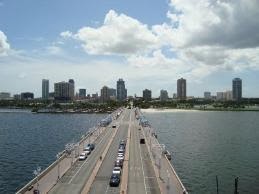
St. Petersburg, Florida
Photo by Lauren Pitone
Flogging, in fact, became so popular in the Tampa Bay area that it soon spread to St. Petersburg. In 1931, ten years after Hillsborough County officially adopted flogging, a civilian group in neighboring Pinellas County started a "flogging for hire" organization.  For the right amount of money, they would arrange the flogging of anyone you wanted flogged.

The commercial floggers, however, went afoul of the law when they flogged... the law. On March 8, 1931, the group kidnapped and flogged Constable F.A. Howard of Ballast Point. Arrests followed.

Despite such evidence that flogging was reaching out of control proportions around Tampa Bay, the practice continued. On November 30, 1935, officers of the Tampa Police Department seized three Union labor organizers without a warrant and carried them to police headquarters. The men were illegally questioned about their political and organizing activities as a "mob" gathered outside. When the three Socialist Party members - Joseph Shoemaker, E.F. Pulnot and S.D. Rogers - were released, they were seized on the grounds of the Tampa Police Department by the "ruffian band" that lay in wait. Carried to a remote area, they were flogged and then scalding hot tar and feathers were poured on their bodies.

Pulnot and Rogers survived the barbarous treatment, but Shoemaker did not.  He died one week later from hideous injuries. Rev. G.F. Snyder of St. Paul's Lutheran Church in Tampa boldly spoke out against the atrocity, aiming his finger at "the very citadel of justice and law administration." A mass meeting was held, but public officials did not attend.

The focus of the nation fixed itself on Tampa. Florida Governor Dave Sholtz demanded a thorough investigation and labor leader Norman Thomas accused law enforcement of mishandling the investigation to "save the face of Tampa police and higher-ups." The president of the American Federation of Labor (AFL) threatened to cancel his group's planned national convention, set for Tampa in 1936.

Tampa Police officers in 1935
Courtesy Florida Memory Collection, Florida State Archives
Then came the bombshell. Six Tampa policemen were arrested on the night of December 18, 1935, on charges that they were members of the so-called "ruffian band." Shoemaker's death, it was alleged, did not result from an attack by a mob, but instead was an execution carried out with a lash and hot tar by Tampa police. A member of the city's fire department also was arrested.

A second bombshell came on January 23, 1936, when Tampa Police Chief R.G. Tittsworth was indicted by a special grand jury as an accessory to the crime. In the end, a total of 10 arrests were made in connection with the incident and Governor Sholtz appointed a special prosecutor to handle the case, saying in the process that he meant no disrespect to the Hillsborough County Solicitor, C.Jay Hardee.

The police officers were acquitted. The family of Joseph Shoemaker never received justice. There was no closure.

Nine hate groups are active around Tampa Bay
Photo by Lauren Pitone
A national civil rights publication called it a "Whitewash" and alleged that the police officers were members of the Ku Klux Klan (KKK). Whether they were or not is impossible to prove, but the Tampa Bay area is still infested with hate groups. According to the Southern Poverty Law Center (SPLC) in Montgomery, Alabama, there are 9 hate groups active in the Tampa Bay area. These include the New Black Panther Party, Neo-Nazis, Christian Identity and the racist Skinhead group Confederate Hammerskins. By comparison, Miami and North Miami are home to three hate groups, only one-third as many as Tampa Bay.  Marianna and Jackson County, home to the former Dozier School, have none.

The Tampa Bay Times has run story after story on the allegations of murders at Dozier School, even though 52 of the 55 people exhumed from the Dozier Cemetery are believed to have been buried there more than 75 years ago. How many stories has it published in the last two years about the officially-sanctioned beatings and death in Hillsborough County from the same era?  None.

I told Ben Montgomery, a reporter with the Tampa Bay Times, about the Tampa floggings in April 2013 and he told me he had never heard of them. I encouraged him to look into them. As of today, his paper continues to publicly ignore the horrors that took place in Tampa even while "seeking the truth" about Marianna. Montgomery has not responded to an email asking why he elected not to report on events that took place in his own community.

Think the official violence in Tampa and Hillsborough County ended long before the days of the "White House Boys" at Dozier School in Marianna?  Watch this video and think again: 2008 Abuse at Hillsborough County Jail.

The Tampa Bay Times at least covered that one.  And then there is this one, reported just today by the Tampa Tribune:  Woman dragged by Tampa police officer.

So far as is known no Tampa area media outlet has tried to find either the survivors of beatings or the families of individuals who were abused by authorities in Hillsborough County during the early 20th century. They continue, however, to run interviews and stories about alleged events that took place in Jackson County at exactly the same time in history.

The University of South Florida, meanwhile,  is spending more than $600,000 of taxpayer money in a "humanitarian effort" to identify 55 unknown graves at Dozier School.  How much money has USF spent to identify the 187 unknown graves at Woodlawn Cemetery within 15 minutes of the doors of its Anthropology Department?

Pam Bondi, Florida Attorney General
She has made no calls for justice in Hillsborough County atrocities.
How much money has the university spent to learn whether any beaten and abused inmates disappeared from the Hillsborough County Road Camp in the 1920s and 30s?

How much money has USF spent looking for a "lost" cemetery associated with the atrocities suffered by adults and children in Hillsborough County?

How many times has Attorney General Pam Bondi commented on the documented atrocities that took place in Tampa and Hillsborough County?  How often has she called for closure for the families of the victims?

Officers from the Hillsborough County Sheriff's Department spent time in Marianna assisting USF in its exhumation of the graves from the Dozier School Cemetery. How much time did they spend last year looking into the skeletons of their own past?

I think you already know the answers to these questions.

This is the first in a series of articles on this topic. Watch for part two in coming days.

Thursday, November 7, 2013

Death at Dozier School (Part Two: The 1914 Fire)

Dormitory destroyed by fire in 1914.
Note:  This is part two in a series on known deaths at the former Dozier School for Boys in Marianna, Florida. The focus is on probable burials at the school's "Boot Hill" cemetery. Please click here to read Part One of this series.


Death at Dozier School

A History of “Boot Hill Cemetery” at the former Dozier School for Boys in Marianna, Florida

by Dale Cox

Part Two: The 1914 Fire

The deadliest single day in the history of the facility later known as Dozier School for Boys was November 18, 1914. Ninety-nine years ago this month, a fire erupted in the “white” dormitory of the school, burning it to the ground and killing seven students and two employees.

The year 1914 was a momentous one in history. An estimated 1,047 people died when the barely-remembered RMS Empress of Ireland went down after colliding with another vessel in the St. Lawrence River, just two years after the legendary RMS Titanic had carried 1,500 to the bottom. Central America witnessed the passage of the first vessel passed through the now famous Panama Canal.  In Sarajevo, a Serbian nationalist assassinated Archduke Franz Ferdinand of Austria, sparking World War I, while in Siberia an attempt to assassinate the brutal Rasputin failed. In the United States, Babe Ruth played in his first major league baseball game, Charlie Chaplin appeared in the first feature-length silent film comedy, Ford Motor Company introduced the 8-hour workday and the Federal Reserve Bank opened for business.

In Jackson County, an unexplained series of fires continued on the campus of the Florida Industrial School for Boys (future Dozier School) in Marianna.

Building identical to burned dormitory (at right, notice the tower)
Florida State Archives, Florida Memory Collection
These fires took place with alarming frequency over the first 14 years of the school’s operation. One in February 1906 had killed six mules and three horses and destroyed corn, hay and 32 barrels of syrup. The cause was arson and the suggestion was raised that former guards had been responsible. “It is supposed that the barn was set on fire to spite the superintendent,” reported the Pensacola Journal, “as several guards have been discharged for various reasons.” Tracking dogs brought to the scene, however, failed to detect the trail of the perpetrator.[i]

The fires continued over the next five years with growing frequency and on January 25, 1911, a new brick barn burned to the ground with almost disastrous consequences:

That the school’s loss is not greater is miraculous, as the dormitory for colored inmates is within fifty to seventy-five feet of the barn. None of the livestock or farming implements were lost. This will badly cripple the school as all of the supplies of this kind [i.e. hay and cattle feed] were in this one barn.[ii]

The outbreak of a fire described as “spectacular and fierce” so close to one of the school’s two dormitories alarmed employees, authorities and reporters alike. Damage was estimated at $10,000, a massive figure in that day and age, with 1,000 bales of hay and several tons of cattle feet being destroyed, along with a supposedly “fireproof” barn.[iii]

Newspaper clippings indicate additional fires took place over the next three years, although none resulted in destruction on the scale of the 1911 blaze. All were blamed on an “incendiary” or arsonist.[iv]

The escalating series of fires came to a dramatic end in the predawn darkness of November 18, 1914:

Closeup of building identical to burned dormitory.
The superintendent and older boys escaped through the tower.
Florida State Archives, Florida Memory Collection
W.H. Bell, acting superintendent, has just wired from Marianna that main building white school was destroyed by fire last night, and eight boys and two officers dead. Please call meeting of Board of Managers with least possible delay. Have matter exhaustively investigated and let me have report.[v]

Immediate reports from the scene indicated that the fire had been discovered by a night watchman at around 3:30 a.m. The watchman passed the main dormitory and saw no problems at 3:15 a.m., but when he returned from his rounds fifteen minutes later, a large fire was burning on the ground floor near the base of the main stairway. He began to call out to the boys and employees sleeping on the second and third floors of the building, trying to alert them to the danger.[vi]

The calls of the watchman alerted Severino Gustinez, a student considered so trustworthy by administrators that he had been given employment at the school and assigned to watch over the younger boys who were housed on the second floor of the east wing of the dormitory. Although some media reports of the time claimed that fire drills had never been held at the school, the opposite appears to have been true.[vii]

Realizing the danger, Gustinez called out “fire drill” to awaken the young students under his charge. Sleepily rising from their beds, they immediately formed into the proper lines for evacuating the building. Realizing that he could not take them down the main stairway due to the fire, he led them down the western stairway to safety. Thanks to “Toto,” all of the younger students made it out of the building without incident.[viii]

Leaving the small boys in charge of a guard named Register, Gustinez then went back into the building where he found an older boy nicknamed “Monkey Wrench” lost in the smoke.  Carrying “Monkey Wrench” in his arms, he made his way back to the stairway but found the door now in flames. Risking his own body to bring “Monkey Wrench” to safety, Gustinez leaped through the burning doorway. Both survived, although the heroic rescuer suffered slight injuries.[ix]

Another older student named Walter Tucker made it out, but was unable to find his bunk mate Button Shaw. Desperate to save his friend, he went back into the burning building, found Shaw still in bed, pulled him out and carried him up to the third floor of the building. The tower that rose above the center of the structure had windows that also functioned as skylights. Dragging Shaw up into the tower and through one of these windows, Tucker carried him across the roof and down the fire escape to safety.[x]

The acting superintendent of the school – later claims to the contrary aside – was in the building and asleep when the fire broke out. Making his way up to the tower, W.H. Bell helped most of the older boys escape through a window and then down the fire escape to the ground.[xi]

Having already saved many lives, Bell now joined a desperate effort to save two employees and a student who could be seen trapped inside a locked grate that blocked access to the fire escape from the second floor:

…The office being in flames, he procured an axe and with the assistance of Mr. Allen, one of the guards, he climbed to the landing of the fire escape at the second floor, where three men were trying to make their escape. He succeeded in breaking the locks of the barred grating to the window, but was unable to get the metal frame out of the window. In the meantime, the floors gave way and the inmates were hurried to their doom.[xii]

Two of the men who died as Bell and Allen tried to save them were Bennett Evans, the school carpenter, and Charles M. Evans, his son who was employed as a guard. Charles had made it out of the building, but was unable to find his father and went back inside to save him. He found Bennett looking for him in the smoke and tried to bring him and a student they found lost in the smoke to safety, but found their escape barred by the locked grate. All were killed when the floor collapsed beneath them.[xiii]

Despite folklore repeated second hand by researchers from the University of South Florida, there was no mention of any kind in the eyewitness accounts of the fire, let alone any actual evidence, that any of the students were chained to their bunks or that they had to break locks to get out of the building. In fact, original reports indicate that all who died were moving freely inside the building, that the western stairway was open and that the fire escape could be and was accessed via the roof of the building. Reporters noted that had some students not panicked, all could have escaped.

The Tampa Tribune, for example, reported that most of the dead were in the west wing of the building farther from the fire than the smaller boys who were led to safety by Severino Gustinez. They became “panic-stricken” the newspaper reported, and lost their lives as a result.[xiv]

According to the Tribune, the guard named Register went back into the building after getting the smaller boys to a safe place. He found a group of older boys still inside and led them to a stairway by which escape was still possible. Frightened by the smoke that filled the stairwell, however, they panicked and went back deeper into the building to a locked window that opened onto the fire escape. They lost their lives as a result. 

The windows had been locked to prevent boys from using the fire escape to run away during the night. The school grounds were not fenced at the time and escapes had been a problem for the staff, which had been overwhelmed by judges around the state with many more students than the facility was designed to handle. The stairways and doors were not locked, nor was the entrance to the fire escape from the top of the building, but the windows opening onto it had been secured.

Within thirty minutes of the time the fire was discovered, the “white dormitory” of the Florida Industrial School for Boys burned to the ground. By the time the sun rose over the horrible scene, only the ruined sections of walls could still be seen.

Although researchers from the University of South Florida have made questionable claims that as many as twelve people died in the fire, initial reports from the scene placed the number at ten (two employees and eight students). Subsequent investigation revealed that the actual number was somewhat lower.  

I will provide more information on the true number of deaths from the fire and some of the controversy surrounding it in my next post in this series.  Be sure to check back regularly at http://twoegg.blogspot.com.


[i] “Fire at State Reform School,” report from Marianna dated February 28, 1906, Pensacola Journal, March 1, 1906, p. 1.
[ii] Pensacola News, January 1911, clipping in Singletary Collection.
[iii] Ibid.
[iv] Clippings from the Marianna Times-Courier, 1911-1914, Singletary Collection.
[v] Gov. Park Trammell to Hon. W.H. Milton, President of the Board of Governors, November 18, 1914, Singletary Collection.
[vi] “Heroic Tampa Boy saves many lives at Marianna Fire,” datelined Marianna, November 20, 1914, Tampa Tribune, November 21, 1914, p. 1.
[vii] Ibid.
[viii] Ibid.
[ix] Ibid.
[x] Ibid.
[xi] Anonymous, “Ten Lives Lost When Florida Reform School Burns at Marianna,” November 18, 1914, report reprinted in numerous newspapers across the United States.
[xii] Ibid.
[xiii] Ibid.
[xiv] “Heroic Tampa Boy saves many lives at Marianna Fire,” datelines Marianna, November 20, 1914, Tampa Tribune, November 21, 1914, p. 1.