A Two Egg TV Page. See more at https://twoeggtv.com.
Showing posts with label webbville. Show all posts

Friday, February 3, 2017

James Webb and Webbville (Part 2)

Webbville as shown on an 1834 map of Jackson County.
Webbville was just reaching its height at the end of 1828 when its top promoter, James Webb, received an unexpected honor from the President of the United States.

This is Part 2 of a two part series on the James Webb and the history of Webbville. Please click here to read Part 1 before continuing.

The U.S. Congress approved the creation of a Federal superior court for the Southern District of Florida on May 23, 1828. President John Quincy Adams signed the Act and three days later named James Webb of Webbville as the new district's first judge.

How President Adams knew the lawyer from Webbville is one of the many mysteries that surround the community. Webb had been elected to the Florida Territorial Legislative Council in 1827, but this alone would not have brought him to the attention of the President. He must have had political connections that recommended him to the Adams administration.

The offer of a Federal judgeship was too big of a prize to decline. Webb accepted the post, resigned his seat in the territorial legislature and prepared to move to Key West. Newspaper accounts and court records indicate that he did return to Jackson County from time to time. In August 1829, for example, he issued notice that he would preside over a term of the Superior Court at Webbville:

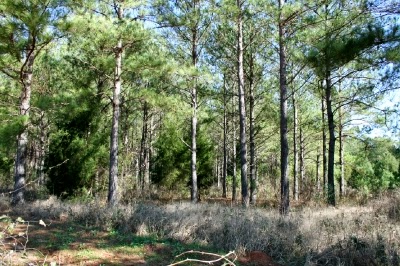
Webbville as it appears today.
Chambers, 24th August, 1829.
ORDERED, That there be an extra term of the Superior Court held in and for the County of Jackson in the Western District of Florida on the first Monday of December next, and of which due notice will be given.
James Webb.
Judge of the Southern District of Florida, Acting in the absence of the Judge of the Western District.

He and Rachel had their fourth child that year with the birth of Charles John Webb.

Judge Webb and his family were soon firmly established in Key West and their lands in Jackson County were sold. Webbville was without its namesake by the end of 1829 and his good fortune could not have come at a worse time for the community.

Webbville had won a referendum of voters to become county seat, but the fledgling community of Marianna refused to give up the fight. The Marianna faction somehow managed to sway the opinion of Lackland Stone of Webbville to their side. He now held Webb's former seat in the legislative council and soon pushed through a bill naming Marianna as the county seat. It was approved on October 20, 1828.

Webbville's promoters viewed this action by Stone as nothing short of betrayal. He had been one of them and had even served as their first postmaster. He sold his businesses while running for the legislature, however, and now cast his lot in favor of Marianna, despite the fact that a majority of Jackson County voters had favored Webbville in the recent election.
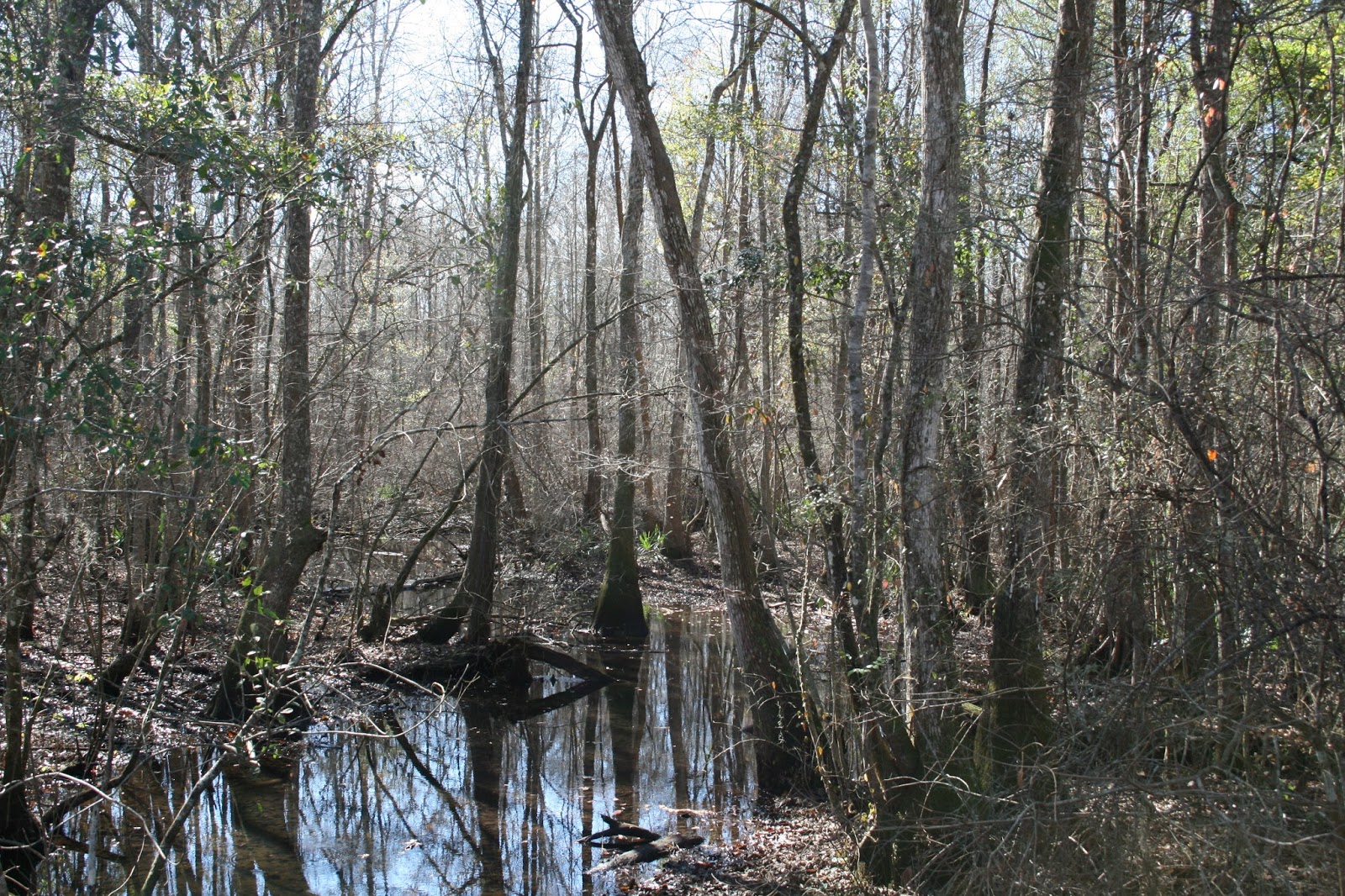
Baker Creek was one of two important creeks that flowed
near the site of the Town of Webbville, Florida.
Webbville turned to the U.S. Congress for help. Florida was still a territory and not a state, which made Congress the final authority for such matters. A petition was sent to Washington, D.C., warning that the Webbville Academy would be forced to close unless Congress intervened. Florida's Territorial Delegate, Joseph M. White, pushed for action.

The U.S. Congress obliged on January 21, 1829, by overturning the legislative act that had given Marianna the county seat title. Webbville once again claimed the distinction. Congress also approved the town's location on lands reserved for school purposes.

Recognizing that they could not legally overrule Congress, Florida's territorial legislators tried a different approach. They took no action on the county seat title, but instead levied fines against any public officials in Jackson County not conducting business from Marianna:

Sec. 3. Be it further enacted, That the Superior and county courts of said county shall hereafter be holden in the house erected and built as aforesaid; and all other county or public transactions shall be held and transacted in the same, and all the prisoners of said county shall hereafter be confined in the house built and erected as aforesaid.

Sec. 4. Be it further enacted, That it shall be the duty of the commissioners aforesaid, to deliver the said houses to the sheriff of said county, who shall allow the marshal and clerk of the Superior courts, and clerk of the county courts; free access to the said house in which the said courts are to be held, and shall also allow the said officers rooms in the same for their several offices.

Sec. 5. And be it further enacted, That it shall be the duty of the said clerks of the Superior and County courts of said county, to hold their offices at the house aforesaid, in the town of Marianna, or within one mile of the same, and on failure thereof, be or they shall forfeit and pay the sum of twenty dollars for every week thereof, to be recovered in the name of the informer, before any justice of the peace in and for said county, in the same manner as in other cases of debt; one half to be paid unto the county Treasurer for the use of the county, and the other half to the informer; and this act shall be in force from and after its passage. 

Baker Creek Road, in use since the 1820s, passed by the
Jackson County home and farm of James Webb.
The threat of a fines had the desired effect. The public officials of Jackson County quickly relocated from Webbville to Marianna and have remained there ever since. The same legislation also approved the building of a courthouse and jail in Marianna and the collection of public funds for the projects. Webbville remained the county seat in title only.

Almost as if to add insult to injury, the Territorial Council on November 19, 1829 approved the incorporation of the Town of Webbville. Even as its residents were beginning to flee, the community became Jackson County's first incorporated town.

The issue of the county seat location surfaced one more time during the Fayette County fiasco of 1832, but Marianna retained its unofficial but very real status as seat of government for Jackson County.

Webbville's loss in the county seat battle marked the end of the town. Its population and businesses shifted to Marianna. Building materials were salvaged from the now vacant buildings for use in homes, barns and fences throughout western Jackson County.The site eventually fell under the ownership of W.D. Barnes, who lived there and named his Webbville Plantation after the failed community. By the time of the War Between the States (or Civil War), his farm was all that remained to remind travelers on the Campbellton Road that the town had ever existed.

Webb-Porter House in Key West, Florida
The home was built by Hon. James Webb
shortly before his relocation to Texas in 1838.
Library of Congress
James Webb, meanwhile, lived in Key West and serve on the Federal bench until 1838 when he resigned his post and relocated to Houston, Texas. He went from there to Austin at the insistence of President Mirabeau B. Lamar, the President of the Republic of Texas, who appointed him to successive positions as Secretary of the Treasury and Secretary of State.

President Lamar's interest in Webb probably had something to do with his family relationship to the judge's wife, Rachel Elizabeth Lamar Webb. He soon recognized that James Webb was a talented and brilliant official, however, and named him Attorney General of the Republic of Texas on November 18, 1839.

The Texas Revolution of 1836 had made Texas an independent nation. Webb's service to the republic gave him the unique status of having held multiple high-ranking positions in the governments of two different nations.

He continued as Attorney General of Texas until March 20, 1841, when he became the Lone Star republic's Minister to Mexico. The latter country refused to seat him so he returned home to represent the Travis-Bastrop-Fayette-Gonzales district as Senator from 1841-1844. Webb served as chairman of the Judiciary Committee and as a member of the Foreign Relations Committee.

James Webb also practiced law in Texas in partnership with Williamson S. Oldham, a former speaker of the Arkansas House of Representatives and onetime Associate Justice on the Arkansas Supreme Court. He was a member of the Convention of 1845 that cleared the way for Texas to become part of the United States.

Webb County in Texas, seen here on a 1920 map, was named
for James Webb, onetime resident of Webbville, Florida.
After statehood he became a reporter for the Texas State Supreme Court and worked with Thomas H. Duval to produce the first three volumes of Texas Reports. Duval, a former Clerk of Courts for Leon County, was the son of former Florida Governor William P. Duval for whom Duval County is named.

Webb became the Secretary of State for the now State of Texas in 1849, holding that post until 1851 when he resigned and moved to the Corpus Christi area. He was named the first judge of Fourteenth Judicial Circuit of Texas in 1854 and was still serving on the bench when he died while en route to the town of Goliad for a session of the court on November 1, 1856.

The man for whom Jackson County's lost town of Webbville was named is buried in the City Cemetery at Goliad, Texas. His tombstone notes that he was a Mason and grand master of the Texas Lodge in 1844.

Although his namesake town in Florida no longer exists, his memory lives on in Texas where Webb County was named in his honor.

Not a single building remains at the site of Webbville today.

For a visual tour of historic Webbville as it appears today, watch a new program from Two Egg TV on Sunday! A link will be posted here as soon as it the program is up and airing.


Tuesday, January 31, 2017

James Webb and Webbville: A remarkable man and Jackson County's first town

A view south down Union Road from the site of
Webbville in Jackson County, Florida.
Webbville is one of Florida's best known ghost towns. It was Jackson County's first incorporated community and - according to the U.S. Congress at least - remains its official seat of government.

Note: This is Part One of a two part series. Click here to continue to Part Two.

Not a soul lives on the site today, but its stories remain some of the most interesting in the county's history.

Florida had been a U.S. territory for only two years when James Webb arrived from Georgia in 1823. A veteran of the War of 1812 and a former school teacher, he had practiced law in both Virginia and Georgia before coming to the "Chipola Settlement" at the age of 31.

Jackson County was only one year old and then stretched from the Choctawhatchee River on the West to the Suwannee River on the east. It included all or parts of today's Holmes, Washington, Bay, Calhoun, Gulf, Franklin, Liberty, Gadsden, Leon, Wakulla, Jefferson, Taylor, Madison, Dixie, Suwannee, Lafayette and Hamilton Counties.

Not a building remains on the site of Jackson County's
first incorporated town. The one-time county seat of
Webbville has vanished without a trace.
Attorneys were few and far between in this vast region. Marianna, Chipley, Bonifay, Panama City, Port St. Joe, Apalachicola, Quincy, Tallahassee, Monticello and other well-known communities of today did not yet exist but settlers were arriving in increasing numbers.

One of the earliest American communities in this region was the old Chipola Settlement, which lay south of today's Waddell's Mill Pond and west of the Chipola River. Similar settlements were growing elsewhere within the present Jackson County limits at Campbellton, Greenwood, Irwin's Mill Creek and on the Apalachicola River near Sneads.

James Webb was a family man and it seems strange today that he would pull up stages and head off into a largely unexplored wilderness but this was how fortunes were made on the American frontier of the early 19th century.

His wife, the former Rachel Elizabeth Lamar, was expecting a child at the time and remained back in Georgia with her family and the couple's 10-year-old daughter, Mary Elizabeth, while James headed south to Florida. He would clear land and build a home before they traveled down to join him.

James Webb's land was located in the Southeast 1/4 of Section
9 and the Southwest 1/4 of Section 10, as shown on this 1826
survey plat. The creek running east to west is Russ Mill Creek.
Webb eventually laid claim to four pieces of land in Jackson County, but the most important of these were two adjoining parcels between Russ Mill Creek and Baker Creek. Located near today's Baker Creek Road, they combined to total about 450 acres, 100 acres of which he cleared over the next few years.

Rachel, Mary and the new baby boy, Thomas Francis Webb, arrived in Florida in 1824. The family grew by another member one year later when another baby boy, James William Webb, was born.

Sugar production then rivaled cotton on the plantations of Jackson County and was especially popular along the wetlands and creeks of the Chipola Settlement. James Webb grew sugar cane on his farm, probably sending the stalks down the creek to the sugar mill near the Natural Bridge of the Chipola River at Florida Caverns State Park. Little is known of this early refinery, but the Pensacola newspaper regularly reported the arrival of hogsheads of sugar from the Chipola River region.

Jackson County grew dramatically between 1822 and 1825. The population soared from fewer than 200 to more than 2,000 in that short time period. The Chipola Settlement emerged as the largest community within today's county limits and a central village began to grow on Section 16, Township 5 North, Range 11 West.

Union Road crosses Russ Mill Creek by way of a wooden
bridge. The creek was an important source of water power
for grist and saw mills that served Webbville.
James Webb hung out his shingle there and opened a law office, one of the first in Jackson County. He later partnered with Peter W. Gautier, a prominent figure in frontier Florida. Other businesses opened as well, among them Col. L.M. Stone's general store. Some idea of the prosperity of the community can be obtained from early real estate listings which mention two story homes with wraparound porches and a brick store building.

The growth of the community further spurred by an act of the Florida Territorial Legislative Council on January 20, 1827. Hoping to head off a growing dispute over the permanent location of a county seat for Jackson County, the legislators appointed a commission to select the final site, survey the community and initiate the sale of lots. James Webb was one of the five members named to this board.

While the selection committee did its work, the legislative council decreed that the courts of Jackson County would meet on Section 16, Township 5 North, Range 11 West. This was the location of Stone's Store, Webb's law office and the growing community of business and houses that would become the county's first town.

Stone's Store had been named a U.S. Post Office the previous June and on February 2, 1837, ads appeared in the Pensacola Gazette announcing that the village had been named Webbville.

Jackson County's first post office, first hotel and first
public school stood atop this hill at Webbville.
James Webb was instrumental in many of the accomplishments of the town that bore his name. He served Board of Trustees for the Webbville Academy, Jackson County's first public school. The students studied Greek and Latin, as well as mathematics, science, literature and other courses of the day. The school opened its doors in 1827 and students sat for their first quarterly finals on May 25, 1827:

The first quarterly examination of the students of this institution took place this day, under the direction of the Trustees, and they take much pleasure in stating, to parents and guardians who have placed their children and wards in this Seminary, that the examination was highly satisfactory and reflected much credit on the teacher, for his care and abilities in conducting the school, and upon the pupils, for their industry and attainments. - Trustees of Webbville Academy to the Pensacola Gazette, May 27, 1827, published in the Pensacola Gazette, June 22, 1827.

James Webb signed the report as one of the school's seven Trustees. The others were Peter W. Gautier, Thomas Baltzell, William P. Hort, Joseph Russ, William J. Watson and Thomas Russ.

Webbville hosted a 4th of July celebration that year. A "numerous assemblage of citizens" listened as Benjamin W. Cumming read the Declaration of Independence. A speech and dinner followed, but the evening's toasts - accompanied by gunfire - were the highlights of the day.

Independence Day of 1827 found Webbville on the verge of great success. Its population and business community were growing. It had been temporarily designated as county seat and the county's first school was functioning well.

The prosperity would not last. A major political fight loomed on the horizon, as did a change that would start James Webb down the path to a remarkable life.

Please click here to continue to Part 2 of this two part series.


Sunday, January 29, 2017

First Settlers of Jackson County, Florida

Campbellton Baptist Church, Florida's oldest Baptist church
in continuous operation, dates from before the War Between
the States and stands near the Spring Creek settlement site.
The first American settlers of Jackson County arrived pushed down from Georgia and Alabama before 1820. 

The following is excerpted from my book:  The History Of Jackson County, Florida: The Early Years.

The smoke had barely cleared from the First Seminole War when the first settlers began to make their way back to the rich lands they had explored with Andrew Jackson in 1818. It was a risky proposition at best. The area that would become Jackson County was still Spanish territory at the time and there was the possibility of violent confrontation with Native American warriors still angered over their losses in the war.

Despite such dangers, however, several dozen frontier families had appeared in the area by 1820. Their initial settlements were along Spring Creek in the Campbellton area, on the Ekanachatte site at Neal’s Landing and along the Apalachicola River south of the Native American towns of Tomatley and Choconicla.

Based on these locations, it appears that the first settlers probably took advantage of fields that had already been cleared by Native Americans. The Chacato village of San Antonio had been located in the area of the Spring Creek settlement and its old fields had been resettled by a party of Creeks from Pucknawhitla by 1778. These fields were undoubtedly still clear of heavy timber in 1820 and it would have been relatively easy for the first settlers to clear away any second growth and underbrush and begin farming.

A section of the old Pensacola-St. Augustine Road can still be
seen between Malone and Campbellton. It connected the Spring
Creek settlement with the Irwin's Mill Creek settlements on the
Chattahoochee River.
The same was true at the Ekanachatte site, which had been abandoned for less than two years. Extensive fields had been cleared over the fifty year history of the village and these were now literally “open for the taking.” In addition, Irwin’s Mill Creek flowed year round and provided sufficient force to turn the wheels of watermills, a fact that eventually led to its modern name.

Some of the names of these first settlers are recognizable in Jackson County today. The Spring Creek settlement, for example, included John Williams, James Falk, William T. Nelson, Abraham Philips, Benjamin Hamilton, Owen Williams, Micajah Cadwell, Joseph Parrot, John Ward, Nathan A. Ward, William Philips, James Ward, Andrew Farmer, Robert Thomas, John Hays, Samuel C. Fowler, Nathaniel Hudson, Wilie Blount, Moses Brantley, Robert Thompson, Guthrie Moore, Stephen Daniel, John Gwinn, John Jones, Allaway Roach, Henry Moses, Joel Porter, Simeon Cook, James C. Roach, John Smith and Presley Scurlock.[i]

Their farms stretched from Holmes Creek on the west across the present site of Campbellton and then down Spring Creek to its junction with the headwaters of the Chipola River. To the south their lands extended about as far down as today’s Waddell’s Mill Pond, while to the north other settlements extended across the Alabama line.

None of these farms were the large plantations for which Jackson County later became known. The largest had around 40 acres in cultivation, but the average settler farmed less than 15 acres. It was a start, though, and qualified each of them to later claim 640 acres after Florida was ceded by Spain to the United States in 1821.[ii]

1823 map of the Jackson County area.
The settlement at Irwin’s Mill Creek, then called “Conchatty Hatchy” or “Red Ground Creek,” included Joseph Brown, William Brown, Joseph Brooks, William Chamblis, James Irwin, Adam Kimbrough, William McDonald, William H. Pyke, George Sharp and Allis Wood.

Down on the Apalachicola, meanwhile, were Charles Barnes, Adam Hunter, John H. King and Reuben Littleton. These men all lived along the stretch of the river between Tomatley and Ocheesee Bluff, where Thomas and Stephen Richards had settled.

Other settlers known to have been in Jackson County prior to 1821 included James Dennard, Jonathan Hagan, John Hopson, Hugh Robertson, Joshua Scurlock and Robert Sullivan, all of whom settled along the upper Chipola east of the Spring Creek settlement, and William Pyles who staked a claim at Blue Spring.[iii]

Blue Springs (or Jackson Blue Springs) was a landmark for
early settlers and Native American residents alike.
Despite the tensions that must surely have existed, incidents between the early settlers and the Native Americans still living in Jackson County seem to have been rare. Econchattimico had assembled a group of several hundred followers at Tocktoethla, but following the destruction of Ekanachatte did all he could to preserve peace with the whites. 

So too did Mulatto King, who assumed permanent leadership of both Tomatley and Choconicla following the death of Yellow Hair. The villages grew considerably following the war due to the arrival of refugees from the destroyed town of Attapulgas in what is now Decatur County, Georgia. Mulatto King welcomed these displaced individuals and allowed them to settle on lands adjacent to his villages.

In truth, the Native Americans living in Jackson County between 1819 and 1821 probably lived much better than their white counterparts. While the early white settlers were struggling to build crude log cabins and clear fields, many of the Native Americans – particularly those of Tomatley – enjoyed a prosperity that they had spent years developing. 

Claims later filed by many of these people indicate that they owned cabins, houses, mills, orchards and fields. A woman named Polly Walker, for example, reported that she owned a dwelling house, two cabins and an orchard of 32 fruit trees. Joe Riley owned a house and improvements valued at $1,150, a substantial amount for the time. Econchattimico reestablished himself at Tocktoethla by clearing 73 acres of land and building a cabin, corn crib, shed, three log cabins, a summer house and two mills. His fields were surrounded by fences built using 14,280 rails.[iv]


 [i] Claims to Land in West Florida, December 10, 1824, American State Papers, Public Lands, Volume 4, pp. 61-63 (Hereafter ASP Public Lands).
[ii] Ibid.
[iii] Ibid.
[iv] List of Claims of Appalachicola Indians who have emigrated West of the Mississippi River, November 11, 1838, Bureau of Indian Affairs, M234, Roll 290, Frame 299.


Thursday, January 26, 2017

A Duel near Campbellton in 1829

Dueling seems such a long ago custom today that it is difficult to imagine that the Campbellton area of Jackson County was once the "go to" place for these affairs of honor.

The nearby state line, then the line dividing the State of Alabama from the Territory of Florida, offered a bit of protection for those who participated in duels. If authorities from Florida tried to arrest one participant, he could simply step across the line into Alabama. If authorities from Alabama tried to arrest the other participant, he could similarly escape into Florida.

The practice of dueling has been reduced to something of a caricature today and is perhaps best remembered for the affair that cost the life of founding father Alexander Hamilton. He was killed by former Vice President Aaron Burr in a duel.

As the death of Hamilton demonstrates, dueling was a serious business. Honor was held in extremely high esteem during the first half of the 19th century. An insulted party, having failed at all other means to obtain justice, could demand that his enemy meet him on the field of honor. The challenged party then had no choice but to apologize and admit his fault, flee and lose all honor, or face the aggrieved party with pistol or blade.

Original 1829 account of the duel
near Campbellton, Florida.
Unless the parties fired into the air after having taken to the field, thus ending the duel with honor, the carefully orchestrated fights would continue until one party or the other was either disabled or dead. This meant that in a fight with dueling pistols, for example, the two antagonists would fire and reload as many times as necessary until or the other could no longer continue.

One such duel took place on the Alabama line north of Campbellton in 1829. Dr. H.B. Crews of Webbville, Jackson County's original but now vanished county seat, took the field of honor against Mr. J.O. Sewall of Alabama. The nature of the dispute that led to the duel is not known, but the outcome was reported by newspapers of the time:

...The parties exchanged three shots; Dr. Crews was wounded on the first and third fires. Mr. Sewall was not injured. Dr. Crews being wounded on the third fire in the muscles of the right shoulder, could not continue the fight. - Florida newspaper reprinted in the Rhode Island American, August 25, 1829.

Fortunately for Dr. Crews, his wounds did not prove fatal. He continued to live in Webbville for years to come, serving as both a town doctor and partner in a pharmacy there.

J.O. Sewall also took up residence in Jackson County after the affair, settling in Marianna. It was an appropriate choice since the towns themselves were bitter rivals.

Of the duel between Sewall and Crews, witnesses felt that honor had been served. "It is perhaps proper to say," noted the newspaper account, "that the conduct of both gentleman was highly appropriate on the occasion."

Dale Cox
January 26, 2017


Saturday, July 19, 2014

#71 Ghost Town of Webbville (100 Great Things about Jackson County, Florida)


Looking down Union Road from the site of Webbville
Webbville, a ghost town and the lost county seat of Jackson County, is #71 on our list of 100 Great Things about Jackson County, Florida.


When Marianna was still just a series of wooded hills, a small town was planted in the wilderness about four miles north of present-day Cottondale. Named Webbville after James S. Webb, an early settler and merchant, the community was the business hub for an area of rich lands called the "Chipola Settlement."

Other early settlers of the Webbville area included William S. Pope, Charles F. Stewart, Thomas Baltzell, Ebenezer J. Bower, Thomas Russ, William J. Watson, Joseph Russ and Lackland McIntosh Stone. These men and their families figured prominently in the histories of Marianna, Sneads, St. Joseph and Apalachicola.

Colonel Stone's well
At some point soon after his arrival during the mid-1820s, Colonel Stone had his slaves begin to dig a well on a hillside east of Webbville. They unexpectedly tapped into a vast network of caves and became so afraid of falling into an unknown abyss that they refused to do more work at the site. Stone had to look elsewhere for water, but his well still remains and is the only known intact trace of the Webbville settlement.

Webbville became the first official town in Jackson County when it was incorporated by the Florida Territorial Legislative Council in January 1827. The move was part of an effort to secure a permanent designation as county seat. Settlers were flooding into Jackson County by the thousands and there was a growing need for a permanent county seat.

Early map showing Webbville, Marianna & Campbellton
Robert and Anna Maria Beveridge, who founded Marianna nine months later in September 1827, had other ideas. They and their investors offered to donate land for a town square and to build a new courthouse and jail at no cost to the taxpayers. The offer ignited a political war between Webbville and Marianna, with the future of the county hanging in the balance.

Marianna scored the first blow by obtaining the designation of County Seat from the Territorial Legislature. Webbville struck back by taking the fight to the U.S. Congress, where a House Committee gave the title to Webbville even though the town stood on 16th Section lands reserved for school purposes. The town dealt with this issue by founding the Webbville Academy, Jackson County's first school. The institution was incorporated by the Legislative Council on December 22, 1827.

19th century ceramic fragment from site of Webbville
Marianna turned back to the Legislative Council and although the territorial legislators could not overrule the U.S. Congress, they did have the power to fine any county official who did not conduct business from the new courthouse in Marianna. Money spoke louder than words and the sheriff, county judge and other local leaders shifted to Marianna, even though Webbville remained the legal county seat of Jackson County.

The battle was far from over. Webbville struck back on February 9, 1832, when the Legislative Council voted to carve off the entire eastern half of Jackson County away as part of a new county. Named Fayette County after the Marquis de Lafayette, the new entity included all of the land between the Chipola and Chattahoochee/Apalachciola Rivers. In Jackson County, the towns of Bascom, Grand Ridge, Greenwood, Malone and Sneads all stand on lands that were once part of Fayette County.  The move was intended to remove Marianna's most vocal supporters in time for a referendum on which town would become the permanent county seat.

Site of Webbville
The move failed, however, because most of the residents of the new Fayette County had no desire to be part of a separate county. They appealed to the Legislative Council for relief and the act establishing Fayette County was repeal. Its lands returned to their original jurisdiction.

Webbville ultimately lost its fight with Marianna, but without really losing it. In the eyes of the U.S. Congress, the town that no longer exists is still the legal county seat of Jackson County. The decision of the Territorial Council to fine public officials that refused to conduct business from the courthouse in Marianna had its desired impact. The courthouse remains there today on the square donated by Robert and Anna Maria Beveridge.

Piece of a broken wine bottle exposed by erosion
As for Webbville, it slowly faded away. The town no longer existed by the time of the War Between the States (or Civil War), but its name was preserved by the plantation of Colonel W.D. Barnes which stood on the site. Union troops raided Barnes' Webbville plantation on their way to the Battle of Marianna, destroying hay, stockpiled corn and other foodstuffs. They also killed livestock, poultry and burnt barns.

The site of Webbville is now just a place where Union Road crosses a hilltop as it leads from State Highway 73 north to County Road 162. To find it, turn from Highway 73 onto Union Road and drive to the top of the hill that you see ahead of you. At that spot you will be sitting in what was the main business district of the Town of Webbville.

Mission San Nicolas interpretive panel
near site of Webbville.
Be sure to stop and read the Interpretive Panel for Mission San Nicolas at the intersection of Highway 73 and Union Road. It is Tour Stop #10 on the new Jackson County Spanish Heritage Trail, a 150 mile driving tour of eleven Spanish colonial sites in Jackson County.

To learn more about Webbville and the early history of Jackson County, please consider my book:

(Book) The History Of Jackson County, Florida: The Early Years

(Kindle E-Book) The History of Jackson County, Florida: The Early Years

It is also available at The Vintage Depot in the restored L&N Train Depot at 2867 Caledonia Street, Marianna, Florida. They are open Monday-Saturday, so drop in for a visit!