A Two Egg TV Page. See more at https://twoeggtv.com.
Showing posts with label w.d. barnes. Show all posts

Saturday, July 19, 2014

#71 Ghost Town of Webbville (100 Great Things about Jackson County, Florida)


Looking down Union Road from the site of Webbville
Webbville, a ghost town and the lost county seat of Jackson County, is #71 on our list of 100 Great Things about Jackson County, Florida.


When Marianna was still just a series of wooded hills, a small town was planted in the wilderness about four miles north of present-day Cottondale. Named Webbville after James S. Webb, an early settler and merchant, the community was the business hub for an area of rich lands called the "Chipola Settlement."

Other early settlers of the Webbville area included William S. Pope, Charles F. Stewart, Thomas Baltzell, Ebenezer J. Bower, Thomas Russ, William J. Watson, Joseph Russ and Lackland McIntosh Stone. These men and their families figured prominently in the histories of Marianna, Sneads, St. Joseph and Apalachicola.

Colonel Stone's well
At some point soon after his arrival during the mid-1820s, Colonel Stone had his slaves begin to dig a well on a hillside east of Webbville. They unexpectedly tapped into a vast network of caves and became so afraid of falling into an unknown abyss that they refused to do more work at the site. Stone had to look elsewhere for water, but his well still remains and is the only known intact trace of the Webbville settlement.

Webbville became the first official town in Jackson County when it was incorporated by the Florida Territorial Legislative Council in January 1827. The move was part of an effort to secure a permanent designation as county seat. Settlers were flooding into Jackson County by the thousands and there was a growing need for a permanent county seat.

Early map showing Webbville, Marianna & Campbellton
Robert and Anna Maria Beveridge, who founded Marianna nine months later in September 1827, had other ideas. They and their investors offered to donate land for a town square and to build a new courthouse and jail at no cost to the taxpayers. The offer ignited a political war between Webbville and Marianna, with the future of the county hanging in the balance.

Marianna scored the first blow by obtaining the designation of County Seat from the Territorial Legislature. Webbville struck back by taking the fight to the U.S. Congress, where a House Committee gave the title to Webbville even though the town stood on 16th Section lands reserved for school purposes. The town dealt with this issue by founding the Webbville Academy, Jackson County's first school. The institution was incorporated by the Legislative Council on December 22, 1827.

19th century ceramic fragment from site of Webbville
Marianna turned back to the Legislative Council and although the territorial legislators could not overrule the U.S. Congress, they did have the power to fine any county official who did not conduct business from the new courthouse in Marianna. Money spoke louder than words and the sheriff, county judge and other local leaders shifted to Marianna, even though Webbville remained the legal county seat of Jackson County.

The battle was far from over. Webbville struck back on February 9, 1832, when the Legislative Council voted to carve off the entire eastern half of Jackson County away as part of a new county. Named Fayette County after the Marquis de Lafayette, the new entity included all of the land between the Chipola and Chattahoochee/Apalachciola Rivers. In Jackson County, the towns of Bascom, Grand Ridge, Greenwood, Malone and Sneads all stand on lands that were once part of Fayette County.  The move was intended to remove Marianna's most vocal supporters in time for a referendum on which town would become the permanent county seat.
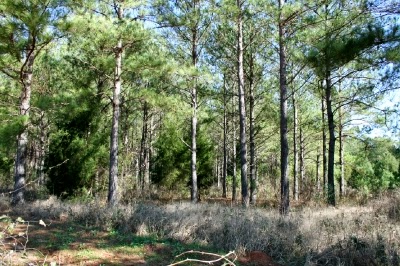
Site of Webbville
The move failed, however, because most of the residents of the new Fayette County had no desire to be part of a separate county. They appealed to the Legislative Council for relief and the act establishing Fayette County was repeal. Its lands returned to their original jurisdiction.

Webbville ultimately lost its fight with Marianna, but without really losing it. In the eyes of the U.S. Congress, the town that no longer exists is still the legal county seat of Jackson County. The decision of the Territorial Council to fine public officials that refused to conduct business from the courthouse in Marianna had its desired impact. The courthouse remains there today on the square donated by Robert and Anna Maria Beveridge.

Piece of a broken wine bottle exposed by erosion
As for Webbville, it slowly faded away. The town no longer existed by the time of the War Between the States (or Civil War), but its name was preserved by the plantation of Colonel W.D. Barnes which stood on the site. Union troops raided Barnes' Webbville plantation on their way to the Battle of Marianna, destroying hay, stockpiled corn and other foodstuffs. They also killed livestock, poultry and burnt barns.

The site of Webbville is now just a place where Union Road crosses a hilltop as it leads from State Highway 73 north to County Road 162. To find it, turn from Highway 73 onto Union Road and drive to the top of the hill that you see ahead of you. At that spot you will be sitting in what was the main business district of the Town of Webbville.

Mission San Nicolas interpretive panel
near site of Webbville.
Be sure to stop and read the Interpretive Panel for Mission San Nicolas at the intersection of Highway 73 and Union Road. It is Tour Stop #10 on the new Jackson County Spanish Heritage Trail, a 150 mile driving tour of eleven Spanish colonial sites in Jackson County.

To learn more about Webbville and the early history of Jackson County, please consider my book:

(Book) The History Of Jackson County, Florida: The Early Years

(Kindle E-Book) The History of Jackson County, Florida: The Early Years

It is also available at The Vintage Depot in the restored L&N Train Depot at 2867 Caledonia Street, Marianna, Florida. They are open Monday-Saturday, so drop in for a visit!


Tuesday, February 25, 2014

New mini-documentary on Battle of Natural Bridge is now online

Natural Bridge Battlefield Historic State Park
My new mini-documentary on the Battle of Natural Bridge is now online and can be viewed for free at www.exploresouthernhistory.com/nbindex.

This battle was fought on March 6, 1865 and preserved Tallahassee's status as the only Confederate capital east of the Mississippi not taken by Union troops during the War Between the States (or Civil War). Numbers of men from Jackson County took part and others were on the way when the fight took place.

Among the highest ranked officers on the field was Lieutenant Colonel W.D. Barnes of Jackson County. He assumed command of the 1st Florida Reserves, an infantry regiment, after its colonel was dashed into a tree by his horse when a cannon shell exploded nearby.

Confederate earthworks at Natural Bridge Battlefield
Barnes lived and operated a plantation in western Jackson County on the historic site of Webbville. The community had once been the county seat - and according to the U.S. Congress still holds that distinction - but unofficially lost that status when the Florida Legislature threatened to fine any public official who did not do business from the courthouse in Marianna.

Also on the field at Natural Bridge was Major William H. Milton, a noted officer and the son of Governor John Milton. Major Milton had saved Tallahassee a few days earlier when he boldly attacked a much larger force of Union troops and sailors at East River Bridge on what is now the St. Marks National Wildlife Refuge. Milton and his outnumbered Confederates drove the Federals all the way to the St. Marks Lighthouse on the shores of Apalachee Bay.  From there he could see the large flotilla of Union warships and transports offshore and realized that a major invasion was underway.

Natural Bridge of the St. Marks River
Milton's ability to provide quick and accurate information to Generals Samuel Jones and William Miller in Tallahassee allowed them to react to the threat in time to assemble sufficient troops at Natural Bridge to defeat the Federals as they came up.

Numerous other men from Jackson County took part in the fighting at Natural Bridge. Soldiers from the county were present in Confederate units that included the 2nd Florida Cavalry, 5th Florida Cavalry, 1st Florida Reserves, Milton Light Artillery, Kilcrease Light Artillery and Corps of Cadets from the West Florida Seminary. Other Jackson County residents took part in the battle on the Union side as members of the 2nd Florida U.S. Cavalry. One, Peter Pelt, was taken prisoner and executed as a deserter following the battle.

To see the new mini-documentary and learn more, please visit www.exploresouthernhistory.com/nbindex.


Tuesday, May 1, 2012

The Raid on the McKay Farm (January 1868)

Freedmen working a farm.
The Battle of the Flowers had ignited passions in Jackson County (see The Battle of the Flowers) and tensions between local white citizens and the Bureau of Refugees, Freedmen & Abandoned Lands intensified through the summer and fall of 1867.

The growing resistance to the Federal government and particularly to its agents, Charles M. Hamilton and William J. Purman, reached the boiling point in January of 1868 when news spread through the county of the kidnapping and beating of two farmers, William McKay and John F.E. McKay. On January 3, 1868, the two filed suit against the Carpetbagger Hamilton, each alleging that the agent:


Col. James F. McClellan
…With force and arms then & there assaulted the said plaintiff then and there beat, bruised & ill treated him, and then and there kept and detained him in prison there, without any reasonable or probable cause whatsoever, for a long time, to wit, for a space of four days….

The lawsuits each sought a minimum of $10,000 in damages and were filed on behalf of both of the farmers by attorneys James F. McClellan, W.D. Barnes, A.H. Bush and Samuel Hawkins. McClellan, Barnes and Bush had all fought on the Confederate side during the recent war.

They alleged that both of the McKays had suffered injury to their persons and businesses as a result of their confinement by Hamilton.

Charles M. Hamilton
The situation developed, in fact, because of an edict handed down by Hamilton himself. Cotton prices had collapsed that year and money was in short supply. Many of the freedmen (former slaves) had purchased things on credit that year, in anticipation of being able to pay their debts when the cotton crop came in. When prices collapsed, they found themselves unable to pay their debts.

The creditors to whom they owed money began to seize their portions of the corn crop in order to settle the debts. Food began to run short and Hamilton decided to deal with the situation by all but completing his takeover of Jackson County's economic system. He ordered planters to cease dividing crops and paying out the debts of their laborers. He and Purman would decide how much the laborers were due and who should be paid.

Carpetbaggers as seen by Southerners
Many of the farmers objected to the agent's order as illegal. Hamilton ordered troops to the Campbellton area to enforce his edict, but the soldiers arrived to find themselves faced with the possibility of armed rebellion. Wisely they avoided a bloody confrontation and returned to Marianna. 

Learning of the outcry from the farmers of Jackson County, one of Hamilton's military superiors - Lt. Col. F.F. Flint - protested to Gen. John Sprague, the military commander of Florida, that the agent was pushing the citizens of the county to the brink and that a serious disturbance might be the result. Governor David Walker joined with Flint in blaming Hamilton for the growing tension in Jackson County.

Hamilton, meanwhile, moved on John and William McKay. The two farmers had dismissed one of their laborers during the year for balking at his orders and refusing to carry out work assignments. He and his family had been evicted from the farm, but after being contacted by the Bureau, the McKays had paid him for the work he actually performed.

Carpetbaggers as seen by Northerners
Hamilton and Purman now demanded, however, that the two farmers pay the worker his share of the crop even though he had not worked through the entire season. They refused. Both men were seized, according to the Marianna Courier, and "ruthlessly incarcerated in a filthy old smokehouse to be made to succumb to an unfair and unjust disposition of their property that amounted to absolute robbery."

In the process of this "arrest," the McKays reported that they had been badly beaten, dragged away from their homes by a band of armed freedmen and held in horrendous conditions.

 A court date was set for April 4, 1868, and Hamilton was issued a summons to appear. According to a notation on the summons, it was "executed by handing a copy of the within to C.M. Hamilton" on January 15, 1868, by Deputy Sheriff R.J. Pittman.

It would take Hamilton nearly six weeks to respond to the filing against him. I will detail his response in the next article.