A Two Egg TV Page. See more at https://twoeggtv.com.
Showing posts with label charles m. hamilton. Show all posts

Monday, May 26, 2014

#74 The Battle of the Flowers (100 Great Things about Jackson County, Florida)

Azaleas in bloom at Riverside Cemetery
The bloodless 1867 confrontation remembered today as the "Battle of the Flowers" is #74 on our list of 100 Great Things about Jackson County, Florida.

Please click here to see the entire list as it is unveiled.

We observe Memorial Day each year as a day of peace in which we honor and remember our nation's fallen soldiers. The custom was started in the South, where the wives, mothers, sisters and daughters of fallen Confederate soldiers gathered to maintain and "decorate" the graves of their loved ones with flowers. The families and comrades of Union soldiers soon adopted the practice as well and it eventually became a National Holiday.

In the Spring of 1867, however, this practice of memorializing the fallen ignited a bloodless uprising against oppression. The "Battle of the Flowers" was led by three young girls and became a landmark event in the history of Jackson County.

Col. John T. Sprague, U.S. Army
National Archives
The incident took place against the backdrop of the sudden and brutal suspension of Constitutional rights in the South. For two years after the end of the War Between the States (or Civil War), the people of the South for the most part tried to accept the outcome of the conflict. General Robert E. Lee had urged them to remain good citizens and they tried. Slavery was abolished, new state constitutions were drafted, elections were held and the long, difficult task of recovering from the destruction of war became the focus of Southern people of all races.

The U.S. Congress - forgetting President Lincoln's promise of "malice toward none, with charity for all" - decided in 1867 that the South had not been sufficiently "punished" for its role in the war. Military rule was implemented in the South and in April of that year Colonel John T. Sprague of the U.S. Army declared martial law in Florida.

To enforce its will, the government spread troops throughout the state and by May 1 a detachment of armed soldiers patrolled the streets of Marianna. The U.S. Constitution was suspended and the rights to speak freely, peacefully assemble and hold and bear arms were outlawed.

Grave of Lt. Isaac Adams at Riverside Cemetery
In Jackson County, opposition to this new policy manifested itself at Memorial Day when three young girls engaged in a now illegal protest.

On April 26, 1867, the ladies and girls of Marianna had observed Confederate Memorial Day by wearing their mourning dresses and placing flowers on the graves of Southern dead at Riverside and St. Luke's cemeteries. A few days later, in a move that probably was not intended to provoke controversy, a group of former slaves placed flowers on the grave of Lieutenant Isaac Adams at Riverside Cemetery.

Lt. Isaac Adams
Second Maine Cavalry
Adams, an officer in the 2nd Maine Cavalry, had been killed during the Battle of Marianna on September 27, 1864. The city had lost 20% of its male population that day, with the list of killed, wounded or captured including boys as young as 12 and men as old as 76.

Many Jackson County residents were still extremely bitter about the human losses suffered by the community in that battle, but they had said nothing when the family of Lieutenant Adams erected a stone monument at his grave. In May 1867, however, the community was alive with outrage over the suspension of the Constitutional Rights of former Confederate soldiers and their families. The adults of the community said little - at least in public - but three young girls carried out a brief protest to express their opinion of the U.S. Government and its soldiers.

The girls - one of whom had lost a brother in the Battle of Marianna and another of whom had seen a close friend shot down in front of her home - removed the fading flowers from Lieutenant Adams' grave and trampled them in the pathway. In normal times, such an action would not have been against Federal law and likely would have been upheld as an expression of free speech. 1867, however, was not a normal time.

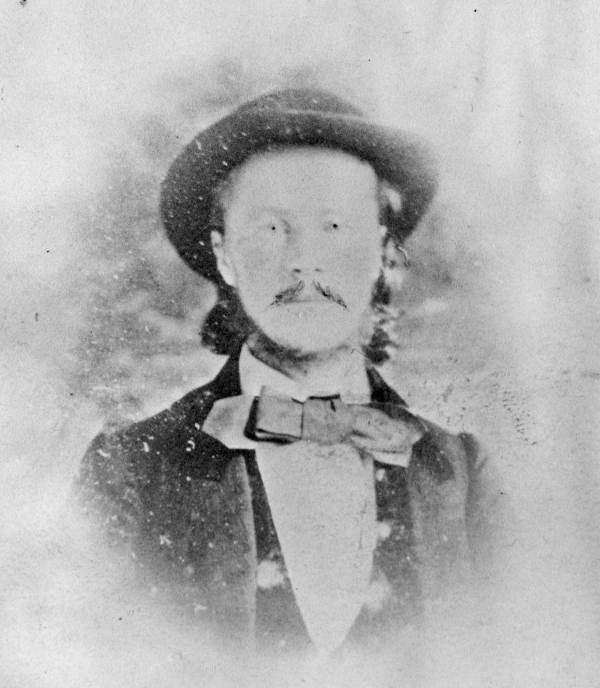
Charles M. Hamilton
Library of Congress
Charles M. Hamilton, an agent of the U.S. Government's Bureau of Freedmen, Refugees & Abandoned Lands, ordered the three teenagers to appear before him to "answer the charge of having desecrated the graves of Union soldiers." Since agents of the "Bureau" were officers in the U.S. Army, Hamilton's order subjected civilians to a military trial, a clear violation of the United States Constitution.

The three teenagers did appear before Hamilton, but to his surprise they were accompanied by their attorney, their families and a huge crowd of supporters. The Marianna Courier described the results of the confrontation:

...An investigation was had, in which no reliable evidence was introduced to support the charge, and the young ladies were immediately released from arrest. We would advise our young ladies for the present, at least, to keep out of the way of these "Union soldiers" dead or alive. As there are no headboards, stones, or cenotaphs in the cemetery to guide your steps, it would be better not to go at all, for fear of treading unawares where you hadn't ought to, to spread flowers, or pick one up to decorate, for it might be called another name and you punished. - Marianna Courier, May 30, 1867.

The people of Marianna believed that Hamilton would have punished the girls had their family and friends not turned out in force. They also considered the agent's attempt to try the three teenagers before a military court to be an egregious abuse of power. The Courier heaped scorn on the agent and suggested that town authorities "immediately provide another avenue to the burial place of our dead that the 'Sacred Spot' be not viewed much less approached, at the peril to the innocent and unsuspecting."

The Battle of the Flowers was the final straw for many citizens of Jackson County, Florida. The nonviolent protest by the three girls led former Confederates across the county to end their peaceful cooperation with the U.S. authorities who controlled the county. Over the years that followed, these men would stage a successful rebellion against Hamilton and his cohorts. Much blood would be shed in what would be called the "Reconstruction War" or "Jackson County War," but by the time it ended U.S. troops no longer patrolled the streets of Marianna and control of the local government had been returned to the local people.

Saturday, July 28, 2012

The Attack on the Watson Farm (February 7, 1868)

William J. Purman
As Reconstruction era violence continued to escalate in Jackson County during the winter of 1868, the forces of Bureau Agent William J. Purman carried out a military-style raid on the farm of Lewis Watson.
Purman had now succeeded Charles Hamilton as agent for the Freedmens Bureau in Jackson County. He continued and expanded upon the extra legal tactics of his predecessor.

Members of the Watson family were rumored to have been involved in the deaths of two freedmen near Campbellton. Purman produced no evidence to prove any allegations against the men nor did he swear out a warrant for them with authorities in Jackson County. He did, however, order an armed party of freedmen to their farm.

The Watson farm was about three miles from Campbellton and the family members and some of their friends looked out on February 7, 1868, and saw organized bodies of freedmen approaching:

John Doyle Examined & Sworn Says that on last Thursday evening a band of armed Negroes approached Mr. Lewis Watson's house in Jackson County by two routes. One party coming from the road to the house, the other party through the field. That there were between 18 and 25 of the Negroes who came from the road and about six or more through the field. That he saw George Harris colored, James Davis, Frank Smith, Bill Smith & Macon McKinnie among the Negroes. That they called one of their party Captain and called other officers but don't recollect.


Freedmen photographed during Reconstruction
The above is from the case file on the attack that was recently discovered along with other records from the Reconstruction era in boxes in the old Jackson County Jail. The records were salvaged prior to the demolition of the old jail.

Doyle, a neighbor of the Watsons, tried to get across a fence when he saw the armed freedmen marching up to the farm:

...[W]hen they approached Mr. Watson's house they did so in a boisterous manner, with their guns presented and as he, Doyle, was getting over the fence, they, the Negroes, ordered him to "halt g-- damn you or I will blow your brains out." He halted and they then arrested [him], Duncan Miles, Marion Watson and John Miller.

The freedmen fired their guns repeatedly in Lewis Watson's yard and also shot at his dogs, which were barking furiously. Doyle asked by what authority he was being arrested:

...[O]ne of them punched him...in the back of the neck with his gun and told him there was their authority and that if he said a sound they would blow his damn brains out.

The freedmen then marched their captives away from the farm. After they had gone about 3/4 of a mile they released Marion Watson and John Miller, but continued on with Duncan Miles and John Doyle:

...They then took a little path leading down into a Hammock near the Baker Field. They took him to a house occupied by Austin Smith, that while there he...asked them for a drink of water and that Macon McKinnie told him he would not need water long g-- damn you and would not give it to him. From Austin Smith's they took him... to Alex Godwin's house. When they got to Alex Godwin's they halted.
Farm Building like the one where Doyle and Miles were held

The armed men clearly were expecting some kind of written papers, probably from Purman, at Alex Godwin's house. Godwin was a freedmen who had once been a slave on the plantation of Alexander R. Godwin. Doyle heard them ask Godwin if a man named Spencer had come with papers. He said that no one had come. After some discussion, the armed force marched Doyle and Miles on to the plantation of F.P. Haywood where they held them in an old building overnight. The initial group of freedmen were joined that night by a second armed band led by Bill Young.

In his sworn deposition, Doyle detailed the discussion he overheard from the men standing guard over him:

...[T]here seemed to be a diversity of opinion in regards to what should be done with them (meaning Doyle and Miles), some were for shooting while others were for waiting for the papers. The next morning they started in the direction of Underwood's, a Justice of the Peace, to give him...a hearing. They were met by Alex Godwin who told them that if they went toward's Underwood's they would be met by a white crowd....
Jackson County as it appeared during Reconstruction

The white men of the Campbellton area had been alerted to the attack and kidnapping and were now armed and in force, looking for the freedmen and their captives. To avoid a confrontation with this group, the freedmen turned towards Marianna.

As they marched for the county seat, the freedmen continued to debate what they should do with their prisoners. Some continued to be for shooting the two men while others favored carrying them on to Marianna.

Doyle swore in his deposition that Mingo Long had arrived with Young's party. A well-known associate of Hamilton and Purman, Long was involved in a series of Reconstruction era crimes including the burning of a cotton gin. He told John Doyle that, if he had his way, the two prisoners would never see Marianna.

The name of another man who would figure prominently in Jackson County's Reconstruction War also appears in the documents of the case file. Calvin Rogers was reported to have been present in the party of freedmen who arrived under Bill Young. Although he did not yet hold the position, Rogers would soon become the constable of Jackson County.

Expected papers never came from Marianna and the freedmen halted their march for the city as they continued to debate what should be done with John Doyle and Duncan Miles. After terrorizing the men for over 24 hours by repeatedly aiming guns at them and threatening to fill their hearts with buckshot, the freedmen realized that they were facing impending violence from the outraged citizens now swarming all over the area. Doyle and Miles were released and the armed force scattered.

There had never been a warrant, criminal complaint or any other document sworn out against the men kidnapped from the Watson farm. Clearly the freedmen had attacked in military formation expecting that some type of papers would be sent out from Marianna. Whether Purman, with whom a number of the men in the armed force were associated, lost his nerve or there was some other complication is not clear.

The victims of the incident immediately swore out criminal complaints against as many of the freedmen involved in their kidnapping as could be identified. Freedmen from around the Campbellton area who were not aligned with Purman's forces testified on behalf of the victims and Judge George F. Baltzell ordered the arrests of Macon McKinnie, Frank Smith, James Davis, George Hawes, H. Smith, Mingo Long, Calvin Rogers, Henry Cotton and Oliver Long on February 12, 1868.

The men were all charged with Sedition and Insurrection, extremely serious crimes. The victims of the attack, however, would never see justice done to their attackers. The suspects had powerful friends and all attempts to try them were blocked.

The case contributed greatly to the growing sentiment in Jackson County that it was no longer possible to obtain justice in the courts. As the year 1868 went forward, the violence between Purman and his allies and the white and some black citizens of Jackson County would surge.

I will continue to post on the Reconstruction War in Jackson County in coming weeks, so be sure to check back regularly.

Sunday, May 20, 2012

Charles M. Hamilton: A Carpetbagger's Disingenuous Defense

Marianna in 1890 (22 years after the McKay Farm raid)
In the last article, I discussed the January 1868 raid on the McKay farm in Jackson County by the forces of Charles M. Hamilton. (Please see The Raid on the McKay Farm).

Hamilton was the Marianna Agent for the Bureau of Refugees, Freedmen & Abandoned Lands. Commonly called the Freedmen's Bureau, the agency had been created by the Federal government at the end of the War Between the States to help the former slaves or "freedmen" make the transition from slavery to citizenship.

While in many places and in many cases the Bureau agents were honorable men who did their best to avoid tension between the races and help the freedmen achieve their new status in society, others - like Hamilton - were not. Hamilton had organized an armed band of freedmen to enforce his will on the people of Jackson County, he overruled the local courts in violation of Florida law and the standing orders of the U.S. Army and in January of 1868 he ordered the kidnapping and illegal detention of William McKay and John F.E. McKay.

Charles M. Hamilton
The McKay case led to the filing of two $10,000 lawsuits against Hamilton, accusing him of heading the unlawful detention of the men, during which they were beaten and injured.

Hamilton's attorneys supposedly responded to the allegations on February 25, 1868. I say supposedly because, as will be seen, there is some strangeness surrounding the dating of their pleading.

The remarkable document filed by them with the Circuit Court of Jackson County was discovered when boxes of old county records were found this spring at the old Jackson County Jail in Marianna. In it, Hamilton and his lawyers employed an unlikely and strange defense and asked that the lawsuits be dismissed:

...[B]ecause he says, at the time of the committing of the said supposed trespasses mentioned in plaintiffs said declaration, and long before that time had been and was at the said time an officer in the military service of the United States, and duly commissioned and accredited as such officer by the government of the United States of America, and as such officer as aforesaid, and that the said trespasses in the said declaration mentioned; whereof and for which the said plantiff hath brought his action in that behalf against the said defendant, in the due exercise of his said office under the said authority and power long before the time granted and issued to him, this deft. by the government of the United States aforesaid and unexpired....

1868 Constitution of Florida (Courtesy Florida State Archives)
In short, Hamilton claimed that because he had been an officer in the U.S. Army at the time of the raid, he could not be held accountable for any abuses done to the McKays. To support this position, he also pleaded the Sixth Section of the Fifteenth Article of the Florida Constitution of 1868:

  Section 6. All proceedings, decisions, or actions accomplished by civil or military officers acting under authority of the United States subsequent to the 10th day of January, A. D. 1861, and prior to the final restoration of the State to the government of the United States, are hereby declared valid, and shall not be subject to adjudication in the courts of this State, nor shall any person acting in the capacity of a soldier or officer of the United States, civil or military, be subject to arrest for any act performed by him pursuant to authorized instructions from his superior officers during the period of time above designated.

There were, as might be expected, some real problems with this defense. The first and biggest is that Charles M. Hamilton was NOT an officer in the U.S. Army at the time of the raid on the McKay farm. His service had ended and he had been discharged from the military on January 1, 1868, days BEFORE William and John McKay had been kidnapped, unlawfully detained and brutally beaten.

In other words, Hamilton committed perjury when he falsely claimed he should not be punished because he was acting as a U.S. officer at the time the civil rights of the McKay brothers were violated.

Nor was this the only problem with his defense. The second one involved his use of Article 15, Section 6 of the 1868 Florida Constitution. This document was not adopted until February 25, 1868, nearly two months after the raid on the McKay farm and weeks after the lawsuits against Hamilton were filed. What is especially curious is that the document filed by Hamilton and his attorneys was also dated February 25, 1868, the same day as the adoption of the state constitution.

John L. Finlayson in 1868
The third problem is that Hamilton's defense appears to have been postdated and not actually filed until months after the deadline given him by the court for responding to the lawsuits filed by the McKays. While the document bears a date of February 25, 1868, it was not actually filed with the court until September 8, 1868, five months AFTER the deadline ordered by the court. The date of filing was noted by John L. Finlayson, Clerk of Courts.

A former Confederate surgeon, Finlayson was a scalawag who received appointment to his office. (Note: "Scalawags" were Southerners who allied themselves with Northerners like Hamilton during the Reconstruction era). He was an ally of Hamilton during his reign in Jackson County.

Hamilton's defense leaves little doubt that his attack on the McKays was unlawful. Perhaps even more significantly, however, the manner in which he defended himself and the issues of date surrounding the document show that he and his associates operated with utter contempt for the courts of Jackson County.

Even on its own, the raid on the McKay farm was a horrible event. Unfortunately for the citizens of Jackson County, it was not the only such attack carried out by the Carpetbaggers and their allies during the winter and early spring of 1868. More on that in the next article!

Tuesday, May 1, 2012

The Raid on the McKay Farm (January 1868)

Freedmen working a farm.
The Battle of the Flowers had ignited passions in Jackson County (see The Battle of the Flowers) and tensions between local white citizens and the Bureau of Refugees, Freedmen & Abandoned Lands intensified through the summer and fall of 1867.

The growing resistance to the Federal government and particularly to its agents, Charles M. Hamilton and William J. Purman, reached the boiling point in January of 1868 when news spread through the county of the kidnapping and beating of two farmers, William McKay and John F.E. McKay. On January 3, 1868, the two filed suit against the Carpetbagger Hamilton, each alleging that the agent:


Col. James F. McClellan
…With force and arms then & there assaulted the said plaintiff then and there beat, bruised & ill treated him, and then and there kept and detained him in prison there, without any reasonable or probable cause whatsoever, for a long time, to wit, for a space of four days….

The lawsuits each sought a minimum of $10,000 in damages and were filed on behalf of both of the farmers by attorneys James F. McClellan, W.D. Barnes, A.H. Bush and Samuel Hawkins. McClellan, Barnes and Bush had all fought on the Confederate side during the recent war.

They alleged that both of the McKays had suffered injury to their persons and businesses as a result of their confinement by Hamilton.

Charles M. Hamilton
The situation developed, in fact, because of an edict handed down by Hamilton himself. Cotton prices had collapsed that year and money was in short supply. Many of the freedmen (former slaves) had purchased things on credit that year, in anticipation of being able to pay their debts when the cotton crop came in. When prices collapsed, they found themselves unable to pay their debts.

The creditors to whom they owed money began to seize their portions of the corn crop in order to settle the debts. Food began to run short and Hamilton decided to deal with the situation by all but completing his takeover of Jackson County's economic system. He ordered planters to cease dividing crops and paying out the debts of their laborers. He and Purman would decide how much the laborers were due and who should be paid.

Carpetbaggers as seen by Southerners
Many of the farmers objected to the agent's order as illegal. Hamilton ordered troops to the Campbellton area to enforce his edict, but the soldiers arrived to find themselves faced with the possibility of armed rebellion. Wisely they avoided a bloody confrontation and returned to Marianna. 

Learning of the outcry from the farmers of Jackson County, one of Hamilton's military superiors - Lt. Col. F.F. Flint - protested to Gen. John Sprague, the military commander of Florida, that the agent was pushing the citizens of the county to the brink and that a serious disturbance might be the result. Governor David Walker joined with Flint in blaming Hamilton for the growing tension in Jackson County.

Hamilton, meanwhile, moved on John and William McKay. The two farmers had dismissed one of their laborers during the year for balking at his orders and refusing to carry out work assignments. He and his family had been evicted from the farm, but after being contacted by the Bureau, the McKays had paid him for the work he actually performed.

Carpetbaggers as seen by Northerners
Hamilton and Purman now demanded, however, that the two farmers pay the worker his share of the crop even though he had not worked through the entire season. They refused. Both men were seized, according to the Marianna Courier, and "ruthlessly incarcerated in a filthy old smokehouse to be made to succumb to an unfair and unjust disposition of their property that amounted to absolute robbery."

In the process of this "arrest," the McKays reported that they had been badly beaten, dragged away from their homes by a band of armed freedmen and held in horrendous conditions.

 A court date was set for April 4, 1868, and Hamilton was issued a summons to appear. According to a notation on the summons, it was "executed by handing a copy of the within to C.M. Hamilton" on January 15, 1868, by Deputy Sheriff R.J. Pittman.

It would take Hamilton nearly six weeks to respond to the filing against him. I will detail his response in the next article.

Saturday, March 31, 2012

The Battle of the Flowers (Part Two)

Flowers and Confederate Graves at Riverside Cemetery
To read part one of this article first, please visit The Battle of the Flowers (Part One).

The trouble that took place at Marianna in May of 1867 is remembered today as the Battle of the Flowers. It began when local freedmen held a memorial service at the grave of Lieutenant Isaac Adams of the Second Maine Cavalry.

Lt. Isaac Adams, 2nd Maine Cavalry
Adams had been shot during the Battle of Marianna on September 27, 1864 (Please click here to learn more about the fight: The Battle of Marianna, Florida). An officer in the Union force that attacked Marianna, he had been cared for by local citizens after the raid and then buried in Riverside Cemetery when he finally died from his wounds some time later. His grave, along with those of other Federals killed in the battle, had been placed apart from the sections of the cemetery containing the resting places both of the local white community and the local slave community. Local legend notes that the dead raiders were not considered good enough to be buried either with the whites or blacks of Marianna.

Scene of Heavy Fighting
The raid caused immense hardship for the people of Marianna. The city lost 20% of its male population in a single day. Among the killed, wounded or captured were the circuit judge, county judge, sheriff, constable, county commissioners, lawyers, doctors, dentist, blacksmith, wheelwright, merchants and school boys. Young boys and elderly men were carried away to prison camps in the North and many never returned, having died from pneumonia, tuberculosis and other diseases at Elmira, New York.

The women and children of Marianna were left to fend for themselves. Food ran short and hunger was rampant. Two homes, a church and the town's pharmacy were burned to the ground. The Union raiders carried away all the livestock and food they could get their hands on.

In short, the Battle of Marianna caused enormous suffering in the city and the people were left extremely bitter over the treatment they had received.

J.H. Brett, Killed in the Battle of Marianna
In the Spring of 1866, the Confederate widows and daughters of Florida joined their counterparts in Georgia in declaring April 26th as Confederate Memorial Day. Flowers were placed on the graves of fallen soldiers and other expressions of remembrance were given.

The day of memory was repeated on April 26, 1867, with the ladies of Marianna wearing their mourning attire and placing flowers on the graves of the Southern dead at Riverside and St. Luke's.

Grave of Lt. Isaac Adams
A few days later, a group of former slaves placed flowers on the grave of Lieutenant Adams at Riverside Cemetery. The move probably was done with no ill intentions, but was received by many of the white residents of Marianna like a slap in the face. It did not take long before three young girls removed the flowers from Adams' grave and trampled them in the dirt pathway.

Although one recent writer describes them as "some young white women," all three of the girls were under the age of 16. One had lost a brother in the Battle of Marianna and another had seen a close friend shot down in front of her home. Right or wrong, they were insulted by the sight of the flowers on Adams' grave and removed them.

The action was not illegal, of course, and did not involve any desecration of the grave itself, but it quickly drew the attention of Bureau agent Charles M. Hamilton. He had suggested that the freed people place flowers on the lieutenant's grave and was outraged that three local girls had seen fit to remove them. It was the first real test of his almost unlimited power over the people of Jackson County.

Charles M. Hamilton
Unwilling to let the challenge go unanswered, Hamilton ordered the teenagers to appear before him to "answer the charge of having desecrated the graves of Union soldiers." They did so, but they did not go alone.

Instead of holding a military trial for three trembling young girls, Hamilton suddenly found himself faced not only by the girls, but by their attorney and a group of family members and supporters from the community. The Marianna Courier described the confrontation:

...An investigation was had, in which no reliable evidence was introduced to support the charge, and the young ladies were immediately released from arrest. We would advise our young ladies for the present, at least, to keep out of the way of these "Union soldiers" dead or alive. As there are no headboards, stones, or cenotaphs in the cemetery to guide your steps, it would be better not to go at all, for fear of treading unawares where you hadn't ought to, to spread flowers, or pick one up to decorate, for it might be called another name and you be punished. - Marianna Courier, May 30, 1867.

 
The people of Marianna reasonably believed that Hamilton would have punished the girls had their family and friends not turned out in force to support them. They also considered the agent's attempt to try three teenagers before a military court to be egregious abuse of power and reacted accordingly. News of the incident spread and the "Battle of the Flowers" became the rallying point around which organized resistance of the occupiers began to grow.

Frank Baltzell, the local newspaper editor, had been captured in the Battle of Marianna and had seen his friends Littleton Myrick and Woody Nickels burned at St. Luke's Church. He used the power of his press to heap scorn on Charles M. Hamilton:

"The Sacred Spot"
   If you should at any time desire to walk, or direct your steps towards the cemetery, tell no one of your purpose, and on reaching there look around, and be careful of observation from within and withour, and at all times treat lightly. We have no doubt, on application, Capt. Hamilton would grant permission to plant a tree, shrub or flower, as an ornament to the graves of those you love, especially if not within a respectful distance from the "Sacred Spot."
   Our town authorities should immediately provide another avenue to the burial place of our dead that the "Sacred Spot" be not viewed much less approached, at the peril to the innocent and unsuspecting. - Marianna Courier, May 30, 1867.


In the view of Marianna's former Confederates, the gauntlet had been thrown down by Hamilton and they now prepared to resist him in his further actions. In carrying out a military trial of three teenage girls, the Bureau agent himself ignited opposition in Jackson County. The Reconstruction War had begun.

I will continue to write about the Reconstruction War in Jackson County over coming weeks, so be sure to check back often. To read previous articles on this topic, please visit the main page at http://twoegg.blogspot.com.


Wednesday, March 28, 2012

The Battle of The Flowers (Part One)

Charles M. Hamilton
The straw that broke the camel's back with regard to relations between Freedmen's Bureau officials Charles M. Hamilton and William J. Purman and the white residents of Jackson County came in the spring of 1867. It is remembered to this day as "The Battle of the Flowers."

It came as the U.S. Army, per its instructions from Congress, began to tighten its control over the people of Florida. Many of the Radical Republicans in Congress felt that the South had not shown proper repentance for secession and the war and that many Southern leaders had failed to show proper deference to the new order of things. The result was the beginning of what history called "Radical Reconstruction."

It began on April 9, 1867, when Major General John Pope issued General Orders No 1, taking control of the state and people of Florida. Colonel John T. Sprague was ordered to Tallahassee without delay, elections were suspended and the army took control of all functions of government. Local officials were retained in their positions until the ends of their terms, when they would be replaced by military appointees:

Gen. John Pope, U.S.A.
...It is to be clearly understood, however, that the civil officers thus retained in office shall confine themselves strictly to the performance of their official duties, and whilst holding their offices they shall not use any influence whatever to deter or dissuade the people from taking an active part in reconstructing their State Governments, under the act of Congress to provide for the more efficient government of the rebel States and the act supplementary thereto. - Gen. John Pope, USA, April 9, 1867.

In other words, the military was suppressing the First Amendment rights of free speech of any person then holding public office in Florida, a list that included almost every influential native Floridian.

Congress had overturned Florida's post-war constitution, which was being ignored by Bureau officials such as Hamilton and Purman anyway. An election was ordered for delegates to a convention that would assemble for the drafting of a new constitution, but anyone who hoped to vote in the election would first be required to take the following oath of loyalty:

     I, _____________, do solemnly swear or affirm, in the presence of Almighty God, that I have resided in the State for ____________ that I am a citizen of the State of Florida; next preceding this day, and now reside in the county of Florida in said State, as the case may be; that I am 21 years old; that I have not been disfranchised for participation in any rebellion or civil war against the United States, nor for felony committed against the laws of any State of the United States; that I have never been a member of any State Legislature, nor held any executive of judicial office in any State, to support the Constitution of the United States and afterwords engaged in insurrection or rebellion against the United States, or given aid and comfort to the enemies thereof; that I will faithfully support the Constitution and obey the laws of the United States, and will, to the best of my ability, encourage others so to do. So help me God.

Col. John T. Sprague, U.S.A.
The orders from General Pope were followed immediately by General Orders No. 2 from Colonel John T. Sprague, the U.S. Army officer in command of Florida. It was short and to the point: "Martial Law is now in force throughout the State."

To enforce its will on the people of Florida, the Federal army now spread soldiers throughout the state. The Post Return of the Post of Tallahassee, Florida, dated May 1, 1867, shows that by the end of April a detachment of U.S. soldiers was back on duty in Marianna.

As should have been expected, a wave of outrage rolled quietly through the towns and cities of the South, including Marianna. The people had been stripped of their Constitutional rights, placed under martial law and threatened with military force after two full years of trying to live as good citizens following the end of the Civil War. 


Abraham Lincoln
The new policy was a slap in the face not just to the people of the South, but to the beliefs of the late President Abraham Lincoln. He had believed that the secession of the Southern states was illegal and that bringing them back to their places in the Union should be as simple as having them declare an end to slavery and renounce their Confederate debts and loyalty. In other words, he saw the restoration of the Union as an easy thing to accomplish once the fighting was over and believed it could be done with mercy and peaceful intent. He had expressed his views in his second Inaugural Address:


...With malice toward none, with charity for all, with firmness in the right as God gives us to see the right, let us strive on to finish the work we are in, to bind up the nation's wounds, to care for him who shall have borne the battle and for his widow and his orphan, to do all which may achieve and cherish a just and lasting peace among ourselves and with all nations. - Abraham Lincoln, March 4, 1865.

President Lincoln, who believed that the South had never really seceded at all, could not have imagined that two years later, Congress would place the Southern people under martial law and the army would enforce its will on peaceful people at the point of a bayonet. His dream of Reunion disappeared into the nightmare of Radical Reconstruction.

Martial law and the almost unlimited power granted to men like Hamilton and Purman boiled over in Jackson County in May of 1867 when the Bureau agents targeted not former Confederates or "unrepentant rebels," but three teenaged girls.

To continue to the second part of this article, please click here: The Battle of the Flowers (Part Two). To read other parts of my coverage of Reconstruction in Jackson County, just go to http://twoegg.blogspot.com.
 

Wednesday, March 21, 2012

Secret Meetings, Night Riders & the Lincoln Brotherhood in Jackson County

William J. Purman
Library of Congress
In the early summer of 1866, Charles M. Hamilton was reinforced at the Freedman's Bureau in Marianna by another Federal appointee, William J. Purman.

Few Reconstruction era officials would generate as much outrage as this Pennsylvanian did among the people of Jackson County. And white citizens were not alone in objecting to Purman's tactics and operations. John Wallace, for example, was an educated freedman who served as a state legislator in Florida during Reconstruction. He linked Purman's arrival in Marianna to what he called,"The Purman-Hamilton Reign of Terror in Jackson County."

Wallace left no doubt of his opinion of Purman and Hamilton, saying of them that, "Every device was resorted to by these agents to embitter the colored man against the white man." In fact, Wallace corroborated the claims of many white citizens who accused the two Bureau officials of operating Jackson County like their personal fiefdom:

Fancified Northern Artist's View of a Brave Bureau Agent
Library of Congress
...What incendiary harangues failed to accomplish they sought to do by exhibitions of their power over the whites, which they displayed in frequent acts of the grossest tyranny. They set at defiance the orders and decrees of the courts of justice when the matters involved were mere questions of right between two citizens, neither of whom were freedmen. They arrested and imprisoned peaceable citizens without any real cause, and refused to furnish them or their counsel with the charges upon which they were held. - John Wallace, Carpet bag rule in Florida,

John Wallace
Critic of Purman & Hamilton
Purman, according to Wallace, was a key supporter of a shadowy organization that Bureau officials organized among the freed slaves of Florida. With rituals based upon corruptions of those of the Masonic Lodge, the organization conducted its meetings in the dark of night and was called the Lincoln Brotherhood. Its presence in Florida was well known long before anyone heard the term "Ku Klux Klan."

Wallace himself was familiar with meetings of the Brotherhood near Tallahassee and there is no doubt that the sessions in Jackson County were very similar:

...The freedmen considered this league a great thing, and their meetings at the church were carefully guarded by armed sentinels, who halted any one who came into the vicinity of the church, requiring the countersign under the penalty of the contents of the old musket. Auxiliary lodges were formed in every part of the county and throughout the State. The regular meetings of these lodges were held every Thursday night, in the most secret places to be secured. - John Wallace, Carpetbag Rule in Florida,

The Lincoln Brotherhood
John Wallace said many Brotherhood members believed they
became true brothers of Abraham Lincoln when they joined the group.
Wallace went on to describe how applicants to the Brotherhood were forced to swear on a human skull they were told was that "of a brother who had been recreant to his trust, had broken his oath and exposed the secrets of this league." Anyone who did so, they warned, would share the man's fate.

The activities of the Lincoln Brotherhood played a significant role in the violence that took place in Jackson County during the Reconstruction era. In fact, local freedmen later would testify before the U.S. Congress that they had been threatened by what they called the "Black Klan." This, they said, was a Klan-like organization, but made up of black men instead of whites. The reference, undoubtedly, was to the Lincoln Brotherhood.

Not all of the targets of the Brotherhood were freedmen, as two Jackson County families soon would learn. I'll detail the group's raids on the McKay and Watson farms in coming posts. But first, in the next of this continuing series on Reconstruction in Jackson County, I'll focus on an event remembered in Marianna to this day as the "Battle of the Flowers." Check back on Thursday for that!

Wednesday, March 14, 2012

Freedmen, Crime and the Courts in the Summer of 1866

Jackson County during the Reconstruction era
The railroad was merely projected at that time.
Continuing with my discussion of the Reconstruction era in Jackson County, the summer of 1866 was a time of growing discontent among the people of all classes.
The old establishment, still embittered from the war, reacted with resentment to the arbitrary decisions of Bureau Agent Charles M. Hamilton, particularly his invalidation of all labor contracts in the county. In striking down all existing contracts, Hamilton overruled not just the local courts, but the legislature and governor of Florida. Then by requiring both landowners and freedmen to pay him for document stamps he further infuriated them and speculation grew that he was lining his pockets at the expense of the people.

The middle class and poor whites were desperate. Hard currency had all but disappeared and the number of civil suits filed in the local court soared. Financing for agriculture and small business had dried up. Many of the women of this class were war widows and many of the surviving men had come home from the war either sick or disabled or both. The terrifying spectre of hunger stalked across the land.

Col W.D. Barnes
19th century lawyer

Among the freedmen, there was a mixture of sentiments. Some had continued to believe they would be given land by the government. They had been warned against these beliefs by the governor himself, but the dream had continued. As a result, many had not entered into labor contracts and now were hungry and destitute. Others wanted nothing to do with further labor and retreated into the pine woods where they established homes for themselves and barely survived.

These tensions, along with the increasingly heavy hand of the Federal government and the all but total inability to understand what the future might hold, led to increasing violence. The local courts, then still operating as they had during and before the war, tried to deal with the situation.
Anderson Baker (left)
A freedman still living in Jackson County in the 1900s

On June 19th, a freedman named Philip Boggs assaulted Mary J. Coley with "force & arms." Initially charged with Assault & Battery, he entered a guilty plea to simple assault and was fined $100. He was found carrying a pistol and pocket knife at the time of his arrest and additionally was charged with secretly carrying weapons. He entered a guilty plea to those crimes as well and was sentenced to spend one hour in the pillory.

Despite the fact that he entered guilty pleas to both crimes, Boggs would be pardoned by the state's Reconstruction governor the next year.

The most brutal crime of the summer, however, came on July 8th.

Two young girls were walking along a road not far from where today's town of Cottondale stands. The oldest was 14 and the youngest was nine. Two freedmen named Henderson White and Lewis White approached from the other direction.

Dr. Theophilus West
Jury member during Reconstruction
According to what the girls told their father when they finally made it home, the two men grabbed the older of the two and dragged her off the road into an adjacent field. Then they took turns raping her as the younger girl watched in fear nearby. By the time the girls made it home, the 9 year old was badly frightened and the 14 year old was badly injured.

Their father went immediately to the proper authorities and swore out a complaint against Henderson and Lewis White. Before they could be arrested, however, Henderson was accused of raping another girl, this one 16 years of age.

The two eventually did stand trial and Henderson White was convicted. On October 17th he was sentenced to hang for his crimes, but the governor intervened and gave him a temporary reprieve.

(Note: I will take a closer look at the case against Henderson and Lewis White in my next post).

Many claims have been made about how freedmen were treated while the courts were still in the hands of the local people. Some have asserted that the former slaves could not obtain justice. A case that developed in July of 1866 provides interesting perspective on the matter.

Benjamin Harrison Neel
Justice of the Peace, 1866
A freedmen identified only as "Robin" was arrested on a warrant issued by Benjamin Harrison Neel, a Justice of the Peace in eastern Jackson County. The alleged crime involved default of bail in another case and Sheriff W.H. Kimbell placed Robin in the Jackson County Jail. On August 11th, however, the freedman petitioned Circuit Judge Allen H. Bush for a writ of habeas corpus.

A former member of the Marianna Home Guard, Judge Bush had been taken prisoner during the Battle of Marianna and carried away to a prison camp in Elmira, New York. He was part of the Confederate leadership of Jackson County and returned from Elmira particularly embittered against Northerners and the North in general.

Robin's petition was prepared and witnessed by Justice of the Peace Jno. F. Hughes:

The petition of Robin a freedman respectfully showith that your petitioner is confined by W.H. Kimbell unjustly (as he apprehends) in the jail of the County of Jackson in the State of Florida for some criminal or supposed criminal matter, which confinement is illegal & wrong.

Judge Bush agreed and on August 14th ruled that "said Robin [is] retained without any charge against him." The freedman was ordered to be released without delay.

The case is interesting in that it proves that freedmen such as Robin could receive fair treatment and beneficial rulings in the courts of Jackson County, where the sitting circuit judge was widely recognized for his pro-Confederate sympathies.

Emanuel Fortune
Freedman and State Representative from Jackson County
This ability by the freedmen to obtain justice in the local courts was demonstrated by other cases that summer. A freedman named William Beedy, for example, was indicted on charges of Assault & Battery and Carrying Secret Arms. Two of the men sitting on the grand jury that returned the indictment against him were not citizens of Jackson County and the case against Beedy was dismissed.

Boxes of newly discovered case files from the Reconstruction era also show that African American women began receiving justice through the courts during the time when the judicial system in Jackson County was still under local control. For the first time ever, cases were made against suspects on charges of assault, battery, rape and theft in which the victims were women who had once been held in slavery.

Freedmen were not yet allowed to serve on juries, but their testimony regularly was heard in court. In addition, the newly discovered records show that both judges and juries tried to be fair and honorable in their application of the law. Freedman convicted of Assault & Battery, for example, generally were fined between $50 and $100. White men convicted of Assault & Battery were fined the same. There were occasional exceptions, but fines, fees and jail terms were remarkably consistent.

The newly discovered files show that the courts of Jackson County made remarkable progress in the short time that former Confederates were in control during the first two years after the end of the War Between the States. A dark cloud, however, was looming on the horizon.

In my next post, I'll discuss in more detail the case that led to the hanging of Henderson White.

Thursday, March 1, 2012

"...His name that sat on him was Death, and Hell followed with him."

Charles M. Hamilton
And I looked, and behold a pale horse: and his name that sat on him was Death, and Hell followed with him. And power was given unto them over the fourth part of the earth, to kill with sword, and with hunger, and with death, and with the beasts of the earth. - Revelation 6:8.

The Reconstruction era in Jackson County took an ominous turn early in 1866 when a Union officer named Charles M. Hamilton arrived in Marianna. To quote the verse from the Book of Revelation, "Hell followed with him."

Hamilton came to Marianna to head up the local office of the Bureau of Freedmen, Refugees and Abandoned Lands (commonly called the Freedman's Bureau). This was the organization tasked by the U.S. Government with overseeing the transition of the former slaves into their new roles as citizens of the country. In most areas of the South, the Bureau's work without violence. In Jackson County, that would not be the case and Hamilton himself was the cause of much of what followed.

When he first arrived in Jackson County, Hamilton was surprised to find that the local whites were "pretty well disposed to the freedmen" and that no significant problems were taking place. This was because the people of both races, after hearing from the governor the previous fall, had moved forward with making arrangements to get the county's farms back into operation.

Gov. William Marvin
Governor William Marvin, the appointed military governor of Florida, had addressed public meetings in Marianna on September 16 and 17, 1865, explaining to the freed people what it meant to be free:
 
…You must be contented with having your freedom, and what else you have you will have to get by work. And when you shall have made it by hard work, you will know how many days of hard toll it cause you to get it, and then you will rightly value it, and take care of it. You now are at liberty to go to work for yourselves; you have none other to work for. You belong now to no man; you have ceased to be property; you never will be sold again; and if you will struggle hard and do right, live as good men and women, and you will prosper, if not, you will suffer.- Gov. William Marvin, September 17, 1865.

The governor had urged all of the county's citizens, both white and white, to cooperate and do what they could to begin producing badly needed food as quickly as possible. And the citizens had responded. Per the governor's instructions, they entered into hundreds of contracts.

These contracts basically were sharecropping agreements. Few of Jackson County's landowners had any real money left after the war, so they offered a share of the crop plus housing, food and other supplies to the freedmen in exchange for them helping to return the farms to production. Surviving examples of these contracts show that they were well done and that the landowners tried to be fair.

Charles M. Hamilton
When Charles Hamilton arrived in early 1866, before even the first post-war crop could be planted, he immediately and illegally invalidated these contracts.

Under Florida law, the labor contracts were under the regulation of the county judge and nothing in either state or federal law gave the Freedman's Bureau any control over existing agreements. Hamilton, however, overruled the law and assumed responsibility for the contracts himself.

Not only did he require that all agreements be made using a printed form he prepared himself, he also required that both landowners and freedmen pay him fees for stamps to be placed on the documents. It was the first step in an assumption of power by the Bureau that far surpassed anything attempted anywhere else in Florida.

The consolidation of power by Hamilton and the Bureau was the spark that soon led to the first outbreaks of violence in Jackson County. The agent's arrival in Marianna, in fact, reasonably could be called the first "shot" in Jackson County's Reconstruction War.


This was the opinion of John Wallace, himself a freedman, who had served in the Second U.S. Colored Troops and fought on the Union side at the Battle of Natural Bridge during the Civil War. He went on to become a teacher and legislator in Florida after the war and summed up his opinion of the cause of the violence in Jackson County as follows:

...The two races became arrayed against each other in deadly hostility, which led to frequent occurrences of violence and bloodshed. This state of things was not due to the enmity of the whites to the blacks, nor their opposition to the new law enfranchising the latter - though they were opposed to it, of course - nor was it due to any natural bad temper or hatred of the whites on the part of the colored people, for under ordinary circumstances there are no more peaceable people in the world than the inhabitants of Jackson County, of both colors, and they would have passed through the ordeal of reconstruction without a jar or disturbance, had it not been for the evil influence of the very men who were delegated to preserve peace, to administer justice, and to promote good fellowship and kindly relations between the freedmen and their former owners. - John Wallace, Freedman and State Legislator.

It did not take long after Hamilton's arrival for things to begin to change in Jackson County.  I'll continue to post on the Reconstruction War in coming days and weeks, so be sure to check back often.