Outnumbered warriors stand and fight in the Georgia woods.
by Dale Cox
 |
| Red Stick Creek warriors at the 2017 reenactment of the Battle of Fowltown during the Scott 1817 Seminole War Battle Reenactment at Chattahoochee, Florida. |
The United States Army opened the battle with a night raid two days earlier (please see First Blood at Fowltown) but failed to kidnap the principal chief Neamathla as ordered to do. Maj. Gen. Edmund P. Gaines ordered a larger force back to the village. Numbering more than 300 men and augmented by a section of light artillery, the strike force was led by Lt. Col. Matthew Arbuckle of the 7th Infantry.
The troops marched from Fort Scott on November 22, 1817, crossing the Flint River at the fort itself to approach Fowltown from the opposite direction of the first attack.
The troops marched from Fort Scott on November 22, 1817, crossing the Flint River at the fort itself to approach Fowltown from the opposite direction of the first attack.
The following is excerpted from my book Fowltown: Neamathla, Tutalosi Talofa & the First Battle of the Seminole Wars :
:
- Begin Excerpt -
Arbuckle’s command halted at some point during the night to rest for a few hours. This guaranteed that the men would be fresh for the battle while also delaying their arrival at Fowltown until well after sunrise. This was probably an intentional way of avoiding the confusion of fighting in the darkness should Neamathla once again resist the presence of the soldiers. It was late morning by the time the troops came within sight of the village:
…The town which is about eighteen miles distant from this place and four from the Bluff we entered on the 23 Instant about 10 O’clock in the morning without opposition. On our approach several signal guns were fired by the Indians who no doubt discovered one of our flanking parties but at the time that all the troops had reached the town no Indians were seen and a few yells only were heard from a swamp which skirts its north east side. I took a position near the town so as to secure the troops from any fire which might issue from the swamp, and after posting such sentinels as would prevent us from being surprised I ordered the men to refresh themselves while the waggons were loading with corn.
Arbuckle was, by nature, a much more cautious officer than Maj. Twiggs. The fact that he approached Fowltown with flanking parties out is clear evidence that he was taking all proper steps to avoid being surprised. Such measures had likely been reinforced before his departure from Fort Scott by Gen. Gaines, who routinely cautioned officers under his command to be vigilant and careful.
The soldiers knew that Neamathla and his warriors were in the swamp and watching them, but the intensity of the attack still took them by surprise when it hit:
…[The loading of the wagons] was done and the troops were about to march when the Indians, fifty or sixty in number (as I judge) were perceived advancing by the sentinels posted in the swamp and fired on: The fire was instantly returned by the Indians who giving the War Hoop advanced rapidly towards our lines. Parties were immediately detached to take possession of the houses between our position and the swamp which movement checked the progress of the Indians and compelled them to fall back. A spirited fire was then kept up for twenty or twenty five minutes when the Indians retreated into the Swamp. During the affair the Indians frequently appeared in the open ground and from the number which were seen to fall, there can be no doubt but six or eight were killed and many severely wounded yet as the swamp was large and uncommonly thick I deemed it not prudent to pursue them into it or search for those who fell on its edges.
Arbuckle was surprised that Neamathla would attack a much larger force over open ground. The intensity of the attack also took him off guard. The officer did not realize, however, that the corn stocks in the village were vital to the survival of men, women, and children through the coming winter. The town had relocated three times in four years. Its once extensive herds of cattle were gone. The corncribs likely meant the difference between life and death for many in the community. The warriors were fighting to save their homes and families and did so against odds of roughly 6 to 1:
…A spirited fire was then kept up for twenty or twenty five minutes when the Indians retreated into the Swamp. During the affair the Indians frequently appeared in the open ground and from the number which were seen to fall, there can be no doubt but six or eight were killed and many severely wounded yet as the swamp was large and uncommonly thick I deemed it not prudent to pursue them into it or search for those who fell on its edges. The skill and valor displayed by the officers and men engaged in the little affair affords a pleasing prospect should their services be required on another important occasion. The Indians must have been deceived as to our numbers otherwise they should not have had the temerity to attack us.
Whether all of the officers and soldiers fought as valiantly as Arbuckle indicated is subject to some debate. Rumors swirled after the battle that Lt. Milo Johnson of the 4th Artillery had not performed well in action. Johnson had graduated from the U.S. Military Academy at West Point in the Class of 1815. Notable officers to come from that class included Gen. Samuel Cooper, who became the highest-ranking Confederate officer, and Col. William Chase, who supervised the construction of Fort Pickens at Pensacola, Florida. Johnson requested a chance to defend himself against the allegations being made against him:
Having understood that a report is calculating through the camp, that I behaved unlike a soldier in being separated from my compy. and while separated in the affair at Fowl Town, on the 23d of Nov. 1817. I am compelled in justice to myself to demand a court of enquiry, to investigate the truth of sd. report.
No further explanation of his actions during the battle has been found, and there is no evidence in the available military records that a court-martial was ever convened in his case. Subsequent events quickly overshadowed the Battle of Fowltown and Johnson’s conduct – whatever it might have been – was forgotten.
Lt. Johnson’s mention of his company appears to indicate that Capt. Donoho’s artillery company was present at the Battle of Fowltown, even though it is not explicitly mentioned in the official reports. The unit did have several field guns, the largest of which was a 6-pounder. The deployment of at least one of these guns during the fighting would explain the discovery of a solid shot near Four Mile Creek. The cannonball is too small to date from the Civil War, and there was no other recorded action in the area from which it could date.
The Native American account of the battle was simple. Boleck and Cappachimico wrote – likely through Alexander Arbuthnot – in a letter to Gov. Charles Cameron in the Bahamas that Fowltown had been attacked by American soldiers. “Our Indians, rallying, drove the Americans from the town,” they reported, “but in their exertions had two more people killed.”
The chiefs did not report the number of warriors who were wounded in the fighting, but U.S. soldiers reported seeing several fall along the edges of the swamp. Lt. Col. Arbuckle listed his own losses as 1 killed and 2 wounded. The soldier who lost his life at Fowltown was Pvt. Aaron Hughes, a regimental musician. He had joined the army at the age of 15 and served through the War of 1812 without injury. He was reportedly shot while trying to rally the troops by standing on an Indian cabin and playing his fife.
The firefight lasted 15-20 minutes and ended when Neamathla and his men withdrew deeper into the swamp. Arbuckle described what happened next as a “march,” but officers in his command said it was a “retreat.” The soldiers definitely moved quickly from the town and marched up the trail to Burges’s Bluff (Bainbridge):
The detachment consisted of 300 men, under the command of Colonel Arbucle. They were attacked about twelve miles from Fort Scott, by a party of Fowltown and Osouche Indians, supposed to be about one hundred, and had one man killed and two wounded, one dangerously. The Indian loss was supposed to be eight or ten. They captured some cattle during the flight, which were retaken in the towns, lying about eight miles from Fort Scot. – The detachment then retreated four miles and threw up breast works.
Another officer described the battle in similar terms when he wrote to his father from Fort Scott on December 2, 1817:
I marched from Fort Hawkins on the 15th Nov. and arrived here on the 19th, at night. On the 23d, Col. Arbuckle crossed Flint river with 300 men, for the purpose of destroying an Indian town, about 20 miles off. We arrived in the town about 12 o’clock, next day – at 3, the Indians attacked us, and after an action of about 15 minutes, they retreated into a large swamp which nearly surrounded their town. – The loss cannot be ascertained – Ours, 1 killed, 1 severely and 3 slightly wounded.
The brief account provided by Cappachimico and Boleck (“Bowlegs”) appears to indicate that Neamathla attacked the retreating soldiers somewhere between Fowltown and Burges’s Bluff and recovered some of the stolen cattle. None of the U.S. accounts are known to mention such an encounter, but the beef was vital to the survival of the Tutalosis, and a raid or quick strike to recover some of it makes sense.
- End of Excerpt -
The soldiers either "marched" or "retreated" to Burges's Bluff (present-day Bainbridge), where they started building a new stockade that they named Fort Hughes after the slain musician.
If angered by the unprovoked raid on his town two days earlier, Neamathla was infuriated by the larger strike. Runners went out from Fowltown to call for help, and hundreds of warriors soon began a general movement for the Flint and Apalachicola Rivers from as far away as the Suwannee.
Retaliation was coming.
Editor's Note: Learn more about the Battle of Fowltown in Dale Cox's acclaimed book Fowltown: Neamathla, Tutalosi Talofa & the First Battle of the Seminole Wars.
 :
:- Begin Excerpt -
 |
| The Village of Fowltown historical marker near the probable site of the important Lower Creek town where the Seminole Wars started on November 21-23, 1817. |
…The town which is about eighteen miles distant from this place and four from the Bluff we entered on the 23 Instant about 10 O’clock in the morning without opposition. On our approach several signal guns were fired by the Indians who no doubt discovered one of our flanking parties but at the time that all the troops had reached the town no Indians were seen and a few yells only were heard from a swamp which skirts its north east side. I took a position near the town so as to secure the troops from any fire which might issue from the swamp, and after posting such sentinels as would prevent us from being surprised I ordered the men to refresh themselves while the waggons were loading with corn.
 |
| Mountain laurel grows at the probable site of Fowltown south of the Four Mile Creek swamps in Decatur County, Georgia. |
The soldiers knew that Neamathla and his warriors were in the swamp and watching them, but the intensity of the attack still took them by surprise when it hit:
…[The loading of the wagons] was done and the troops were about to march when the Indians, fifty or sixty in number (as I judge) were perceived advancing by the sentinels posted in the swamp and fired on: The fire was instantly returned by the Indians who giving the War Hoop advanced rapidly towards our lines. Parties were immediately detached to take possession of the houses between our position and the swamp which movement checked the progress of the Indians and compelled them to fall back. A spirited fire was then kept up for twenty or twenty five minutes when the Indians retreated into the Swamp. During the affair the Indians frequently appeared in the open ground and from the number which were seen to fall, there can be no doubt but six or eight were killed and many severely wounded yet as the swamp was large and uncommonly thick I deemed it not prudent to pursue them into it or search for those who fell on its edges.
 |
| Neamathla (Eneah Emathla) The principal chief of Fowltown. |
…A spirited fire was then kept up for twenty or twenty five minutes when the Indians retreated into the Swamp. During the affair the Indians frequently appeared in the open ground and from the number which were seen to fall, there can be no doubt but six or eight were killed and many severely wounded yet as the swamp was large and uncommonly thick I deemed it not prudent to pursue them into it or search for those who fell on its edges. The skill and valor displayed by the officers and men engaged in the little affair affords a pleasing prospect should their services be required on another important occasion. The Indians must have been deceived as to our numbers otherwise they should not have had the temerity to attack us.
 |
| Pensacola's Jacksonian Guard demonstrates uniforms and weapons of the Battle of Fowltown era. Courtesy of the Jacksonian Guard |
Having understood that a report is calculating through the camp, that I behaved unlike a soldier in being separated from my compy. and while separated in the affair at Fowl Town, on the 23d of Nov. 1817. I am compelled in justice to myself to demand a court of enquiry, to investigate the truth of sd. report.
No further explanation of his actions during the battle has been found, and there is no evidence in the available military records that a court-martial was ever convened in his case. Subsequent events quickly overshadowed the Battle of Fowltown and Johnson’s conduct – whatever it might have been – was forgotten.
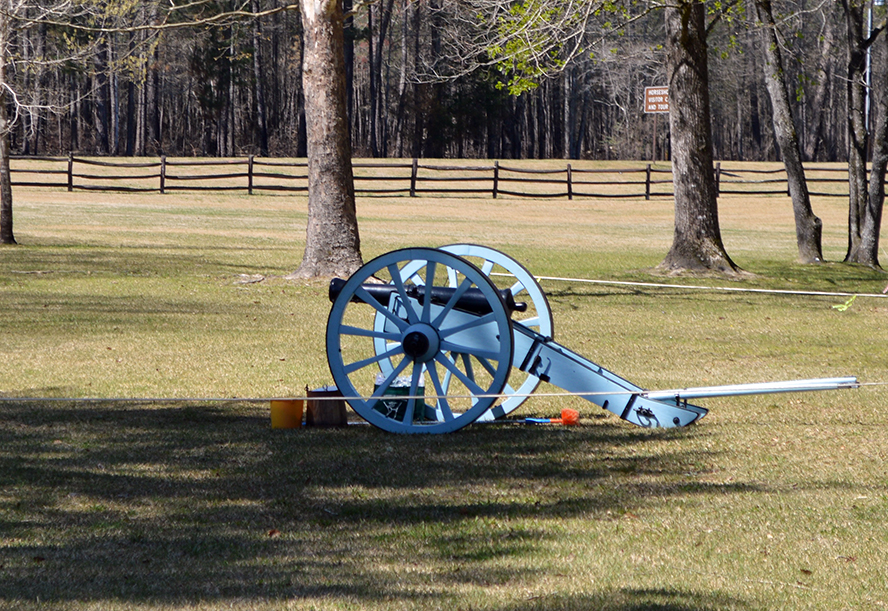 |
| A cannon similar to the one carried to Fowltown by Arbuckle's command is on display at Horseshoe Bend National Military Park in Alabama. |
The Native American account of the battle was simple. Boleck and Cappachimico wrote – likely through Alexander Arbuthnot – in a letter to Gov. Charles Cameron in the Bahamas that Fowltown had been attacked by American soldiers. “Our Indians, rallying, drove the Americans from the town,” they reported, “but in their exertions had two more people killed.”
 |
| Fresh water trickles from a small steephead spring at the probable site of Fowltown in Decatur County, Georgia. |
The firefight lasted 15-20 minutes and ended when Neamathla and his men withdrew deeper into the swamp. Arbuckle described what happened next as a “march,” but officers in his command said it was a “retreat.” The soldiers definitely moved quickly from the town and marched up the trail to Burges’s Bluff (Bainbridge):
The detachment consisted of 300 men, under the command of Colonel Arbucle. They were attacked about twelve miles from Fort Scott, by a party of Fowltown and Osouche Indians, supposed to be about one hundred, and had one man killed and two wounded, one dangerously. The Indian loss was supposed to be eight or ten. They captured some cattle during the flight, which were retaken in the towns, lying about eight miles from Fort Scot. – The detachment then retreated four miles and threw up breast works.
 |
| "Fowl Town Swamp" as drawn by an early surveyor when the area was still part of the original Early County, Georgia. |
The brief account provided by Cappachimico and Boleck (“Bowlegs”) appears to indicate that Neamathla attacked the retreating soldiers somewhere between Fowltown and Burges’s Bluff and recovered some of the stolen cattle. None of the U.S. accounts are known to mention such an encounter, but the beef was vital to the survival of the Tutalosis, and a raid or quick strike to recover some of it makes sense.
- End of Excerpt -
The soldiers either "marched" or "retreated" to Burges's Bluff (present-day Bainbridge), where they started building a new stockade that they named Fort Hughes after the slain musician.
If angered by the unprovoked raid on his town two days earlier, Neamathla was infuriated by the larger strike. Runners went out from Fowltown to call for help, and hundreds of warriors soon began a general movement for the Flint and Apalachicola Rivers from as far away as the Suwannee.
Retaliation was coming.
Editor's Note: Learn more about the Battle of Fowltown in Dale Cox's acclaimed book Fowltown: Neamathla, Tutalosi Talofa & the First Battle of the Seminole Wars
.
Experience living history camps, military drills, musket and cannon demonstrations, the 19th-century keelboat Aux Arc ("Ozark"), battle reenactments, and more at the annual Scott 1817 Seminole War Battle Reenactment in Chattahoochee, Florida, on December 7-8, 2019. Learn more at Scott1817.com.


