A Two Egg TV Page. See more at https://twoeggtv.com.
Showing posts with label native american. Show all posts

Monday, April 15, 2024

"Concentrate them on the Apalachicola River"

Apalachicola River at Chattahoochee,
Florida.
Andrew Jackson's plan for a Seminole homeland on the Apalachicola River

by Dale Cox


Chattahoochee, Florida - The Seminole Tribe of Florida and Miccosukee Tribe of Indians of Florida have survived generations of war and are today synonymous with the Big Cypress and Everglades regions of South Florida. 


Their greatest tribulation began when the United States assumed control of Florida in 1821. Battered from the opening years of the Seminole War, the Seminole and Miccosukee were scattered and unsettled. Large and long-settled towns including Ekanachatte, Holms' Town, Tallahassee Talofa, and Miccosukee were in ashes. Newer but important communities including Boleck's (Bowleg's) Town and the large maroon (self-liberated and free Black) settlement under Nero had been destroyed. Fields cleared through years of labor lay fallow or were already occupied by new American settlers. Orchards and fish weirs lay untended. [1]

The new "owners" of Florida did not intend to continue a treaty signed years earlier by the Muscogee (Creek) Nation and Spain. It declared that only lands so far inland as the tidal influence on the rivers and creeks (or such as were transferred by treaty) should be open for settlement. All the rest of the interior belonged to the Native Americans, with the restriction that they could not sell or otherwise dispose of these lands without the consent of the King of Spain.

Since the United States clearly did not plan to abide by this agreement, four new schools of thought grew among the whites over what should be done with the Indians. The first called for the complete relocation of all Native Americans from Florida to the Creek Nation in Alabama and Georgia, despite the fact that the Treaty of Fort Jackson had just reduced Creek lands by more than 22 million acres. It also ended any claims that the Muscogee had to Florida by cutting them off from it. [2]

Early 19th-century painting of American Indians
catching and smoking sturgeon in the Apalachicola
River across from Aspalaga Bluff.
University of West Florida
A second option called for the mass removal - at government expense - of all of the American Indians in Florida to new homes west of the Mississippi River. Actually proposed by Thomas Jefferson for all Native people east of the Mississippi, this idea seemed logical to white thinkers who could not conceive that the Seminole and Miccosukee would not readily give up their lands if offered the opportunity to do so. 

The third option, supported by a bevy of early Florida leaders, suggested the drawing of an imaginary line across the peninsula at some point well below areas coveted for white settlement. All of the Indians would voluntarily remove [i.e., be forced] below the line. Despite their claims that the new "reservation" included vast areas of good land, there is plenty of evidence that promoters of the scheme knew that the region was sickly, swampy, and sandy.
Andrew Jackson
(Later in life.)
Library of Congress

The fourth option, proposed by none other than Andrew Jackson himself, is perhaps the most intriguing of all. Since it is the only one of the four that proposed leaving a large area of their original homeland in Seminole and Miccosukee hands - not to mention a significant area of rich agricultural and timber land - you might be interested in learning more about it. [3]

Jackson was acting as military governor of Florida when he proposed the idea of creating a massive land-stake for the Seminole and Miccosukee on the Apalachicola River. He viewed them as distinctly separate from the Muscogee or Creek Red Sticks that had come down into Florida during and following the Creek War of 1813-1814. These latter individuals, Jackson felt, should be required to return to the Creek Nation in Alabama and Georgia. The Seminole and Miccosukee, he suggested, should be left with good lands:

...As to those who have been born and raised within the Floridas, it is absolutely necessary that they should be collected at one point, and secured in their settlements by act of Congress, in case they cannot be prevailed upon to unite with the Creek nation, to which they originally belonged: this latter course is very desirable for their own safety, as well as dictated to us by sound policy. [4]

The general turned governor proposed that Congress provide an annuity to assist in the survival of the Indians and that efforts be made to encourage them to "embrace an agricultural life." Of course, Miccosukee, Ekanachatte, and other towns were noted for their massive fields and herds of cattle, horses, and other livestock until Jackson and his forces destroyed them during the fighting of 1817-1818. 

...Should the Indians prefer continuing within the Floridas, it will be expedient, for the safety of our frontier on the seacoast, to concentrate them on the Appalachicola river, immediately adjoining the southern boundary of Georgia and Alabama, on both sides of the river, and downward, so as to include a sufficient area for them. By this means a sufficient white population may be interposed between them and the seaboard, and afford a settlement strong enough to cover and protect St. Augustine and Pensacola, as well as the peninsula of Florida. [5]

Unlike anyone else proposing options for where the Native inhabitants of Florida should go, Jackson surprisingly held one distinction - he actually discussed his idea with some of the people for whom recommended leaving lands on the Apalachicola River:

...[Y]ou will see that the difficulty of collecting the native Indians of the Floridas to the point on the Apalachicola will not be great. They are rejoiced to hear that a country will be allowed [them] to live in at all - such have been their apprehensions of their future fate since the transfer of their country to the United States, excited, no doubt, by mischievous advisers; and they will be still more so to find that they will be fostered and protected by the American Government. [6]

19th-century paddlewheel steamer preparing to head
down the Chattahoochee and Apalachicola Rivers.

Jackson proposed that Congress immediately designate the large area for the Seminole and Miccosukee, instead of waiting for a treaty to be negotiated. He felt it made more sense to reserve these lands in Florida from the beginning before they could be settled, also pointing out that if the Indians concentrated on lands of their own, surveying the rest of the new territory would be easier. [7]

Jackson did not mention that he was personally familiar with the lands along the upper Apalachicola River because he had seen them himself during the spring of 1818. They were some of the richest in Florida and the area that he envisioned as a permanent home for the Seminole and Miccosukee included today's Jackson, Gadsden, and at least the northern halves of Calhoun and Liberty Counties.

By 1860, Jackson and Gadsden would prove to be among the most agriculturally productive counties in the state. According to census data collected that year, the two counties were among the seven most productive in Florida, with farms valued at more than $2.7 million dollars ($101.6 billion today). [8]

History, of course, shows that Andrew Jackson's recommendation for a Seminole and Miccosukee nation on the upper Apalachicola River was not accepted. The Treaty of Moultrie Creek (1823) instead condemned the vast majority of Native Americans in Florida to difficult lives on new lands in the central and southern reaches of the territory. Desperation for game and resentment at seeing white settlers occupying better lands nearby led to cattle raids and confrontations. Tensions rose.
Fort Gibson, Oklahoma
Where army officers tricked the
Seminole exploring party.

Trickery followed as an exploring party of Seminoles went west to look at proposed new lands in what is now Oklahoma. Before their leaders and warriors in Florida could even consider the matter, the U.S. Government claimed that these explorers had agreed for the entire tribe to go west. They said that they had not and the Seminole and Miccosukee people in Florida told U.S. officials that the explorers lacked such authority in the first place. The United States turned deaf ears to this position and fighting exploded. Men, women, and children died by the thousands. 

The U.S. Government likewise moved against the Muscogee (Creek) people in Alabama. Claiming that its powerful army could not protect them from settlers intruding on Creek lands and unscrupulous land speculators determined to swindle them at every turn, officials told the Creeks that they could either go west at federal expense or remain behind and live on under the laws of the states on small individual plots as required by the Indian Removal Act of of 1830.  That act, championed by Andrew Jackson himself, led to the forced removal of most Cherokee, Chickasaw, Choctaw, and Muscogee (Creek) by 1837. Only the Seminole and Miccosukee held out in significant numbers.

What might have happened had the U.S. Government accepted Andrew Jackson's 1821 recommendation that a large area of land be titled to the Florida tribes on the upper Apalachicola River? 
Sylvania Marker in Jackson County
The lands proposed for the Seminole
and Miccosukee instead became
home to some of the largest bastions
of slavery in Antebellum Florida.

It is an interesting thought to ponder. They still would have received annual payments from the U.S. Government as they did on the much poorer lands later assigned them in Central and South Florida under the Treaty of Moultrie Creek, but they would have owned by legal title - not just moral right and treaty - most if not all of four agriculturally or timber rich North Florida counties. 

The most important navigable waterway connecting a vast agricultural region of Alabama and Georgia to the Gulf of Mexico passed right through the center of these lands. In fact, the City of Apalachicola which soon developed at the mouth of the Apalachicola River was one of the three busiest ports anywhere on the Gulf prior to the Civil War.

With richer farms and some of Florida's top timberlands, the story of the Seminole and Miccosukee people from 1821 to 1835 might have developed in a much different way. Jackson likely would have regretted giving legal title to so much prime Florida real estate (prime in the 19th-century, that is) to them. Land given by treaty, as all Native Americans know, is easy to take away. Land given by legal title, however, is not so easy to take.

From his expansionist perspective, Andrew Jackson clearly rethought the wisdom of giving legal title for large areas of land to Indian nations before he pushed the Indian Removal Act of 1830. By then the concept was to title small pieces of land to individual Native American heads of households. These could more readily be swept up by land speculators and swindlers. Not so when an entire tribe owns all of its land by title in one giant block.

Andrew Jackson was no longer a powerful general in 1821, however, and had not started his rise to the Presidency. The country's political leaders found it easy to ignore his suggestion. His proposed home for the Seminole and Miccosukee people instead became part of the Territory of Florida's third county when Jackson County was created and named for him on August 12, 1822. At that time Jackson County extended from the Choctawhatchee River to the Suwannee.

One can only wonder whether he remembered his idea for a Seminole and Miccosukee homeland on the Apalachicola at all nine years later when the Indian Removal Act of 1830 became law.

To learn more about the years before and immediately after Jackson County was established, please consider my book: The History of Jackson County, Florida: The Early Years.

References

[1] For a history of the beginning of the Seminole War era, please see Fowltown: Neamathla, Tutalosi Talofa & the first battle of the Seminole Wars by this writer.
[2] These various options are discussed in numerous letters of time.
[3] Gov. Andrew Jackson to Sec. of State John Quincy Adams, Oct. 16, 1821, H. Doc. No. 513, 17th Congress, 1st Session.
[4] Ibid.
[5] Ibid.
[6] Ibid.
[7] Ibid.
[8] Census of Agriculture, Florida 1860, USDA Census of Agriculture Historical Archive.

Monday, November 30, 2020

Archaeology & History mark Seminole War Battle Anniversary


Today marks the 203rd anniversary of the Scott Battle of 1817. The first Native American victory of the Seminole Wars, this engagement took place on the bank of the Apalachicola River at what is now River Landing Park in Chattahoochee, Florida. Click play above to learn more about the battle and a new archaeology project that is aimed at finding key evidence from the battlefield itself!

Thursday, November 19, 2020

Yaupon Holly: Nature at Florida Caverns


Yaupon Holly, a wild shrub found at Florida Caverns State Park and throughout the region, produces more natural caffeine than any other native plant in North America. 

Southeastern Native Americans - including the Muscogee (Creek), Yuchi, Seminole, and others - used it as a primary ingredient in the preparation of the "black drink." 

Learn more from Asst. Park Manager Billy Bailey of Florida Caverns by clicking the play button above:

Tuesday, February 18, 2020

Econchattimico's long journey on the Trail of Tears

"They have suffered very much."


by Dale Cox
Econchattimico's Town was sketched in 1838 by a visiting
French nobleman. It stood north of today's Sneads, Florida.

Yesterday's article focused on the forced removal of Econchattimico's and John Walker's bands from their lands in Jackson County, Floria, by U.S. troops under Brig. Gen. Zachary Taylor. Please see Zachary Taylor and the Red Ground King.

Today we continue the story of this humanitarian tragedy with the departure of the Native Americans from Florida and their arrival in Oklahoma, as well as the failure of the United States government to ever pay them for their lost homes and fields.

The following is excerpted from my book: The History Of Jackson County, Florida: The Early Years.

-Excerpt-

The people from Econchattimico’s and John Walker’s reserves were joined near the mouth of the Apalachicola River by 34 refugee Creeks who had been captured following their flight from Jackson County earlier in the year. Brought from a concentration camp on Dog Island in the Gulf of Mexico, they brought the total number of men, women, and children in the group to more than 300 souls.

Dog Island is visible on the horizon in this photo taken from
top of the Crooked River Lighthouse at Carrabelle, Florida.
Creek Indian refugees were held there in 1838.
Brig. Gen. Taylor had reservations about the safety of moving more than 300 men, women, and children through the Gulf aboard the steamboat Rodney, so Daniel Boyd contracted two additional vessels, the schooners Octavia and Vesper. After a brief stop in St. Joseph (today's Port St. Joe), the entire party moved on to Pensacola:

We left Pensacola on the 29th ult. and arrived at New Orleans on the 2d inst. At New Orleans we took on board the Rodney the Indians shipped per schooner Octavia and Vespar, and next morning proceeded on our voyage and reached Natchez on the 5th. We remained at Natchez one day in order to procure supplies, and to afford the Indians an opportunity to purchase clothing which they stood very much in need of. To those who had not the means to purchase for themselves I supplied such articles as were absolutely necessary for their comfort on the voyage.

They have suffered very much from sickness. Six have died since we left Chattahoochee and more than twenty are now upon the sick list. The weather has been unusually cold for the season, which has no doubt increased the number of invalids.

The water in the Mississippi River is very low; we lay two days upon a sand bar about twenty five miles above Vicksburg. If the Arkansas River continues as low as it is reported to be at present, I will disembark the Indians at the first convenient point where transportation can be procured and proceed by land to Fort Gibson. [1]

Fortunately for the suffering men, women, and children, the Rodney was able to steam up the Arkansas River as far as Little Rock. The Native Americans transferred there to the steamboat North St. Louis to continue the trip upriver, but the second vessel ran aground at nearby Cadron, Arkansas. [2]

The Arkansas River, seen here at Van Buren,
Arkansas, was too shallow for the steamboat
carrying the Apalachicola survivors and they
had to walk through brutal winter weather.
Left with no choice but to continue overland through bitterly cold conditions, the exhausted emigrants finally reached Fort Gibson in present-day Oklahoma on January 10, 1839. A muster roll prepared that same day revealed that 272 of the original 393 survived the trip. Econchattimico and John Walker were among the survivors, but many of their followers were not. Of the African Americans or Black Seminoles who once lived under the protection of the two chiefs, only one made it to Fort Gibson. [3]

The final tally of emigrants included 126 residents of Walker’s Town, 81 from Econchattimico’s village, 34 refugee Creeks, and 32 holdovers from John Blunt’s band. The latter individuals remained behind on the Apalachicola when their chief and most of his followers left for Texas in 1834. Among the residents of Econchattimico’s town was George Perryman, a well-known figure on the early frontier and the son of former principal Seminole chief Thomas Perryman. [4]

Fort Gibson in what is now Oklahoma was the western end of
the Trail of Tears for the survivors under Econchattimico and
John Walker. 
The little group settled in the eastern edge of the Creek Nation, not far from present-day Muskogee, Oklahoma. They built cabins and started clearing lands for themselves, but their winter arrival did not help them acclimate to the new country. Many died from illness and starvation over the coming months.

Three months after they arrived in today's Muscogee (Creek) Nation, the emigrants submitted a list of claims to the government seeking reimbursement for the value of the property they left behind in Florida. Their claims totaled $3,042.80. The amount may not seem significant but is worth $84,403.67 today (excluding interest). The losses included dozens of cabins, corn cribs, sheds, and acres of crops and fruit orchards. The government also still owed $15,000 to them for giving up their lands and moving west.  The money was still owed 22 years later when the War Between the States or Civil War broke out in 1861. [5]

The new Confederate government entered separate negotiations with the Apalachicolas, treating them as a sixth "civilized tribe" alongside the Creeks, Seminoles, Cherokees, Choctaws, and Chickasaws. The Confederates secured a separate treaty with them by promising to pay the long overdue claim at the end of the war in exchange for their support and military service. The Apalachicola warriors finally took up arms against the United States, turning out to fight the government that they had tried so long to appease:

The Apalachicola warriors fought on the Confederate side in a
number of engagements west of the Mississippi, including the
bloody Battle of Pea Ridge, Arkansas.
…The said Apalachicola band remained loyal to the United States, and maintained their peace and friendship unbroken; but in the year 1837 they were induced, by the urgent solicitation of the emigrating agent of the United States, to remove from the country occupied by them in Florida to the Indian country west of Arkansas, leaving the lands…and a large number of horses, mules, cattle, hogs, wagons, and other articles which they could not collect together and carry with them, and which the said emigrating agent persuaded them to leave in his charge, on his promise that the owners should be paid the value of all such their property in money by the agent of the United States on their arrival in the country provided for them on the west side of the Mississippi. [6] 

The Apalachicola chiefs and warriors fought on the side of the Confederacy in numerous battles across the modern states of Arkansas and Oklahoma. They never received the money they were promised. The collapse of the Confederate government ended any remaining hope.

The Apalachicola served in the Creek regiments raised in the Indian Nations during the war and were among the last Confederate soldiers anywhere to give up their arms. Their war finally ended when their commander, Brig. Gen. Stand Watie became the last Confederate general to surrender on June 23, 1865.

-End of Excerpt-

The sites of Econchattamico's and John Walker's reservations in Jackson County are unmarked. Walker's lands were along the Apalachicola River just east of present-day Sneads, Florida. Econchattimico's grounds were north of Sneads along today's River Road. Significant portions of both parcels remain in the hands of the Federal and state governments today.

To learn more about the Trail of Tears in Jackson County, Florida, please consider:


References:

[1] Daniel Boyd to C.A. Harris, Commissioner of Indian Affairs, November 11, 1838.
[2] Arkansas Gazette, November 28, 1838.
[3] J.R. Stephenson, “Muster Roll of a Company Seminole who have emigrated West of the Mississippi River,” January 10, 1839.
[4] Ibid.
[5] J.R. Stephenson to T.H. Crawford, Commissioner of Indian Affairs, March 6, 1839.
[6] Supplementary Article to Treaty between the Confederate States of America and the Creek Nation, July 10, 1861.

Thursday, January 9, 2020

Pirate & Heritage Days coming to Three Rivers State Park!

May event will commemorate the legacy of William Augustus Bowles!

by Dale Cox

The pirate and adventurer William Augustus Bowles
will be remembered at Pirate & Heritage Days at
Three Rivers State Park in Sneads, Florida.
The Chattahoochee River and Lake Seminole in eastern Jackson County are abundant in the history of the adventurer and pirate William Augustus Bowles. He once lived along the river, and his ships made it as far upstream as the forks of the Chattahoochee and Flint Rivers, where Lake Seminole is located today.

To commemorate this unprecedented era of history, Three Rivers State Park is working with the Jackson County Tourist Development Council, the City of Sneads, Jackson County Parks,  and Two Egg TV to host a brand new festival. Pirate & Heritage Days will take place at the lakefront state park on May 1 & 2, 2020.

Bowles arrived in the area during the American Revolution after he was tossed from the British military at Pensacola for a disciplinary infraction. He wandered lost in the woods of Northwest Florida until a trading party of Native Americans found him and carried him to the Perryman towns. These large Lower Creek Indian villages were near today's Parramore Landing.

Bowles enjoyed his new life there so thoroughly that he married Mary Perryman, the daughter of Chief Thomas Perryman, and was adopted by the tribe. He fought at the Battle of Pensacola, one of the most significant actions of the Revolutionary War, in 1781. America's ally Spain won the battle, however, and regained control of the city and Florida.

Bowles's pirate ships flew the "State of
 Muskogee" flag in 1799-1804.
State Archives of Florida/Memory Collection
The adventurer went briefly to his family home in Maryland and then on to the Bahamas, from where he came back to the area to open a new route for smuggled goods from the islands. Spain captured him, however, and sent him away to Cuba, Spain, and eventually the Philipines. Bowles escaped, and by 1799 was back in North Florida!

He was furious over his treatment and declared war on Spain! By this time, he called himself the Director-General of the "State of Muskogee," a mostly imaginary empire that he founded in the Florida borderlands. His followers included white adventurers from American territory and the Bahamas, Maroons (escaped slaves), and a few hundred Lower Creek, Seminole, and Miccosukee warriors.

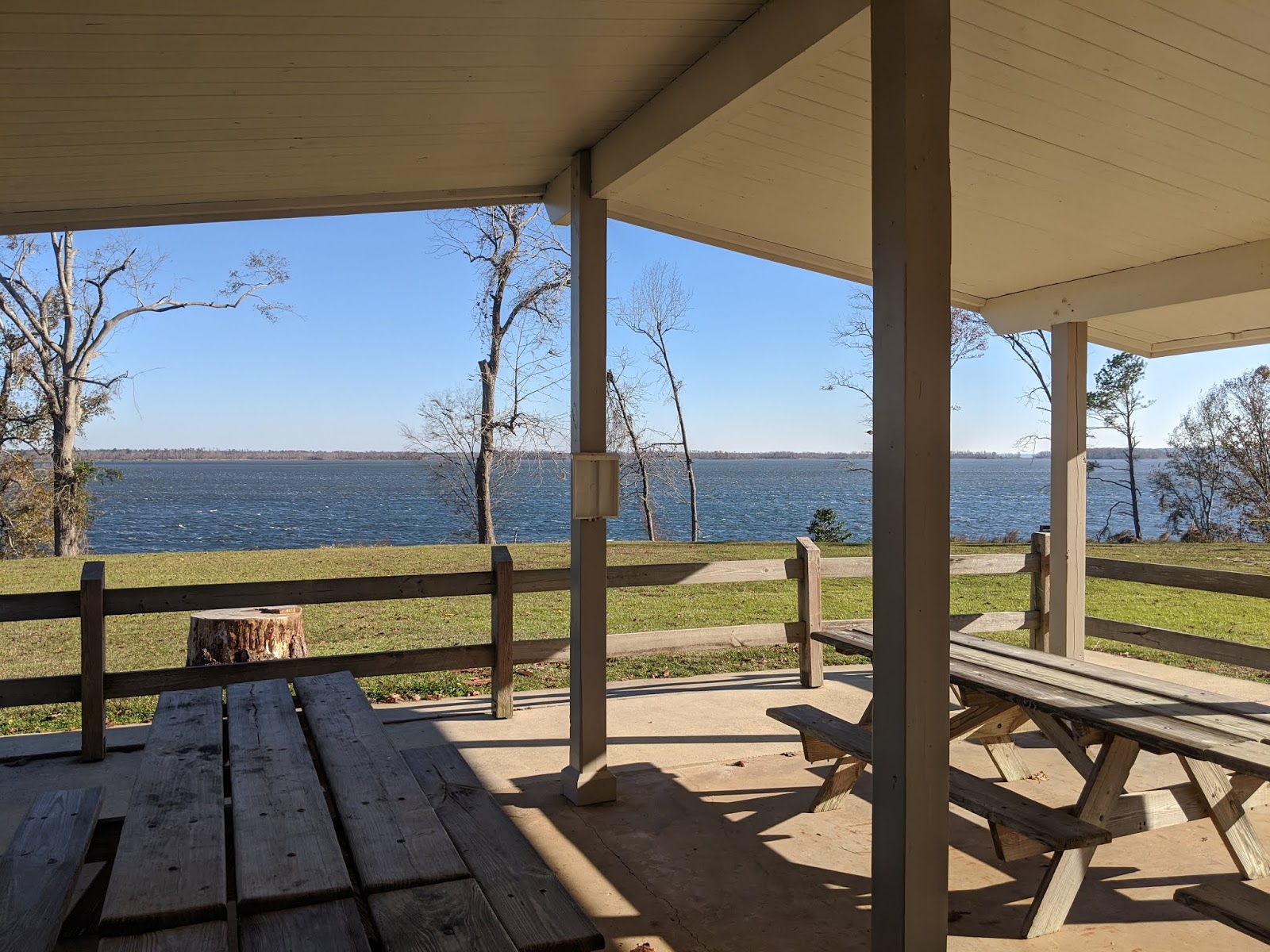
Three Rivers State Park is on the shores of beautiful
Lake Seminole in Sneads, Florida.
To carry out his war, Bowles commissioned a flotilla of "privateer" ships that sailed from the Apalachicola River out into the Gulf of Mexico to prey on Spanish merchant ships. These pirate vessels raided dozens of ships, and their crews included Native Americans from the Perryman towns. The raids continued for about five years until he was captured again and sent away to prison in Cuba, where he died.

The story of Bowles and his pirate ships is a big part of the culture and history of Jackson County. Two different buried treasure legends originate from his activities!

Pirate & Heritage Days will feature a boat parade on Lake Seminole, food trucks, vendors, living history encampments, live music, storytelling, and much more! Everything will take place lakefront at beautiful Three Rivers State Park, with the boat parade launching at Sneads Park and passing the festival grounds.

More details are coming soon, but mark your calendars for the afternoon/evening of May 1 and morning/midday of May 2! If you have a boat or even a kayak or canoe, make plans now to join the boat parade on Friday, May 1!


Saturday, November 23, 2019

Neamathla surprises Arbuckle as fighting continues at Fowltown

Outnumbered warriors stand and fight in the Georgia woods.


by Dale Cox

Red Stick Creek warriors at the 2017 reenactment of the
Battle of Fowltown during the Scott 1817 Seminole War
Battle Reenactment at Chattahoochee, Florida.
The main fighting of the Battle of Fowltown took place 202 years ago today at the Lower Creek village just south of present-day Bainbridge, Georgia. 

The United States Army opened the battle with a night raid two days earlier (please see First Blood at Fowltown) but failed to kidnap the principal chief Neamathla as ordered to do. Maj. Gen. Edmund P. Gaines ordered a larger force back to the village. Numbering more than 300 men and augmented by a section of light artillery, the strike force was led by Lt. Col. Matthew Arbuckle of the 7th Infantry.

The troops marched from Fort Scott on November 22, 1817, crossing the Flint River at the fort itself to approach Fowltown from the opposite direction of the first attack.

The following is excerpted from my book Fowltown: Neamathla, Tutalosi Talofa & the First Battle of the Seminole Wars:

- Begin Excerpt -

The Village of Fowltown historical marker near the probable
site of the important Lower Creek town where the Seminole
Wars started on November 21-23, 1817.
Arbuckle’s command halted at some point during the night to rest for a few hours. This guaranteed that the men would be fresh for the battle while also delaying their arrival at Fowltown until well after sunrise. This was probably an intentional way of avoiding the confusion of fighting in the darkness should Neamathla once again resist the presence of the soldiers. It was late morning by the time the troops came within sight of the village:

…The town which is about eighteen miles distant from this place and four from the Bluff we entered on the 23 Instant about 10 O’clock in the morning without opposition. On our approach several signal guns were fired by the Indians who no doubt discovered one of our flanking parties but at the time that all the troops had reached the town no Indians were seen and a few yells only were heard from a swamp which skirts its north east side. I took a position near the town so as to secure the troops from any fire which might issue from the swamp, and after posting such sentinels as would prevent us from being surprised I ordered the men to refresh themselves while the waggons were loading with corn. 

Mountain laurel grows at the probable site of Fowltown south
of the Four Mile Creek swamps in Decatur County, Georgia.
Arbuckle was, by nature, a much more cautious officer than Maj. Twiggs. The fact that he approached Fowltown with flanking parties out is clear evidence that he was taking all proper steps to avoid being surprised. Such measures had likely been reinforced before his departure from Fort Scott by Gen. Gaines, who routinely cautioned officers under his command to be vigilant and careful.
The soldiers knew that Neamathla and his warriors were in the swamp and watching them, but the intensity of the attack still took them by surprise when it hit:

…[The loading of the wagons] was done and the troops were about to march when the Indians, fifty or sixty in number (as I judge) were perceived advancing by the sentinels posted in the swamp and fired on: The fire was instantly returned by the Indians who giving the War Hoop advanced rapidly towards our lines. Parties were immediately detached to take possession of the houses between our position and the swamp which movement checked the progress of the Indians and compelled them to fall back. A spirited fire was then kept up for twenty or twenty five minutes when the Indians retreated into the Swamp. During the affair the Indians frequently appeared in the open ground and from the number which were seen to fall, there can be no doubt but six or eight were killed and many severely wounded yet as the swamp was large and uncommonly thick I deemed it not prudent to pursue them into it or search for those who fell on its edges. 

Neamathla (Eneah Emathla)
The principal chief of Fowltown.
Arbuckle was surprised that Neamathla would attack a much larger force over open ground. The intensity of the attack also took him off guard. The officer did not realize, however, that the corn stocks in the village were vital to the survival of men, women, and children through the coming winter. The town had relocated three times in four years. Its once extensive herds of cattle were gone. The corncribs likely meant the difference between life and death for many in the community. The warriors were fighting to save their homes and families and did so against odds of roughly 6 to 1:

…A spirited fire was then kept up for twenty or twenty five minutes when the Indians retreated into the Swamp. During the affair the Indians frequently appeared in the open ground and from the number which were seen to fall, there can be no doubt but six or eight were killed and many severely wounded yet as the swamp was large and uncommonly thick I deemed it not prudent to pursue them into it or search for those who fell on its edges. The skill and valor displayed by the officers and men engaged in the little affair affords a pleasing prospect should their services be required on another important occasion. The Indians must have been deceived as to our numbers otherwise they should not have had the temerity to attack us. 

Pensacola's Jacksonian Guard demonstrates uniforms and
weapons of the Battle of Fowltown era.
Courtesy of the Jacksonian Guard
Whether all of the officers and soldiers fought as valiantly as Arbuckle indicated is subject to some debate. Rumors swirled after the battle that Lt. Milo Johnson of the 4th Artillery had not performed well in action. Johnson had graduated from the U.S. Military Academy at West Point in the Class of 1815. Notable officers to come from that class included Gen. Samuel Cooper, who became the highest-ranking Confederate officer, and Col. William Chase, who supervised the construction of Fort Pickens at Pensacola, Florida. Johnson requested a chance to defend himself against the allegations being made against him:

Having understood that a report is calculating through the camp, that I behaved unlike a soldier in being separated from my compy. and while separated in the affair at Fowl Town, on the 23d of Nov. 1817. I am compelled in justice to myself to demand a court of enquiry, to investigate the truth of sd. report. 

No further explanation of his actions during the battle has been found, and there is no evidence in the available military records that a court-martial was ever convened in his case. Subsequent events quickly overshadowed the Battle of Fowltown and Johnson’s conduct – whatever it might have been – was forgotten.

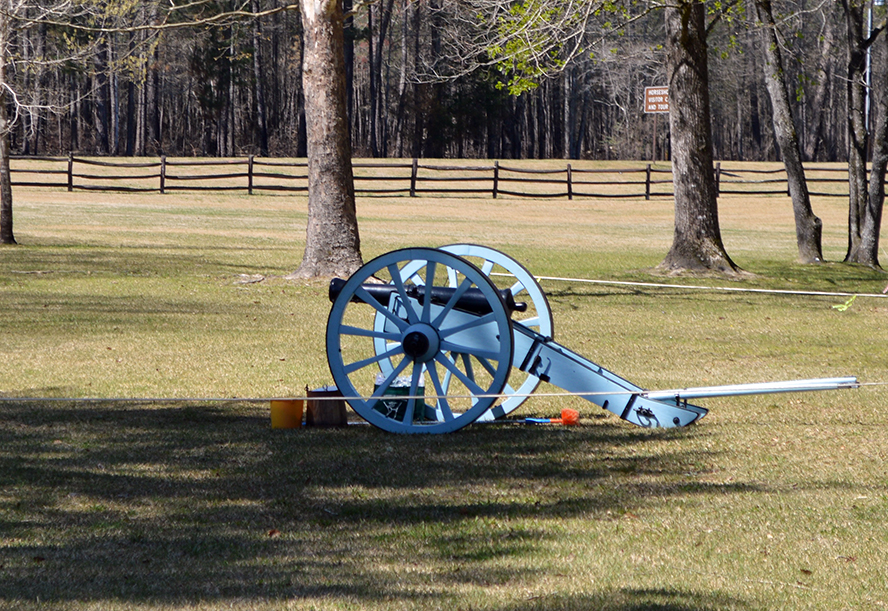
A cannon similar to the one carried to Fowltown by
Arbuckle's command is on display at Horseshoe Bend
National Military Park in Alabama.
Lt. Johnson’s mention of his company appears to indicate that Capt. Donoho’s artillery company was present at the Battle of Fowltown, even though it is not explicitly mentioned in the official reports. The unit did have several field guns, the largest of which was a 6-pounder. The deployment of at least one of these guns during the fighting would explain the discovery of a solid shot near Four Mile Creek. The cannonball is too small to date from the Civil War, and there was no other recorded action in the area from which it could date.

The Native American account of the battle was simple. Boleck and Cappachimico wrote – likely through Alexander Arbuthnot – in a letter to Gov. Charles Cameron in the Bahamas that Fowltown had been attacked by American soldiers. “Our Indians, rallying, drove the Americans from the town,” they reported, “but in their exertions had two more people killed.”

Fresh water trickles from a small steephead spring at the
probable site of Fowltown in Decatur County, Georgia.
The chiefs did not report the number of warriors who were wounded in the fighting, but U.S. soldiers reported seeing several fall along the edges of the swamp. Lt. Col. Arbuckle listed his own losses as 1 killed and 2 wounded. The soldier who lost his life at Fowltown was Pvt. Aaron Hughes, a regimental musician. He had joined the army at the age of 15 and served through the War of 1812 without injury. He was reportedly shot while trying to rally the troops by standing on an Indian cabin and playing his fife.

The firefight lasted 15-20 minutes and ended when Neamathla and his men withdrew deeper into the swamp. Arbuckle described what happened next as a “march,” but officers in his command said it was a “retreat.” The soldiers definitely moved quickly from the town and marched up the trail to Burges’s Bluff (Bainbridge):

The detachment consisted of 300 men, under the command of Colonel Arbucle. They were attacked about twelve miles from Fort Scott, by a party of Fowltown and Osouche Indians, supposed to be about one hundred, and had one man killed and two wounded, one dangerously. The Indian loss was supposed to be eight or ten. They captured some cattle during the flight, which were retaken in the towns, lying about eight miles from Fort Scot. – The detachment then retreated four miles and threw up breast works. 

Another officer described the battle in similar terms when he wrote to his father from Fort Scott on December 2, 1817:

"Fowl Town Swamp" as drawn by an early surveyor when
the area was still part of the original Early County, Georgia.
I marched from Fort Hawkins on the 15th Nov. and arrived here on the 19th, at night. On the 23d, Col. Arbuckle crossed Flint river with 300 men, for the purpose of destroying an Indian town, about 20 miles off. We arrived in the town about 12 o’clock, next day – at 3, the Indians attacked us, and after an action of about 15 minutes, they retreated into a large swamp which nearly surrounded their town. – The loss cannot be ascertained – Ours, 1 killed, 1 severely and 3 slightly wounded. 

The brief account provided by Cappachimico and Boleck (“Bowlegs”) appears to indicate that Neamathla attacked the retreating soldiers somewhere between Fowltown and Burges’s Bluff and recovered some of the stolen cattle. None of the U.S. accounts are known to mention such an encounter, but the beef was vital to the survival of the Tutalosis, and a raid or quick strike to recover some of it makes sense.

- End of Excerpt -

The soldiers either "marched" or "retreated" to Burges's Bluff (present-day Bainbridge), where they started building a new stockade that they named Fort Hughes after the slain musician.

If angered by the unprovoked raid on his town two days earlier, Neamathla was infuriated by the larger strike. Runners went out from Fowltown to call for help, and hundreds of warriors soon began a general movement for the Flint and Apalachicola Rivers from as far away as the Suwannee.

Retaliation was coming.

Editor's Note: Learn more about the Battle of Fowltown in Dale Cox's acclaimed book Fowltown: Neamathla, Tutalosi Talofa & the First Battle of the Seminole Wars.

Experience living history camps, military drills, musket and cannon demonstrations, the 19th-century keelboat Aux Arc ("Ozark"), battle reenactments, and more at the annual Scott 1817 Seminole War Battle Reenactment in Chattahoochee, Florida, on December 7-8, 2019. Learn more at Scott1817.com.

Sunday, November 17, 2019

400 Luminaries to light the Apalachicola River on December 7th

Massive Luminary Service by the river at Scott 1817 Seminole War Battle

by Dale Cox

A luminary service underway at the site of Fort Hughes in
J.D. Chason Memorial Park in Bainbridge, Georgia, in 2017.
Four hundred candle-lit luminaries will reflect off the waters of the Apalachicola River on the night of December 7, 2019. They will honor the men, women, and children of both sides who died in events surrounding the First Seminole War and the destruction of the "Negro Fort" or Fort at Prospect Bluff.

The memorial and illumination is part of the Scott 1817 Seminole War Battle Reenactment. The annual event takes place this year at River Landing Park in Chattahoochee, Florida, on December 6, 7, and 8. The luminary service begins at 6:30 p.m. Eastern/5:30 p.m. Central, and the public is encouraged to attend.

The special event will include a 19th-century military ceremony by the Jacksonian Guard from Pensacola, Florida, followed by a Native American and Maroon (Black Seminole) observance organized by the Lower Chattahoochee Band of Yuchi Indians living history unit. Both groups are participating in this year's reenactments of the Scott 1817 Seminole War Battle.

The authentic keelboat Aux Arc ("Ozark") will visit from
Arkansas to recreate the actual boat attacked in 1817 at what
is now River Landing Park in Chattahoochee, Florida.
That encounter took place at the site of today's River Landing Park on November 30, 1817, and the luminaries will be lit on the actual battlefield. The Scott Battle took place when several hundred Red Stick Creek, Miccosukee, Seminole, Yuchi, and Maroon (Black Seminole) warriors attacked a U.S. Army keelboat on its way up the Apalachicola River. The Native Americans were furious because soldiers had attacked the Lower Creek village of Fowltown, killing several men and women and igniting the First Seminole War.

The battle ended with the deaths of 34 U.S. soldiers, 6 women, 4 children, and an unknown number of Native American warriors. It led President James Monroe to order Maj. Gen. Andrew Jackson's 1818 invasion of Spanish Florida and ultimately was the key factor in the cession of Florida from Spain to the United States.

The luminary service promises to be a beautiful and moving event that memorializes two crucial and connected parts of history. Approximately 136 men, women, and children lost their lives in the First Seminole War, and 136 of the luminaries will honor them.

Reenactors from the 7th Infantry Living History Association
conduct a memorial ceremony at Camp Recovery, site of a
hospital encampment during the 200th-anniversary event.
Two hundred seventy luminaries will memorialize the 270 men, women, and children killed on the lower Apalachicola River when the U.S. military destroyed the Fort at Prospect Bluff or Negro Fort on July 27, 1816. The remaining four luminaries honor the lives of four U.S. sailors who died in that campaign.

It will be the first time that all of the people who died in the fighting along and near the Apalachicola River from 1816 to 1819 will be remembered in a single memorial service. The luminaries will honor men, women, and children without regard to age, race, sex, or religious belief.

The sight of so many luminaries reflecting off the silent waters of the Apalachicola River should be unforgettable. The public is encouraged to attend.

River Landing Park is located on River Landing Road, Chattahoochee, Florida. Living history events will take place Saturday, December 7, and Sunday, December 8, from 9 a.m. to 3 p.m. Eastern/8 a.m. to 2 p.m. Central. Battle reenactments are scheduled for 12:30 p.m. Eastern/11:30 a.m. Central on Saturday, December 7, and 2 p.m. Eastern/1 p.m. Central on Sunday, December 8.

All events are free, and the public is welcome!

To learn more, please visit Scott1817.com or www.facebook.com/scott1817.

Monday, October 7, 2019

Bigfoot Attack in the Okefenokee Swamp!

A 19th century Sasquatch attack in Georgia?

by Dale Cox

The Okefenokee Swamp is a vast wetland that covers more
than 680,000 square miles in Georgia and Florida.
The Okefenokee Swamp has been the focus of stories about giants and other strange creatures for as long as anyone can remember. Is it possible that a Bigfoot or some similar monster actually attacked a party of hunters there in 1829?

Early Muscogee (Creek) Indians regarded the swamp with both reverence and wariness. They told naturalist William Bartrum that in its center was an island of high ground inhabited by a race of incredibly beautiful women called the "daughters of the sun." Their husbands were "fierce men, and cruel to strangers." [1]

Glimpsing this mysterious island from afar, a group of Creek hunters tried to reach it but found that it was protected by strange magic:

...[I]n their endeavors to approach it, they were involved in perpetual labyrinths, and, like enchanted land, still, as they imagined they had gained it, it seemed to fly before them, alternately appearing and disappearing. They resolved, at length to leave the delusive pursuit, and to return; which, after a number of inexpressible difficulties, they effected. When they reported their adventures to their country-men, their young warriors were inflamed with an irresistible desire to invade, and make a conquest of, so charming a country; but all their attempts have hitherto proved abortive, never having been able again to find that enchanting spot, nor any road or pathway to it, yet they say that they frequently meet with certain signs of its being inhabited, as the buildings of canoes, footsteps of men, &c. [2]

A massive old-growth cypress in the
Okefenokee Swamp.
Legends grew that the husbands of the "daughters of the sun" were men of gigantic stature who would kill any outsider who dared to enter the swamp. The Creeks called it Ekana Finaca or "Trembling Earth." 

Frontier settlers cleared farms along the margins of the great swamp by the late 1700s but generally avoided the hundreds of square miles of wetland that made up its interior. The winter of 1828-1829, however, was a time of extraordinary drought, and two men decided to explore as deep into the swamp as possible. 

Taking their flintlock rifles, they headed into the Okefenokee and for two weeks, explored a large area of it. The two men - and one of their young sons - were nearing the center of the swamp when they discovered gigantic footprints:

...The length of the foot was eighteen, and the breadth nine inches. The monster, from every appearance, must have moved forward in an easy or hesitating gait, his stride, from heel to toe, being a trifle over six feet. [3] 

The men decided that they "had seen enough" and started a long retreat from the swamp. Reaching their homes after nearly a four-week absence, they told friends and neighbors what they had seen. A bigger party of hunters from just across the Florida line decided to see for themselves, and one of the men from the first group agreed to guide them. 

...Following, for some days, the direction of their guide, they came at length upon the track first discovered, some vestiges of which were still remaining; pursuing these traces several days longer, they came to a halt on a little eminence, and determined to pitch their camp, and refresh themselves for the day. [4]

Many of the swamp's trees are rooted in peat and will actually
shake or tremble as you walk past them.
The party of nine men started firing off their rifles to clear them of damp powder, planning to reload them for the night. At this point, though, a strange creature suddenly charged their camp:

...[T]he next minute he was full in their view, advancing upon them with a terrible look and ferocious mien. Our little band instinctively gathered close in a body and presented their rifles. The huge being, nothing daunted, bounded upon his victims, and in the same instant received the contents of seven rifles. [5]

The wounded creature reacted by killing five of the explorers, "which he effected by wringing the head from the body." The survivors continued to fight until "writhing and exhausted," the monster collapsed. The last four men gathered around the creature for a closer inspection. They found it to be 13-feet tall from head to toe, with "his breadth and volume of just proportions." [6]

Terrified that the dying monster's howls and cries might attract others of its kind, the hunters fled their camp. They eventually emerged from the Okefenokee to repeat their tale. Their five companions were left where they had fallen, but no one was brave enough to venture back into the swamp to locate and bury them.

The 1829 account is one of the first to describe the creature known today as Bigfoot, Sasquatch, or the Skunk Ape. People in the area continue to report the discoveries of giant footprints, and some even claim to have seen an enormous hair-covered creature deep in the wetlands and prairies of the Okefenokee Swamp.

If you are interested in learning more about the Okefenokee, please visit Okefenokee Swamp National Wildlife Refuge.

To see stunning views of the swamp, please click play for a great free video:


We also have more links to help you explore some of its great places to visit:


References

[1] William Bartram, Travels of William Bartram, 1790.
[2] Ibid. 
[3] Milledgeville Statesman, January 1829, republished by the Connecticut Sentinel, February 9, 1829.
[4] Ibid.
[5] Ibid.
[6] Ibid.