A Two Egg TV Page. See more at https://twoeggtv.com.

Saturday, October 30, 2010

The True Story of the Ghost of Bellamy Bridge

The story of the Ghost of Bellamy Bridge has been told in Jackson County for more than 100 years, yet it always seems to emerge as a favorite when the first hint of fall is in the air and kids start to think of Trick or Treating.

Bellamy Bridge, for the uninitiated, is an old iron frame bridge that spans the Chipola River a few miles north of Florida Caverns State Park. The wooden floor is long gone and all that remains is the skeleton of iron beams and girders. It is not currently accessible by land, but can be seen from a boat or canoe in the river (the easiest way is to put in at Turner's Landing off Bump Nose Road north of Marianna and paddle upstream until you see the bridge).

There are many stories about what happens at Bellamy Bridge in the middle of the night. Some say that the ghostly figure of a young woman can be seen walking through the thick trees of the swamps bordering the river. Others claim to see balls of fire either falling from the sky into the river or appearing and disappearing along the banks of the rivers. The most vivid tales are of the fire specter of a woman that can be seen screaming and running for the bridge near the river.

All of these stories originate from events that took place in the 19th century and not one, but two weddings of that era. If you would like to read the real story behind the Bellamy Bridge "haunting," then please visit www.exploresouthernhistory.com/bellamybridge. When you get there, be sure to follow the link to "The Ghost of Bellamy Bridge: An In Depth Account" to read the full true history behind the Bellamy Bridge legend.

You'll also find a photograph of the ghost itself!

Monday, October 25, 2010

Ghosts of the Russ House

The Russ House in Marianna is one of the most beautiful architectural landmarks in Florida. Listed on the National Register of Historic Places, it is a local treasure and is the ideal location for the purpose it currently serves - that of Chamber of Commerce and official welcome center for visitors to Jackson County.

Built in 1895 and remodeled to its present appearance in 1910, the home has been a centerpiece of the Marianna community for more than 100 years. The house has also seen its share of tragedy over the years and perhaps it is this history that contributes to its status as one of the "most haunted" places in Florida.

According to Betty Gilbert Davis of the Big Bend Ghost Trackers, the organization that conducted an extended investigation of the ghost reports in the Russ House, her group found evidence of at least two ghosts in the old house, one male and one female.

Most who believe that the house is haunted believe the male ghost is that of its builder, Joseph W. Russ, Jr., who took his own life in 1930 after seeing the family's fortune evaporate during the early days of the Great Depression. The figure of a man with a mustache has been seen in the house and eyewitnesses have reported hearing strange sounds and picking up odd scents there.  A ghostly figure has also been seen peering through the windows of the tower atop the house, something that would be a remarkable feat for a living person as it opens directly into the second floor of the house and has no floor of its own!

To learn more about the stories and some of the known history of the Russ House, please visit www.exploresouthernhistory.com/russhouseghosts.

Thursday, October 14, 2010

Ghost Stories to be featured in Marianna on October 23rd


I'll be telling the true story of the Ghost of Bellamy Bridge, along with other area ghost stories to help fund guide dogs for blinded veterans.  The event will begin at the Marianna High School parking lot on Caverns Road and go from there. Here's the official press release:

Ghost Storytelling To Be Hosted by Cox

On Saturday, October 23rd historian Dale Cox will tell "The True Story of the Ghost of Bellamy Bridge" and several other area ghost stories as a fund raiser for "Paws for Patriots" sponsored by Blue Springs Society, Children of the American Revolution and Chipola Chapter, NSDAR.  The event will begin at 5:00 p.m. CST in front of Marianna High School at 3546 Caverns Road.  A donation of $5 for adults, $3 for teenagers and $1 for children under thirteen is requested.  "Paws for Patriots" provides guide dogs for blinded veterans and is a division of Southeastern Guide Dogs based in Palmetto, Florida.
    
Generations of youth have visited the Bellamy Bridge on dark, foggy nights to look for the ghost of the beautiful, young bride that is said to be seen as she searches for her beloved husband. Elizabeth Croom Bellamy died on May 11, 1837 and is buried near Bellamy Bridge on the Chipola River Some have described her ghost "as a pale image in a long, white gown, moving slowly along the riverbank.  Others say that she is engulfed in flames, screaming as she makes a mad dash for the nearby bridge and river.  The third story holds that the ghost can be seen plunging from mid-air straight down into the waters of the Chipola."*    For well over a hundred years area residents have heard the story of how Elizabeth Bellamy died from the burns she suffered when her elegant wedding gown caught fire as she danced too close to a candle at the elaborate reception after her marriage to Dr. Samuel C. Bellamy, a prominent member of early Jackson County society.  However  historian Dale Cox has researched the true story of Elizabeth and will tell how the legend was most certainly influenced by a novel written by Caroline Lee Hentz, who spent her later years in Marianna and is buried in the St. Luke's Episcopal Church cemetery. 

To read more about
area "ghosts" including the fascinating Bellamy Bridge ghost please go to http://www.exploresouthernhistory.com/ghosts.html. Be sure to notice the ghostly image photographed at the Bellamy Bridge by historian Cox.

*Cox, Dale Alan. "The Ghost of Bellamy Bridge" Chapter TwoTwo Egg, Florida:  A Collection of Ghost Stories, Legends and Unusual Facts.  Page 10.

Please contact Mary Robbins at snoopyxii60@hotmail.com or 850-209-4066 to reserve a place and for additional information about the October 23rd event.   

Monday, October 4, 2010

Large Crowd enjoys annual Oak Grove Homecoming at Old Parramore

People gather at Old Parramore
A large crowd turned out in the beautiful fall weather on Sunday, October 3rd, for the 49th Annual Oak Grove Homecoming at Old Parramore.

Parramore was a riverboat port that thrived on the Chattahoochee River in eastern Jackson County from around 1885 until the paddlewheel riverboats stopped running in 1927. At its height, the town had 5 stores, a cotton gin, gristmill, blacksmith shop, sawmill, post office and four turpentine stills as well as a series of landings along the river.

The photos below are from the 2010 event at historic Oak Grove Baptist Church, which opens its doors only once each year (for the annual homecoming). Next year will mark the 50th year for the homecoming, which brings together people from all over the country with ties to the historic community.

Basford Brothers Quartet

Dinner on the Grounds

The Picnic Pavilion

Oak Grove Church, a memorial to the people of Old Parramore.

Thursday, September 30, 2010

Oak Grove Homecoming at Old Parramore set for Sunday


The annual Oak Grove Homecoming will be held this Sunday (October 3rd) at Old Parramore in eastern Jackson County.

Parramore was a town that thrived from around 1885 to 1927 as a riverboat port where cargoes of lumber, turpentine, cotton, catfish and even gopher tortoises were shipped out on paddlewheel steamboats for transport up or down the Chattahoochee and Apalachicola Rivers. At its height, the community - which was never incorporated but was a town just the same - had five stores, a cotton gin, sawmill, gristmill, blacksmith shop, four turpentine stills, post office and more. Today it has been reclaimed by the pine woods.

Each year on the first Sunday in October, however, Old Parramore comes back to life. Oak Grove Baptist Church, which opens its doors only once a year, plays host to the annual Oak Grove Reunion. The gathering brings people and families with ties to the Parramore area back for conversation, a church service, dinner on the grounds and music.

This year's event will take place on Sunday and things will get started around 10 a.m. I've donated 20 signed copies of my new book, Old Parramore: The History of a Florida Ghost Town, to Oak Grove Church and they will be available for donations to the church, with 100 percent of the proceeds going to support the annual homecoming and care of the historic church and grounds.

If you can't make it to the homecoming, the book is also available through Amazon.com by following the link at left.

Friday, September 17, 2010

Old Parramore - New Book by Dale Cox now available!

For Immediate Release:
September 17, 2010

A limited number of autographed copies of Old Parramore: The History of a Florida Ghost Town, the latest book from writer and historian Dale Cox, are now available by order only.

The book is the eighth by Cox, a Jackson County native and graduate of Malone High School, and tells the story of Old Parramore, a once thriving steamboat port on the Chattahoochee River in Jackson County. The town reached its height between 1885 and 1927, before gradually fading away as trucks and trains replaced the paddlewheel riverboats that once nosed up to the town's landings.

The volume will be available in local and online bookstores in about two weeks, but advance orders can now be placed for a limited number of autographed copies by visiting www.twoeggfla.com/oldparramore.

Please allow 10-15 business days for delivery.

Monday, August 23, 2010

Battle of Marianna Legend is Plagued by Inaccuracies

by Dale Cox

Note:  The following article is now available in its entirety at http://www.twoeggfla.com/.


On September 27, 1864, Union troops attacked the Jackson County city of Marianna. Almost since that day, it seems, confusion has reigned over what really happened in the engagement that could well be called "Florida's Forgotten Battle."

The traditional story of the bloodshed that afternoon is told by a marker on the grounds of St. Luke's Episcopal Church:

Here at High Noon on September 27, 1864, a Federal raiding force of 900 men under Brigadier-General Alexander Asboth fought a Confederate home guard of 95 men under Captain Jesse J. Norwood. Entering Marianna from the West, the main body of Federals encountered unexpected resistance at Ely's Corner, fell back, rallied, and charged, driving the home guard back to this churchyard, flanked by other Federals moving in form north of the church. The defenders engaged the invaders in fierce combat. By Federal order, St. Luke's Episcopal Church was destroyed by fire, and the bodies of five Confederates were burned almost beyond recognition. The West Florida News reported total Confederate losses of 9 killed, 16 wounded, 54 captured, and estimated Federal losses of 15 killed, 40 wounded.

Some other traditions that have grown up around the battle include the legend that the fierce resistance of the Marianna Home Guard prevented the Union troops from carrying out a plan to capture Tallahassee; that men and boys were intentionally massacred in St. Luke's churchyard after they surrendered; that the battle began with the home guards positioned behind a barricade of wagons and other items at Ely Corner, that Colonel A.B. Montgomery, the Confederate commander in Marianna, abandoned the city without a fight; and that only militia or "home guard" troops fought in the battle.

Unfortunately much of the legend of the Battle of Marianna was based on accounts... Please click here to read the entire article.

Tuesday, August 17, 2010

High Winds topple historic old water tower in Malone

High winds and storms that passed through northern Jackson County sent the historic old water tower in Malone crashing down Monday night (August 16th).

The tower was replaced decades ago by the town's new water tower, but was a landmark that had stood since the early 1900s. It had previously survived a plane crash the claimed the life of a local pilot, but last night's winds sent the entire structure tumbling over. Morning found it leaning against the room of the building shown here.

No one was injured, but considerable damage was done to a building at the Malone Peanut Company. Cranes were on location throughout the day to prevent the fallen tower from doing additional damage.

To see additional photos, please visit www.twoeggfla.com/malonetower.

Thursday, June 10, 2010

Two Egg, Florida T-shirts and other Souvenirs now Available!

I've received so many emails from people trying to find Two Egg, Florida tshirts and other souvenirs that I've made arrangements to make them available at http://www.twoeggfla.com/.

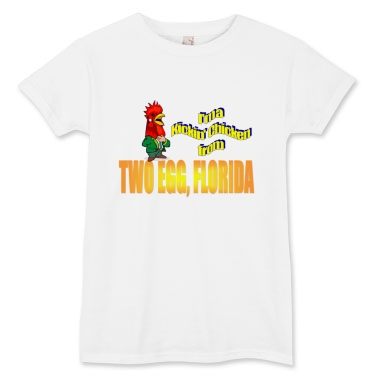
In addition to tshirts, the Two Egg collection includes a variety of other types of clothing, coffee mugs, travel mugs, coasters, bbq aprons and even cutting boards featuring several different images and logos featuring the quaint and historic community of Two Egg, Florida. Some are emblazoned with photographs of the Two Egg highway sign, while others feature the "I'm a Kickin' Chicken from Two Egg, Florida" and "Two Egg, Florida: Capital of the New South!" logos.

Prices begin at around $10 and range up depending on the item. Almost all sizes are available, with shirts customized for men, women and children. Even organic shirts are available for those who follow the Green Movement.

To learn more, please visit http://www.twoeggfla.com/ and look for the link in the yellow box just below the heading.

Friday, May 7, 2010

State forces destruction of Two Egg historic sites

Of the more than 2,244 properties with reported pollution in Florida, only one of them could result in the destruction of a historic landmark as treasured as the old Pittman store in downtown Two Egg, Florida.

For generations, visitors and residents alike have treasured the picturesque central crossroads of the unique and charming community. Untold hundreds of people have posed in front of Two Egg's two historic store structures and the downtown view has been featured in publications including Life magazine and National Geographic, on television around the world and in the book Two Egg, Florida. But now, as a result of the enforcement of a state law by the Florida Department of Environmental Protection in a way that showed total disregard for the historical integrity of one of Florida's most treasured landscapes, Two Egg has been forever changed.

Please click here to read the full story and see "Then and Now" photographs of downtown Two Egg, Florida.

Wednesday, April 14, 2010

Blue Springs is one of the Most Historic Places in Jackson County


I've written quite a bit here about Blue Springs, the beautiful first magnitude spring a few miles east of Marianna.

This stunning natural spring, which pours out an average of 73 million gallons of clear water a day, has played a key role in the history of the the area for hundreds of years. Archaeological evidence from the vicinity indicates that Native American hunters frequented the spring for thousands of years before the first European explorers entered what is now Jackson County.

The Spanish visited Blue Springs, which they called Calistoble or Calutoble (depending on the source), in 1674, 1675, 1676, 1686 and 1693. The British made note of the road that passed by the spring as being a major trail during the era of the American Revolution. Future President and Major General Andrew

 Jackson passed the spring in 1818 during the First Seminole War. It was settled by less than two years later by William Pyles, who crossed into Florida while it was still Spanish territory and threw up a log cabin and started farming at Blue Springs.

Over the years that followed, the main spring became a focal point on the 3,100 acre cotton plantation of William Robinson, which was incorporated into the more than 6,000 acre Sylvania Plantation of Florida's Confederate governor, John Milton.

To learn more about the history of Blue Springs, please visit the new webpage on the spring at www.exploresouthernhistory.com/jacksonbluespring.

Wednesday, April 7, 2010

Irwin's Mill Creek was Key Area for Early Settlers

By Dale Cox


Irwin’s Mill Creek – When American settlers began drifting across the Florida line into what would become Jackson County in the years following the First Seminole War, one of the areas that immediately attracted their attention was the rich country along the south side of Irwin’s Mill Creek.

Then called Red Ground Creek, this beautiful spring-fed stream rose in the southeast corner of Alabama and flowed down across the border into the northeast corner of Jackson County. Florida was then still Spanish territory and would remain so until 1821, but to these early settlers, the opportunity offered by the high quality land was more than worth the risk of moving into a foreign country.

Several factors attracted early settlers to the area as they began to drift across the line in around 1819. First was the availability of good, clean water. Second, the creek flowed with enough force to power a watermill, one of the few industries essential to life in the early 19th century. Third, the land along the creek was very rich and ideal for farming the types of crops then popular (corn, sugar cane, cotton). Finally, the heavy forests that grew naturally across much of the region had already been cleared away.

For at least fifty years, the area of Jackson County from Irwin’s Mill Creek down to Neal’s Landing on the Chattahoochee River had been the site of the important Creek Indian village of Ekanachatte or “Red Ground.” Established before the American Revolution, this rather spread out town had been supported by fields and pastures along both the river and creek. Ekanachatte had been destroyed on March 13, 1818, during the First Seminole War and its inhabitants had relocated downriver to a new site about ten miles north of present-day Sneads.

The fields and cleared areas were empty when white settlers began to arrive, providing an excellent opportunity for them to build homes and start farming immediately without the back breaking labor of felling old growth trees to clear land.

By 1821, when Florida was ceded to the United States by Spain, Irwin’s Mill Creek had become one of the three largest early settlements in Jackson County. The others were in the Spring Creek area near Campbellton and along the Apalachicola River below Sneads.

Given the opportunity to file claims for land they had occupied while Florida was still a Spanish colony, ten Jackson County residents did so based on farms they had established along the creek between 1819 and 1821. They were Joseph Brooks, Joseph Brown, William Brown, William Chamblis, James Irwin, Adam Kimbrough, William McDonald, William H. Pyke, George Sharp and Allis Wood.

The presence of so many heads of household indicates that the Irwin’s Mill Creek settlement probably had a total population of at least 50 or 60 people.

James Irwin, one of these early settlers, built the mill that provided the creek the name by which it is known today. The ruins of his mill can still be seen and are thought to be the only surviving remains of a structure built in Jackson County while Florida was still Spanish territory.

Note: You can learn more about early settlements in The History of Jackson County, Florida: The Early Years. The book is available online at http://www.amazon.com/, where you can also find the second volume in the set, The History of Jackson County, Florida: The War Between the States.

Sunday, April 4, 2010

Two Egg featured on the morning news in California's Capital City!

 I had an enjoyable interview this morning with the nice folks of the Good Day Sacramento show on KMAX-TV, the CBS owned and operated CW network station in Sacramento, California.

They were interested in sharing the story of Two Egg with their viewers for a bit of fun on their Easter Morning show. So, they went from talking about hunting for eggs to how Two Egg got got its name. We talked about one of the stories behind the naming of the unique and special little community, as well as some other features of interest in Two Egg and Jackson County, including the Bellamy Bridge ghost legend.

If you would like to see the interview, you can watch it here:


It was a fun way to spend a few minutes talking about our great area and promoting Jackson County to the viewers in Sacramento, which is not only California's capitol city, but also a significant metropolitan area with an area population of more than 2,000,000 people!

 There has already been a nice surge of visits to the Two Egg website at http://www.twoeggfla.com/, so hopefully more people are taking the time to learn about Two Egg and enjoy information about Jackson County and the surrounding area.

Thanks again to the Good Day Sacramento folks for seeking us out!

Saturday, April 3, 2010

Spring Blooming Season arrives in Two Egg area!

The dogwood trees are coming out just in time for Easter in Two Egg and eastern Jackson County. It looks like the spring blooming season is going to be spectacular
Here are a few samples of photos taken over the last day or so. You can see more at http://www.twoeggfla.com/.

Just look for the Spring Arrives in Two Egg, Florida link under Two Egg News Updates.


Friday, April 2, 2010

Legend of the Dogwood Tree is a Popular Local Tradition

One of my favorite legends of the spring is the story of the beautiful little dogwood tree.

The dogwood is noted for its small size but stunning beauty. Each spring it blooms in full force and trees all over Jackson County are now covered with stunning blossoms. The annual blooming season also brings back memories of the old Southern legend that the dogwood tree provided the wood for the cross on which Jesus Christ was crucified.

The story holds that the dogwood once grew to great size, so big that it provided timber for various purposes. Because it provided sturdy, solid hardwood, the tree was selected to provide the timbers for the cross of Jesus. Its role in the crucifixion, however, brought about eternal changes for the tree.

Legend holds that God both cursed and blessed the dogwood tree. It would never again grow large enough for  its wood to be used for crucifixions. In exchange for its loss in size, the dogwood was blessed with its beautiful blooms, which open each year in celebration of Easter. The petals themselves hold special significance associated with Easter.

To learn more about this unique story, please visit www.twoeggfla.com/dogwood.

Tuesday, March 16, 2010

A Marianna Resident Meets the Union Navy

By Dale Cox

The following account of Marianna resident Eli Moore’s encounter with the Union navy at St. Andrew Bay was written in 1862 by Miss Sarah Jones (pseudonym of Catherine Cooper Hopley). An English tutor hired to serve on the Sylvania plantation of Governor John Milton near Blue Spring, she witnessed many incidents of life in Jackson County during the Civil War period.

“A resident of Marianna had gone down to St. Andrew’s Bay to fit up temporary salt-works, in order to make enough for his own family use. Such practices were becoming common wherever persons lived in the neighborhood of the coast. Another gentleman contemplated establishing works, large enough to supply one of the midland towns, where he had been offered as much as ninety dollars a barrel!

“Our Marianna adventurer’s salt-works became known to the enemy, parties of whom were in the habit of landing for predatory excursions along the coast. One day a skirmishing party arrived on the shore, and coming up to the place, asked him what he was doing there.

“Mr. [Eli] Moore told them.

“‘How much are you making?’ asked the captain, ‘and for whom? Is it for sale? Is it for the Government? Is any one else making salt about here? Who? How far off? How long have they been making it? How long have you been engaged in this business?’

“All of which questions were replied to by the saltmaker.

“The Federal captain then expressed a wish to see the other works, but Mr. Moore hesitated, and made some excuses about the distance, and so forth.

“‘But I want to see them – I insist on it; or I will order my men to destroy these works of yours immediately,’ said the captain.

“The prudent salt-maker still hesitated, and pleaded the inconvenience of leaving his business; but upon the Federal captain becoming furious, and threatening to shoot him down on the spot, he changed his tone, and said in a sort of confidential manner, ‘Well, to tell the truth, there is a horse company (cavalry) not far from here, and I thought, may be, you’d rather not tumble up against them.’

“The captain suddenly recollected that he had an engagement which compelled his immediate return, and cried out, ‘Turn about, boys! – march!’ to his men; adding to the family salt-maker, ‘Well, well! I have not time to go so far to-day; but mind you do not make any salt for the rebel Government. I do not object to your making a little for yourself, but you must be quick about it; we shall not permit you to be here long.’

“By this pardonable ruse, Mr. Moore saved not only his own, but his neighbour’s salt-works, both of them making the most of the time their federal masters allowed to their sovereign subjects.”

Note: This and other accounts of life in Jackson County during the Civil War years are among the stories found in the new book, The History of Jackson County, Florida: The War Between the States. The book is available at Chipola River Book and Tea in Downtown Marianna or online by clicking the ad at left.

Sunday, March 7, 2010

Chipola River could once block traffic for weeks!

The rains and high water we have seen this winter reminds me of stories I have heard and read from the early history of Jackson County, when rivers and creeks were much great barriers to travel than they are today.

The Spanish, for example, visited the county in 1674-1675, 1677 and 1693. They usually followed the real "old Spanish trail," a footpath that led from the Apalachicola River near today's Sneads northwest across the county along a line that took it just north of Grand Ridge to Blue Spring and on to the Natural Bridge of the Chipola River at Florida Caverns State Park.

Most of their surviving accounts describe few problems in their travels, but in 1693 they found the water running high and it caused major difficulties for them. At the Natural Bridge of the Chipola River, for example, they described water and mud that reached the girths of their horses. As still happens today, so much water was coming down the Chipola that it overflowed the sink where the river normally goes underground and flooded the bridge itself.

The Chipola, in fact, would continue to cause problems for more than 200 years to come. By the time of the Civil War, for example, an open wooden bridge spanned the river at Marianna, but during high water the entire structure would be submerged. This meant a total halt to mail and other communication with the county seat, as English tutor Sarah Jones, who lived on Governor Milton's Sylvania Plantation, described in 1862:

When we arrived at the swamp near the Chipola, which flows into the Chattahoochie [i.e. Apalachicola], the water was up to the spokes of the wheels, and when we returned, less than two hours afterwards, the water had risen more than half a foot. “It is just nine days since any mail left this place,” said the postmaster, “and the river is rising now, so there will be no chance of sending for a week or two.” And no chance of obtaining the mail either!

Jones related that the postmaster would often throw away all but the most recent newspapers to save postal patrons the "trouble" of reading old news. The river would continue to cause such problems almost annually until the elevation of the bridge was finally raised in the years after the Civil War.

To read more of Miss Jones' descriptions of Jackson County during the Civil War, please consider my new book The History of Jackson County, Florida: The War Between the States. It is available through Amazon by clicking the link here or can be purchased in downtown Marianna at Chipola River Book and Tea on Lafayette Street across from the Battle of Marianna monument. You can read more about the Natural Bridge of the Chipola at www.exploresouthernhistory.com/floridacaverns.

Tuesday, February 23, 2010

A Monster in Two Egg??? Parramore area sightings raise questions!

It appears that Florida's famed "skunk ape" may be ranging north.

Several eyewitnesses have come forward to report sightings of a strange, upright, hairy creature roaming the ponds and swamps about seven miles northeast of the downtown Two Egg crossroads. Locals are calling it the "Two Egg Stump Jumper."

Available descriptions describe the mysterious creature as being smaller in size than a human, but covered in hair. It walks or runs on two legs and seems to frequent swampy and wooded areas. At least two of the sightings have taken place at night, indicating the monster may be nocturnal.

According to eyewitnesses, one of which described the creature as "pale" in color, it seemed as startled to see them as they were to see it. Both described it as upright, but only saw it as it was running away on two legs. It is said to look something like a "hobbit" or "mini" Bigfoot.

Such stories are fairly common in Central and South Florida, where residents have been reporting encounters with what they call the Skunk Ape for years. They are much more rare in Jackson County, but are not entirely unknown.

If you would like to read the full story of the Two Egg Stump Jumper sightings, please visit www.twoeggfla.com/monster.

Friday, February 12, 2010

Two Egg receives first snowfall in a decade!


As snow flurries spread across Jackson County this afternoon, the Two Egg area received its first snowfall in a decade.

Heavy snow began falling in the Two Egg area at around 3:30 p.m. and continued for more than an hour. In places the snow came heavy enough to create a light dusting on grass, trees and plants. The community had been under a Winter Weather Advisory all day. Please click here to see more.

The snow that reached Jackson County marked the southern edge of a large winter storm that is expected to continue moving across the South for the next couple of days. Areas of Alabama, including Mobile, reported snowfall of more than 5 inches and major traffic delays were reported across that state. Heavy snow was also reported south of the Alabama line west of Jackson County in the Florida Panhandle.

Students at Baptist Bible College in Graceville reported heavy snow falling there shortly before 3 p.m. and students at Chipola College in Marianna reported the same about 15 minutes later.

To see more photos of the Two Egg snow, please visit www.twoeggfla.com/snow2010.

Tuesday, February 9, 2010

Life on a Jackson County Plantation - An Excerpt from the New Book

The following is excerpted from Chapter One of my new book, The History of Jackson County, Florida: The War Between the States. The book is available through Amazon.com by clicking this ad. It is also available at Chipola River Book and Tea in Downtown Marianna.

This excerpt discusses Sylvania, the Jackson County plantation of Confederate Governor John Milton:

"...Milton’s plantation, Sylvania, was centered around a surprisingly modest home all but hidden from view in a grove of lush trees. English tutor Sarah L. Jones (a pseudonym) vividly described her first view of plantation manor:


"It was just light enough to distinguish a long, low dwelling, surrounded by a deep piazza reached by steps extending along the whole front. A very pretty style of building, quite Southern, and in the midst of a wood. Excepting the drive to the house, and a cleared space in front, it was literally in a wood, and was therefore appropriately called ‘Sylvania.’

"Jones quickly discovered that Sylvania was a unique mixture of gentility and boisterousness and her arrival at the home in the trees was quite memorable. She described how she was invited into the parlor for tea by Mrs. Milton, all under the watchful eyes of the family’s ten youngest children:

"A fire was soon blazing in the sitting-room, called the parlour, the evenings being chilly; but the doors remained open, and I heard steps and voices on the piazza, and saw by the light of the blazing fire, splendid black eyes peeping in at the windows, and popping away on meeting mine, and I knew that some of the ten were ascertaining what sort of a looking body ‘the new teacher, Miss Jones’ might be.

"At the tea-table some half-dozen of the ten appeared, and I never saw such a collection of eyes in my life. They were all dark, and all beautiful, and all like their mother’s, but no two pairs alike. ‘Pretty girls, and amiable, evidently; manners perhaps a little uncouth, listless and inexpressive; temper easy, mind undeveloped, and character also expressionless. Such were my pupils in Florida….

"Life at Sylvania, however, soon proved to be a bit more difficult than the young teacher had expected. She quickly discovered to her chagrin that Jim, one of the Milton slaves, was a prankster who enjoyed taking items from the home and hiding them in the woods. Prior to bed one night she had arranged a row of books on a piano in the little one-room plantation schoolhouse, only to return to the building the next morning to find them gone:

"‘I bet a dollar that Jim…has carried them off into the woods,’ said Johnny.
‘Why should he do that.’
‘Oh, just for mischief. I left my violin here one evening, and the next day it was gone. A long time afterwards, which I was hunting in the woods, I found it smashed up under the trees; and I know Jim broke it up for mischief.’ Thus the row of books vanished, their loss borne amiably and unconcernedly, without an effort to recover them.

"Miss Jones soon discovered that the girls of the family were just as playful as Jim. In fact, she soon realized that the Miltons, like other wealthy elites of the Southern planting class, did not discipline their children at all:

"…Southern parents who have been reared on the same principals do not understand the discipline necessary to enforce any system. They are too indulgent, too much accustomed to control an inferior class, and to allow their children to control that class, to reconcile to themselves the idea of compelling obedience in their own children when once past infancy, which would perhaps be placing them too much on a par with the negroes.

"In short, the tutor believed that wealthy Southerners did not discipline their children because doing so would place them on the level of slaves. She described how little Johnny would even call a slave to carry his spade for him while helping her in the garden. As a result, her efforts to teach the Milton children were frustrating in the extreme. The children would come and go from the little school on the grounds as they pleased. Sometimes other children from the neighborhood would come, other times not.

"While Jones’ account provides a fascinating look at life in the Milton home itself, the plantation was first and foremost a place of work and farming. The future governor of Florida held 52 slaves, some were children and others house servants, but most were field hands, who worked all day in the fields and woods of the plantation. Jones paid little attention to them during her sojourn at Sylvania, noting only that they were “too busy planting, or ploughing, or chopping wood” to assist her with her small garden...."

To read more, please consider The History of Jackson County, Florida: The War Between the States.