A Two Egg TV Page. See more at https://twoeggtv.com.
Showing posts with label legend. Show all posts

Sunday, May 7, 2017

The Spirit of Blue Springs: A Jackson County Ghost Story

Water flows from the submerged cave at Jackson Blue Spring
as TwoEgg.TV's Rachael Conrad works on a coming program.
The following is legend that was handed down by early settlers of Jackson County. The events described took place long before the first Spaniard set foot in Florida. It revolves around Blue Springs, which the State of Florida has renamed Jackson Blue Springs.

A war once raged in eastern Jackson County. The Chacato, a Native American group that had intruded into Florida from the north, established settlements between Holmes Creek and the Chipola River. They soon began to raid the towns of the Apalache Indians who lived east of the Ochlockonee River around present-day Tallahassee.

The Apalache fought back and the region between the Chipola and Apalachicola Rivers became a depopulated buffer zone that separated the warring chiefdoms. The attacks and counterattacks continued but neither could defeat the other and the war bogged down into a bloody stalemate.

Jackson Blue Spring, locally called Blue Springs, is the head
of Marianna's beloved Merritt's Mill Pond. It is an impressive
first magnitude spring and the largest source of water for the
Chipola River.
It was in this time of conflict, the Blue Springs legend holds, that a young woman of the Chacato stumbled upon a young warrior of the Apalache. The two fell in love but kept their romance secret because they knew that their families would object.

The young woman, however, was the daughter of the most powerful Chacato chief. He hoped to form a military alliance with the Chisca, a militaristic group that lived along Irwin's Mill Creek and the Chattahoochee River. The Chisca were fiercely independent and involved in a war of their own against the Apalache.

The chief of the Chacato offered his daughter as a bride to the young war chief of the Chisca in a gesture that he hoped would cement the proposed alliance. The latter group agreed to the proposal and a wedding was scheduled on neutral ground at Blue Springs.

The prospective bride, however, pleaded with her father and in tears begged him to call off the marriage. He refused and ordered her to comply with his will.

The mouth of the cave as seen from beneath the surface.
Photo by Alan Cox.
The young woman's desperation grew as the hour approached andshe concluded that she could not allow the marriage to happen.

Crowds of Chacato and Chisca gathered at the spring for the ceremony but instead watched in stunned disbelief as she suddenly bolted for the water. Before anyone could stop her, she leaped into the spring and dove down deep through the clear water and into the mouth of the submerged cave itself. All efforts by the bravest warriors to find and save her ended in failure.

At this point her true love arrived on the outskirts of the camp, determined to rescue her from her pending marriage. The scene of panic that he saw from his hiding place confused him and it took until sundown that he was able to learn that his beloved had taken her own life by diving down into the spring.

The young warrior waited for darkness and then walked down into the spring himself. He too dove down into the cave and disappeared forever in its depths.

The chief of the Chacatos was despondent and filled with regret over the loss of his daughter. He walked down to the spring at sunrise the next morning to think and express his grief. As the ray of the rising sun penetrated to the bottom of the spring, however, he saw two figures standing there in the shadows at the mouth of the cave. They were holding hands. He knew that it must be his daughter, Calistoble, and her beloved.

Jackson Blue Spring is the only first magnitude spring in the
entire Apalachicola/Chattahoochee/Flint/Chipola River Basic.
The chief decreed at that moment that the spring would bear his daughter's name. People from any tribe or nation could come there without fear to enjoy the cold water, beautiful forests and abundant wildlife. It remained known as Calistoble Spring for many years.

The chief's decree also came with a serious warning. If anyone should disturb the beauty of the water where his daughter's spirit remained, the spring would stop flowing and become nothing more than a stagnant pool.

The Chacato and Apalache eventually disappeared from Florida, the victims of war and oppression. The Creeks and Seminoles that followed, however, abided by the powerful declaration of the ancient chief and preserved Calistoble as a place of recreation, beauty and peace. They also handed down the old warning that damaging the beauty of the spring would bring about its death.

Visitors claimed that the spirits of the lost lovers could be seen moving in the waters of the spring on moonlit nights, constant reminders of the long ago tragedy and a father's warning to to any who might disturb his daughter's peace.

Possession of the spring eventually passed on to the whites, but they soon adopted a plan to adapt it for industry and in doing so awakened the curse and summoned the anger of the Spirit of the Spring.

What happened? Read the story in the conclusion of this article: http://twoegg.blogspot.com/2017/05/bluespringsspirit2.html!

To learn more about the history of Blue Springs, please click play on this video from TwoEgg.TV:


Friday, May 5, 2017

Thirty-seven years asleep in a Marianna cave?!

Stunning formations at Florida Caverns
State Park in Marianna, Florida.
The caves of the Marianna area and Florida Caverns State Park were places of mystery, legend and sometimes even hiding for our ancestors.

Creek and Seminole families hid in caves during the First Seminole War. They were the first stop on the Underground Railroad for African-Americans escaping slavery. Women, children and the elderly used them as hiding places during the Battle of Marianna. Outlaws frequented out of the way caverns during reconstruction and moonshiners made use of more than one during Prohibition!

In one case - if the media is to be believed - a man even stayed inside one for 37 years!

The story appeared in a New York newspaper in 1887 and was picked up by other papers across the nation:

...A few days ago there appeared upon the register of the Fifth Avenue hotel the name of a gentleman from Marianna, Fla. He was a good talker, and told a most extraordinary tale of an occurrence that took place in the neighborhood of his home town. It is believed by everybody in that section of the state, "and," said the narrator, "I am not prepared to say it is not true, as more than half the people in that town saw the hero of the story." - (New York Graphic, 1888).

Billy Bailey of Florida Caverns State Park explores
the narrow passages of Old Indian Cave.
The incident originated from a large cavern 2 miles from Marianna. Tradition identifies this as the Natural Bridge or "Old Indian" Cave at today's Florida Caverns State Park. That cave, however, does not have a spring or karst window inside as the story relates:

...On April 1, 1884, a party of explorers consisting of two gentlemen and five ladies, visited the cave. They followed the path that led to a point known as "The Spring," where a bold stream of cold clear water gushed forth from the rock, and flowed in a rivulet for some fifty feet and disappeared under a mass of detached fragments of limestone. - (New York Graphic, 1888).

It may or may not be significant that the date of this expedition was given as April Fool's Day.

The South America Pool during a time of low water. The rim
of the pool approximates the shape of South America.
There are a number of caves immediately around Marianna that match the description given in the article. The "South America Pool" in the tour cave at Florida Caverns State Park forms a rivulet of clear water at times and the Ladies' Cave west of the park has a strong-flowing stream of water. Both are within 2 miles of Marianna.

It was after the party of explorers reached "the Spring" that the story got really interesting:

...[O]ne of the gentlemen of the party, with his cane, detached a jutting rock particularly brilliant with mica spangles from what seemed the solid wall of rock. A large mass of loosened rock followed the fragments with a crash which reverberated hundreds of times throughout the cavernous depths. Then it was an astonishing sight met the eyes of the party which at first rendered them motionless with horror and fright. A hitherto unknown chamber was seen through the aperture, and but a few feet away, apparently motionless as the stone floor on which it lay, was the body of a man clad in the habiliments of a soldier, with his musket beside him. - (New York Graphic 1888).

Kelly Banta of Florida Caverns State Park guides a tour
through an enchanted forest of columns and formations.
It took a few minutes for the explorers to recover their senses enough to move closer. The man did not appear to be breathing but neither did he show signs of being dead. The two male explorers tried to lift the body which caused its rotten clothing and equipment to fall away. They wrapped it in a waterproof coat and carried it to the banks of the underground spring. The ladies of the party made their way out to daylight and headed to Marianna in their carriage to alert the citizens.

The two gentlemen explorers located two other men nearby and with them reentered the cave:

...They went directly to the spring. To their astonishment they found that the man supposed to be dead was living with half open eyes, breathing stertorously, while a faint color tinged his cheek. Examination disclosed rapid but distinct pulsation. The horrified men carried the phenomenon to the open air outside the cave as quickly as the burden would allow. -  (New York Graphic, 1888).

The men succeeded in getting the "phenomenon" to take a few sips of brandy and then took him to a nearby cabin. They left him there and started for town but quickly ran into a group of some 50 townspeople on its way to the cave. The crowd went to the cabin and the mysterious stranger was examined by several of Marianna's doctors.

The tour cave at Florida Caverns State Park offers visitors
an incredible array of formations and colors.
They gave him stimulants and he soon recovered enough to talk but due to his weakness the physicians would not allow him to be asked questions until the following day. He then told the following story:

...He said that in 1837 he was sent from Pensacola to Fort Dade with important military papers. When near Marianna he was followed by a band of Choctaws, who had gone on the warpath in sympathy with their Seminole brethren.
   Being hard pressed, he abandoned his horse and finding a hole in the ground he squeezed into it, and fearing the Indians would discover his trail, went some distance into the cave, when he suddenly felt a difficulty in respiration, a feeling of drowsiness came over him, and he remembered no further. - New York Graphic, 1888).

The story is definitely bizarre but it includes some little known true facts. Probably the most significant is that there was a handful of Choctaw warriors with a group of Creek Indians that fled into the Florida Panhandle following the Battle of Hobdy's Bridge, Alabama, in February 1837. This fact is so obscure that many modern researchers of the Seminole War are not aware of it.

The Cathedral formation at Florida Caverns State Park. Did a
Seminole War soldier really spend 37 years in such a cave?
Also of significance is the mention of Fort Dade, a Seminole War log fort that should not be confused with a later Fort Dade that is open to the public on Mullet Key near St. Petersburg. The original Fort Dade was built in 1837 where the historic Fort King Road crossed the Withlacoochee River near today's community of Lacoochee, Florida.

The New York newspaper's account of this Florida "Rip Van Winkle" concludes:

...It was hard to make the soldier believe that thirty-seven years had passed while he lay in coma, and that the fields of rice, sugar cane and cotton which dotted the landscape were the same wilderness through which he had been chased by the Indians. He seemed to be of a retiring disposition, and did not care to pose as an object of curiosity, and when his strength fully returned disappeared, and was never afterwards heard of. - (New York Graphic, 1888).

Could a Seminole War soldier really have slept for 37 years in a Marianna cave? The writer of the story's original headline probably summed it up best: "A story that the guileless people of Florida unhesitatingly believe."

Dale Cox
May 4, 2017

P.S. To hear the version of this legend as told today and to journey into Old Indian Cave at Florida Caverns State Park, please click play on this video:


Friday, April 18, 2014

#81 Legend of the Dogwood (100 Great Things about Jackson County, Florida)

Dogwood blossoms on Good Friday
My favorite local Easter legend is #81 on the list of 100 Great Things about Jackson County, Florida.

Please click here to see the entire list as it is unveiled.

The beautiful dogwood tree is one of the best things about spring in the Deep South. The little trees shed their leaves in the winter after offering a beautiful burst of fall red color, but then in the spring they bloom with an incomparable glory of white blossoms.

Popular tradition in Jackson County associates them with the crucifixion and resurrection of Jesus Christ.

According to the story, the dogwood once grew much larger and served a terrible purpose. Its wood provided the cross on which Jesus was crucified.
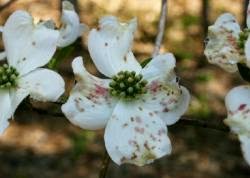
A wild dogwood in bloom.

As Christians know, the story of the crucifixion is one of both great horror and great redemption. Good Friday, which is being observed across the world today, is remembered as the day on which Christ was nailed to a cross outside the walls of Jerusalem. It is remembered with horror because of the great suffering and cruelty he suffered. It is remembered as a day of great redemption, because it was the day on which he took the sins of the world upon his own shoulders and gave his life that we might live.

As Jesus said, "Greater love hath no man than this, that a man lay down his life for his friends." By laying down his life for us on Good Friday, he offered us all a better world and a brighter future.

The Legend of the Dogwood holds that because the tree served a terrible yet necessary purpose in providing the cross on which Jesus sacrificed his life for all people, it was altered and yet saved by God. Its size was reduced so that no dogwood would ever again grow large enough  to be used in a crucifixion. Then, to make up for its loss in stature, God blessed the tree with its beautiful blossoms.
Dogwood tree in bloom.

The blooms of the dogwood come to life each spring just before Easter to remind us of the resurrection of Jesus Christ. To help in this annual rite of remembrance, the blossoms were given special features. They are formed of four petals, with each blossom taking the shape of a cross.

The center of the flower symbolizes the crown of thorns that was placed on Jesus' head and the tip of each petal is indented with the prints of the nails that penetrated his hands and feet. And finally, by Good Friday of each year red spots appear on the beautiful white blossoms to symbolize the drops of blood that spilled from the body of the Savior.

The legend is an old and treasured part of Southern culture and history and is #81 on our list of 100 Great Things about Jackson County, Florida.

Happy Easter!


Friday, April 2, 2010

Legend of the Dogwood Tree is a Popular Local Tradition

One of my favorite legends of the spring is the story of the beautiful little dogwood tree.

The dogwood is noted for its small size but stunning beauty. Each spring it blooms in full force and trees all over Jackson County are now covered with stunning blossoms. The annual blooming season also brings back memories of the old Southern legend that the dogwood tree provided the wood for the cross on which Jesus Christ was crucified.

The story holds that the dogwood once grew to great size, so big that it provided timber for various purposes. Because it provided sturdy, solid hardwood, the tree was selected to provide the timbers for the cross of Jesus. Its role in the crucifixion, however, brought about eternal changes for the tree.

Legend holds that God both cursed and blessed the dogwood tree. It would never again grow large enough for  its wood to be used for crucifixions. In exchange for its loss in size, the dogwood was blessed with its beautiful blooms, which open each year in celebration of Easter. The petals themselves hold special significance associated with Easter.

To learn more about this unique story, please visit www.twoeggfla.com/dogwood.