 |
| Webbville as shown on an 1834 map of Jackson County. |
This is Part 2 of a two part series on the James Webb and the history of Webbville. Please click here to read Part 1 before continuing.
The U.S. Congress approved the creation of a Federal superior court for the Southern District of Florida on May 23, 1828. President John Quincy Adams signed the Act and three days later named James Webb of Webbville as the new district's first judge.
How President Adams knew the lawyer from Webbville is one of the many mysteries that surround the community. Webb had been elected to the Florida Territorial Legislative Council in 1827, but this alone would not have brought him to the attention of the President. He must have had political connections that recommended him to the Adams administration.
The offer of a Federal judgeship was too big of a prize to decline. Webb accepted the post, resigned his seat in the territorial legislature and prepared to move to Key West. Newspaper accounts and court records indicate that he did return to Jackson County from time to time. In August 1829, for example, he issued notice that he would preside over a term of the Superior Court at Webbville:
 |
| Webbville as it appears today. |
ORDERED, That there be an extra term of the Superior Court held in and for the County of Jackson in the Western District of Florida on the first Monday of December next, and of which due notice will be given.
James Webb.
Judge of the Southern District of Florida, Acting in the absence of the Judge of the Western District.
He and Rachel had their fourth child that year with the birth of Charles John Webb.
Judge Webb and his family were soon firmly established in Key West and their lands in Jackson County were sold. Webbville was without its namesake by the end of 1829 and his good fortune could not have come at a worse time for the community.
Webbville had won a referendum of voters to become county seat, but the fledgling community of Marianna refused to give up the fight. The Marianna faction somehow managed to sway the opinion of Lackland Stone of Webbville to their side. He now held Webb's former seat in the legislative council and soon pushed through a bill naming Marianna as the county seat. It was approved on October 20, 1828.
Webbville's promoters viewed this action by Stone as nothing short of betrayal. He had been one of them and had even served as their first postmaster. He sold his businesses while running for the legislature, however, and now cast his lot in favor of Marianna, despite the fact that a majority of Jackson County voters had favored Webbville in the recent election.
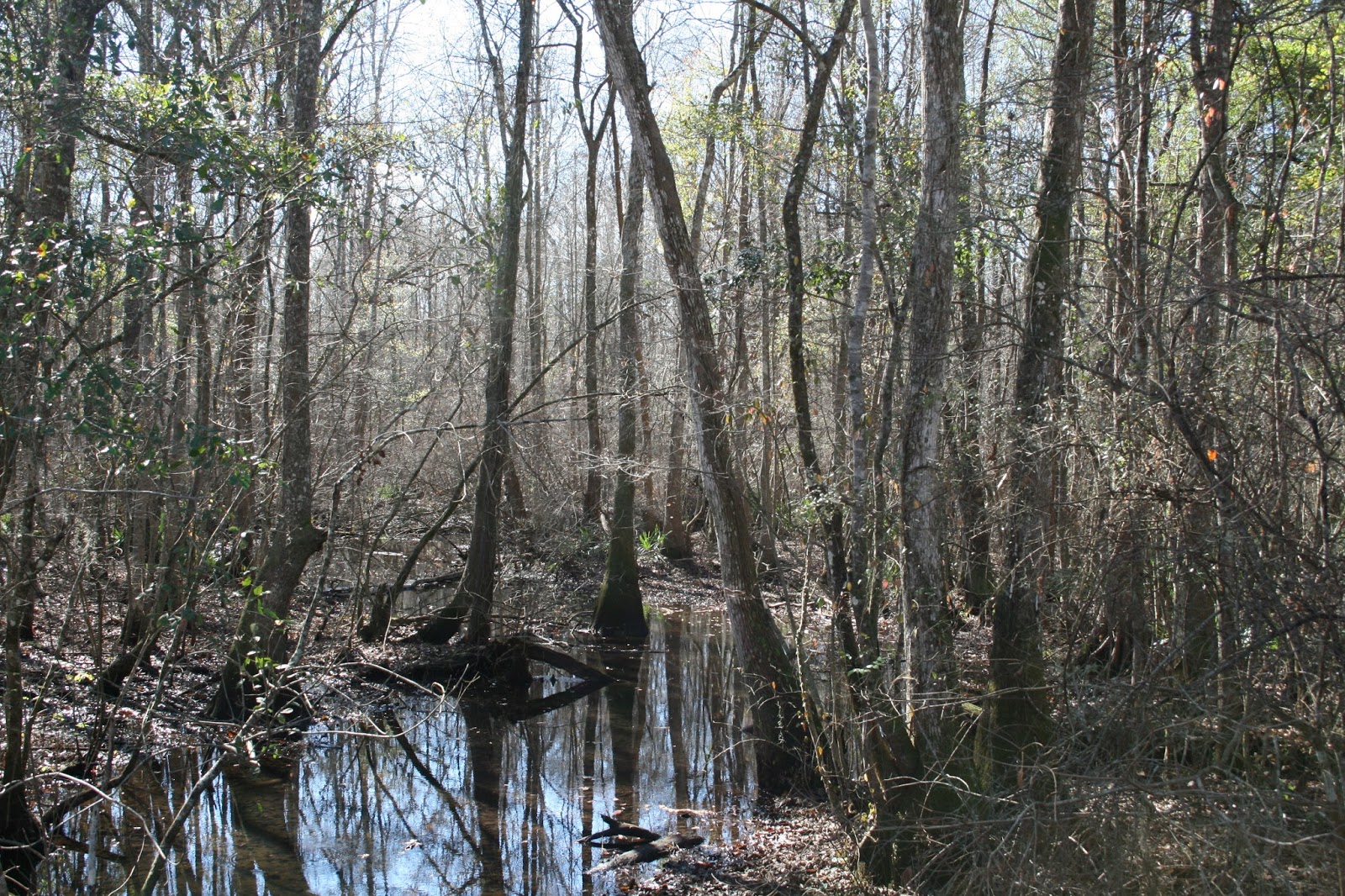 |
| Baker Creek was one of two important creeks that flowed near the site of the Town of Webbville, Florida. |
The U.S. Congress obliged on January 21, 1829, by overturning the legislative act that had given Marianna the county seat title. Webbville once again claimed the distinction. Congress also approved the town's location on lands reserved for school purposes.
Recognizing that they could not legally overrule Congress, Florida's territorial legislators tried a different approach. They took no action on the county seat title, but instead levied fines against any public officials in Jackson County not conducting business from Marianna:
Sec. 3. Be it further enacted, That the Superior and county courts of said county shall hereafter be holden in the house erected and built as aforesaid; and all other county or public transactions shall be held and transacted in the same, and all the prisoners of said county shall hereafter be confined in the house built and erected as aforesaid.
Sec. 4. Be it further enacted, That it shall be the duty of the commissioners aforesaid, to deliver the said houses to the sheriff of said county, who shall allow the marshal and clerk of the Superior courts, and clerk of the county courts; free access to the said house in which the said courts are to be held, and shall also allow the said officers rooms in the same for their several offices.
Sec. 5. And be it further enacted, That it shall be the duty of the said clerks of the Superior and County courts of said county, to hold their offices at the house aforesaid, in the town of Marianna, or within one mile of the same, and on failure thereof, be or they shall forfeit and pay the sum of twenty dollars for every week thereof, to be recovered in the name of the informer, before any justice of the peace in and for said county, in the same manner as in other cases of debt; one half to be paid unto the county Treasurer for the use of the county, and the other half to the informer; and this act shall be in force from and after its passage.
 |
| Baker Creek Road, in use since the 1820s, passed by the Jackson County home and farm of James Webb. |
Almost as if to add insult to injury, the Territorial Council on November 19, 1829 approved the incorporation of the Town of Webbville. Even as its residents were beginning to flee, the community became Jackson County's first incorporated town.
The issue of the county seat location surfaced one more time during the Fayette County fiasco of 1832, but Marianna retained its unofficial but very real status as seat of government for Jackson County.
Webbville's loss in the county seat battle marked the end of the town. Its population and businesses shifted to Marianna. Building materials were salvaged from the now vacant buildings for use in homes, barns and fences throughout western Jackson County.The site eventually fell under the ownership of W.D. Barnes, who lived there and named his Webbville Plantation after the failed community. By the time of the War Between the States (or Civil War), his farm was all that remained to remind travelers on the Campbellton Road that the town had ever existed.
 |
| Webb-Porter House in Key West, Florida The home was built by Hon. James Webb shortly before his relocation to Texas in 1838. Library of Congress |
President Lamar's interest in Webb probably had something to do with his family relationship to the judge's wife, Rachel Elizabeth Lamar Webb. He soon recognized that James Webb was a talented and brilliant official, however, and named him Attorney General of the Republic of Texas on November 18, 1839.
The Texas Revolution of 1836 had made Texas an independent nation. Webb's service to the republic gave him the unique status of having held multiple high-ranking positions in the governments of two different nations.
He continued as Attorney General of Texas until March 20, 1841, when he became the Lone Star republic's Minister to Mexico. The latter country refused to seat him so he returned home to represent the Travis-Bastrop-Fayette-Gonzales district as Senator from 1841-1844. Webb served as chairman of the Judiciary Committee and as a member of the Foreign Relations Committee.
James Webb also practiced law in Texas in partnership with Williamson S. Oldham, a former speaker of the Arkansas House of Representatives and onetime Associate Justice on the Arkansas Supreme Court. He was a member of the Convention of 1845 that cleared the way for Texas to become part of the United States.
James Webb also practiced law in Texas in partnership with Williamson S. Oldham, a former speaker of the Arkansas House of Representatives and onetime Associate Justice on the Arkansas Supreme Court. He was a member of the Convention of 1845 that cleared the way for Texas to become part of the United States.
 |
| Webb County in Texas, seen here on a 1920 map, was named for James Webb, onetime resident of Webbville, Florida. |
Webb became the Secretary of State for the now State of Texas in 1849, holding that post until 1851 when he resigned and moved to the Corpus Christi area. He was named the first judge of Fourteenth Judicial Circuit of Texas in 1854 and was still serving on the bench when he died while en route to the town of Goliad for a session of the court on November 1, 1856.
The man for whom Jackson County's lost town of Webbville was named is buried in the City Cemetery at Goliad, Texas. His tombstone notes that he was a Mason and grand master of the Texas Lodge in 1844.
Although his namesake town in Florida no longer exists, his memory lives on in Texas where Webb County was named in his honor.
Not a single building remains at the site of Webbville today.
For a visual tour of historic Webbville as it appears today, watch a new program from Two Egg TV on Sunday! A link will be posted here as soon as it the program is up and airing.

